The elevated Metromover is a convenient mode of transportation that cuts through the swaths of Miami’s modern skyscrapers, which, frankly, look uninspiringly similar. To get a better appreciation of the city’s older, better buildings, get your feet on the ground and take a walk around town, or drive out to the Coconut Grove and Coral Gables neighborhoods. There you’ll find the city’s gems before its succession of real estate booms. These are my favorites.
#1 Vizcaya Museum & Gardens
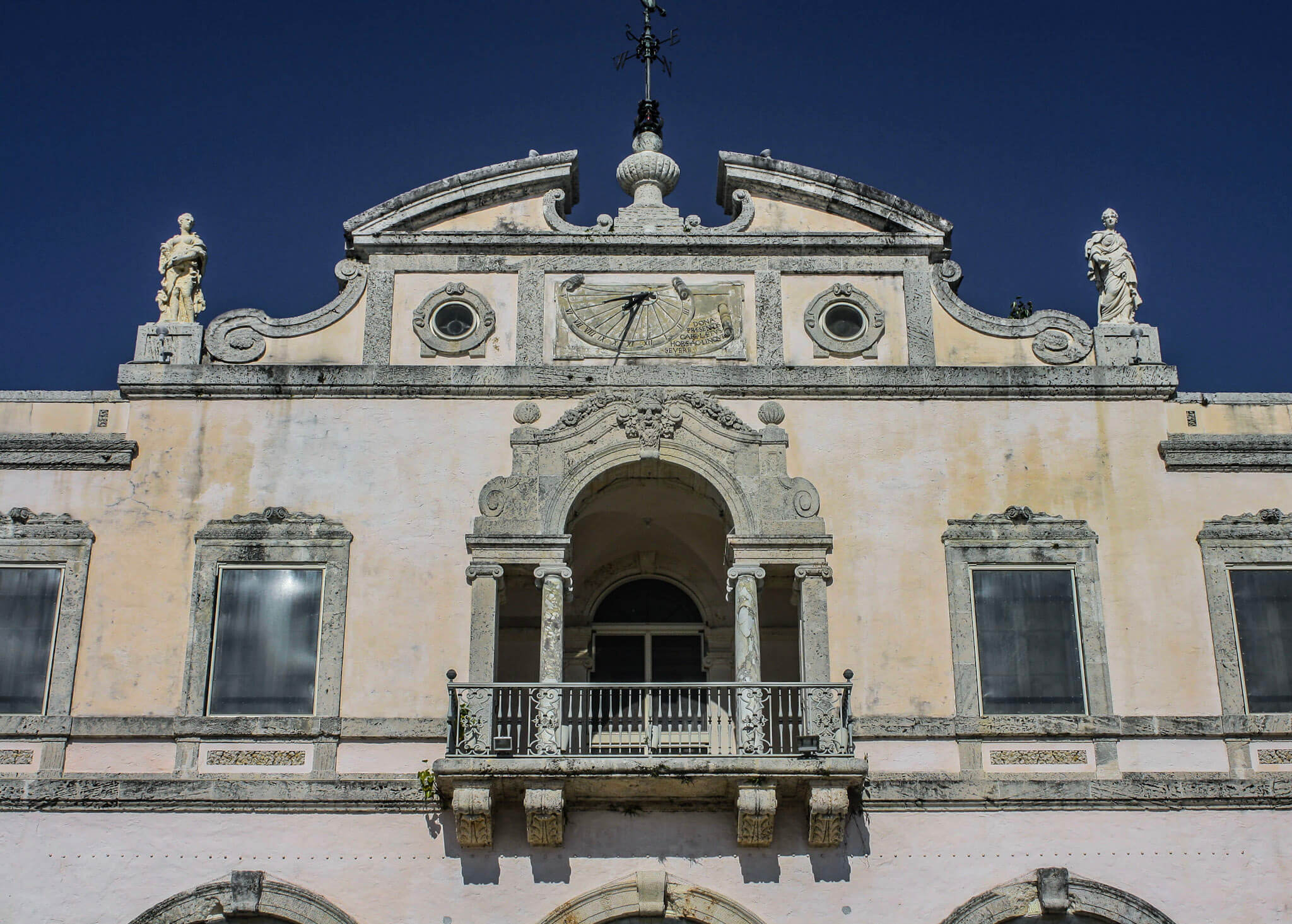
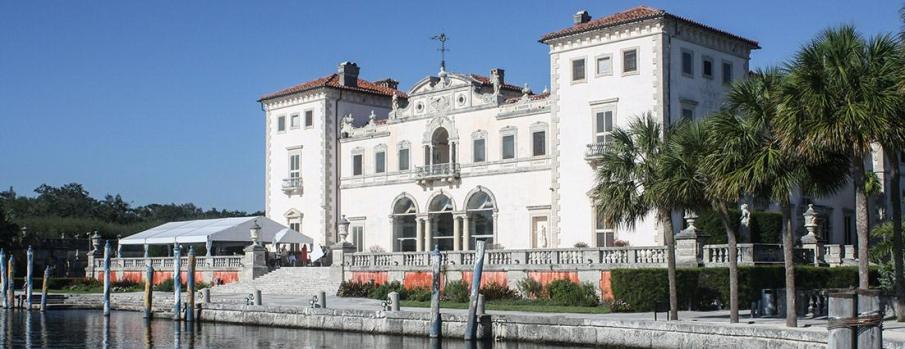
I stood on one of the terraces at Vizcaya, a 34-room Italian Renaissance villa on the shore of Biscayne Bay in the Coconut Grove area of Miami. Built by James Deering between 1914 and 1922 as his winter residence, Vizcaya still endures as a genteel oasis in the midst of a subtropical forest just minutes from Miami’s modern skyline. Conceived as a modern interpretation of an 18th-century Italian villa, Vizcaya’s designers employed traditional Mediterranean architectural elements and tweaked them for the local climate.
Deering envisioned his home being approached by boat, so it’s the bayside façade that received the grandest details, including the terrace. A breaker a few feet out into the water was constructed like a wrecked classical barge cluttered with statues, a vessel of the Greek gods dashed against the Floridian coast. It’s the perfect spot to begin an exploration of the estate’s 50 acres among native rockland hammock trees.
After I circumnavigated the building, I stepped inside for a closer look at how Deering lived. A central courtyard, originally open to the sky, is the heart of Vizcaya, with loggias leading from room to room framing it on all four sides. The first floor was given to the estate’s public areas—arcades and loggias, reception rooms with marble floors, a library, and a dining room, all furnished with recherché objects Deering acquired from Italy. The walls in the over-the-top music room are paneled with paintings framed with gilded wood moldings. Illuminated by an ornate Venetian chandelier, the room contains a gilded zither, a harp, and a 17th-century Italian spinet.
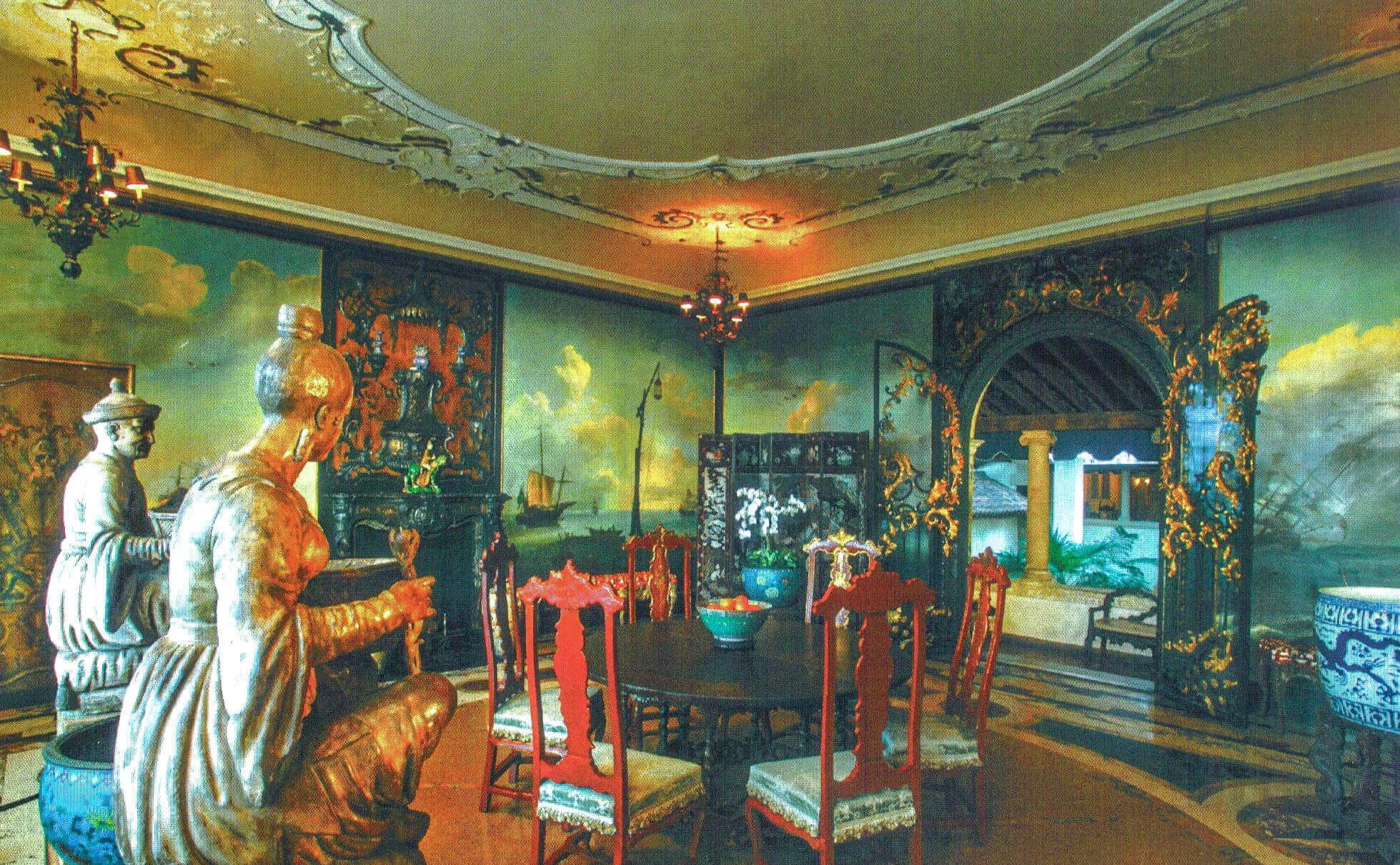
More private areas occupy the second floor, including several bedrooms and a breakfast room that rivaled the size of my entire apartment and that contains four corner chandeliers rather than a central one. Deering’s regal bathroom has a tented ceiling draped in embroidered linen. Despite its age, Vizcaya was a very modern edifice for its time, boasting a water filtration system, generators, heating and ventilation systems, a central vacuum-cleaning system, a dumbwaiter, a couple of elevators, and a partially automated laundry room.
To finish up, I returned to the terrace, where I contemplated the multi-million-dollar legacy of one man’s efficacious desire to achieve extravagant comfort in a jungle.
#2 Freedom Tower
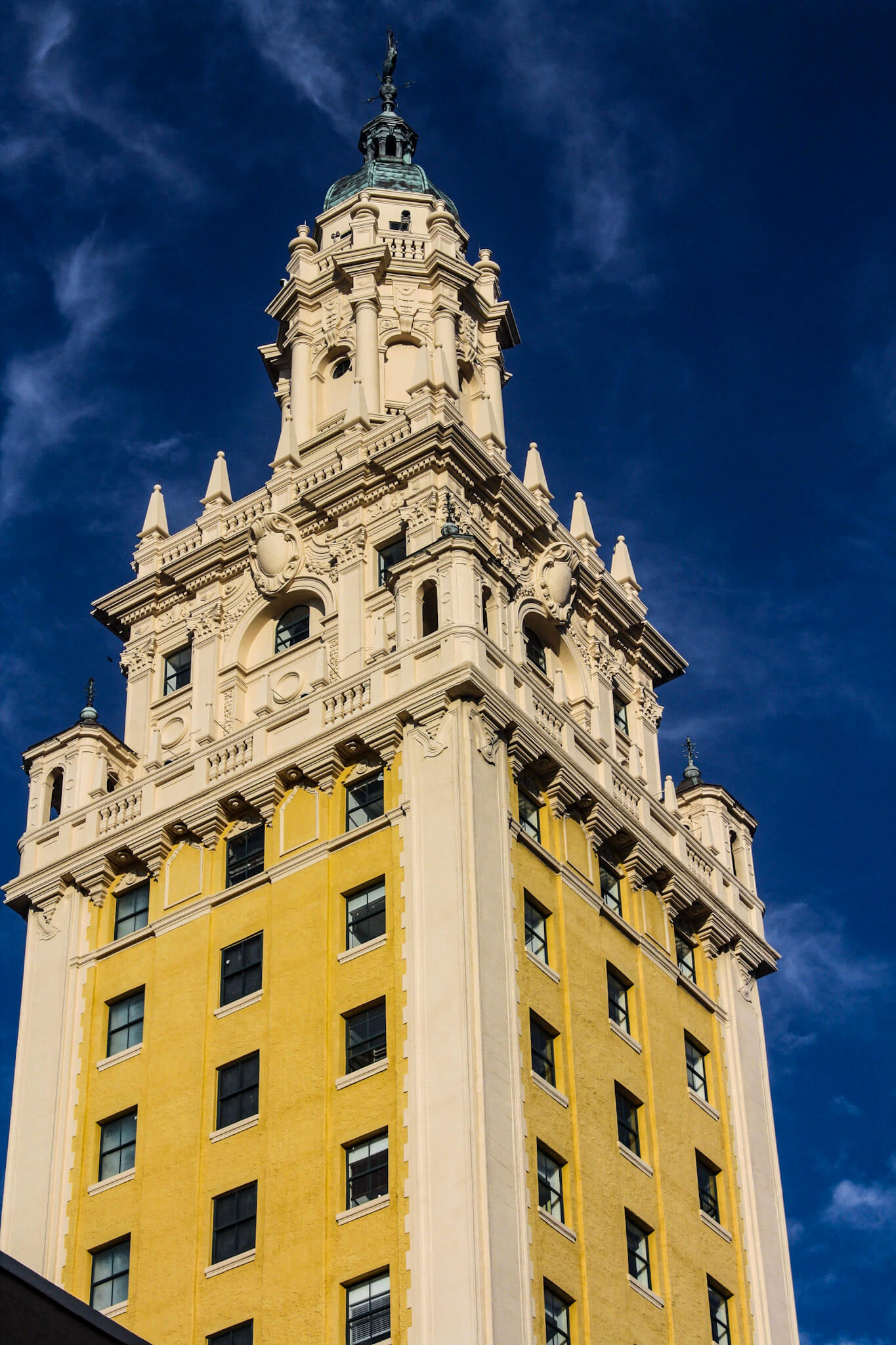
Originally the headquarters and printing facilities of the Miami Daily News, Freedom Tower (now a museum operated by Miami Dade College) remains one of the city’s signature buildings. Inspired by the design of the Giralda Tower in Seville, Spain, it rose in 1925 as one of the city’s first skyscrapers. From 1962 to 1974, the building served as the Cuban Refugee Center, assisting hundreds of thousands of Cubans seeking asylum in the United States. Then, after decades of disrepair, the Freedom Tower was rescued by Cuban American community leaders aiming to honor the Cuban legacy in the city, who donated it to Miami Dade College in 2005. Three years later, it was designated a National Historic Landmark, and it reopened to the public in 2025 following a $25 million restoration.
The Mediterranean Revival–style building blends Spanish, Italian Baroque, and Moorish design elements. The 17-story structure features a block-long base where the grand frontispiece employs tall oak doors, a cast-iron decorative transom, and Corinthian capitals on the travertine columns that support a large swan’s neck pediment. Below this pediment, a tall, round arched opening, with foliated scroll spandrels and an elaborate escutcheon resting on a projecting keystone, forms the main entrance. Above it rises the orate tower with a splendiferous top—a riot of balustraded, cartouches, columns, blind arches, and pyramidical finials with balls at their peaks, all capped by an octagonal cupola with a weather vane shaped like a Spanish galleon.
#3 Stone House (Charles Deering Estate)
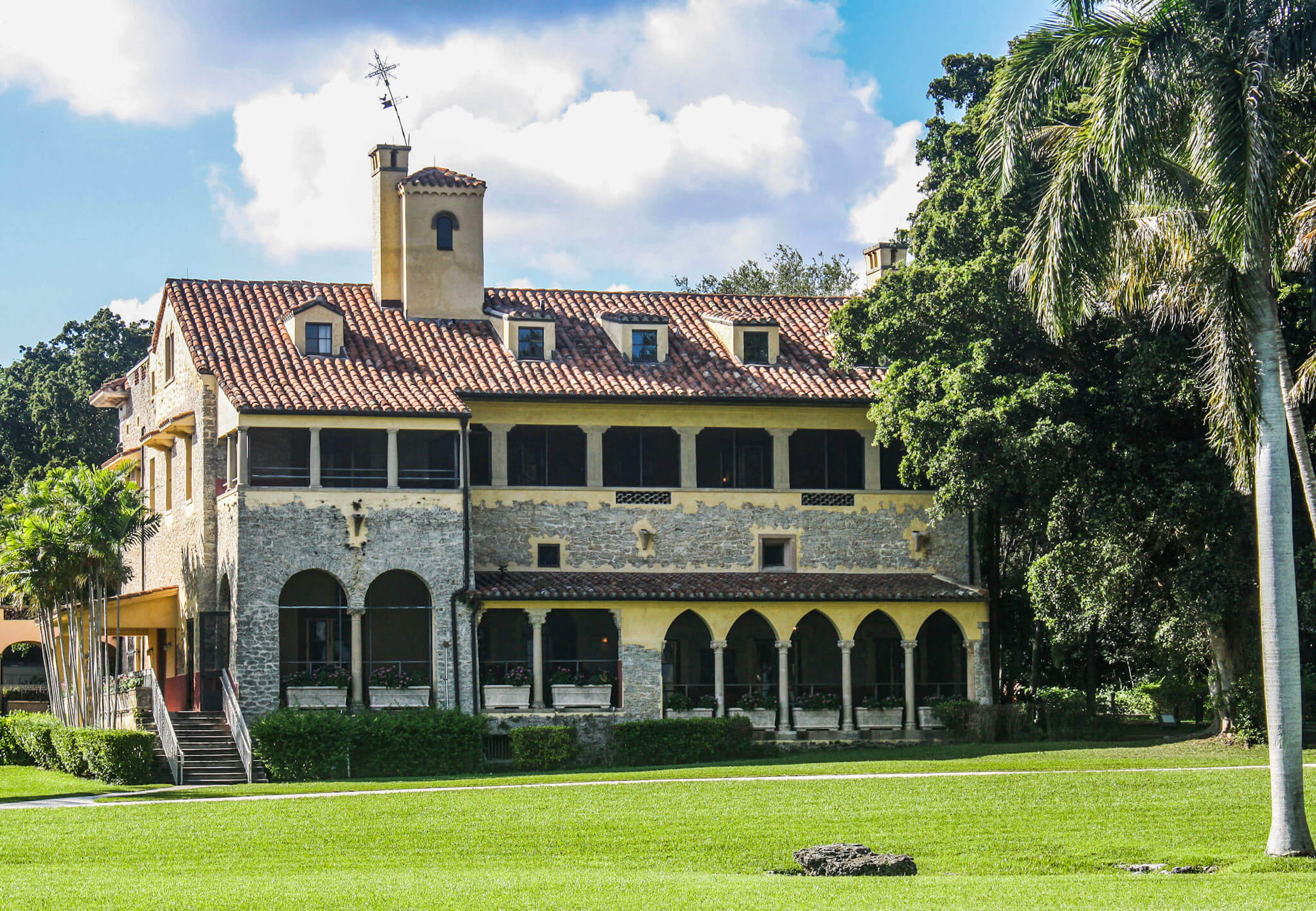
American businessman, art collector, and philanthropist Charles Deering (brother to James, of Vizcaya fame) had his Mediterranean Revival–style home built in 1922 along the shore of Biscayne Bay to showcase his valuable art and furnishings collection. He didn’t get to enjoy it very long—he died in 1927. But what he left behind is open to the public today in the state-run property. The Great Chicago Fire of 1871 spooked Deering, nervous over what a fire could do. So he had his architects build his Spanish-style Stone House mansion (1) without a stove (cooking was done in a cottage on his property); and (2) with 18” concrete walls, brass doors, and façade of oolitic limestone, made of tiny, spherical grains called ooids that are glued together and resemble fish roe. The arcaded porch along the entrance features rounded arches with capitals with dragons; the one facing the bay has pointed arches with capitals with floral designs. Inside, you’ll find tile floors, arched doorways, crystal and iron chandeliers, and coffered ceilings as well as the wine cellar that had been well hidden behind built-in cabinetry (think Prohibition Era) and was rediscovered during the cleanup after Hurricane Andrew inflicted serious damage upon the house in 1992. If you should be here at Christmas, you’ll be treated to tasteful holiday decorations as well as gentle manatees visiting the boat basin lined with palm trees.
#4 Gesu Church
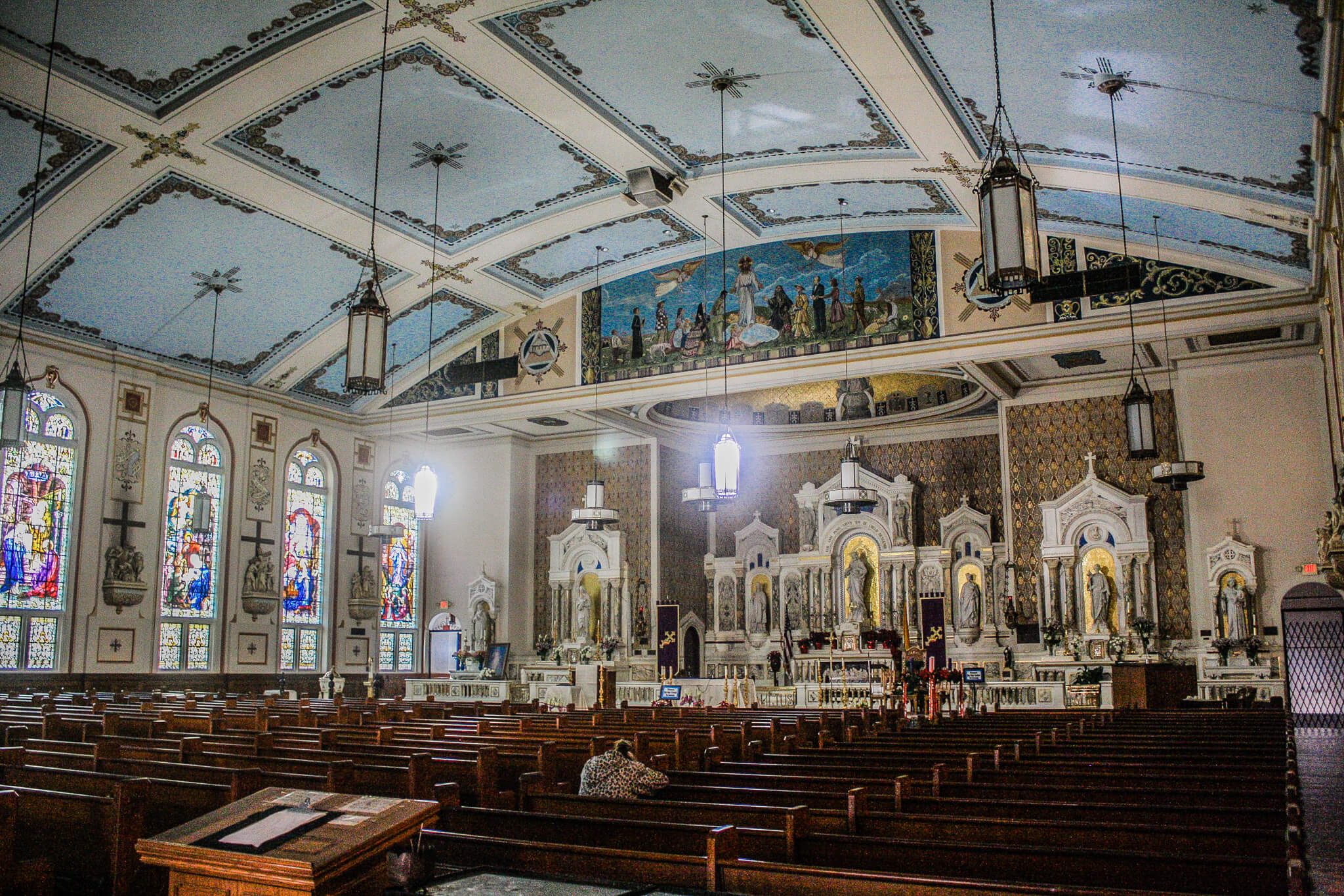
With a congregation dating back to 1896 (the city’s oldest Roman Catholic parish), the current Gesù Church building, constructed in the Mediterranean Revival style, was completed in 1925. Repainted in a deep salmon pink (as opposed to the original putty color) with white trim and a pair of medallions with the alpha and the omega, the façade sports a massive arched portico under an Arabesque tower. The wide-open interior, under an unsupported arched, embossed ceiling, can seat 800 worshippers comfortably. All along the nave, wonderful sculpted Stations of the Cross alternate with 30’-tall stained-glass windows from Germany that depict key moments from the lives of Jesus and Mary. In the sacristy, the reredos features a statue of Christ flanked by St. Pius V, the pope who approved the mission to Florida, and St. Francis Borgia, the general of the Society of Jesus who began that mission. The chancel, baptismal font, and altar are of white Italian marble (the latter featuring a bas relief of da Vinci’s Last Supper), and the mural above the altar shows Jesus welcoming people of all races from around the world. Up in the broad choir loft with the pipe organ, the rose window tapped an appropriate source for its images—with St. Cecilia, the patroness of musicians, in the center, surrounded by eight cherubim playing medieval instruments. It all combines to be one of the most beautiful churches in Florida.
#5 The Barnacle
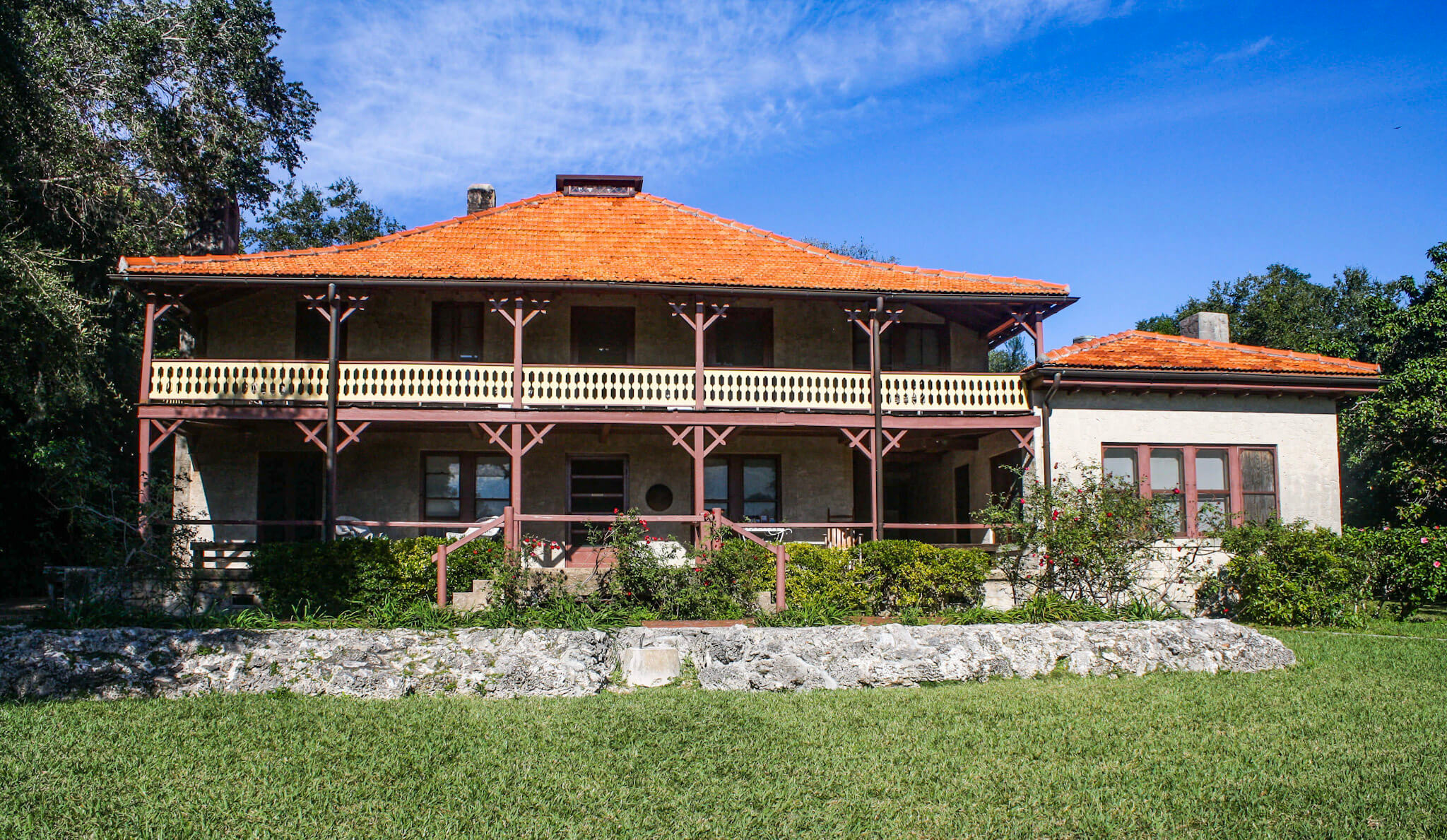
My drive into Coconut Grove took me to the Barnacle Historic State Park. I was here to check out the oldest house in Miami-Dade County still in its original location, and it comes with quite a remarkable story. An American yacht designer, Ralph Middleton Munroe was born in Staten Island, New York. He married when he was 28, and after giving birth to a daughter, Munroe’s wife contracted tuberculosis. Within three years, tragedy ensued: The couple had headed to Florida with her sister, leaving their daughter behind with her grandmother, hoping the warm weather would help her condition. It didn’t. His wife died, her sister died on the way back to New York, and his daughter was dead by the time he returned home. Devastated, he returned to Florida and ran into a wealthy man whose life he had saved years before and who sold him 40 acres of bayfront land in 1886 for $400. Munroe had his house built in 1891 on wood pilings, raised for both air circulation and hurricane damage prevention (which has worked remarkably well ever since, surviving the 1926 hurricane and Hurricane Andrew with minimal damage). The house also included a central room octagonal in shape, with a cupola that would suck out the heat. Munroe named his home “The Barnacle,” acknowledging this room’s resemblance to the little crustacean. When Munroe needed more space for his new and growing family (he remarried and had two more children), he raised the entire house to build another floor in 1908, replacing the wraparound porch with two porches running the width of both stories, and enabling him to entertain high society. He also built a marine railway, the still-visible tracks of which ran from his property and then underwater out to Biscayne Bay, where ships hauling finds from wrecks could easily be unloaded onto the train and brought back to land. Munroe died at age 82 in 1933, and his family remained at The Barnacle until 1973, when they sold it to the State of Florida for visitors to enjoy.
Five Runners-Up
- Miami-Dade County Courthouse (1928)
- David W. Dyer Federal Building and United States Courthouse (1934)
- First Presbyterian Church of Miami (1949)
- Dade-Commonwealth Building (1925)
- U.S. Post Office and Courthouse (1914)
I’d Love to Hear From You!
Have you been here? Have I inspired you to go? Let me know!


