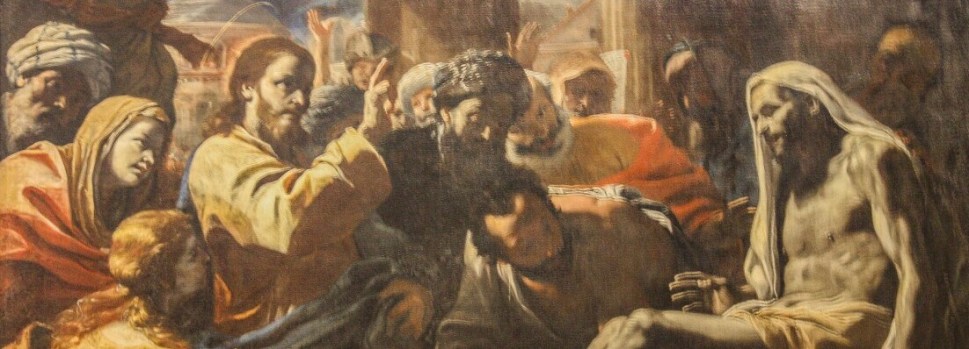
“Lazarus, come forth.” So said Jesus in the Gospel of John at the tomb of his deceased friend, who had died four days prior. And with that, Lazarus rises from the dead. One of Jesus’ most dramatic miracles (well, they’re all pretty dramatic) has lent itself to masterful works of art over many centuries. These are my favorites.
#1 The Resurrection of Lazarus, by Giovanni di Paolo (1426, Walters Art Museum, Baltimore, Maryland)
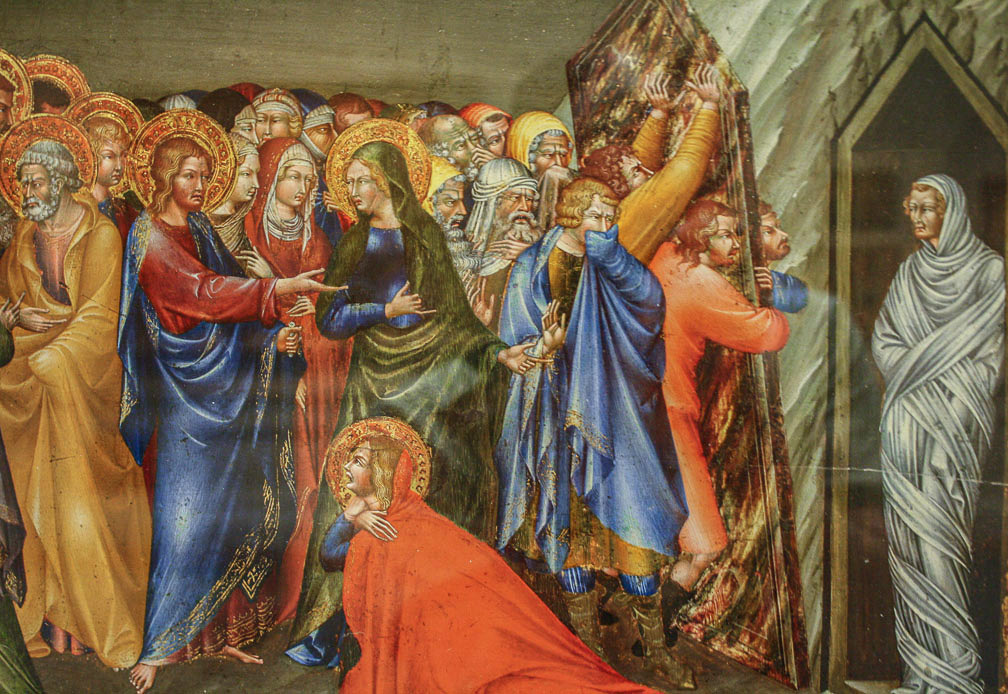
In the outstanding Walters Art Museum, one of the top five things to see in Baltimore, I came upon this striking depiction of Lazarus being raised from the dead. Originally part of a predella (the paintings on the base of an altarpiece) in a chapel in San Domenico Church in Siena, Italy, the painting bounced around a few owners until the Walters acquired it in 1931. Di Paolo’s scene, done in tempera and gold leaf, and Byzantine and late Gothic in style, presents a backdrop of a gentle field, individual hills, a few trees, a charming footbridge over a river bend, and a golden sky. In the foreground, a parade of agitated saintly people with their halos and ordinary folks without them crowd around the entrance of a tomb carved into a hill. Jesus is front and center, gesturing toward the tomb. Lazarus’ sisters, Mary and Martha, are beside Him, one kneeling and one standing, beseeching Him for assistance. At the right, three men are removing the tomb door, revealing a standing, and very much alive, Lazarus, still swathed in white cloth from head to toe, as if he’s a stage actor making a grand entrance and calmly waiting for the applause to die down before he delivers his first line. Note the two figures overwhelmed by the stench of the tomb, one holding his nose with his fingers, another covering his nose and mouth with his blue robe.
#2 Resurrection of Lazarus, by Giuseppe Cesari (1592, Corsini Palace, National Gallery of Antique Art, Rome, Italy)
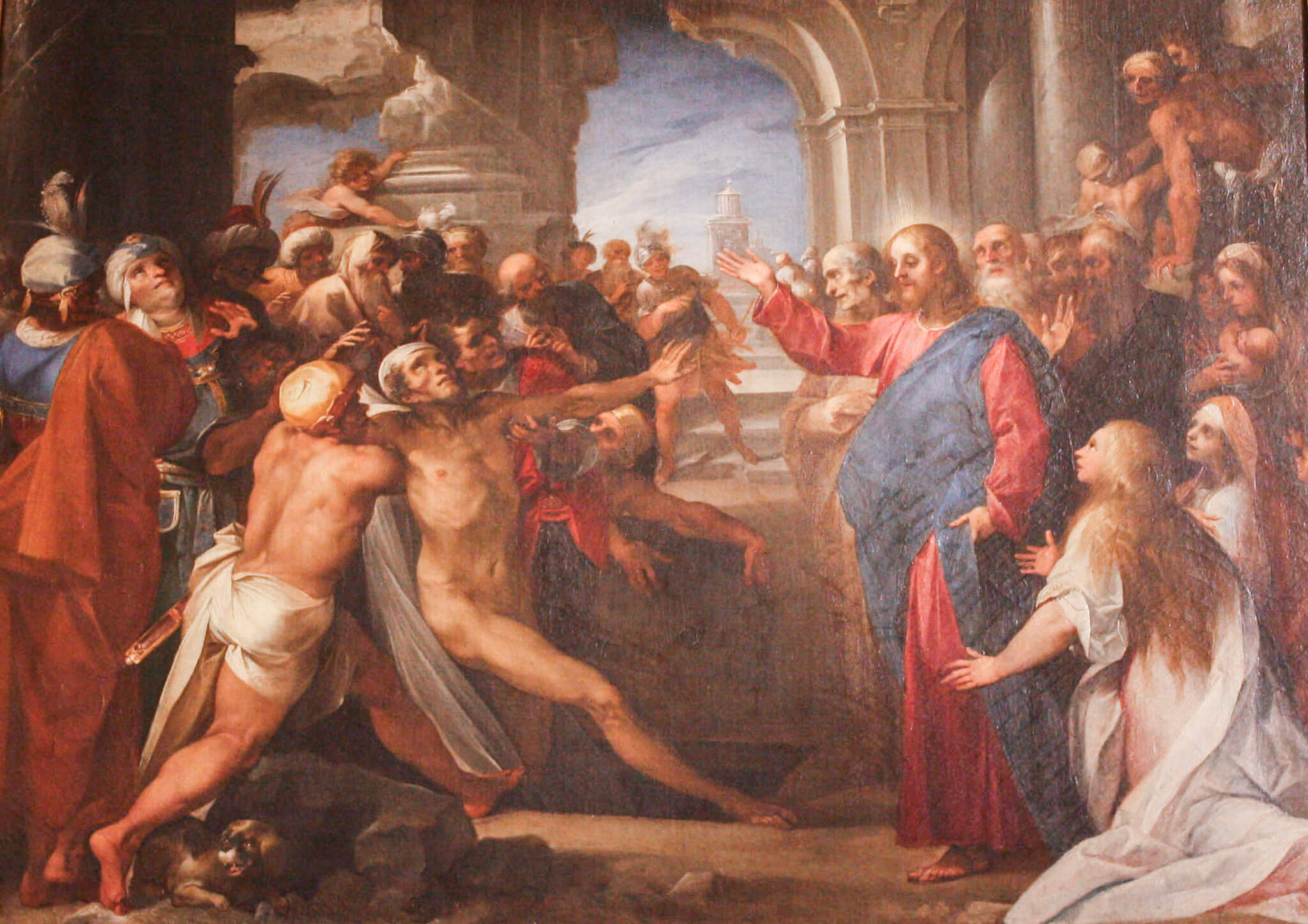
Over the course of its history, Corsini Palace, a late-Baroque palace built in the 15th century and expanded and enhanced in the mid-1700s, has hosted not only the Corsini family but also a cardinal who was a pope’s nephew, Queen Christina of Sweden after her abdication in the 1600s, and Joseph Bonaparte (Napoleon’s brother). Today, this magnificent setting hosts a very fine collection of art, from Caravaggio to Rubens to van Dyck. Among the great works is this oil on canvas painting of Lazarus. In a fairly chaotic scene set against a semi-ruined architectural backdrop, Jesus commands Lazarus to rise; you can almost see the words on His lips. A naked Lazarus emerges from his tomb, wearing nothing but a skull cap, with the assistance of several of the other figures. Lazarus looks upward, probably wondering what was happening, while the couple of dozen people (and one angel) crowding the scene react with shock, disbelief, incredulity, and amazement. Even the dog, at the feet of the shirtless man holding Lazarus up, seems excited by the unfolding miracle.
#3 Raising of Lazarus, by William Jay Bolton (1848, St. Ann & the Holy Trinity Church, Brooklyn, New York)
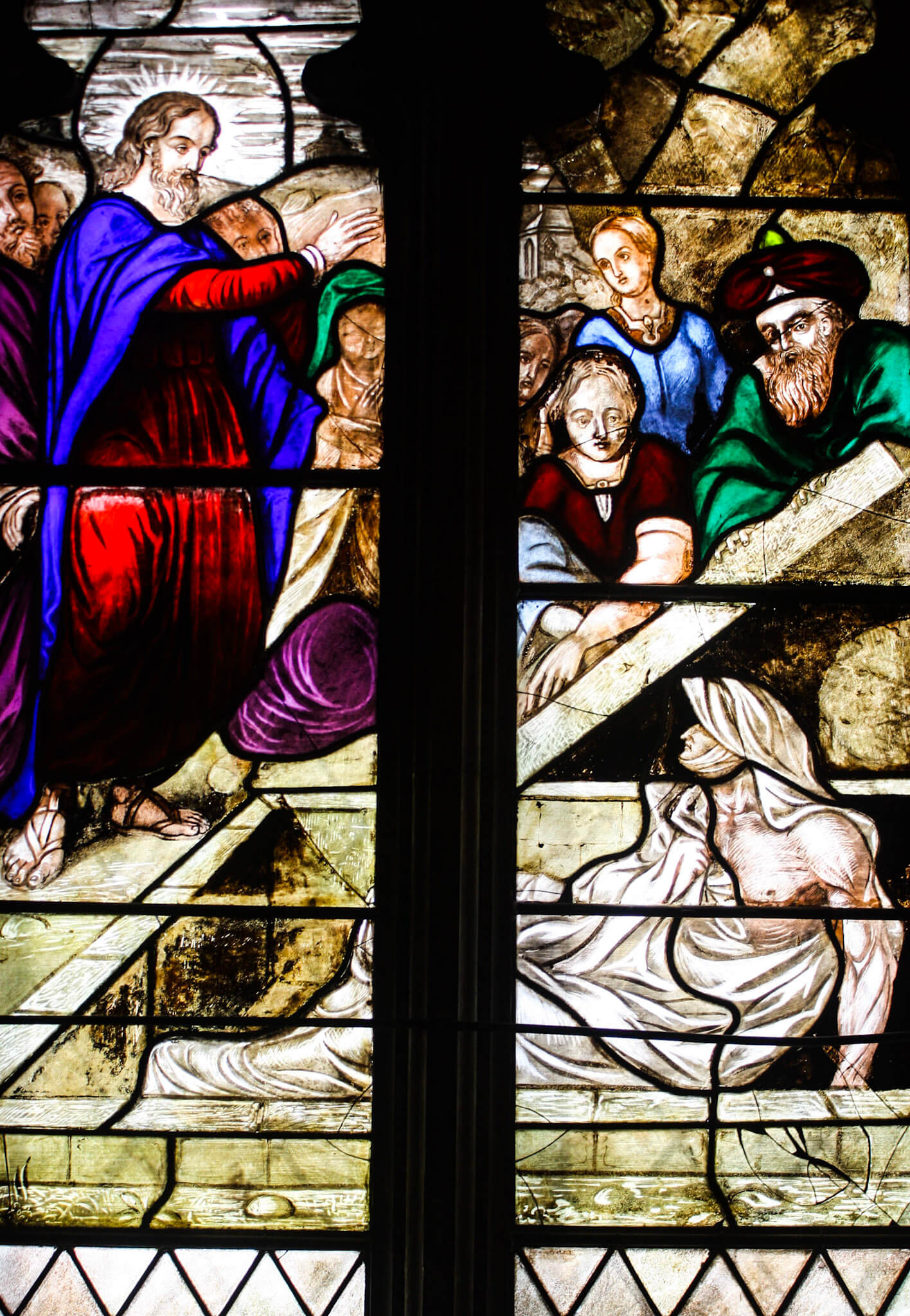
My neighborhood of Brooklyn Heights, in Brooklyn, New York, is home to half a dozen churches. One of them, originally just the Church of the Holy Trinity, is particularly historic. Completed in 1847 on the highest point in the then sparsely settled area, the brownstone-over-brick church, with interior plaster walls colored and textured to look like stone, is both a National Historic Landmark and one of the most important examples of Gothic Revival architecture in the United States. A 275’ tower was installed in 1869, but the spire was removed in 1906 due to safety concerns and was never restored. Inside, a 63’-high intricate fan-vaulted ceiling covers the 145’-long and 42’-wide nave. Among its rich ornamentation is an extensive suite of figural stained-glass windows made by William Jay Bolton with assistance from his brother. These were the very first such windows designed and made in North America, rather than being imported from Europe. The 55 windows (only one of which has been lost) were made in Pelham, New York, between 1845 and 1848, predating by several decades the works of more well-known stained-glass artists Tiffany and LaFarge. Unusually colorful for their time and expertly detailed, they’re considered the finest American stained-glass windows from the early 19th century. Bolton divided his windows into four Biblical themes—Old Testament, New Testament, the Tree of Jesse, and the family tree of Jesus. Among the New Testament windows in the two balconies (climb up the stairs to see them up close) is the depiction of Lazarus. Jesus, on the right in bold red and blue, commands Lazarus to rise. As the lid of his tomb slides away, Lazarus begins to sit up, resting on one arm, his white funeral cloths falling away from his ghostly pale bare shoulder, still wearing the covering over his head and below his chin to keep his jaw closed. He is expressionless, looking directly at his resurrector as if he’s just been awakened from a forgettable dream.
#4 Raising of Lazarus (1522, National Museum, Wroclaw, Poland)
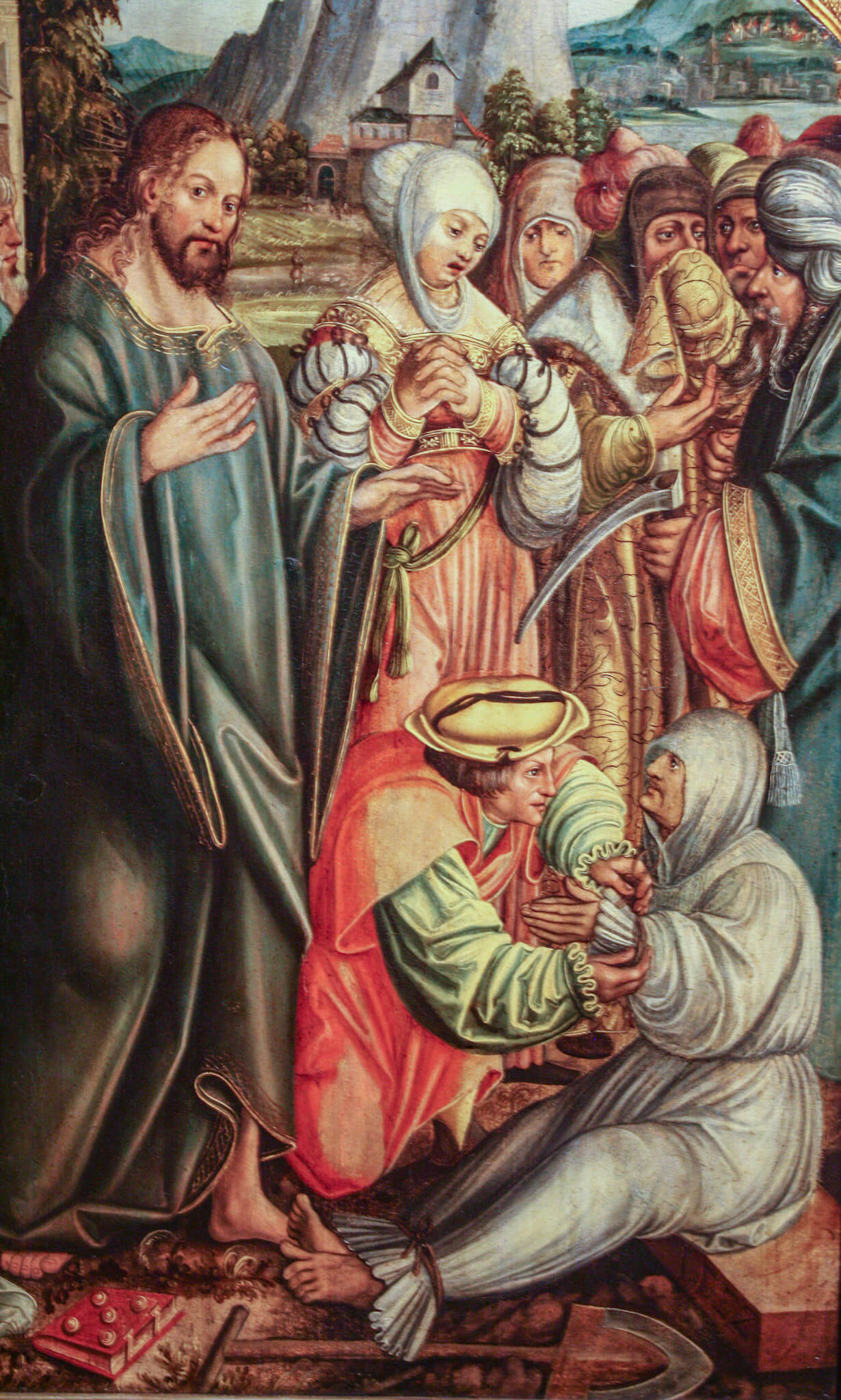
Set against a backdrop that looks more like a Polish mountain village than a Middle Eastern city, this painting by an unknown artist is housed in the former Silesian Regency Office, a massive and wonderful edifice from 1886. The figures are dressed elegantly, clearly the upper class of their time, one of whom covers his nose and mouth with a cloth to fend of the odor of the rising corpse below him. A kneeling figure is in the process of removing the binding around the wrists of the risen Lazarus still in his white funeral clothes, who looks not at him but up at Jesus, clear-eyed and with an expression of gratefulness. Jesus, in a fine robe with golden trim, is the curious figure here; He doesn’t look at Lazarus or at any of the other figures. Rather, He stares straight out at the viewer, with a sharp look, almost rebuking you, as if to say, “After this, do you still not believe in me?”
#5 The Raising of Lazarus, by Palma il Vecchio (1514, Philadelphia Museum of Art, Philadelphia, Pennsylvania)
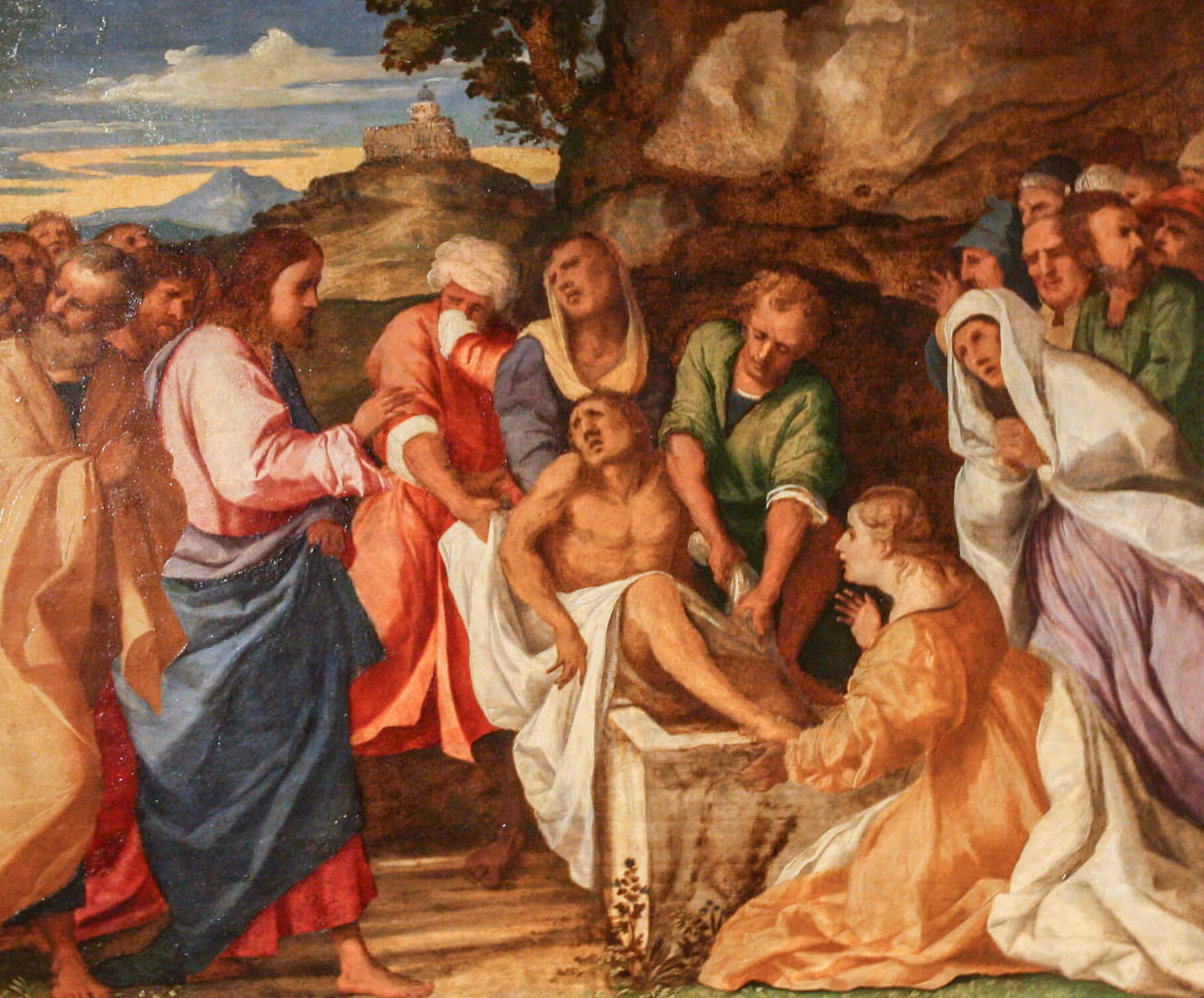
One of the largest art museums in the United States, the Philadelphia Museum of Art, well over a century old, holds more than 200,000 objects and is easily recognizable to millions of movie lovers who recognize it as the building at the top of the 72 stone steps that Sylvester Stallone ran up in Rocky in 1976. One such object is the oil-on-wood painting The Raising of Lazarus. Done in the Italian High Renaissance style, it shows Jesus with a raised hand, gesturing for Lazarus to rise from his above-ground tomb. The onlookers, including Lazarus’ two sisters, watch the event carefully, with three men lifting Lazarus up, one of whom covers his nose and mouth to keep the malodorous airs at bay. Everyone’s facial features are softened, yet they still convey their emotions, especially Lazarus himself, who seems like he’s in quite a bit of pain and looks at Jesus with an ambivalent expression that I couldn’t resolve—either one of profound relief at being returned to the living, or one of disappointment at being awakened from eternal slumber.
Five Runners-Up
- Story of Lazarus and Scenes From the Book of Job, by Erhard Altdorfer (1522, National Museum, Wroclaw, Poland)
- Raising of Lazarus, by Mattia Preti (1658, Barberini Palace, National Gallery of Antique Art, Rome, Italy)
- The Raising of Lazarus at the Prayer of His Sister Mary, by Michelangelo Cerruti (1735, Church of Saint Mary Magdalene, Rome, Italy)
- The Resurrection of Lazarus Between Jan Micault, Livina Cats van Welle and Their Children, by Jan Cornelisz. Vermeyen (1559, Oldmasters Museum, Brussels, Belgium)
- The Raising of Lazarus, by Benjamin West (1780, Wadsworth Atheneum Museum of Art, Hartford, Connecticut)
I’d Love to Hear From You!
Have you been here? Have I inspired you to go? Let me know!


