I crossed the upper level of the iconic Dom Luís I Bridge, spanning the Douro River, and walked from Porto to Vila Nova de Gaia. Then I turned around for a soul-stirring scene. This is, undoubtedly, one of the best urban views in Europe. The buildings of Portugal’s second-largest city tumble down the hillside toward the river, with the sky above speared by the steeples of churches in all shapes and sizes. I had been to many of them to see their over-the-top exuberance, and this vantage point helped put them in geographic context. These are my favorites.
#1 Church of St. Francis (Igreja de São Francisco)
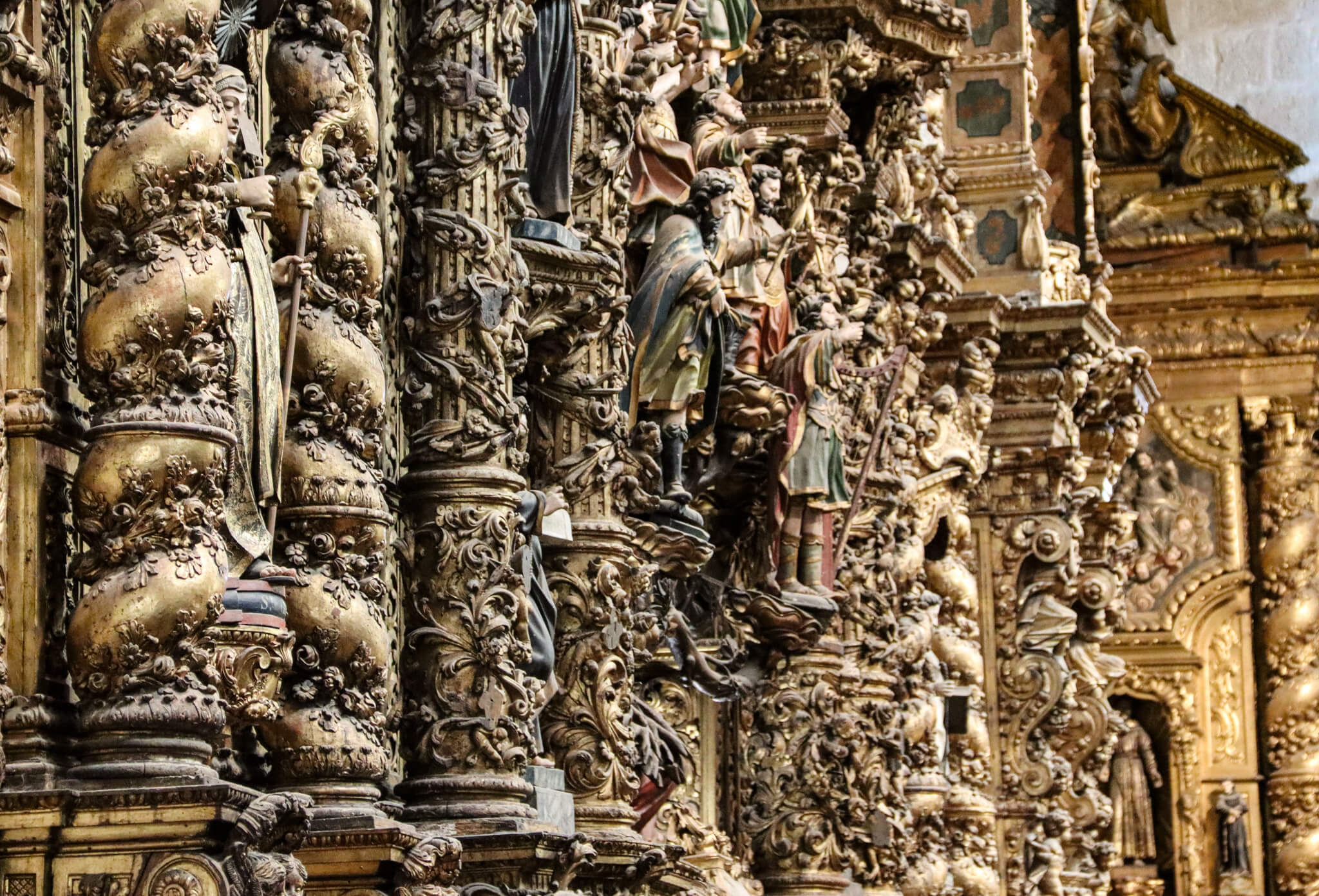
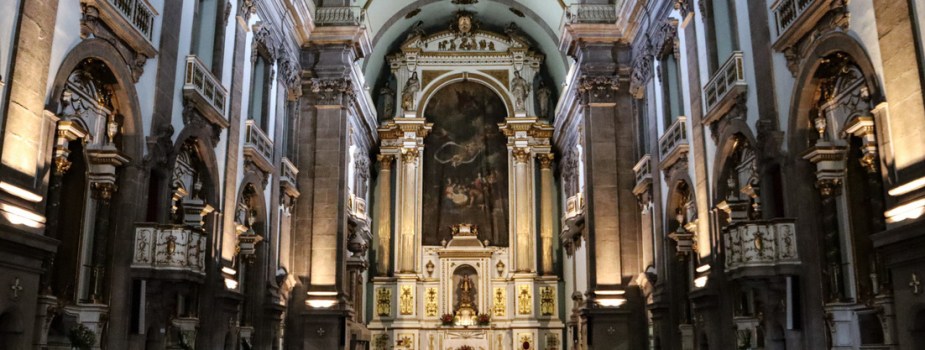
The Church of St. Francis is intimidating. This massive church, declared a UNESCO World Heritage Site more than 500 years after it was completed, in 1425 (nearly 200 years from its commencement), rises like a behemoth from the slanted street. From here, I took in the somewhat plain stone façade, featuring a portal with a triangular gable adorned with a pentagram. The series of granite staircases seems off-putting, but I had to climb the nearly 100 steps to gain entrance into the city’s most prominent Gothic structure through the west portal, highlighted by an elaborate rose window, solomonic columns, and a statue of St. Francis. Inside, there’s a sharp shift from Gothic to Baroque styles, and it’s all rather eye-popping. I strolled down all three aisles, mouth agape. Just about all of the church’s surfaces—ceilings, walls, pillars, chapels, window frames—are covered with Portuguese gilt woodwork, called talha dourada. Once Portugal colonized Brazil, the gold started to pour in, and nearly 1,000 lbs. of it was used to gild the woodwork. Among all the altarpieces, the most elaborate and important is the one depicting the Tree of Jesse. This polychromed woodwork, completed around 1718, represents the family tree of Jesus, complete with Mary and Joseph, Anne and Joachim, and a dozen kings of Judah, all rising from a recumbent Jesse among the roots. The decorative richness throughout the church is quite excessive, but it’s what makes this church Porto’s most beautiful. When it became too overwhelming, I headed downstairs to the more somber catacombs, where Franciscan monks and members of Porto’s wealthiest families are buried. You’ll also find the spooky ossuary, with thousands of human bones, through a glass floor.
#2 Porto Cathedral (Sé do Porto)
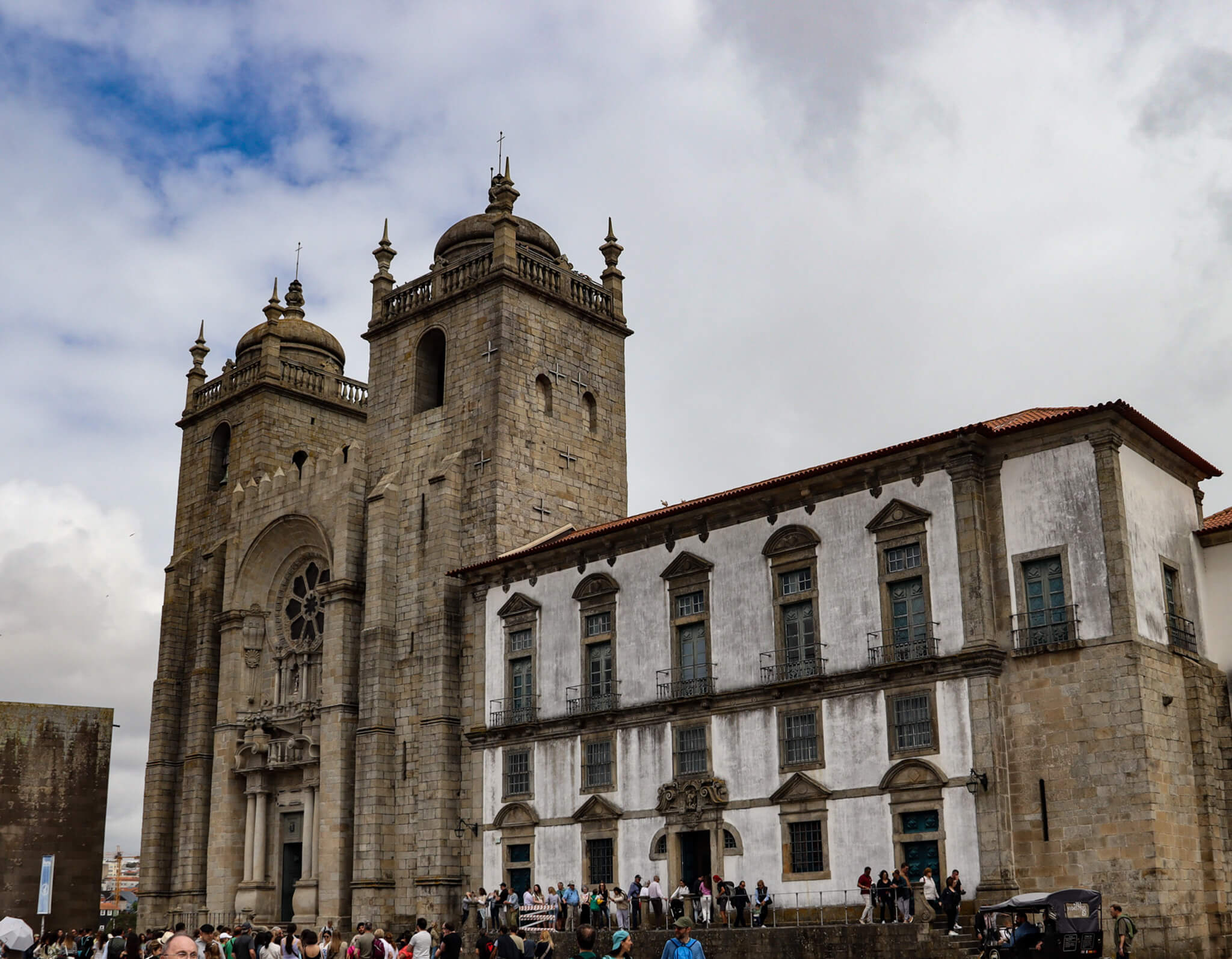
I approached the gargantuan Porto Cathedral from its side, lured by the seductive sound of a street musician playing “The Sound of Silence” on a very futuristic-looking violincello so beautifully that it brought tears to my eyes. He was sitting in front of the staircase that splits in two directions, leading up to an arcade with series of gorgeous blue and white azulejo panels. I continued around the corner of the church to the big, shadeless square that fronts it and looked up at the fortress-like façade: a Baroque porch, Romanesque rose window, and crenellated arch, sandwiched between two square towers, each supported by two buttresses and crowned with balustrades and a cupola. Inside, the cathedral smells old; indeed, it dates back to the 12th century. A barrel vaulted ceiling covers the narrow nave, flanked by two aisles, separated by large pillars. Throughout the cathedral, I found three red-marble holy-water fonts, a towering altarpiece with twisted columns, a gilded organ, and the baptismal font with a bronze bas-relief of John the Baptist baptizing Christ. For me, the highlight is the cloister and the terrace above it. Both feature beautiful blue-and-white azulejo panels—the former’s Bible scenes wedged into large pointed arches, the latter spread out in wide panels depicting idyllic countrysides, the well-to-do in all their finery, mythological figures, and hunting scenes, including one with a pair of gentlemen horseback riders, with their plumed hats, and their dogs chasing a very alarmed ostrich.
#3 Carmo Church (Igreja do Carmo)
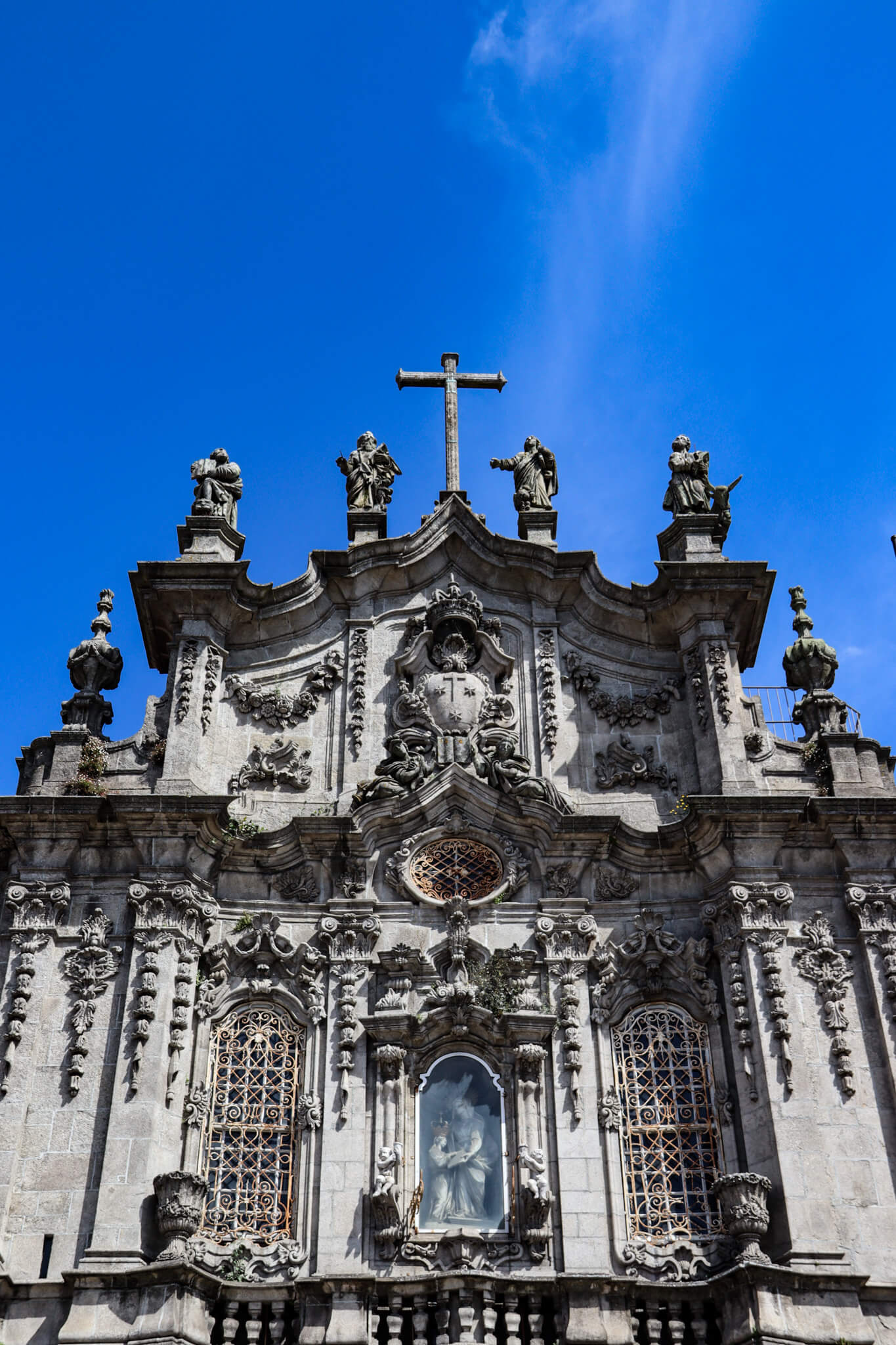
Gomes Teixeira Square plays a little trickery for first-time visitors with its architectural curiosity. What I first assumed to be one very large church is actually two distinct churches, separated only by the narrowest of houses (about 3.3’ wide). Urban legend holds that two churches are not allowed to share the same wall, and this border house prevented, er, unwanted communication between the monks and nuns of both churches. The Baroque church on the right, Carmo Church, was completed in 1768. Its front façade grows more elaborate the higher it reaches, with its upper section topped with statues of the four evangelists. Two niches occupied by statues of the prophets Elijah and Elisha, carved in Italy, flank the front doors. The side, however, is the real star: a wall covered entirely by a mural of locally made blue-and-white azulejo tiles that works its way around windows and doors as it depicts a giant scene of the founding of the Carmelite Order, added to the church in 1912. Inside, you’ll find a single nave with seven gilt altars, sculptures, oil paintings, wood carvings, and rich decorations. The elaborate altarpiece rises up to the barrel ceiling, where a mural depicts Jesus breaking out of His tomb.
#4 St. Anthony Church of the Gatherers (Igreja de Santo Antônio dos Catadores)
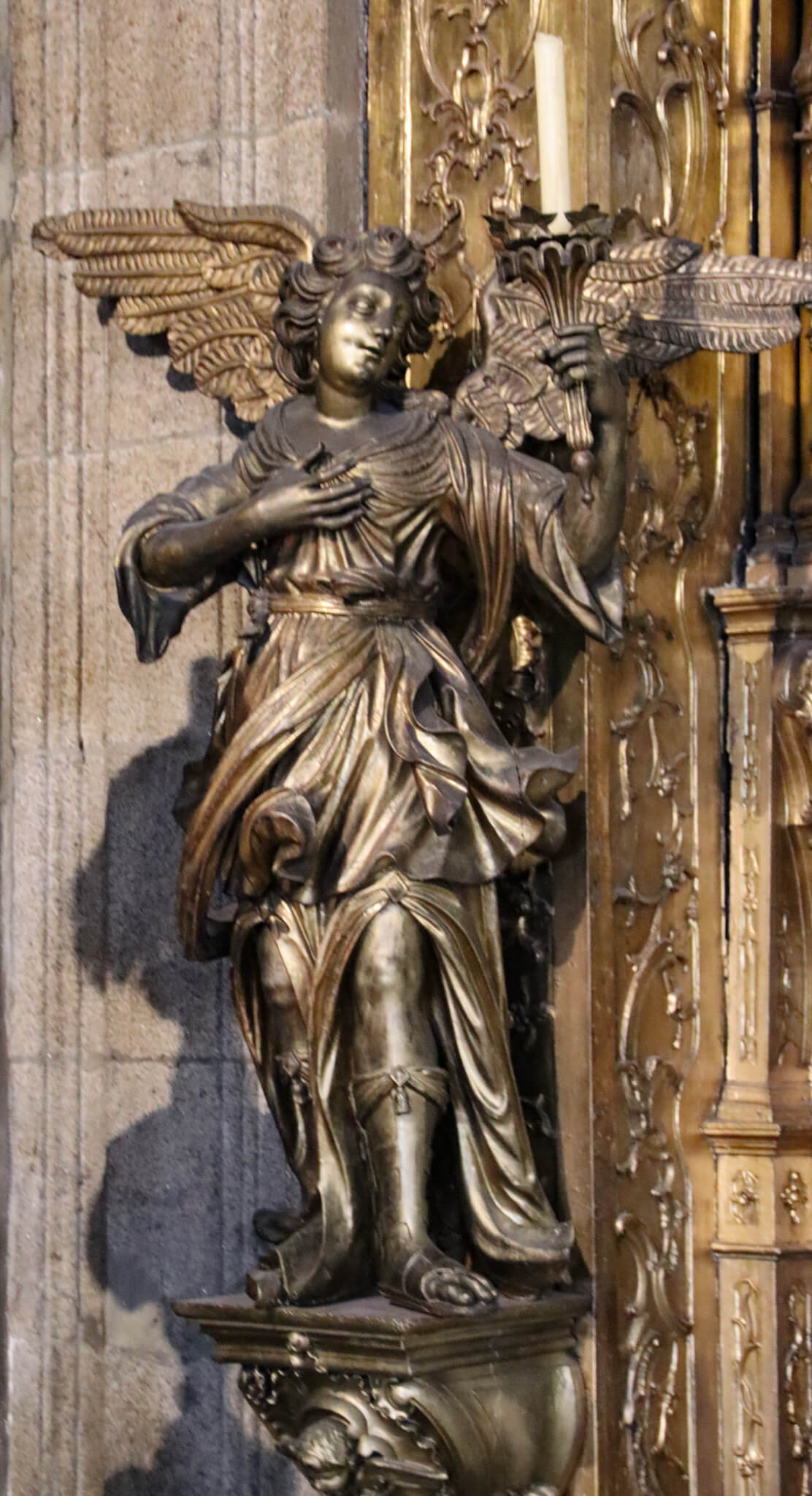
Just a few blocks from my excellent hotel, Infante Sagres, I found St. Anthony Church of the Gatherers at the head of a bustling section of Porto that also includes São Bento, one of the world’s top five train stations. Dedicated to St. Anthony of Padua, who was born in Portugal in the 12th century and became a Franciscan priest, eventually finding his calling in Padua, Italy, the church features impressive stonework around the windows and blue-and-white azulejos depicting the story of St. Anthony and the Assumption of the Blessed Virgin Mary in between pilasters. Inside the church, which dates back to 1703, I found a herringbone wood floor, barrel ceiling, simple but attractive Stations of the Cross, angel candleholders, a finely carved Holy Family, and an altar with a baldachin. Hard to believe that, during the 13-month siege of Porto (1832–33), the church was used as a hospital and a storage facility for military equipment.
#5 Church of the Carmelites (Igreja dos Carmelitas)
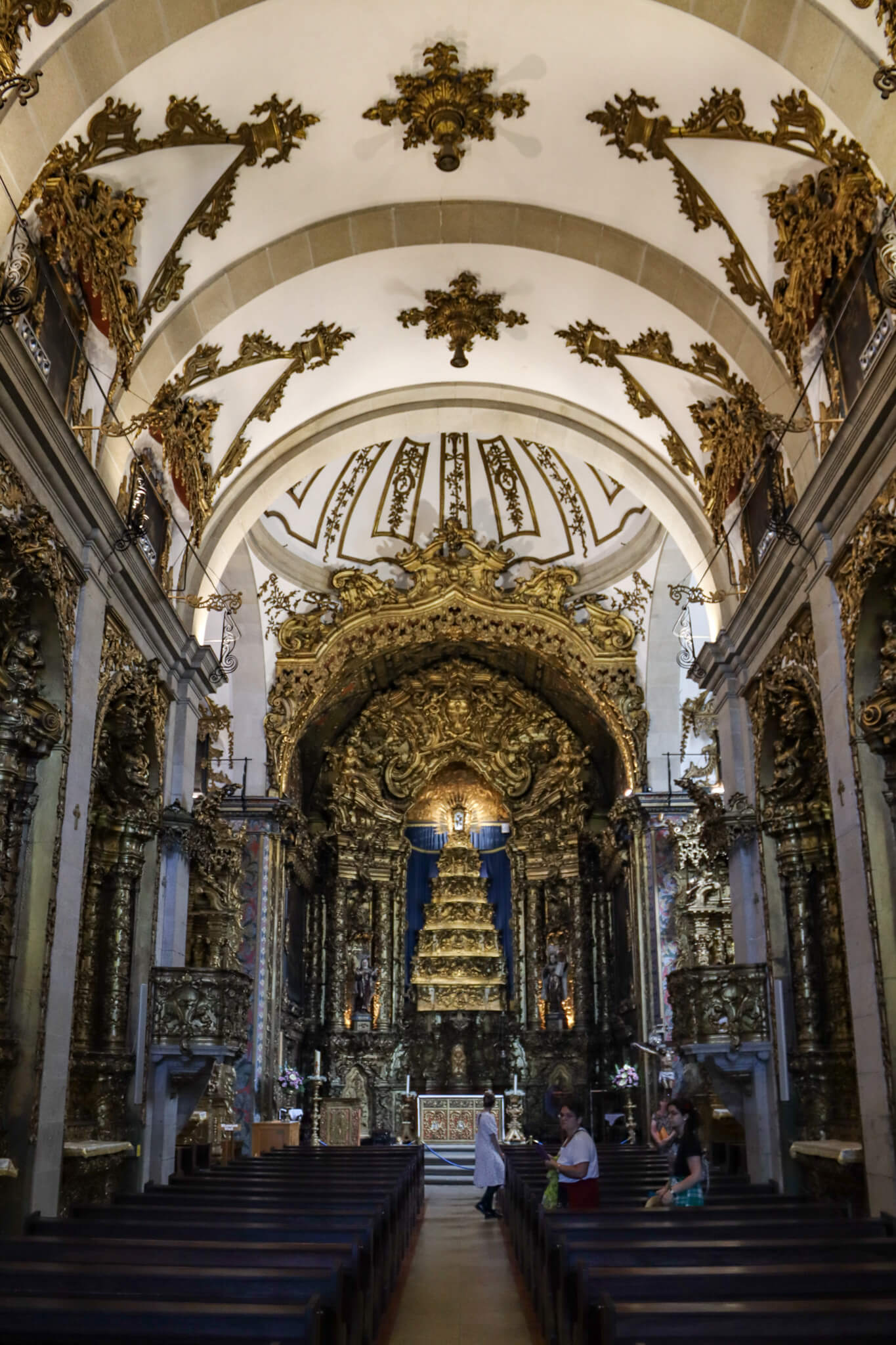
On the other side of that curious little house next to Carmo Church #3, above), the Church of the Discalced Carmelites was completed in 1622, with its interior decorations following up by 1650. The granite façade features a three-story bell tower, with clearly visible bells, monochromatic blue tiles, and a bulb-shaped dome. Three entrances are accented with round arches and finely hewn grillwork, topped by niches holding statues of Our Lady of Mount Carmel, St. Joseph, and St. Teresa of Ávila. Above, trapezoidal windows flank a central rectangular window, and the top of the church sports a triangular pediment with baluster crowns. Inside, there’s a really lovely barrel ceiling, six heavily gilded chapels alongside the single nave, and a wonderful organ, notable for the horizontal horns protruding from the pipe area. Like St. Anthony Church of the Gatherers, this church, too, has a military connection, when it served as a troop barracks during the Napoleonic occupation of 1808–14.
Five Runners-Up
- Trinity Church (Igreja da Trindade; 1840)
- St. Lawrence Church (Convento de São Lourenço; 16th century)
- Church of Our Lady of Lapa (Igreja de Nossa Senhora da Lapa; 1860)
- Chapel of Souls (Capela das Almas; 1929)
- Church of the Clergymen (Igreja dos Clérigos; 1750)
Leave a Comment
Have you been here? Have I inspired you to go? Let me know!


