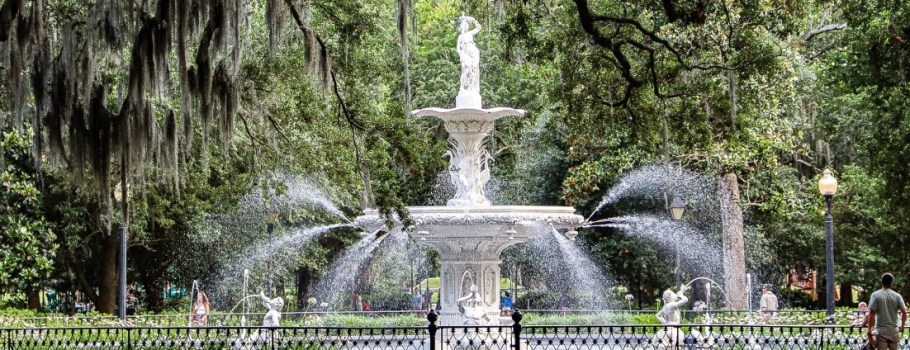
No city in the world does fountains better than Rome. But that doesn’t mean the Eternal City has a monopoly on them. Although the Fountain of Youth could arguably be considered the world’s most famous fountain, it never existed, much to the disappointment of Ponce de León and thousands of delusory people before him. Around the globe, fountains that actually do exist have achieved levels of artistic perfection while contributing to the city beautiful, cooling you off when summer becomes stifling, and providing some great stories, like the Gefion Fountain in Copenhagen, Denmark. These are my favorites.
#1 Peace Fountain (New York, New York)
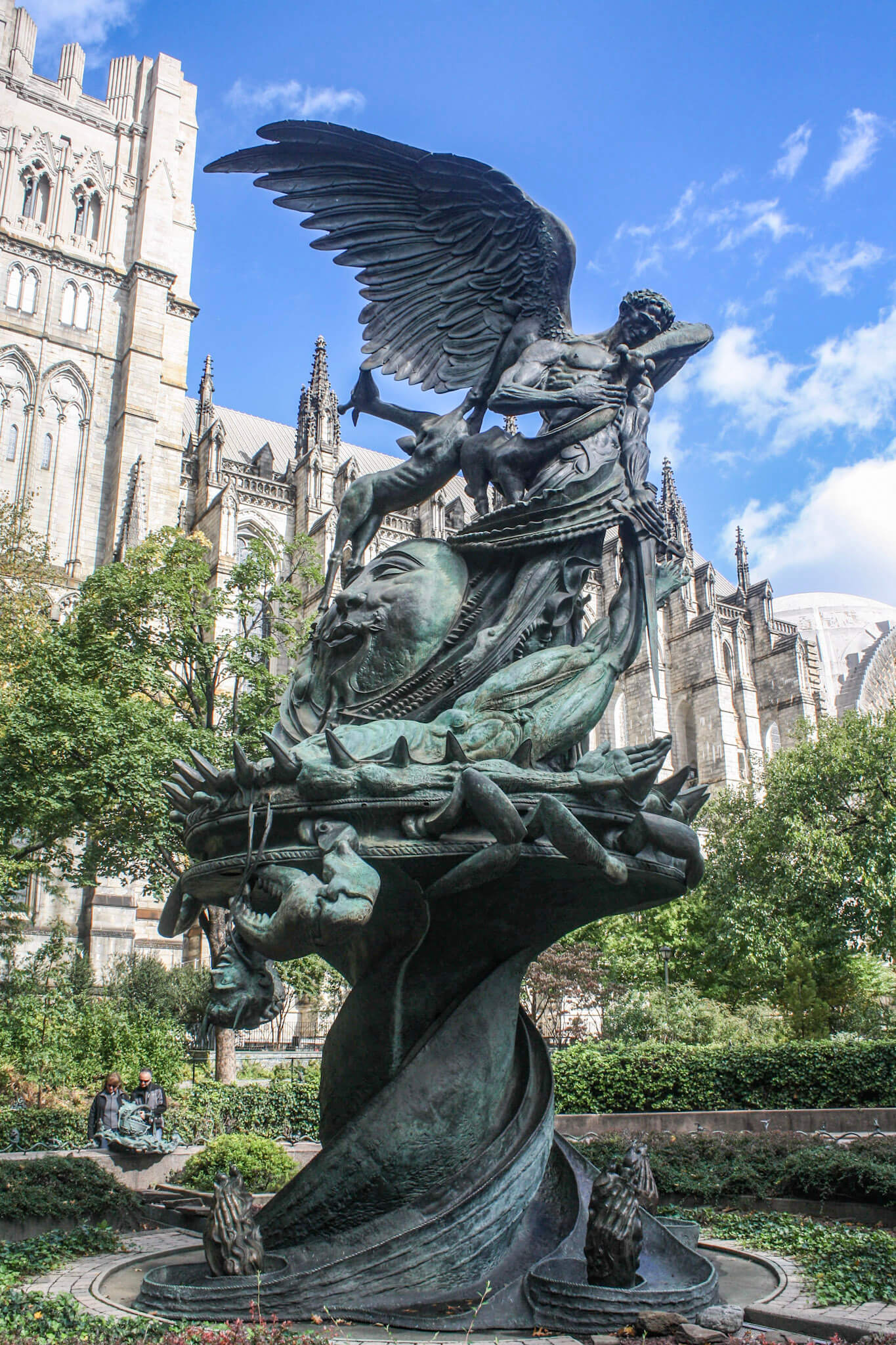
In the little park next to the massive and still unfinished Cathedral of St. John the Divine in Morningside Heights in Manhattan, the Peace Fountain thrills people of all ages, chock full of both whimsy and serious spiritual considerations. Unveiled in 1985, the 40’-tall bronze fountain and sculpture celebrates the triumph of good over evil and the battle between the Archangel Michael and Satan. Standing atop a swirling helix pedestal, a ripped Michael, his huge wings outstretched, holds a sword facing downward, leading the eye to a giant crab that represents the origin of life in the sea. Satan’s defeated body rests on the crab’s shell, and his decapitated head hangs upside-down from a claw. Human features are added to a round eastward-looking sun (with its eyes open) and a westward-facing moon (eyes closed), while a lion and a lamb rest comfortably next to one another. Of course, my favorite parts are the nine giraffes (one of the world’s most peaceful animals) prancing around the entire sculptural grouping, including one resting its head on Michael’s chest as he caresses its long neck. Dedicated to the creativity of the world’s children in celebration of the 200th anniversary of the New York City Episcopal Diocese, the 16-ton fountain features a collection of 120 small, delightful bronze sculptures, created by grade-school children, encircling the entire arrangement on an undulating bronze rope. This first-of-its-kind children’s sculpture garden features, for instance, an owl with flared wings sheltering an owlet on either side, a Noah’s ark riding tempestuous waters with Noah himself holding onto a giraffe while a mermaid rises from a wave, an elephant sitting on its butt with its trunk raised proudly, a cockatoo with its crazy head feathers, and a turtle with a finely carved shell. As an added bonus, bronze plaques on simple stands can be found on the other side of the walkway that surrounds the fountain—images and words by and about such peace promoters as John Lennon, Confucius, and Henry David Thoreau.
#2 Ogre Fountain (Bern, Switzerland)
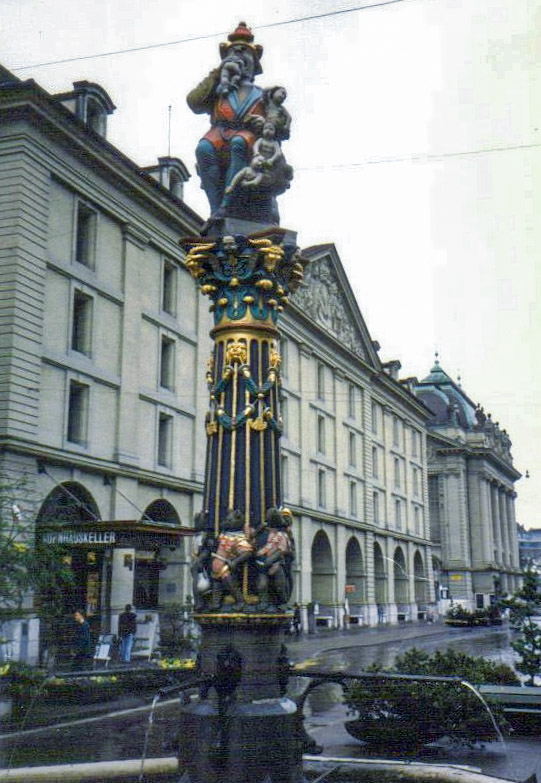
Throughout Old Town in the capital of Switzerland, I strolled among its nearly four miles of one of the world’s top five arcades. Here, dozens and dozens of Bern’s Renaissance fountains commemorate Swiss heroes, allegorical figures, and historic events from the Middle Ages. They served as meeting places where folks gathered to gossip, bathe, and obtain clean drinking water. Today, many of them stand in the middle of cobble streets, in between tram tracks and preventing drivers from speeding. The most memorable of these is the Ogre Fountain, or the Kindlifresserbrunnen (literally, the Child-Eater Fountain). Sitting atop a column, the fearsome ogre holds the body of a naked child as he chomps down on its head. Other terrified children try to escape from the ogre’s sack, knowing they’re about to be devoured. Created in 1546, the fountain has generated various theories about its meaning, proposing that the ogre is Krampus, the creature from Alpine folklore who punished misbehaving children during the Christmas season; or that he’s the Greek god Cronus eating his own children; or that he’s Saturn eating the months; or that he’s an enemy of the eight cantons of the Old Swiss Confederacy trying to gobble them up (which supports the presence of the frieze of armed bears [the city’s symbol] marching off to war at the base of the column); or that he’s an overshadowing duke’s jealous younger brother who gathered Bern’s children and ate them. Or he simply could be a carnival character intended to frighten disobedient children into behaving. Whatever the real story, this is a fountain you won’t forget.
#3 Doulton Fountain (Glasgow, Scotland)
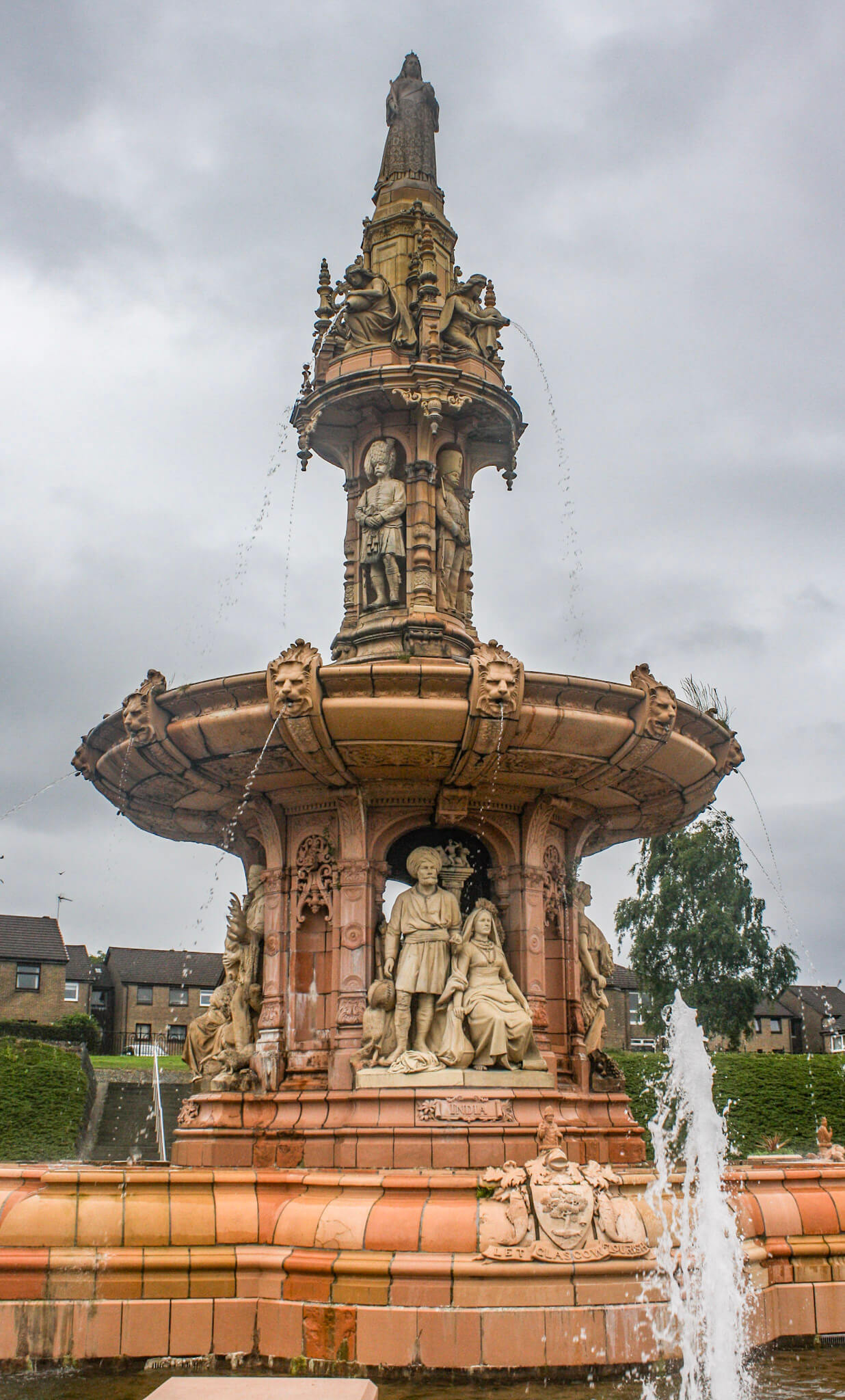
Before I entered the People’s Palace in Glasgow Green, one of the best museums in Scotland, I stopped to admire the fountain just outside the building’s entrance. The world’s largest terracotta fountain, made entirely of ceramic tiles and terracotta sculptures, rises 46’ high from a 70’-wide basin. Created for the International Exhibition of 1888 to commemorate Queen Victoria’s reign and Victorian imperial achievement, the fountain is topped by a statue of the queen (a reproduction; the original was destroyed by a lightning strike in 1891) dressed as the empress of India in a lace dress, wearing the imperial crown and holding a scepter and orb. Beneath her, four figures hold overturned urns that pour recycled water into the upper basin, where lion heads spew it out into the lower basin, from which jets spout out even more water. On each of four sides, a sentry represents the regiments of England, Ireland, Scotland, and the Royal Navy. At the base, sculptural groups represent four of Britain’s former major colonies: Australia, Canada, India, and South Africa. The rim bears the city’s coat of arms, with the motto “Let Glasgow Flourish.”
#4 Fountain of the Continents (Mendoza, Argentina)
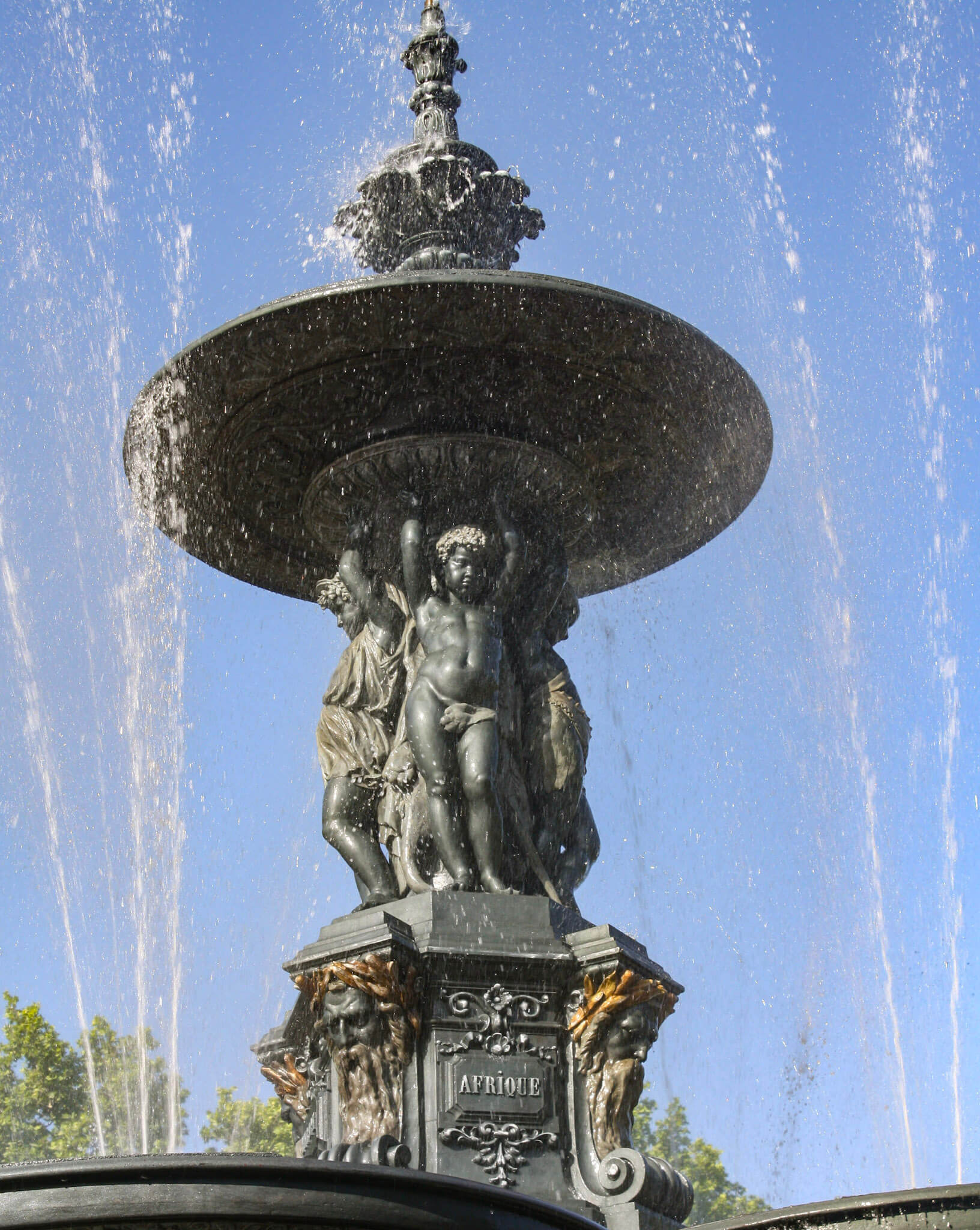
After a boozy day of wine tasting at a trio of wineries around the leafy city of Mendoza, I shuffled my way into the 971-acre Parque San Martín. There’s lots to see here—royal gates, monuments, a rose garden and lake, sculptures, and especially the Fountain of the Continents. Acquired in France in 1909 and made operational in Mendoza in 1911, the Fuente de los Continentes represents the continents of Africa, America, Asia, and Europe. The cast-iron fountain’s main pool, which measures almost 66’ in diameter, features four mermaids holding large conical seashells. In the center, two atlantids and two caryatids, surrounded by frolicking winged cherubs, support four huge circular plates measuring almost 18’ in diameter. Rising from the center of the plates, four statues of children, each representing one of the continents, support a top plate that sprouts a decorative finial element. Water shoots out in all directions, from the plates and basin and figures, and, when lit from below at night, makes a striking impression. Even better: During harvest season, in a nod to the city’s famous wine industry (think, in particular, of great Malbec), the water is colored red.
#5 Ross Fountain (Edinburgh, Scotland)
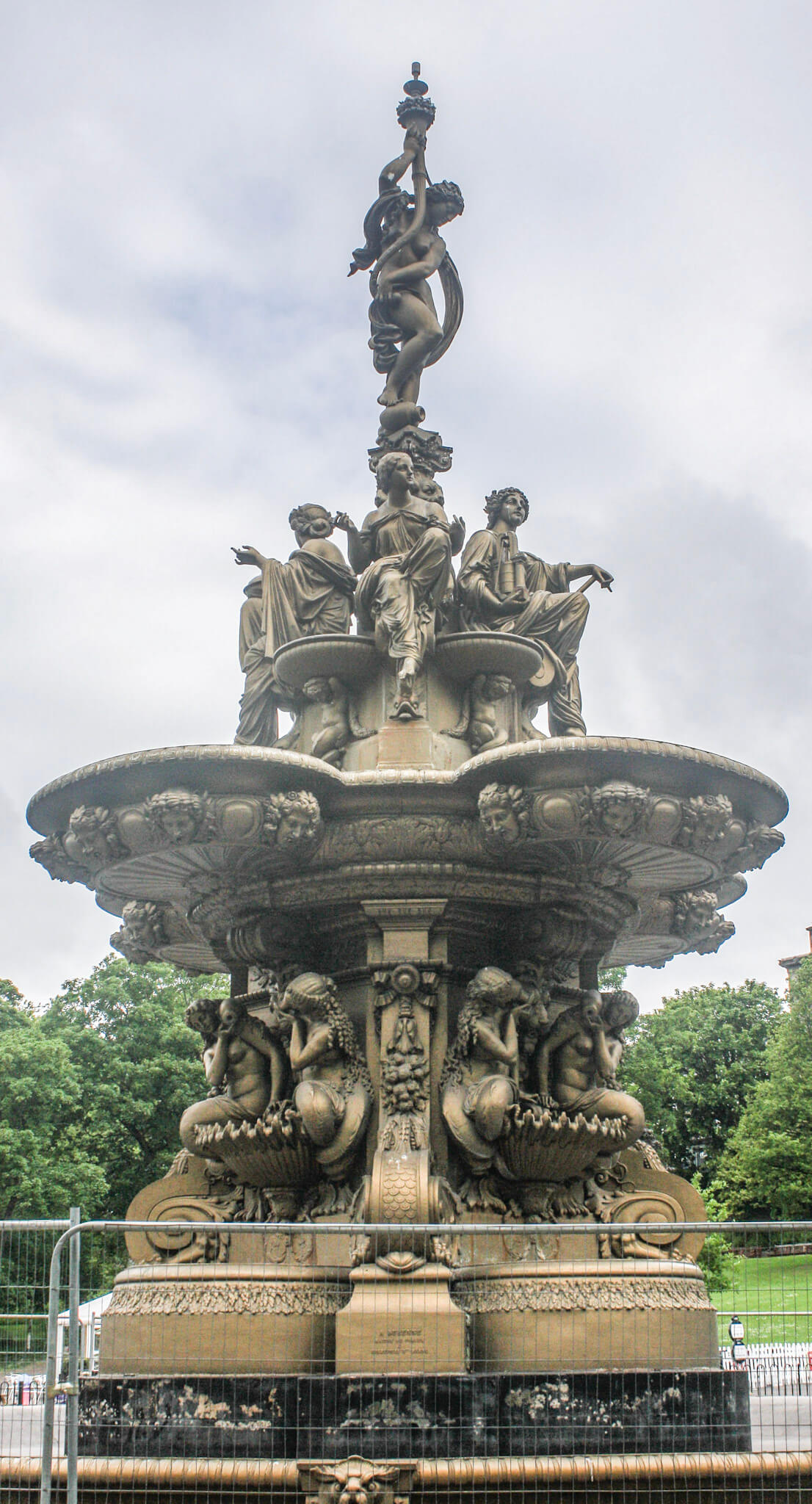
My pace slowed as I entered the lovely Princes Street Gardens, from which the rocky walls of Old Town rise up, capped by the expansive Edinburgh Castle. It’s a wonderfully serene spot to enjoy a snack and to take in the gardens’ attractions, like the floral platinum jubilee clock, the Scottish American Memorial, and especially Ross Fountain—an iconic symbol of the city that was initially unwanted and considered tasteless. This exquisite cast-iron fountain was produced at an iron foundry in France and displayed at London’s International Exhibition of 1862, where a local gunmaker, Daniel Ross, saw it and impulsively bought it for £2,000. After its 122 pieces were shipped to London, Ross gifted it to Edinburgh—but Edinburgh didn’t want it. The fountain’s bathing nymphs and voluptuous naked figures didn’t exactly jibe with public mores at the time, and Victorian locals found the entire thing unattractive. So it sat in storage for a full decade before it was reassembled and opened in the gardens in 1872 (one year after Ross died), but even then, controversy raged: The minister and congregation of St. Cuthbert’s Church (one of the most beautiful churches in Edinburgh), which backed directly onto the gardens, felt the fountain was a disconnect from the area’s tone, and that the sacred space of St. Cuthbert’s, the oldest continually used site of worship in Edinburgh, since the seventh century, was besmirched by such a tacky monument. Nevertheless, the fountain remained where it was. And it’s looking better than ever, recently restored and boasting fresh colors of turquoise, gold, and brown.
Five Runners-Up
- Trevi Fountain (Rome, Italy)
- Forsyth Park Fountain (Savannah, Georgia)
- Peacock Fountain (Christchurch Botanic Gardens, Christchurch, New Zealand)
- Grand Army Plaza Fountain (Brooklyn, New York)
- Brewer Fountain (Boston, Massachusetts)
Leave a Comment
Have you been here? Have I inspired you to go? Let me know!


