There always seemed to be a centuries-old church spire or steeple or tower poking up over its surrounding buildings wherever I walked along the seductive canals of Bruges. They added to the indelible vibe of this remarkable city, one of the best-preserved medieval cities in all of Europe. With more than 30 churches to choose from for visiting, I knew I wouldn’t be able to see them all. But their fairly close proximity to one another enabled me to check out a great number of them. These are my favorites.
#1 Church of Our Lady (Onze-Lieve-Vrouwekerk)
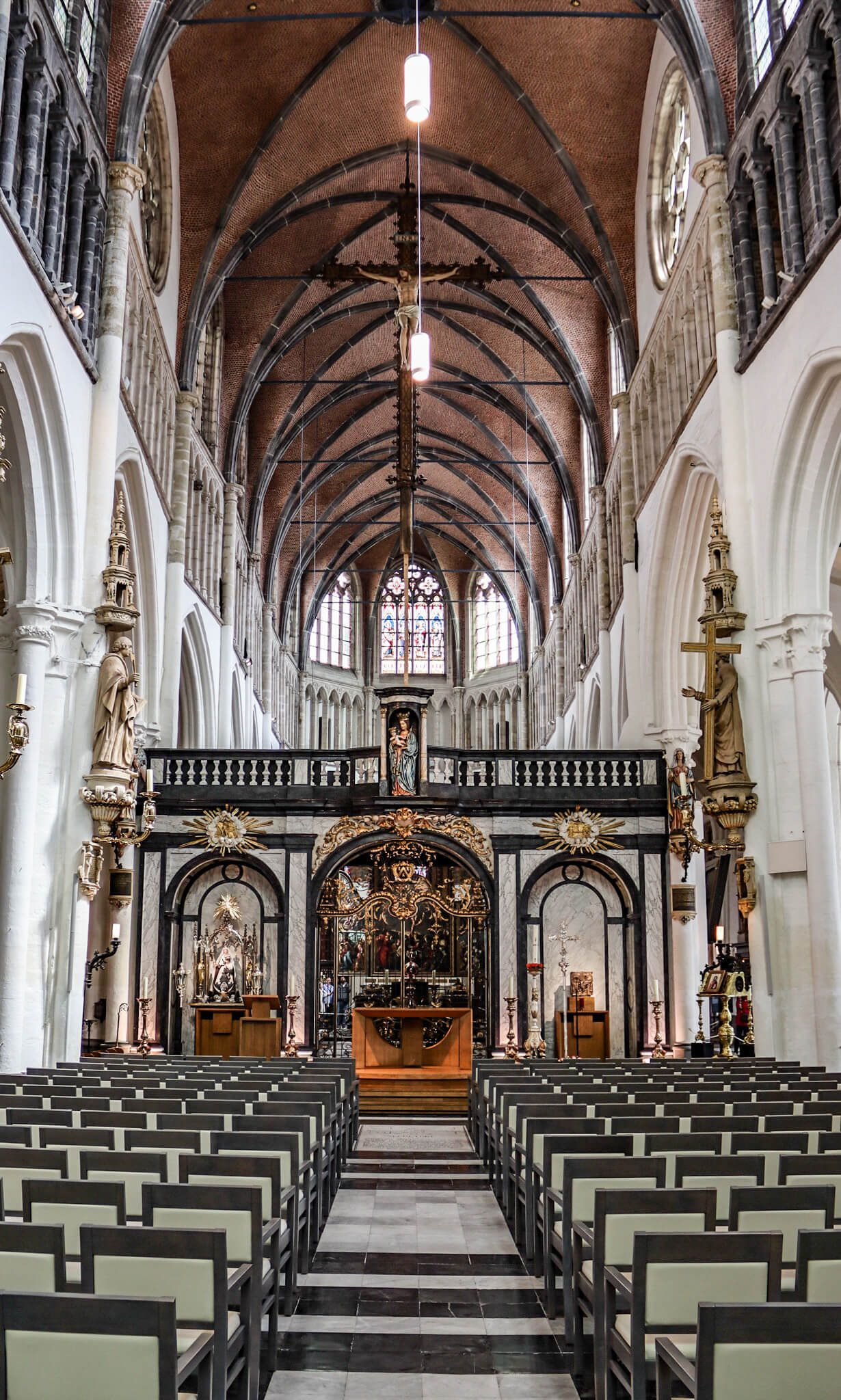 In the heart of Bruges, ringed by cobblestone streets and passageways, rises the incredible Church of Our Lady. And I do mean rise—the tower, at 379’ tall, is the third-tallest brick tower in the world. What with its slew of turrets and crockets, flying buttresses, and charmingly undersized dormer windows, this church defines the city’s skyline. Construction began in the 1270s and wasn’t completed until the early 16th century. In the nave, statues of the Apostles stand on shelves under canopies, and a giant crucifix hangs from the ribbed brick ceiling over the rood screen. A magnificent pulpit without a single straight line looks like it may ascend to heaven at any given moment. The black-and-white tiled floor might resemble a hedge maze when viewed from above. A number of side chapels invite exploration, including one from 1482, created for a wealthy man as his personal area of worship. I loved the unusual Last Supper, with the sculpted Apostles standing, each on his own pedestal and wearing what I could only imagine were streets clothes of the time (one dons a hat), in a circle around Jesus. Look for the circular reliquary that contains relics from the Virgin Mary and all 12 Apostles. Then look up to see the statue of St. Anthony, accompanied by a very cute pig wearing a bell. Visiting the church is free, but for a fee you can access its museum section, especially to see Michelangelo’s Madonna and Child marble sculpture—allegedly the only one of his works to leave Italy during his lifetime.
#2 St. Salvator’s Cathedral (Sint-Salvatorskathedraal)
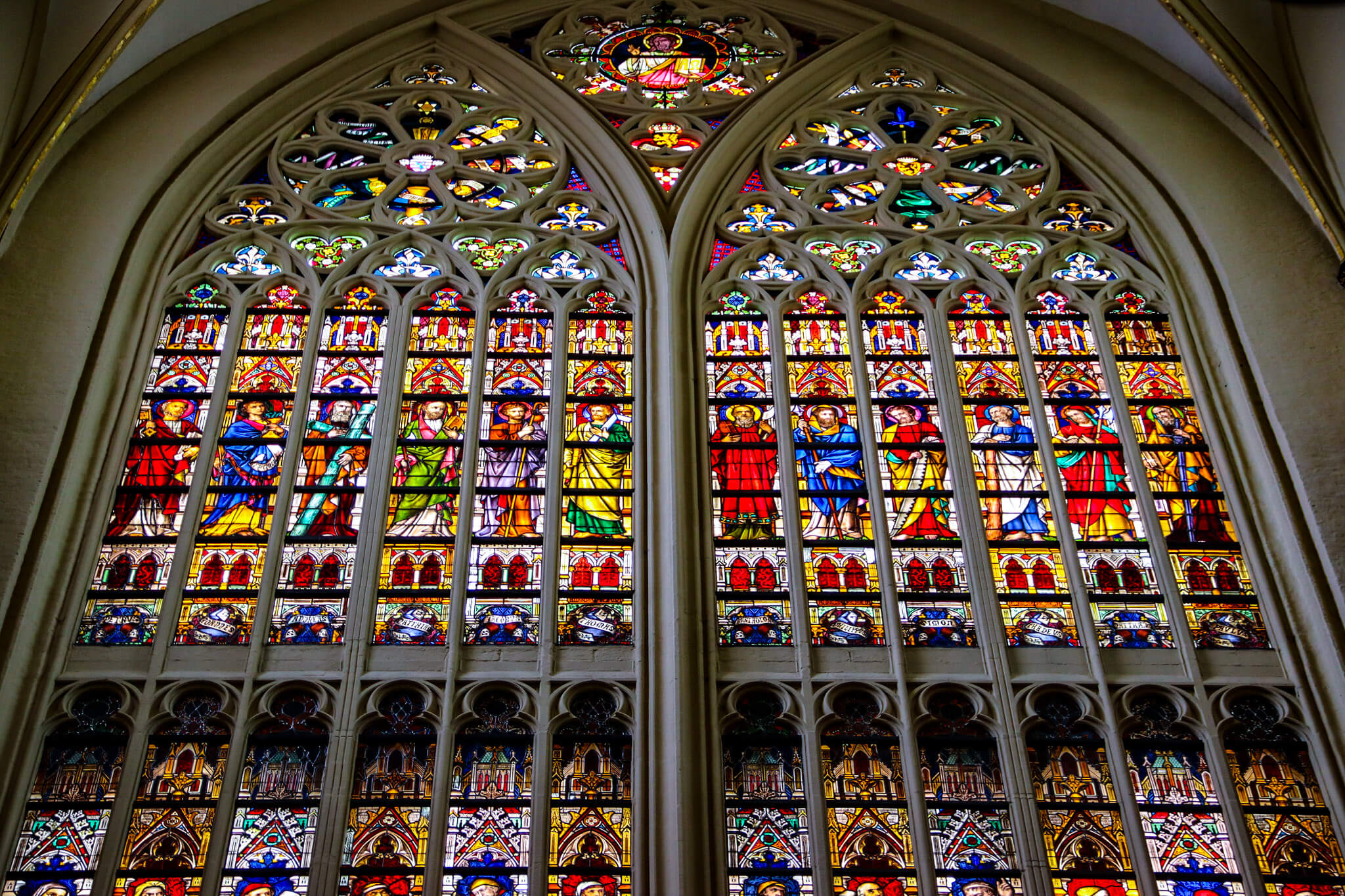 St. Salvator’s Cathedral saw most of its construction last from 1275 and 1375, with ensuing additions and renovations over the following centuries. I entered the brick Gothic church via the doors at the base of the soaring 262’ tower and was immediately impressed by the church’s verticality. Along the nave, upward-thrusting clustered columns support pointed arches, below the triforium and pointed-arch windows in the clerestory. The interior tells the cathedral’s history—it received a Baroque makeover in the 17th century following the damage from the Iconoclasm, and in the late 1800s it was repainted and redecorated in the neo-Gothic style. It was during this latter period that the church received its gorgeous stained-glass windows, depicting Bible scenes and saints accompanied by their symbols. Side chapels are dedicated to shoemakers (look for the crowned boot), cloth-shearers, and hosiers. There’s an impressive rood loft with a commanding marble statue of God; a pulpit with marble medallions of the Four Evangelists and a statue of the founder of this parish, holding a floor plan of the church; and terrific tapestries with scenes from the life of Christ, including one with one of the world’s best depictions of Palm Sunday. One of my favorite little details was in the choir stalls, from around 1430—the misericords on the seats’ undersides, small sculpted works of art with scenes from everyday life in the Middle Ages, alternating with Bible scenes and leaf ornamentation.
#3 Basilica of the Holy Blood (Basiliek van de Heilig Bloed)
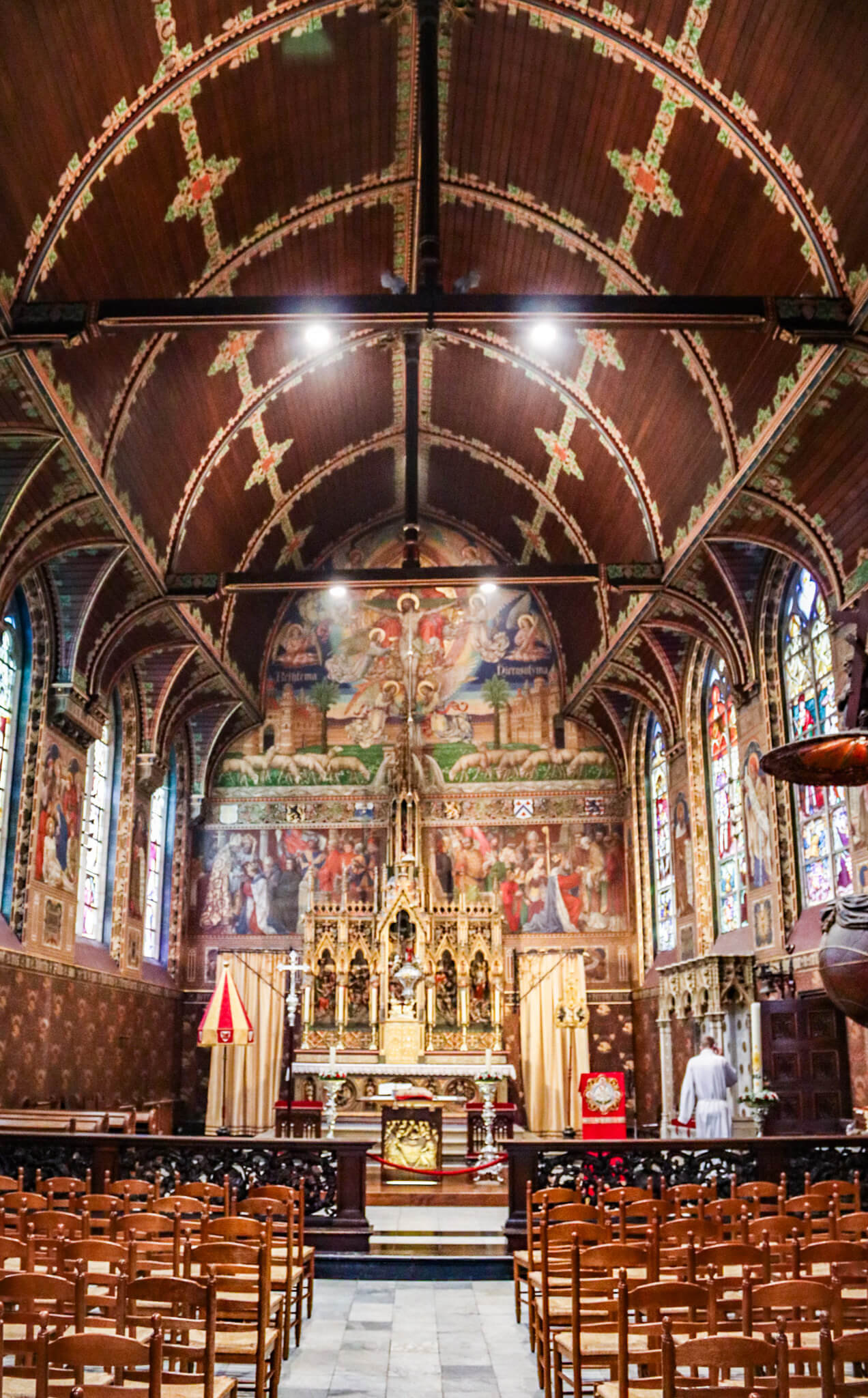 At the corner of Burg Square, adjacent to the sumptuous City Hall, stands the Basilica of the Holy Blood, rebuilt in the 19th century after the 1100s original was destroyed during the French Revolution. Gilded bronze statues and medallions on the façade represent such nonreligious figures as Archduchess Isabella of Burgundy and the Flemish Philip of Alsace. I headed downstairs first, to St. Basil Chapel, which dates back to 1149. Then I walked up the fantastic, wide spiral staircase with brick walls and ribbed ceilings, completed in 1533, to the basilica. It’s crowded here, for a very good reason, which I saved for last. First, I checked out the stained-glass windows depicting, in chronological order, the princes who ruled the County of Flanders from the 1300s to the 1700s. The unique pulpit attached to the wall was made in 1728 in the shape of a globe, as God’s word must reach the whole world. There’s a fine series of painted Stations of the Cross inset into wood panels, an oak communion bench decorated with foliage and busts of saints, and an excellent Last Supper in alabaster in the small altar. The large mural behind the altar is divided into two sections. The top part depicts the mystery of the Cross, with a crucified Jesus before a seated God, surrounded by angels and with a flock of sheep at His feet; on the right is an image of Bethlehem, where Jesus was born, and on the left is Jerusalem, where He did. The bottom part of the mural portrays the transportation of the Holy Blood relic from Jerusalem to Bruges (a legend that has since been debunked). And that’s why everyone was here. Off to the side, a line quietly queued up, waiting patiently and without complaint to see the relic. I joined the line and waited, watching those ahead of me to get the routine right—there’s a definite procedure here. When it’s your turn, you kneel down before the relic—a few drops of Jesus’s blood, held in a glass vial—and say a little prayer. The silent woman opposite you then hands you a mini-pamphlet with prayers in different languages. It’s actually quite moving, and, for believers, it’s just about the closest you’ll get to God while still on Earth.
#4 St. James’ Church (Sint-Jakobskerk)
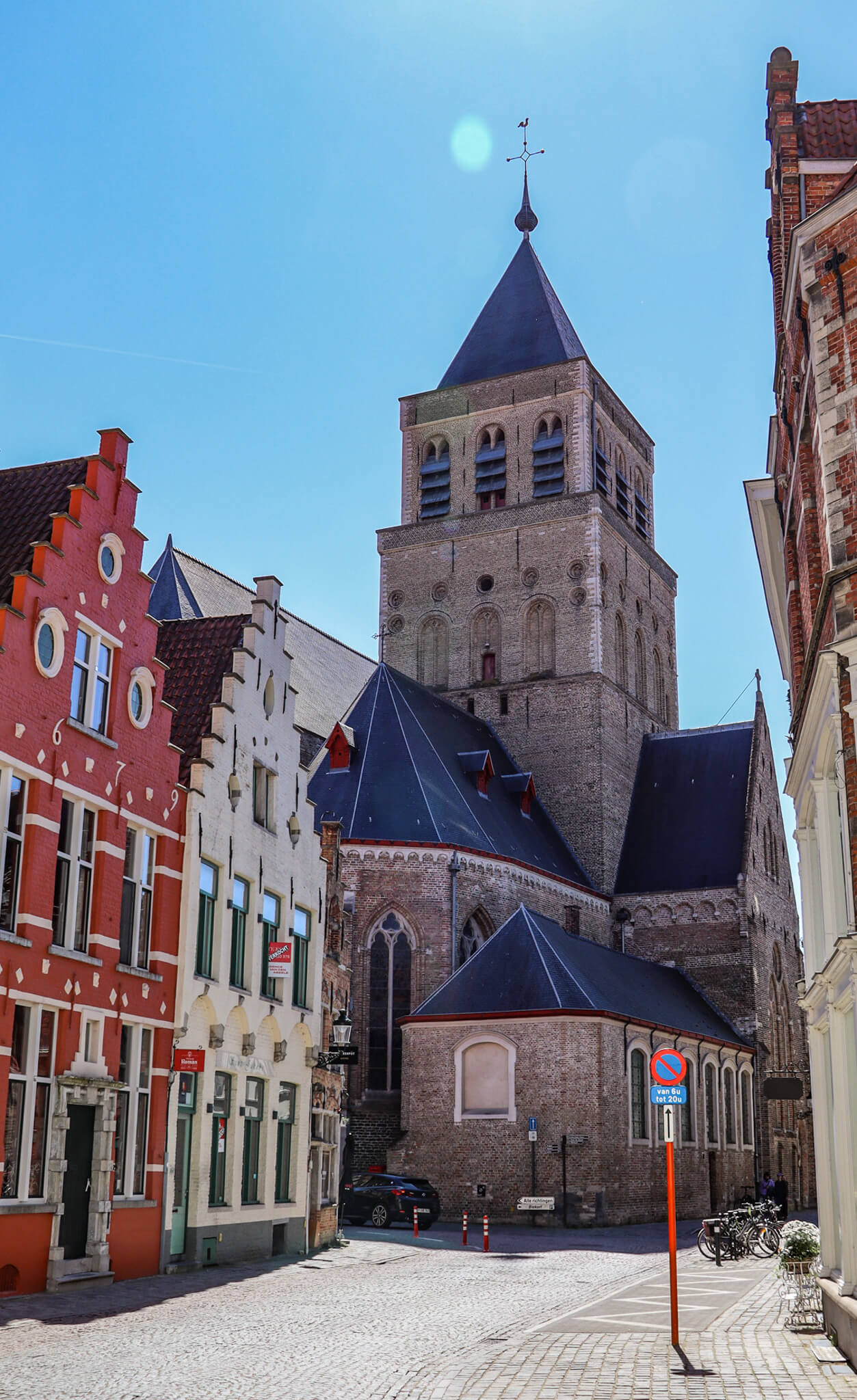 Despite being less than half a mile away from the more touristy part of Bruges, St. James’ Church is wonderfully undervisited. Encircled by narrow brick streets (and a side alley with a semi-exposed public urinal that dates back centuries), the church towers over its neighbors. With its oldest parts dating back to 1240, the church achieved its current size during the 15th century. I walked around the entire circumference of the church, marveling at its brick exterior and heavy crossing tower, before I stepped inside, through the pointed arch entrance with a red wooden door with a decorated broker including a sculpture of St. James. Some of its medieval character remains, but the church today largely reflects the extensive remodeling in the Baroque style in the 17th and 18th centuries, following the destructive looting by iconoclasts in 1580. There’s a trove of treasures here to admire—the black-and-white marble covering on the lower walls, with sculpted heads of the Apostles; the marble rood screen; the oak pulpit liberally carved with figures and cherubs; the confessional with a pair of holy men serving as atlantids between the salomónicas; plenty of fine paintings, including one of St. Veronica and Jesus on His way to His crucifixion; and lovely stained-glass windows, including a Last Supper scene with an unusual feature: A red-headed Judas, with one hand clutching his bag of silver and the other resting on his wrinkled forehead, who usually bears no nimbus at all, has one here, and it’s a dark blue, unlike the golden halos of the other Apostles. Don’t miss the side chapels. Among the usual types, such as the Chapel of St. Anthony and the Chapel of the Faithful Souls, you’ll also find the Chapel of the Surgeons and the Chapel of the Butchers. The best is the Crypt Chapel, with effigies of buried aristocratic family members below a curious ceiling decorated with Latin, the symbols of the Four Evangelists, and what could easily pass for a picture of the mess of wires below your computer today. The church is an important stop along the Via Brugensis, the medieval pilgrimage route to the Spanish pilgrimage site Santiago de Compostela that you can still follow today.
#5 Blessed Virgin Mary Church (Heilige Maagd Mariakerk)
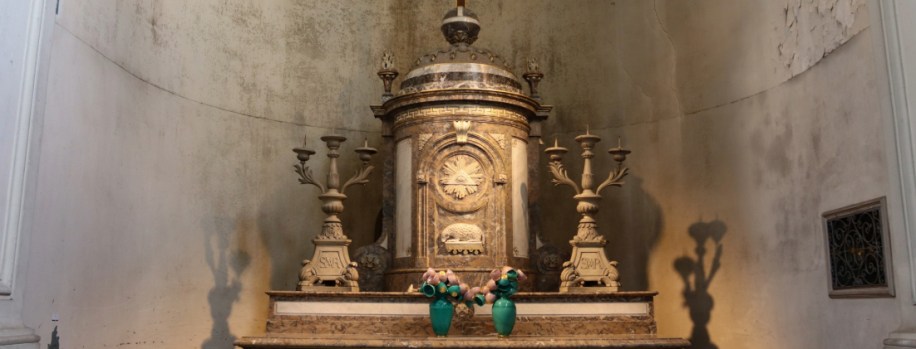
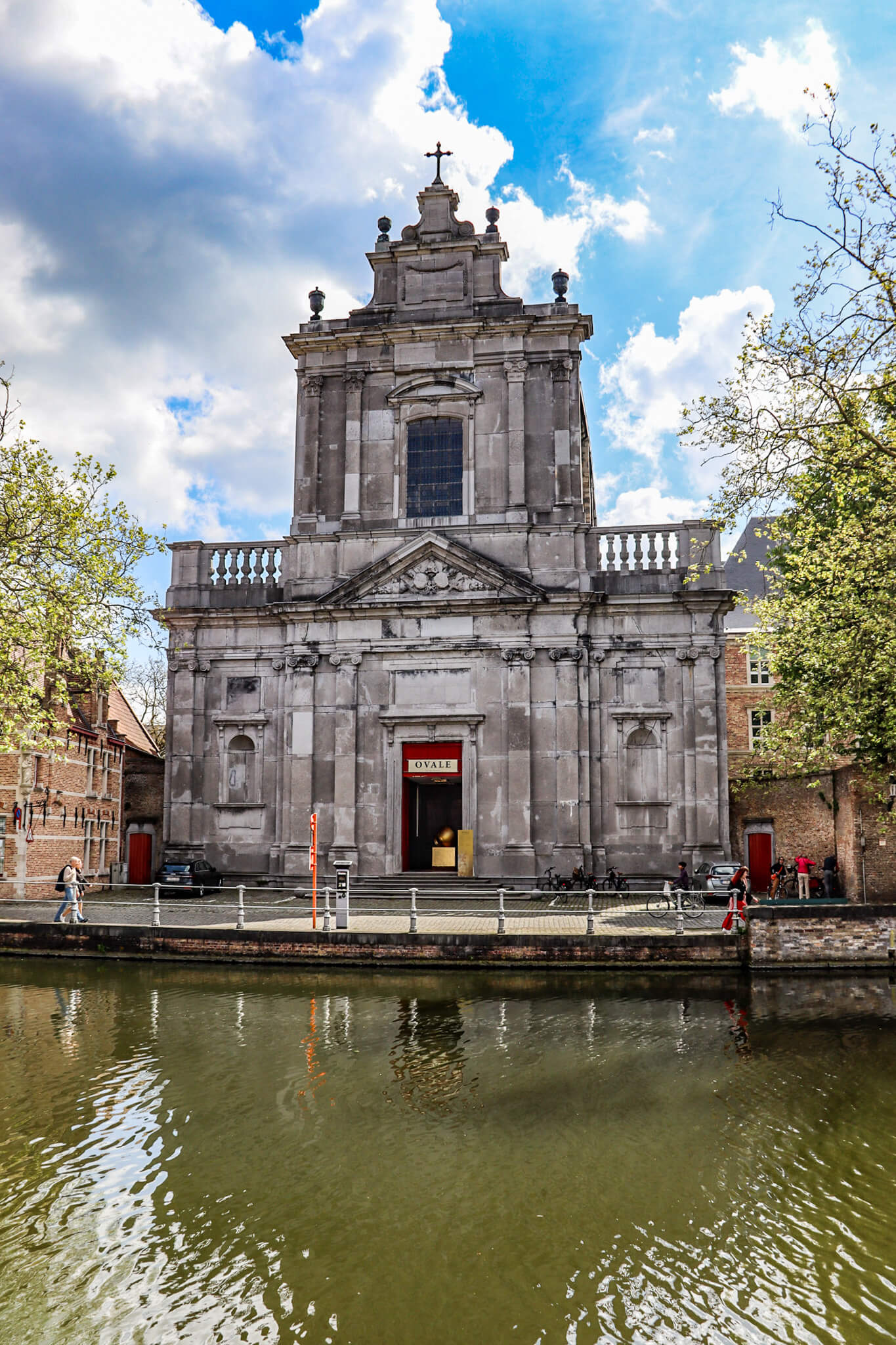 Just a block or two from my excellent accommodations, Hotel Ter Duinen, on the other side of the Langerei canal, I found the Blessed Virgin Mary Church. Completed in 1778 as the church of the Abbey of the Dunes, the Catholic church experienced occupation by French armies, served as a depot for nationalized goods, and functioned as a Dutch Reformed church before returning to its original purpose in 1818. The somber classicist façade in blue limestone features empty niches, short balustrades, and decorative urns. The bright interior is divided into a high central nave flanked by Corinthian pilasters rising to the barrel vault ceiling with bosses. I made my way forward, past the oak pulpits from the 17th century, with staircases guarded by angels, and the oak choir stall to the marble high altar. Half a dozen tall candlestick holders flank the elegant tabernacle. I turned to look back at the organ in the marble loft, with balustrades and urns. Aside from the wood, and the black-and-white marble floor in various designs, the entire church is a monochromatic light-cream color—except for the bowls, vases, and teacups by a Belgian artist, placed throughout the church as an art exhibit in a playful, colorful way that adds to the character of this lovely church.
Five Runners-Up
- Jerusalem Chapel (Jeruzalemkapel, 1428)
- St. Giles Church (Sint-Gilliskerk, 1258)
- St. Walburga Church (Sint-Walburgakerk, 1641)
- St. Anne’s Church (Sint-Annakerk, 1620)
- Beguinage Church of St. Elizabeth (Begijnhofkerk, 1605)
Leave a Comment
Have you been here? Have I inspired you to go? Let me know!


