The oldest city in New York State, Albany was claimed by Henry Hudson for the Dutch in 1609, settled in 1614 with the construction of a fort, chartered as a city in 1686, and named the state capital in 1797. I was sure that an American city with that much history would be a fascinating place to visit. And it didn’t disappoint. Every morning from my comfortable bed and breakfast (built in 1884 as the home of a manufacturer of garments using ostrich feathers) in the Washington Park Historic District, I would explore this city’s parks, museums, architecture, and history, ending my days with dinner at the likes of Albany Pump Station or Jack’s Oyster House. There is plenty to see and do in this city of just about 100,000 people (and if you’re here in early spring, you can check out the Tulip Festival, an annual tradition since 1949 that ties that wonderful flower to Albany’s Dutch history). These are my favorites.
#1 Marvel at the Grandeur of the Cathedral of the Immaculate Conception
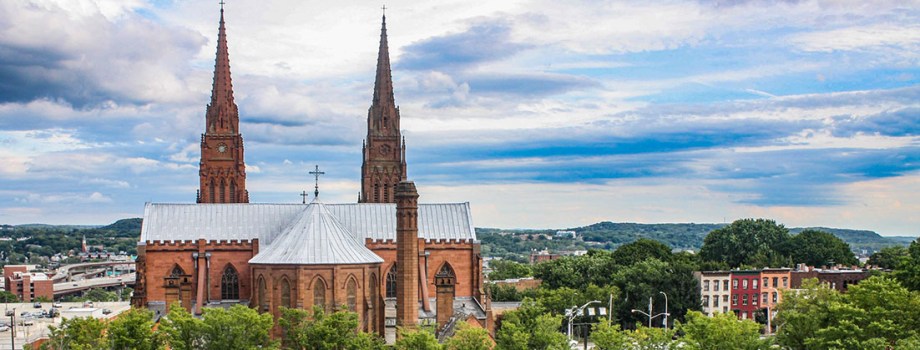
 In the heart of downtown Albany, one of the most beautiful churches in Albany boasts an impressive historical record as the first American Catholic cathedral built in the neo-Gothic style, the second-oldest cathedral in New York (after St. Patrick’s in New York City), the third-oldest in the United States, and the tallest building in Albany when construction ended in 1852. The cathedral escaped the wholesale razing of the surrounding neighborhood to create Empire State Plaza and stands in stark contrast to the banal modernist office towers across the street. The brick, sandstone, and plaster cathedral occupies a corner lot and features two spires that top out at 210’. I entered the magnificent Cathedral of the Immaculate Conception through the middle of three portals and was immediately drawn to the exceptional sculptural arrangements of the Stations of the Cross, which won the Gold Medal at the 1888 Paris Exposition. There’s plenty more to be awed by: The Last Judgment Window was made in England, the oak high pulpit was hand-carved in Holland, and the oak choir stalls were carved in Belgium. You’ll also find a Caen stone baptismal font and the regal Cathedra—the bishop’s chair. Clustered columns with heavy capitals of organic motifs, including lots of grapes, grape leaves, and grape vines, support the vaulted ceiling with heavy bosses. The cathedral also holds my favorite depiction of Palm Sunday, a stained-glass window displaying the full spectrum of colors.
#2 Explore the New York State Capitol
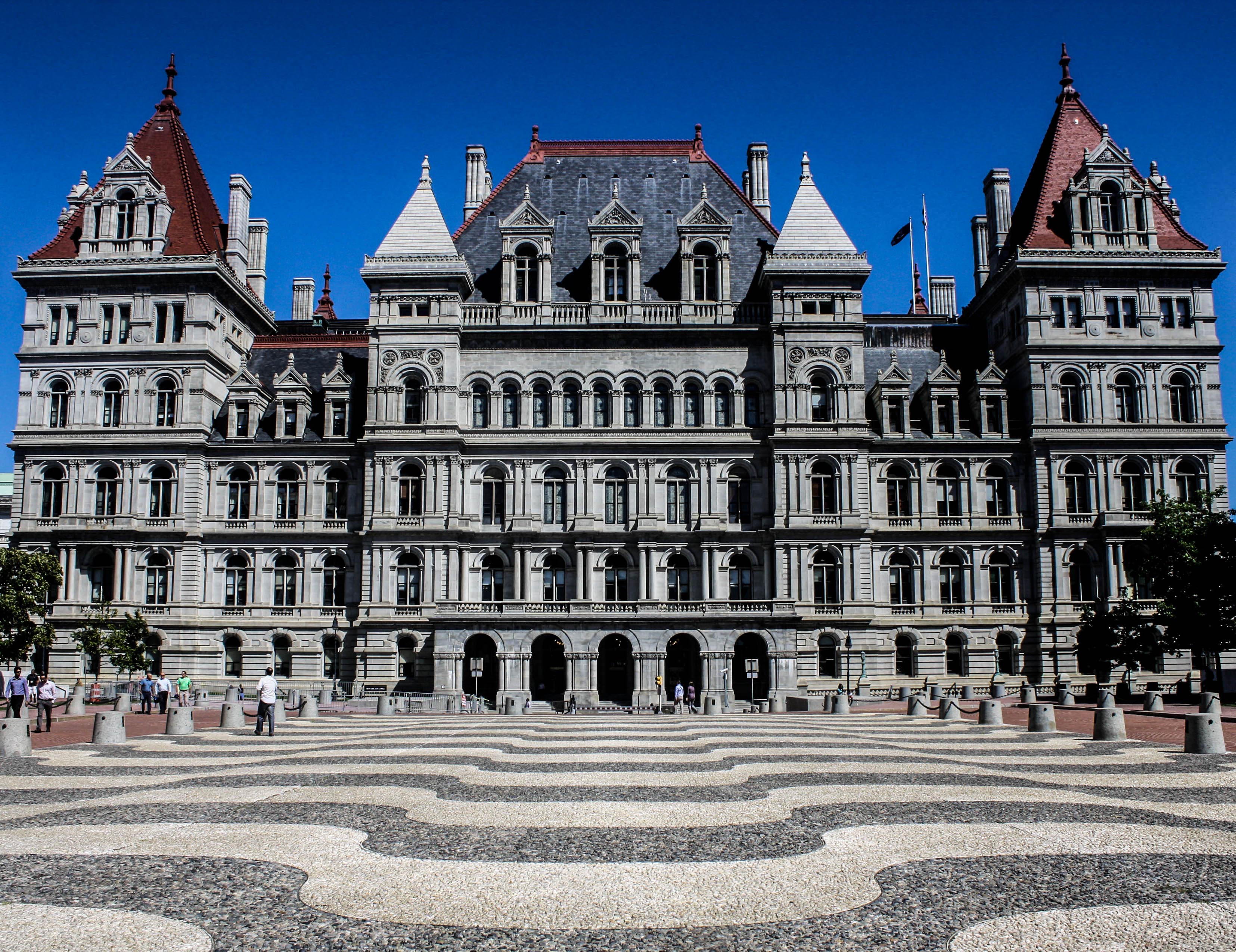 Architecturally unlike any other state capitol in the United States, the New York State Capitol in Albany is one of the country’s most beautiful capitols. Because it took so long to build (1867 to 1899, when it was dedicated by Governor Theodore Roosevelt), it’s a mix of architectural styles that somehow blend seamlessly and that is generally referred to as Romanesque Revival and Neo-Renaissance. Built for a whopping cost that exceeded $25 million (more than the U.S. capitol), the five-story granite building is simply superior. It features a central section with two connecting sections that link to corner towers with pyramidal red roofs, best viewed from the center of Empire State Plaza before it. Overall, it could be mistaken for an enormous French chateau, with its dormer windows and clusters of chimneys.
 Inside, the surprisingly dark interior was a little disorienting; there is no grand open space or clearly articulated or instinctive routes to follow. Instead, I got to discover lots of wonderful treats along the byzantine layout, survivors of the 1911 fire that consumed a large part of the building as well as what was, at the time, the nation’s fifth-largest and the world’s 12th-largest library. Three grand staircases beckon you to start climbing: the Moorish- and Gothic-style Assembly Staircase, with a huge skylight; the other Moorish- and Gothic-style Senate Staircase, made of Scottish sandstone, with a glassless rose window in the most unexpected place, and bas-relief carvings of plants, fish, turtles, and mythical animals, and granite owls carved into a column capital; and the most elaborate, the four-pronged Great Western Staircase, designed by the incomparable Henry Hobson Richardson. Made of warm–rose-colored stone and brimming with ornate lampposts (this was one of the first public buildings in the United States to employ electricity), this staircase features fantastic hand-carved sculptures of 77 governors, presidents, explorers, poets, and soldiers, including Civil War heroes Abraham Lincoln and Ulysses S. Grant, all found hidden among column capitals, along the walls, and at the bases of arches, along with additional unidentified faces (probably friends of the carvers) used to fill in the ornamentation, no pattern of which is repeated. Countless arches and windows line each floor, and you’ll enjoy hunting for some fine details like an eagle and the New York State coat of arms. The Senate Lobby has a beautiful Victorian-tile floor; the Minton tile floor in the Upper Senate Corridor is just as nice. There’s also an impressive Moorish-Gothic–style Assembly Chamber, the largest room in the building, with stained glass, and brass and alabaster chandeliers, and the Governor’s Reception Room, with fantastic murals on the curved ceiling depicting important events in New York State military history, such as the battle between English and Dutch colonists fighting for control of the region. As if this capitol wasn’t already unique, there’s a Dunkin’ Donuts located inside.
#3 Ramble Around the Former Delaware & Hudson Railroad Company Building
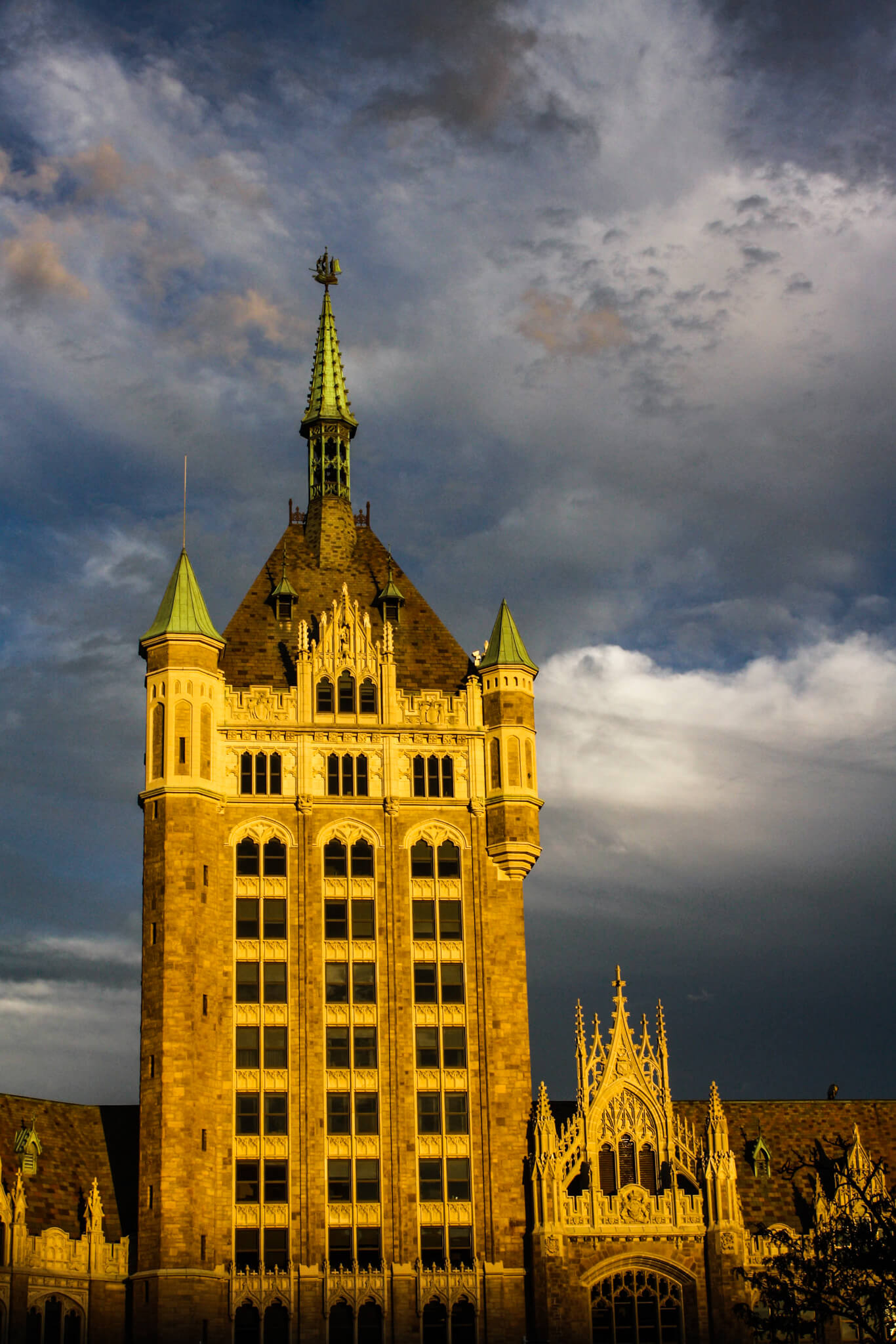 Just a couple of blocks up from the Hudson River, the palatial former Delaware & Hudson Railroad Company Building dominates the foot of State Street—and is often mistaken for the state capitol by not-so-well-informed visitors. With a design based on part of the Cloth Hall in Ypres, Belgium, the railroad’s headquarters was constructed in sections between 1914 and 1918, and the result was a huge and spectacular edifice that still remains one of the most beautiful buildings in Albany. A central 13-story tower anchors the asymmetric Gothic building, whose length exceeds 600’. From there, the older north arm and the more ornate south arm lead to additional towers, the southern one functioning as the headquarters of the Albany Evening Journal, whose editor just happened to play poker with the architect, the president of the D&H, and the Republican political boss of the city. After both organizations decamped from the building, it remained vacant until the State University of New York (SUNY) purchased it as its central administration offices, renovated it, and moved in in 1977, five years after the building was added to the National Register of Historic Places. In a fairly selfish gesture (not quite so shocking, given the cabal of the original foursome who put together the building), the SUNY chancellor made the top four floors of the southern tower his rent-free residence. I managed to talk myself inside despite not having a SUNY ID to check out the long halls with beautiful columns with floral capitals and with ribbed groin vault ceilings covered in herringbone-patterned tiles. But the real beauty is found outside. Decorated windows, finials and crockets, turrets, gargoyles, and cinquefoil arches add tremendous flair to what was basically an office building. Plenty of flourishes acknowledge the history of Albany that transcend the railroad company and the newspaper. Way atop the central fleche, an eight-foot-tall working copper weathervane replicates Henry Hudson’s ship, Half Moon. Stone beavers appear between the dormers of the north wing; gables along the south wing bear coats-of-arms of key Dutch families, including that of the city’s first mayor. Stone reliefs of the names and dates of important figures in the history of print can be found on the façade as well as the crests of Hudson and of European royalty, and the seals of the city and state. Prescient to SUNY occupying the building, there’s a small stone owl a few stories up, and a particularly stern-looking bespectacled taskmaster pointing to a page in an open book. And if anyone could explain the bizarre figure attached to the corner at the very southern end of the building, I’d love to know the meaning of the lion-demon being wearing something Madonna might have donned in her prime, with its legs suggestively spread and apparently giving birth to a reptilian creature.
#4 Graze Through the Empire State Plaza Farmers Market
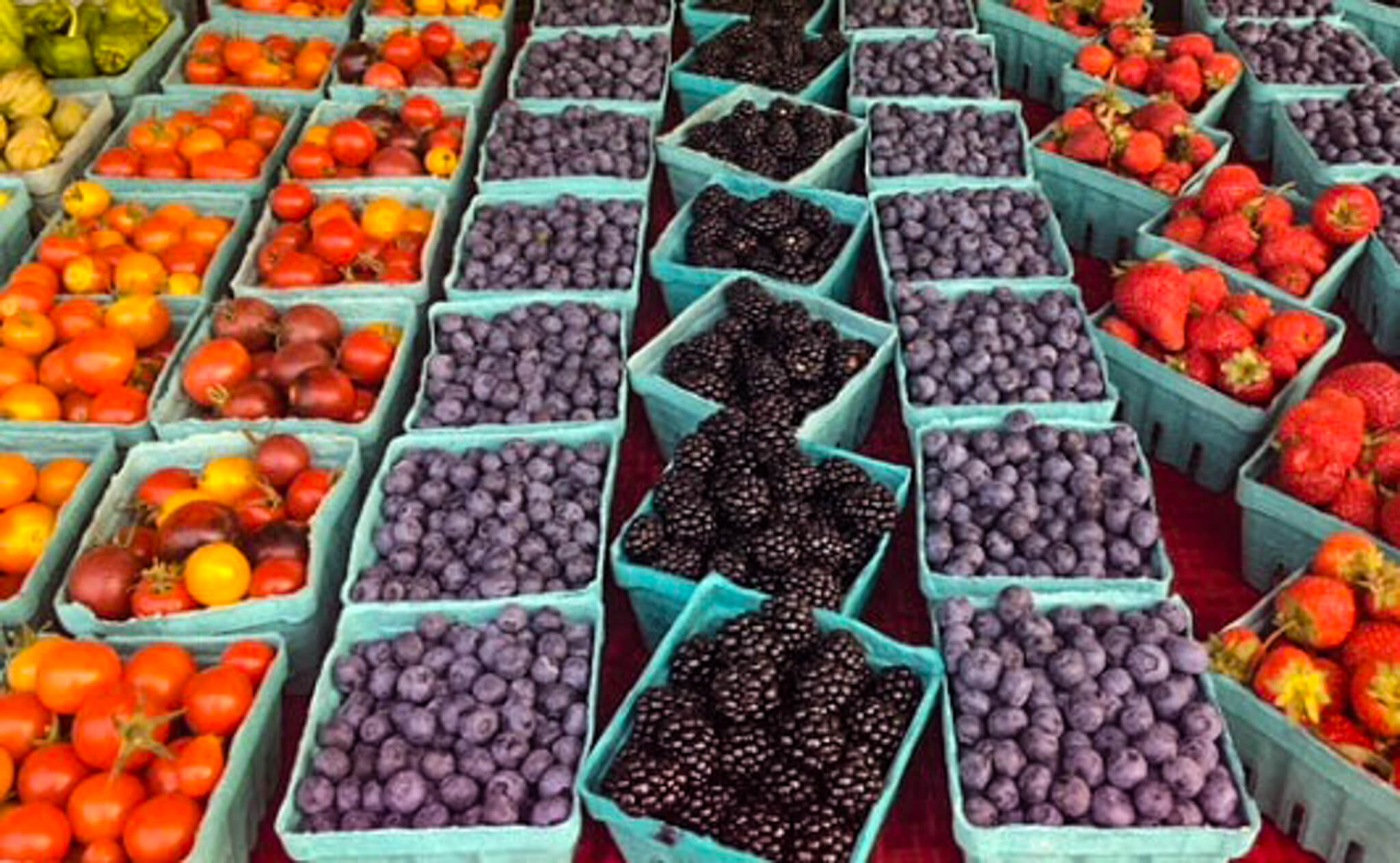 Empire State Plaza should be the heart of Albany, but it’s not. There’s a lot to see and do here—the state capitol, a performing arts center, a convention center, the New York State Museum, the New York State Library, and those lovely rectangular pools crossed by pedestrian bridges. But the whole area is often regarded as a not-so-successful urban renewal project from the 1960s and 1970s, and people seem to flee from the bland office towers framing it at the end of the day, not even sticking around for a cancer awareness fundraiser and information session that attracted no more than 40 people. But for a few hours every Wednesday and Friday between May and October, the plaza comes alive with the wonderful farmers market. Local growers gather to sell their organic produce and other products that travel only a short distance to get here. Listen to the live music that will accompany you as you let your nose and eyes lure you from one tempting stand to the next, from one food truck selling empanadas to another selling crepes. Pick up a bag of freshly picked apples, strands of black squid ink fettucine, baskets of blueberries and Concord grapes, a wedge of aromatic cheese, a just-baked spinach pie, or a bunch of sunflowers. The colors and variety of fruits and vegetables could easily seduce you into becoming a vegetarian. Then, like I did, order up some terrifically flavorful moussaka, a glass of apple cider, and a cinnamon chip scone, and enjoy a lunch al fresco.
#5 Learn Something New at the New York State Museum
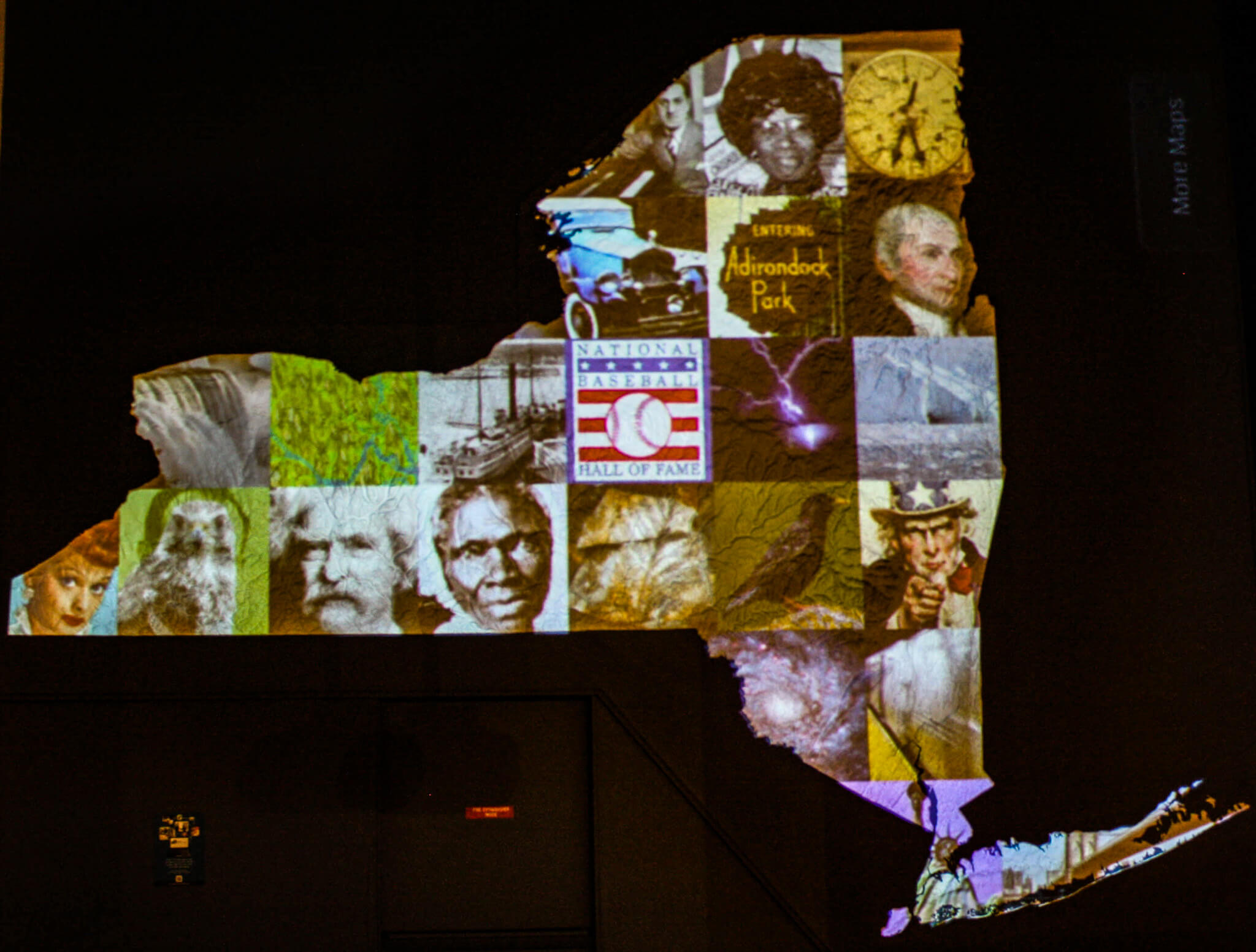 What happened to the mastodons? What did an Iroquois longhouse look like? What lives in the six million acres of Adirondack Park? You’ll find answers to these, and a lot more, questions at the New York State Museum. Housed in the Cultural Education Center since its construction since 1976, the museum’s 100,000 square feet of exhibition space are filled with everything you wanted to know about New York State. Established in 1836, it’s the oldest and largest state museum in the United States, holding more than 16 million scientific specimens and one million cultural objects. You’ll learn about the state’s Native Peoples, beautiful native birds (more than 240 species breed here) and wildlife, and earliest fire engines that look like they wouldn’t be able to extinguish much more than a Boy Scout campfire. The spectacular collection of minerals and gems found throughout the state is a delight (especially those fluorescent ones that glow in the dark), and the exhibits on New York City explore everything about the Big Apple, from its underground bedrock foundation to the tops of its skyscrapers. When the sobering 9/11 exhibit gets too much for you, turn a more cheerful eye toward the spectacular full-sized carousel made in 1916. Fifty people at a time could spin around this amusement ride, sitting in the decoratively carved Neptune’s Chariot or on one of the 40 animals, including 36 horses. You’ll have fun searching for the four non-equine animals (two of each) as you wrap up your visit here, now much more informed about the Empire State.
Five Runners-Up
- Relax in the enchanting Washington Park.
- View excellent sculptures and drawings at the Albany Institute of History & Art.
- Catch a show at the historic Palace Theatre.
- Discover the culture, pride, and oppression of Italian Americans at the American Italian Heritage Museum and Cultural Center.
- See Albany from above on the 42nd floor of the Erastus Corning Tower.
Leave a Comment
Have you been here? Have I inspired you to go? Let me know!


 Stephen Travels