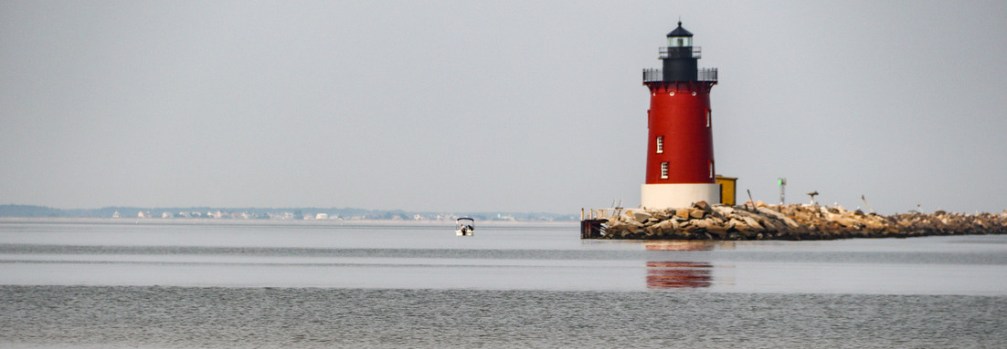
Ever since the Lighthouse of Alexandria in Egypt was completed around 246 BC, lighthouses have been guiding sailors around the world. Found everywhere from ocean coastlines to lakeshores to isolated islands, these unique structures take on a variety of shapes and sizes—tall and slender, short and squat, round or square. Each has a unique light signal and painted daymarks that enable mariners to identify which lighthouse they’re looking at, pinpointing their exact location, at any time of day.
Modern technology has improved their functionality and effectiveness, at the same time doing away with the need for human keepers, who, quite often, were single men (although the keeper’s generously proportioned two-story dwelling with its double staircase at Fire Island Lighthouse in New York, for instance, shows that a family could live there quite cozily). It must have been a lonely life for those single guys, and a dangerous one, one that I can’t imagine. When a 30’ ocean wave slams into a lighthouse, or when a hurricane howls around it for hours, or when it’s encrusted in ice, it doesn’t seem like my ideal occupation—especially if it’s situated on its own off-shore island. Yet, they’re still quite attractive to me, and fun and interesting places to visit. These are my favorites.
#1 Roman Pharos (Dover Castle, Dover, England)
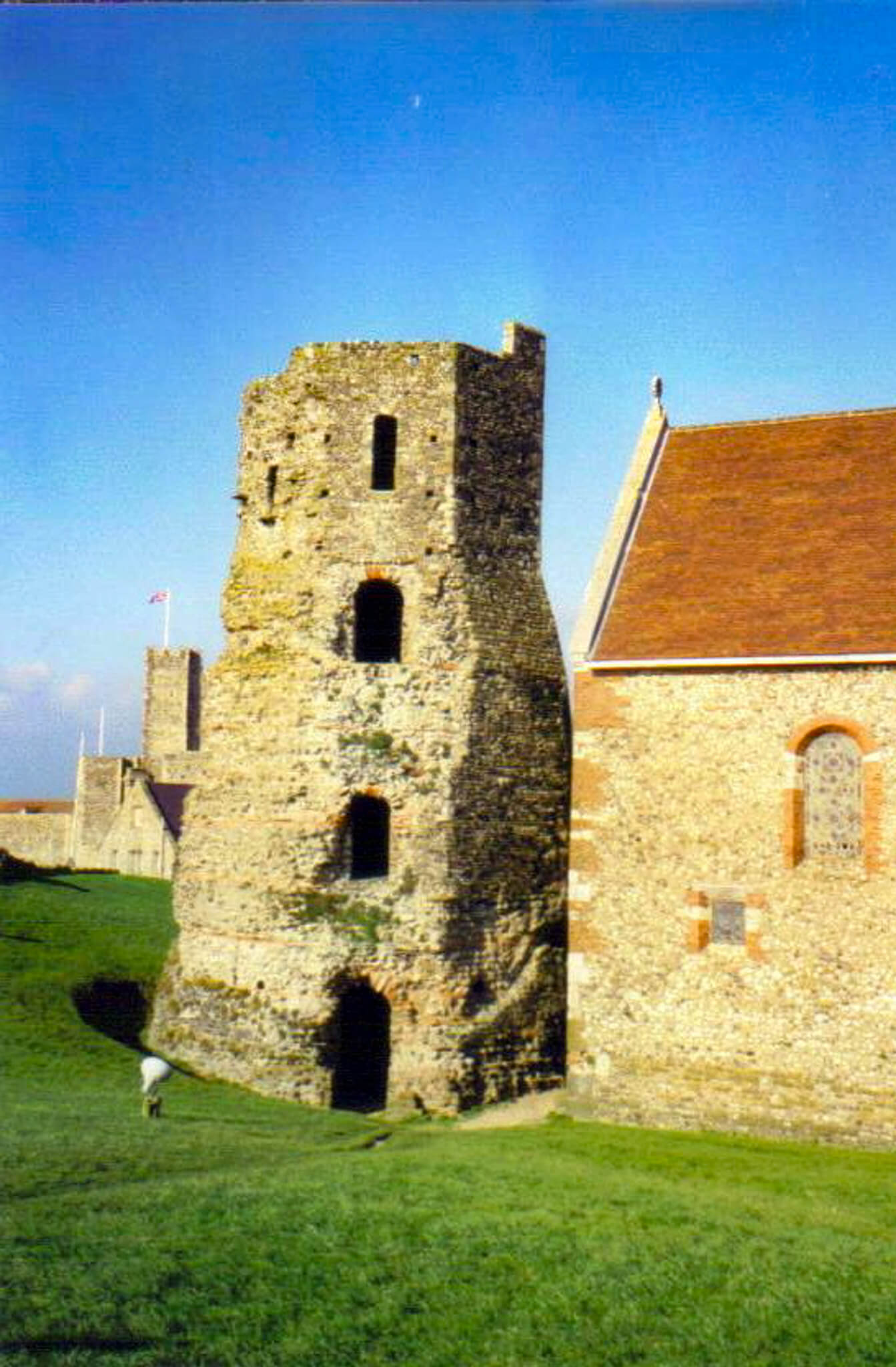
I day-tripped to Dover from London to see those famous white cliffs and the medieval castle. I didn’t know about the castle’s most intriguing component. Although you can find plenty of ruins from the Roman Empire scattered around the Mediterranean Sea, I wasn’t expecting to find one of only three extant Roman lighthouses in the world in England. (You’d have to go to Spain or Libya to see the other two.) Here atop a hill, Dover Castle commands a stupendous view of where the English Channel and the North Sea merge, the shortest sea crossing between England and continental Europe. This position means it was a vital location for the conquering Romans. Located within the outer walls of the castle complex, which came later, the Romans built their pharos, or lighthouse, about 2,000 years ago to guide ships of the Roman fleet into the harbor below. Resting on a vertical plinth of Kentish ragstone, the eight-sided lighthouse stands almost 52’ high, and its base measures about 40’ in width, which doesn’t taper all that much as it rises. The walls are built of mortared flint rubble, faced with blocks of tufa and greenish sandstone. Bands of orange-red brick separate each level of the tower; you can also spy the brick at the arched openings. Burning braziers on the platform at the top of the tower would have been the equivalent of today’s powerful lenses. Long after the Romans withdrew from England in the early 400s, an Anglo-Saxon church was built directly next to the lighthouse in about 1000 and incorporated it as a bell tower, connected to the church via a short passage. That kept it relevant for centuries, but by the early 1800s, the lighthouse was falling into disrepair, vulnerable to sea air and inclement weather. A century later, in the 1910s, the lighthouse was repaired. Still the most complete and the tallest Roman structure in England, as well as Britain’s oldest standing building, this Roman lighthouse will simply fascinate you.
#2 Swakopmund Lighthouse (Swakopmund, Namibia)
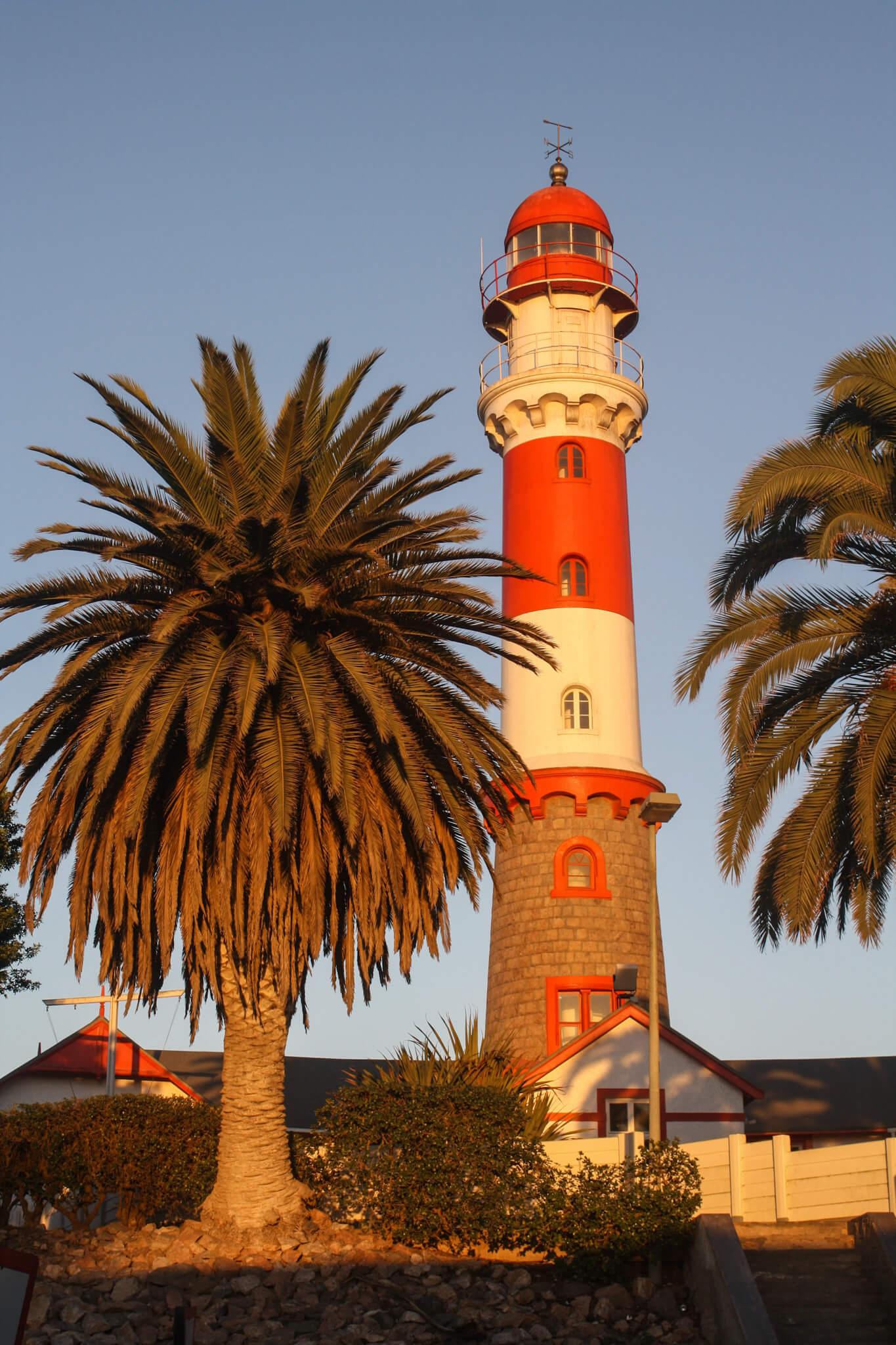
If I walked across the parking lot from my hotel in Swakopmund, the Strand Hotel, I would arrive at the beach on the country’s Atlantic coast and would watch spectacular sunsets every night. When I walked in the opposite direction, I arrived at a park where helmeted guineafowl provided endless entertainment and where I got a close-up view of the very attractive Swakopmund Lighthouse, a key element of the city’s skyline, and a very handsome one at that. Replacing an original version that was swept away by a storm, this second incarnation was built in 1902 at only 36’ high; it grew 32 more feet with an addition in 1910. The lower portion is unpainted brick; the upper portion, painted with red and white horizontal bands for its daymarks, tops off at a red dome with a weather vane. The lighthouse received its present light in 1982, enabling its signals to be seen at a distance of 20 miles. Its importance to sailors cannot be overstated—not only did it mark the city’s harbor, it also warned ships of Namibia’s infamously treacherous Skeleton Coast farther north. In fact, it’s so essential that it’s depicted in the upper-right quadrant of the city’s municipal coat of arms.
#3 Belém Lighthouse (Lisbon, Portugal)
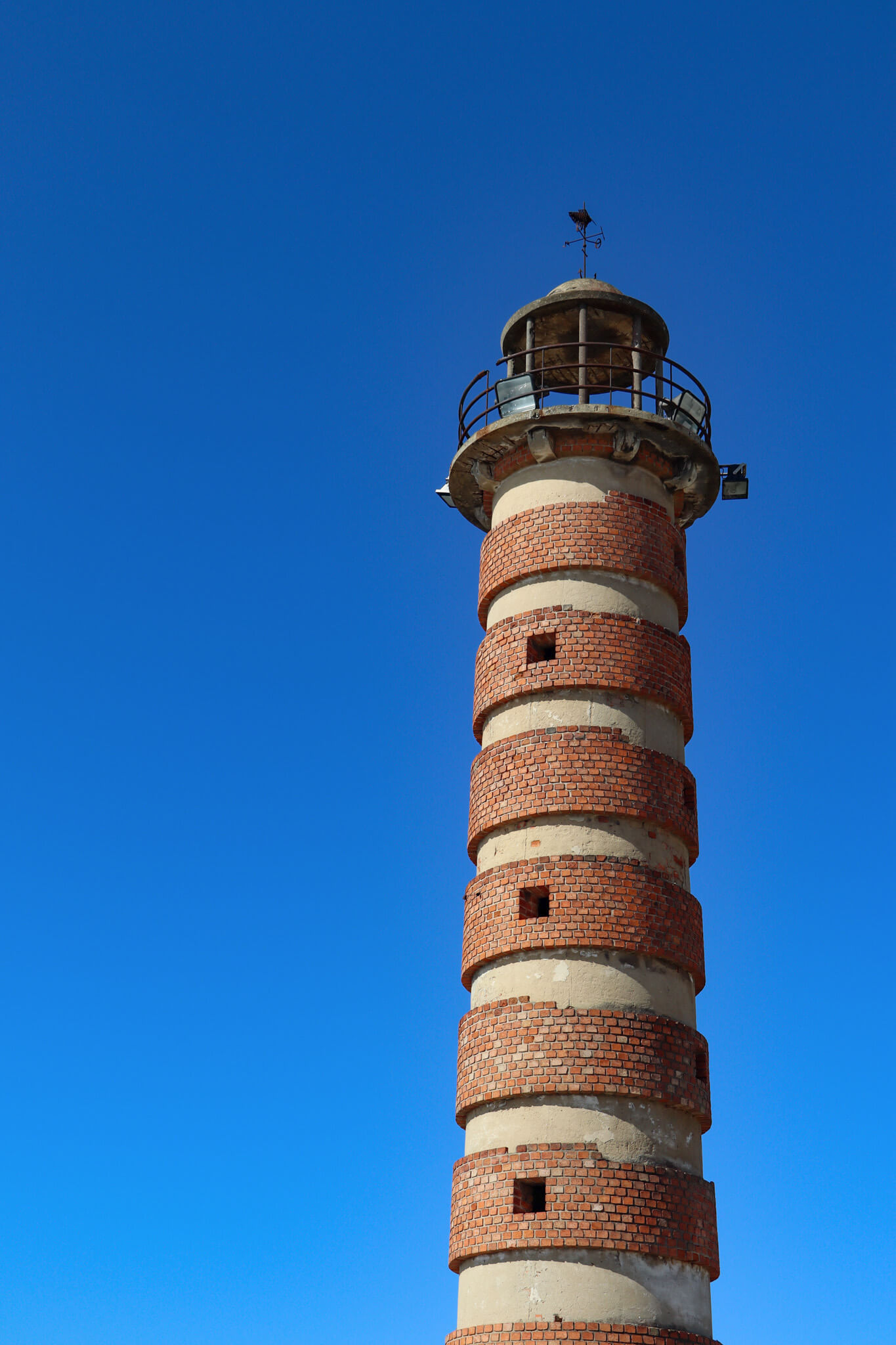
I took a streetcar from the heart of Lisbon to the Belém district to visit a couple sights in particular: the extraordinary Jerónimos Monastery and Belém Tower, two of the city’s iconic buildings. After being wowed by both of them, I decided to take a long stroll along the Tagus River on my way to the massive Monument of the Discoveries. Once I skirted around a marina, I came to an unanticipated delight: the Belém Lighthouse. This tall tube sports bands of bricks in layers of 12, some clearly missing, projecting from the structure, every other one with a deep square window. At the top, above the observation deck, a dome that looks like a papal saturno is topped with a weather vane attached to an anchor and capped by what could be either a feather or a fish skeleton. I would have liked to imagine the likes of Portuguese explorers such as Vasco da Gama and Pedro Álvares Cabral sailing by this lighthouse on their way into the Atlantic Ocean, destined to explore and colonize all parts of the world, from India to Brazil to East Africa. But, alas, that never happened. This lighthouse was built for the Portuguese World Exposition in 1940 to mark the 800th anniversary of the foundation of the Portuguese nation as well as the 300th anniversary of its restoration of independence from Spain—and it never functioned as a lighthouse.
# 4 William Livingstone Memorial Lighthouse (Detroit, Michigan)
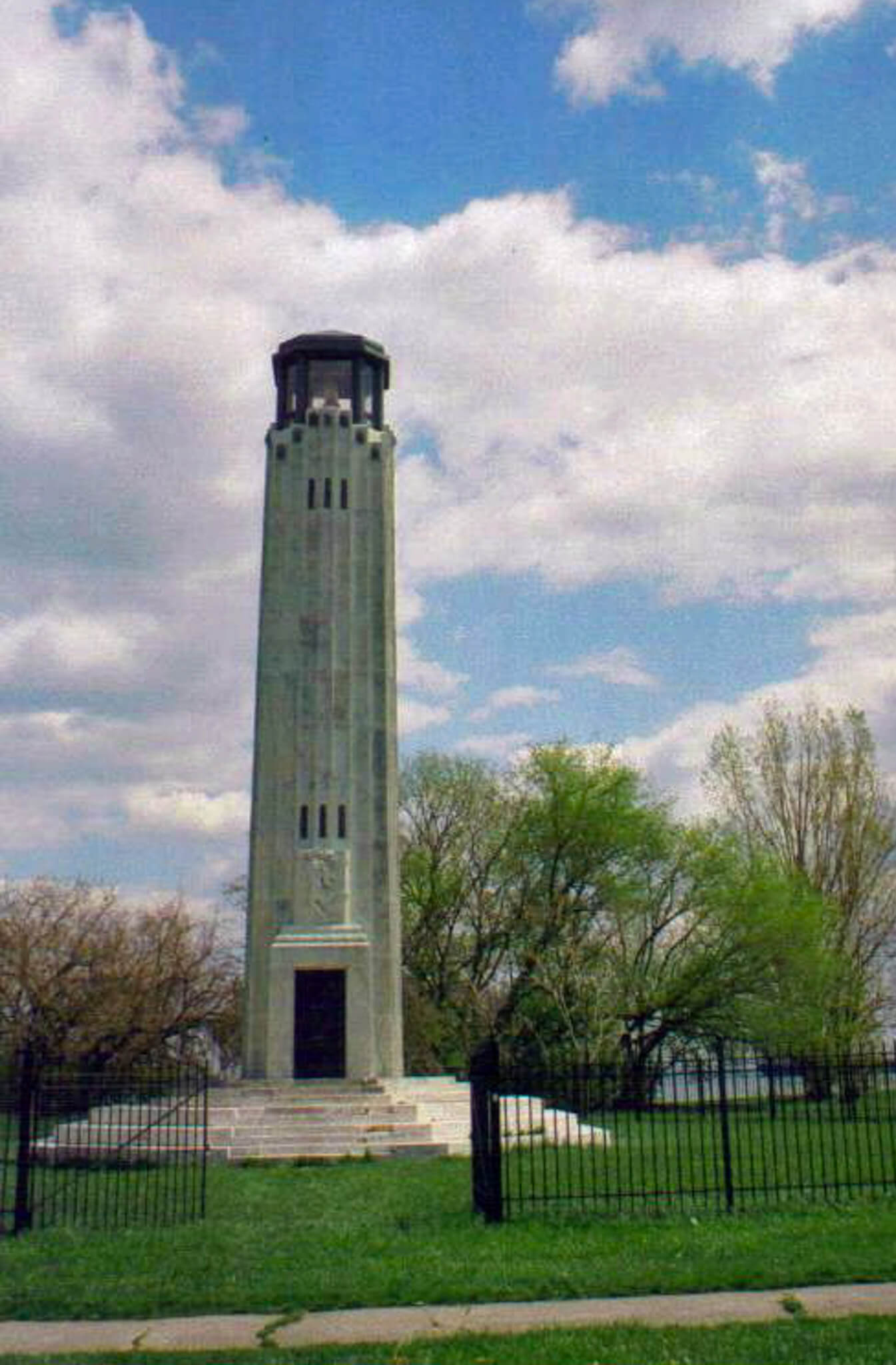
Belle Island, a 982-acre island park in the Detroit River about three miles from downtown Detroit, is home to bicycle and jogging paths, open fields, athletic fields, an aquarium, picnic areas, playgrounds, lakes, a yacht club, and a driving range. I was there to see all that, plus the Dossin Great Lakes Museum and the anchor from the wreck of the Edmund Fitzgerald. And then I found something unique—the only marble lighthouse in North America. Named after Detroit resident William Livingstone, president of the Dime Bank, owner of the Detroit Evening Journal, long-time president of the Lake Carriers Association, and, most significantly, the man responsible for important navigational improvements on the Great Lakes, including the creation of a deep-water channel in the lower Detroit River, the lighthouse began to take shape after Livingstone died in 1925. His friends and colleagues raised funds and support for an appropriate monument to Livingstone. Designed by Detroit architect Albert Kahn, the Livingstone Memorial Lighthouse stands at 58’ and was sculpted out of Georgia marble. Completed in 1930, the Art Deco lighthouse takes the shape of a fluted pillar, with a stylized bronze eagle at the top of each flute. The entire structure is topped by the bronze and glass lens, which generates a beacon that can be seen for up to 15 miles, helping ships navigate their way in and out of Lake St. Clair. At ground level, steps lead up to the entrance door, surmounted by a relief panel depicting humanity overcoming nature, particularly water. On the opposite side, the marble dedication plaque to Livingstone is held up by a pair of putti. The lighthouse fared well until about 1969, when it began to fall into disrepair. Repeatedly vandalized for the next two decades, it was restored in the 1990s and still functions as an operating lighthouse, one of about 130 in Michigan, more than any other U.S. state. The original cost was $100,000. Considering that it’s been said that, at the time it opened, more ships passed through this channel than the Panama or Suez canals, I’d say that was money well spent.
#5 Yaquina Head Lighthouse (Newport, Oregon)
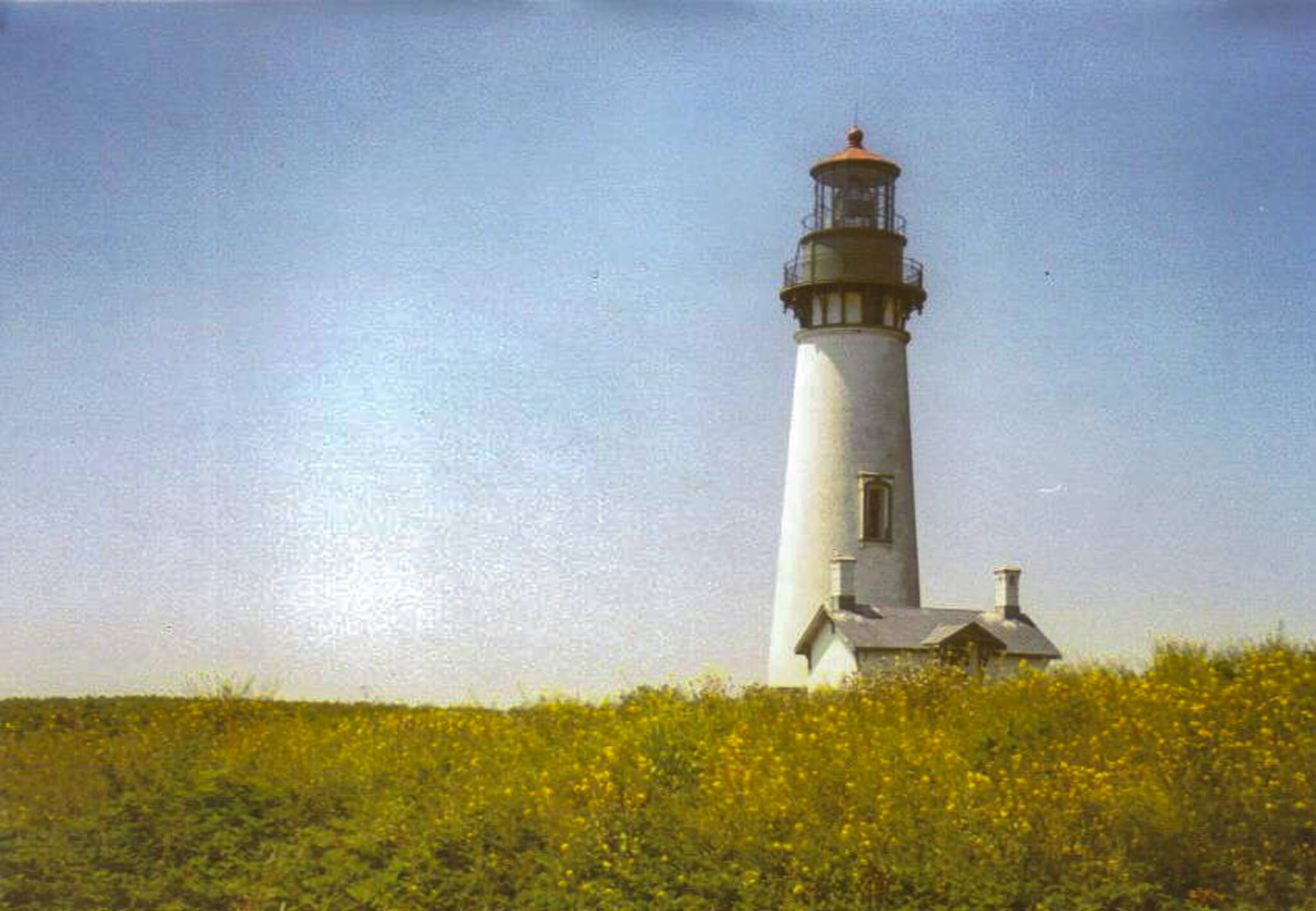
The Oregon coast is wild. From giant sand dunes to sea lion colonies to shipwrecks, it provides plenty of excitement, especially with all those Pacific waves continually crashing on its shores. Good thing Oregon has 11 lighthouses along its 363-mile coastline to help mariners. The Yaquina Head Lighthouse is the tallest of them all, soaring up 93’ (that’s 114 steps to the top). The lighthouse was born in Paris, from whence it was shipped to Oregon and first lit in 1873. Constructed with more than 370,000 bricks and painted white, except for the black at the top and the red cap over the lens, the lighthouse has three windows at different levels. Lighthouse keepers lived here until 1939, when the U.S. Coast Guard took over its management. During World War II, 17 servicemen were stationed here to look out for enemy ships. Automated in 1966 and listed in the National Register of Historic Places in 1993, it remains active, with a 20-second light characteristic—two seconds on, two seconds off, two seconds on, and 14 seconds off—that can be seen for 19 miles out to sea.
Five Runners-Up
- Seven Foot Knoll Lighthouse (Baltimore, Maryland; 1856)
- Holland Harbor Lighthouse (Holland, Michigan; 1872)
- Key West Lighthouse (Key West, Florida; 1848)
- Delaware Breakwater East End Lighthouse (Lewes, Delaware; 1885)
- Felgueiras Lighthouse (Porto, Portugal; 1886)
I’d Love to Hear From You!
Have you been here? Have I inspired you to go? Let me know!


 Stephen Travels