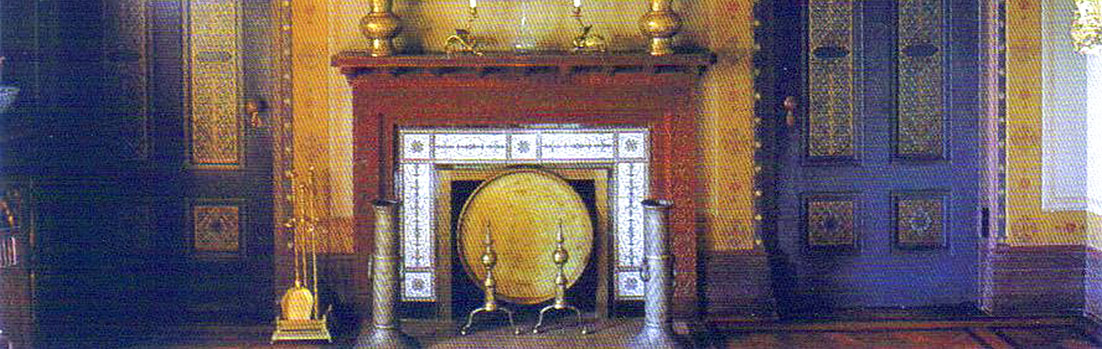
When I was a junior in high school, I took part in a class trip to Switzerland. While there, we visited Gruyères Castle. In one of the rooms, I walked into the fireplace and was soon joined by four of my friends—five teenagers, standing upright and in a single file, with enough room to add half a dozen more. Although not one of the most beautiful fireplaces I’ve ever seen, it was certainly one of the largest, and one of the most memorable. Since then, I’ve seen many more of these structures, quite a few of which have converted their utilitarian purpose—to heat a room—into works of art. These are my favorites.
#1 Main Town Hall (Gdansk, Poland)
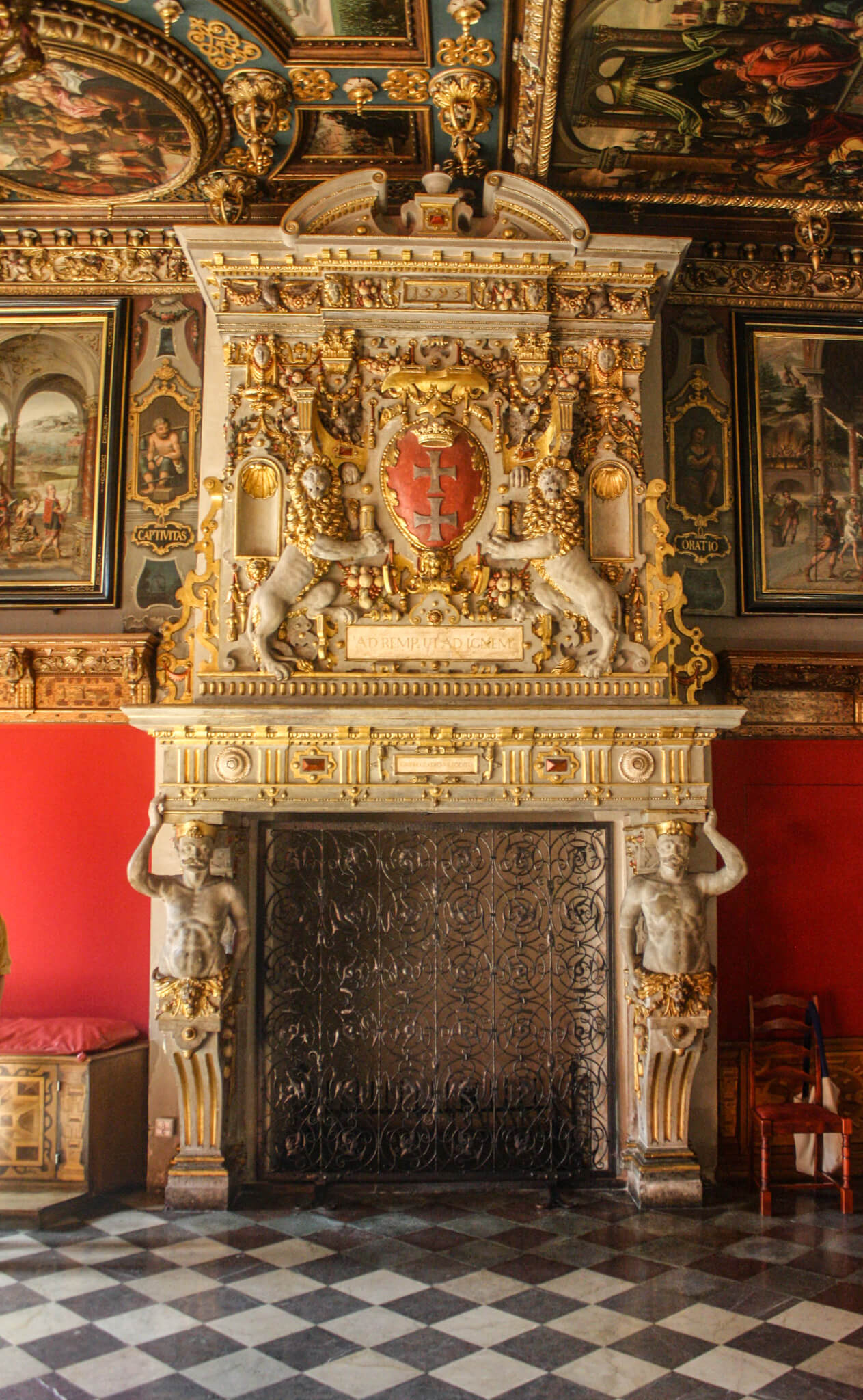 Along the Royal Way, the glorious heart of Gdansk that was decimated during World War II and spectacularly rebuilt afterward in the style of what had been there before the destruction, I visited the Historical Museum of Gdansk, housed in the Main Town Hall, completed in the 1400s as the seat of city authorities. In the highly ornamented Red Room, which houses a stunning ceiling covered in paintings and encrusted frames, as well as one of the world’s best depictions of hell, I found this striking fireplace. On either side of the black filigree fireplace screen stands a bare-chested atlantid holding up the corbel with his head and one arm. The overmantel is dominated by Gdansk’s grand coat of arms: a golden crown hovering above two silver crosses on top of each other, all on a red shield, and everything held up by a pair of lions. Created in 1593 (look for the year at the top of the overmantel, just below the broken pediment with the little urn), this masterpiece is awash in gilded stucco sea shells, faces, garlands, birds, and fruits, totally befitting the opulent room in which it stands.
#2 Brugse Vrije (Bruges, Belgium)
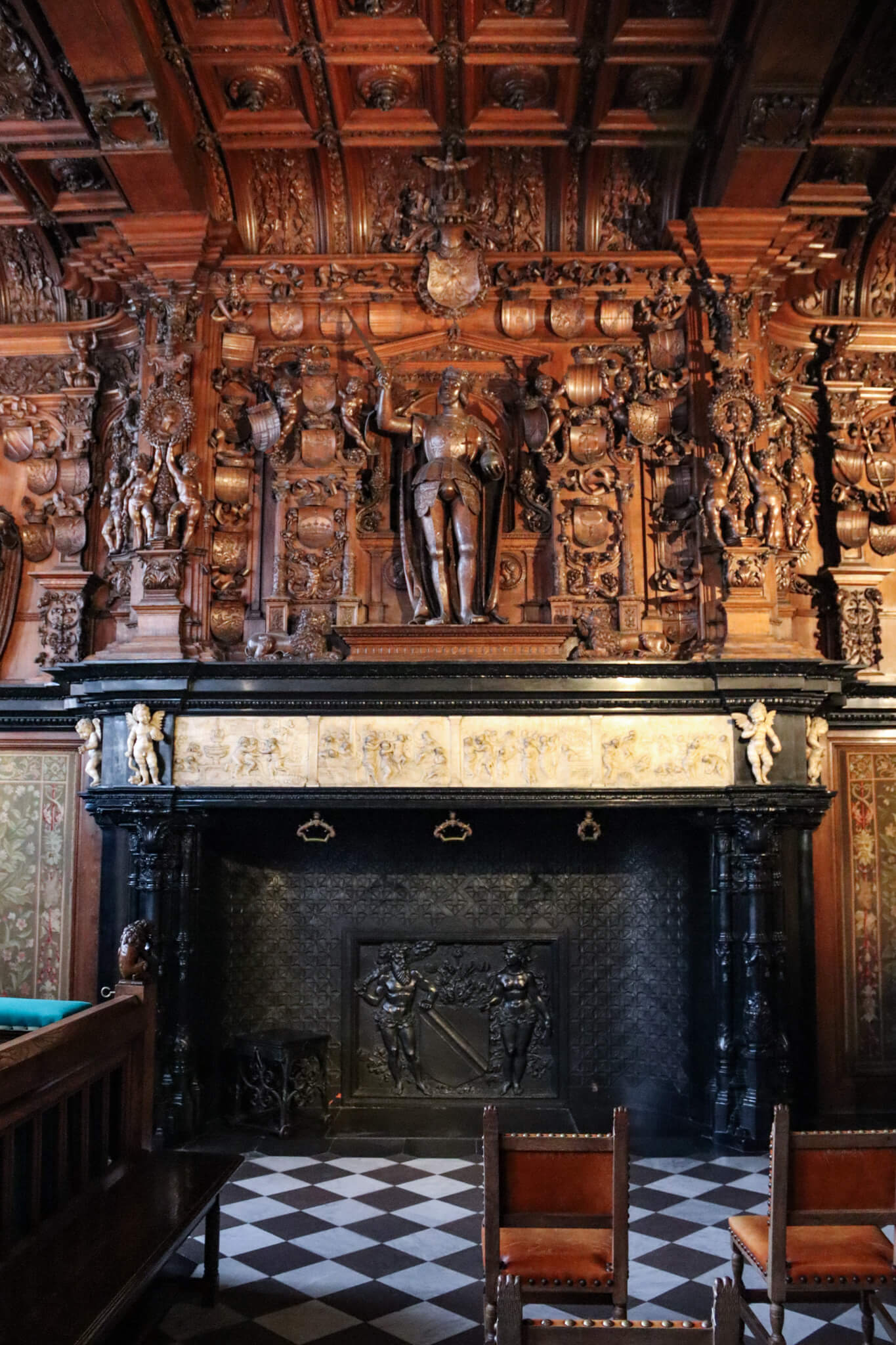 One of the components of the majestic buildings in the Burg in the historic core of Bruges is Brugse Vrije (Liberty of Bruges, which refers to the countryside in a wide area around the city). The eye-catching building is embellished by gold and statues, with Lady Justice sparkling on the roof, a reference to the building’s function as a law court from 1795 to 1984. Wedged between it and the former Courts of Justice is the entrance I was searching for. Inside the Aldermen’s Chamber, I found one of the world’s most beautiful fireplaces, completed in 1581 to commemorate the victory of Emperor Charles V over the French King François I at Pavia. The fireplace itself is done in black marble. Above it, an alabaster frieze depicts, in four scenes laden with figures, the biblical story of Susanna, who, while bathing in her husband’s orchard, aroused the passions of the Jewish elders, who demanded sex from her. She refused, so they accuse her of marital infidelity. Eventually, the young woman is vindicated and the elders condemned. Above that is the crowning glory, the oak chimney piece populated by life-size statues. Front and center is Charles himself. Flanking him are statues of his grandparents: Emperor Maximilian of Austria and Duchess Mary of Burgundy, and King Ferdinand II of Aragon and Queen Isabella I of Castile. All the men sport rather generous codpieces. His parents, Philip the Fair and Joanna the Mad, are represented in the medallions behind him. The rest of the space is embellished by branches, wreathes, putti, lions with curly manes, and coats of arms referring to the regions that Charles ruled. This masterpiece of wood carving, combined with the marble and alabaster elements, is a work of art not to be missed.
#3 Miramont (Manitou Springs, Colorado)
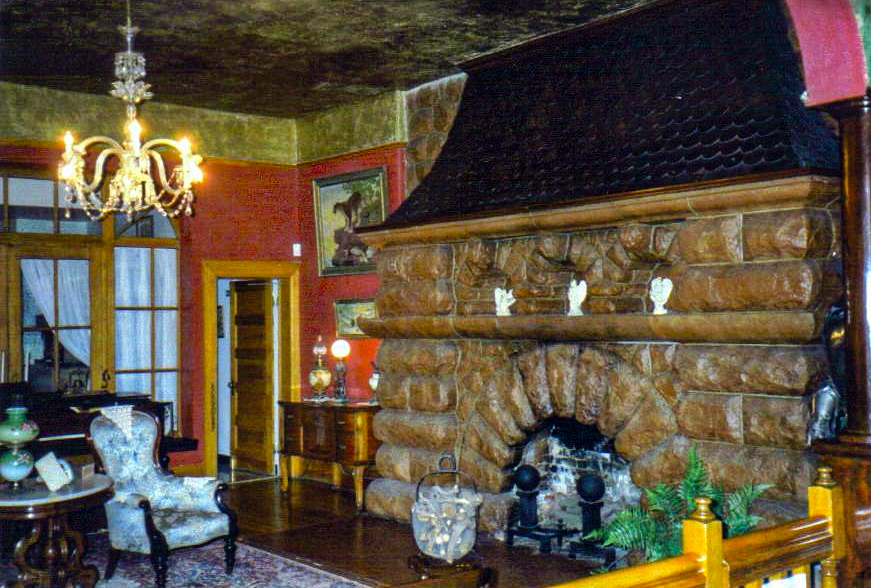 Built as a private home for French-born Father Jean Baptiste Francolon in 1896, Miramont is a hodgepodge of nine different architectural styles that gives it a disjointed vibe. Its history adds to the confusion: It has served six unique, and very different, purposes, including (once the unpopular priest and his mother abandoned the place in 1900) as a sanitarium for tuberculosis patients, a boarding house for the wealthy, a vacation and retreat house for clergy, and, during World War II, residential apartments. To me, it could have also been used as the setting for a haunted house thriller. With 46 rooms spread out over 14,000 square feet, there’s plenty to see at Miramont. One of the standouts is the massive red sandstone fireplace. The arch of the 20-ton fireplace is repeated by three smaller arches with protruding keystones above the mantel. The dark fishscale hood adds a different textural dimension. It’s bulky and beautiful, and, at 40,000 lbs., it weighs more than a Greyhound bus.
#4 Vanderbilt Fireplace, Metropolitan Museum of Art (New York, New York)
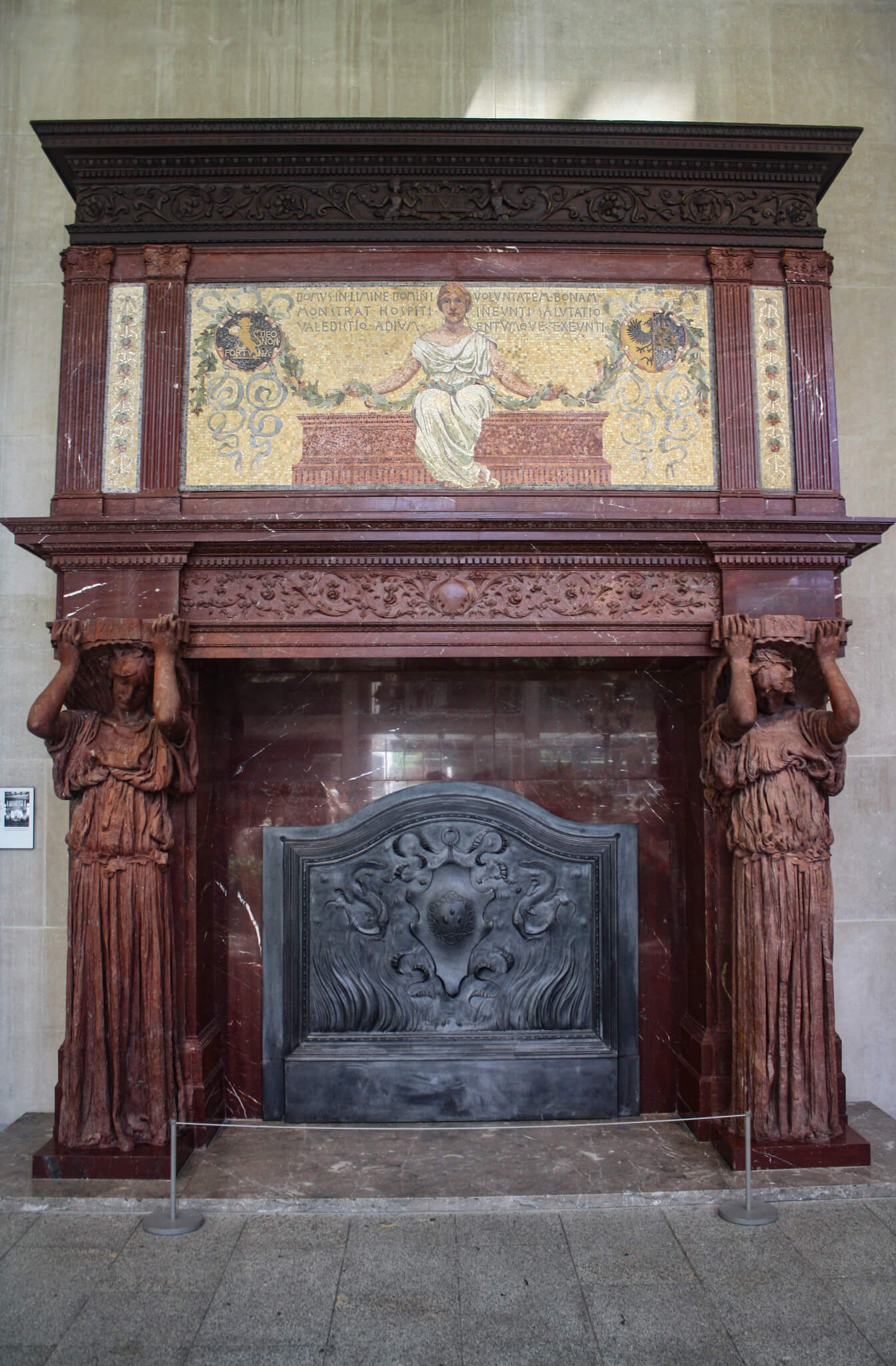 New York’s Metropolitan Museum of Art, the largest art museum in the United States, occupies a two-million-square-foot neo-classical building along the eastern edge of Central Park. It houses more than two million objects, masterpieces of art of all kinds of media. In the American Wing, I found one of them, the Vanderbilt Fireplace. Originally dominating the entrance hall of Cornelius Vanderbilt II’s mansion, it found its way about 25 blocks north when it was donated to the museum by his wife in 1925, just before the mansion was tragically demolished. Famed American sculptor Augustus Saint-Gaudens created this piece in 1883. On either side of the marble and cast-iron fireback stand caryatids with bowed heads, uplifted arms, and richly textured gowns. The left lady, her waist encircled by ivy leaves, represents Love (“Amor” is inscribed above her); on the right, the female statue, with a girdle of laurel, stands for Peace (topped with the inscription “Pax”). In the mosaic overmantel, flanked by fluted Corinthian pilasters, a classically dressed woman holds garlands, and Latin inscriptions translate as a welcome wish and an expression of farewell. In the center of the oak entablature at the top you’ll find a simple V. Measuring about 15’ high, nearly 13’ wide, and approximately three feet deep, this fireplace is a prime example of the unimaginable wealth of New York’s Gilded Age.
#5 Old Faithful Inn (Yellowstone National Park, Wyoming)
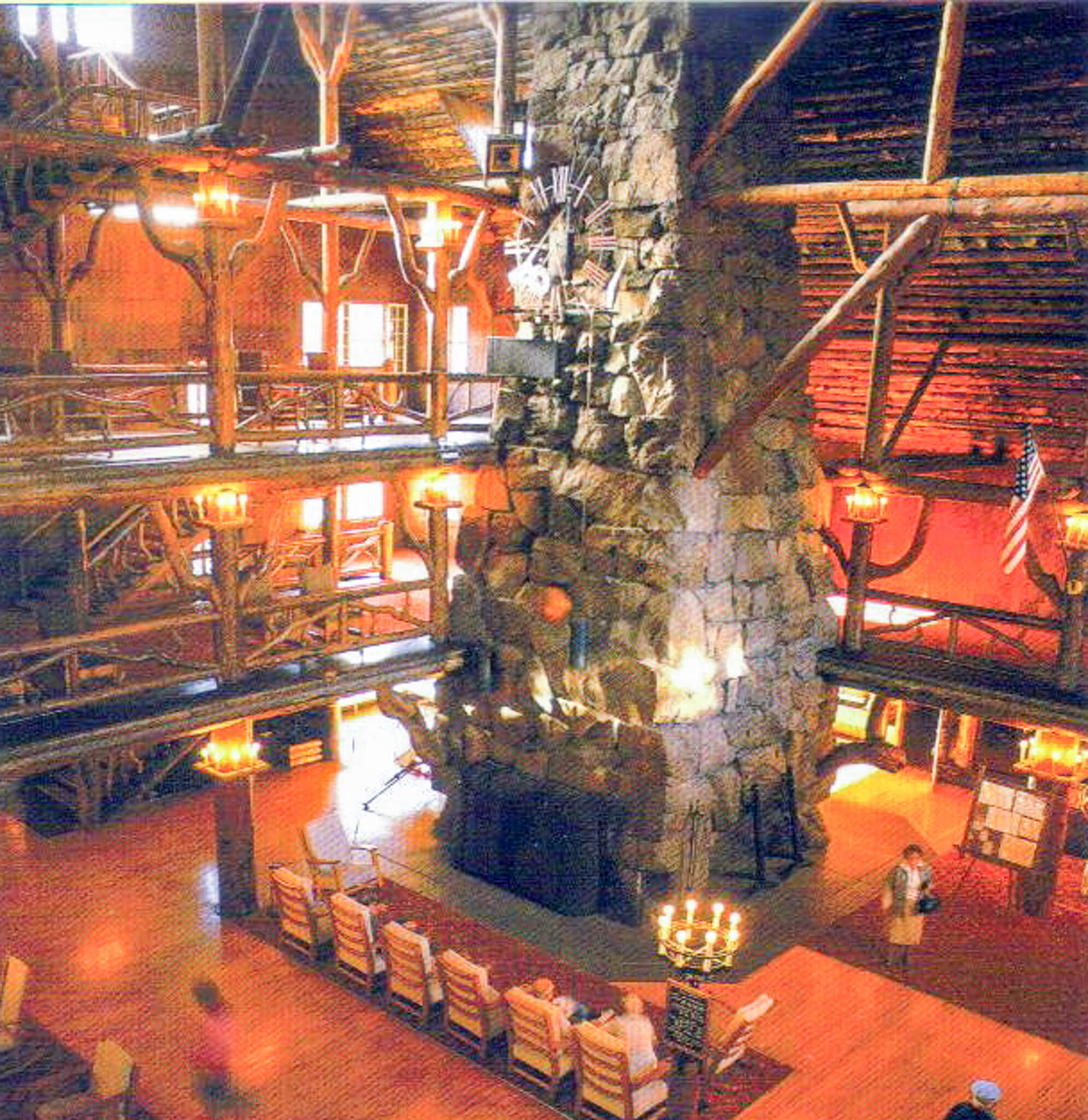 I wouldn’t want to stay here—far too many tourists streaming in and out and around the inn create human traffic jams all day long. Visiting Old Faithful Inn in Yellowstone National Park, however, is a different story—it’s one of the top five things to see in Wyoming. Constructed with locally obtained materials during the winter of 1903–04, this mammoth inn—the largest log structure in the world—runs nearly 700’ in length, and parts of it reach seven stories high. Inside, in the center of the lobby, you’ll find a massive free-steanding 500-ton fireplace built of volcanic rhyolite that dominates the cavernous space, reaching up to the ceiling about 80’ above. About two stories up, the somewhat modern look of the hand-crafted copper clock on the north face belies the fact that it was made in 1904. The original eight hearths on all four sides were reduced to four following an earthquake in 1959 that did some noticeable damage. Try to score a rocking chair around the fireplace to take in the whirlwind of activity around you and enjoy the comforting heat, or do what everyone who checks in here is going to do: Watch the reliably punctual Old Faithful geyser erupt just steps from the inn itself.
Five Runners-Up
- Biltmore Hotel (Coral Gables, Florida)
- Romekirke Hall, Akershus Castle (Oslo, Norway)
- Royal Palace, Stirling Castle (Stirling, Scotland)
- Chimneypiece, Period Rooms, Metropolitan Museum of Art (New York, New York)
- The Cloisters (New York, New York)
Leave a Comment
Have you been here? Have I inspired you to go? Let me know!


 Stephen Travels