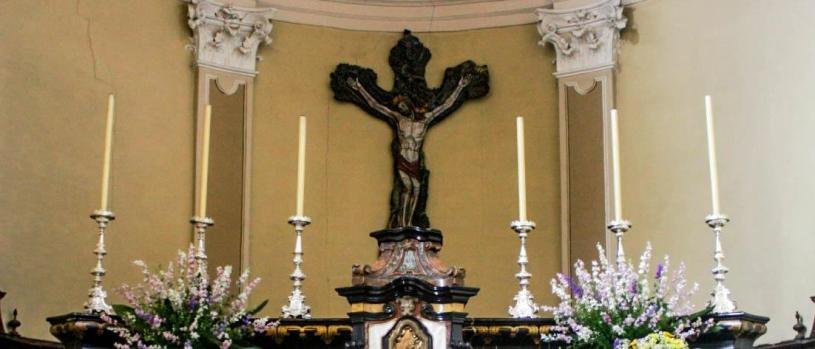
Let’s face it: Death by crucifixion is pretty nasty. First, you endure the pain of having nails driven into the feet and, depending on your executioner’s methods, the hands, wrists, or lower forearms. Second, you’re left to hang there, exposed to the elements, including animals. Third, you’re denied any nutrition. Fourth, your shoulders begin to separate from their sockets. And last, after a long, slow, excruciating dying process, you eventually succumb to anything from heart failure to dehydration to a pulmonary embolism. Even Jesus Himself wasn’t too fond of it, beseeching, “Father, if You are willing, remove this cup from Me.” For 2,000 years, this scene on which the entire Christian faith rests has been represented in art in all kinds of media. These are my favorites.
#1 Evangelists on Calvary (Croatian Museum of Naïve Art, Zagreb, Croatia)
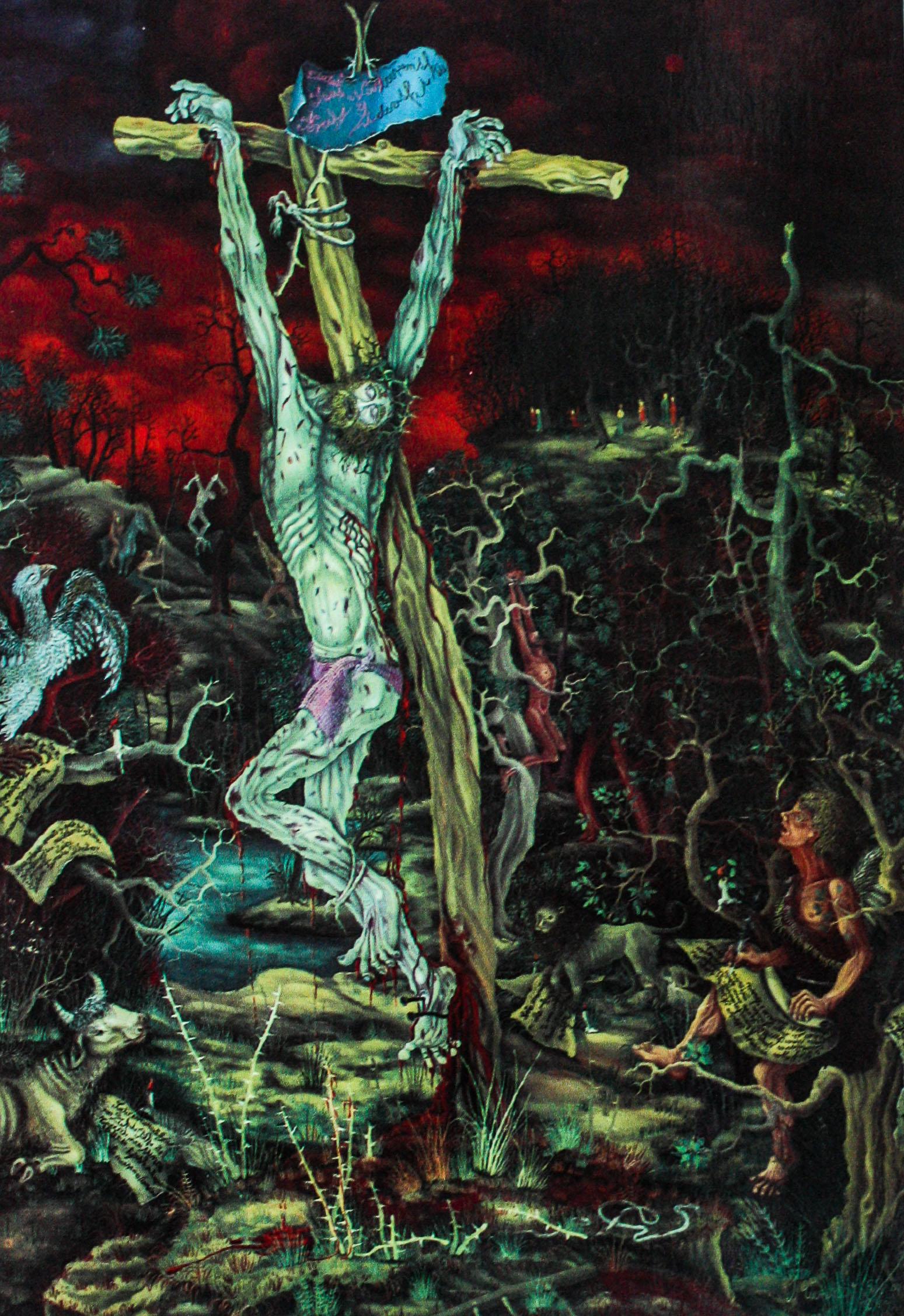 The highlight of Zagreb’s under-visited Croatian Museum of Naïve Art (only about 15,000 patrons per year, even though it’s one of the best museums in Croatia) is also the most astounding Crucifixion I’ve ever come upon. Ivan Večenaj’s 1966 painting Evangelists on Calvary is a gruesome and utterly riveting masterpiece. Saturated with vivid colors, this arresting painting focuses on a gray-skinned Jesus, His body drained of blood that pours freely from His wounds and the thorny crown. His arms appear extra-long, perhaps from having actually stretched while He hung from His wooden torture device. What makes this masterpiece even more gripping is everything that’s occurring around Him: the Four Evangelists who appear on either side in their symbolic form, the tortured bodies of the two thieves who were crucified beside Christ, the minatory storm clouds, and the angry blood-red sky. This is not a peaceful or mournful or contemplative scene; it’s lonesome, brutal, and tempestuous. And it’s something you’ll never forget.
#2 Christ of St. John of the Cross (Kelvingrove Art Gallery and Museum, Glasgow, Scotland)
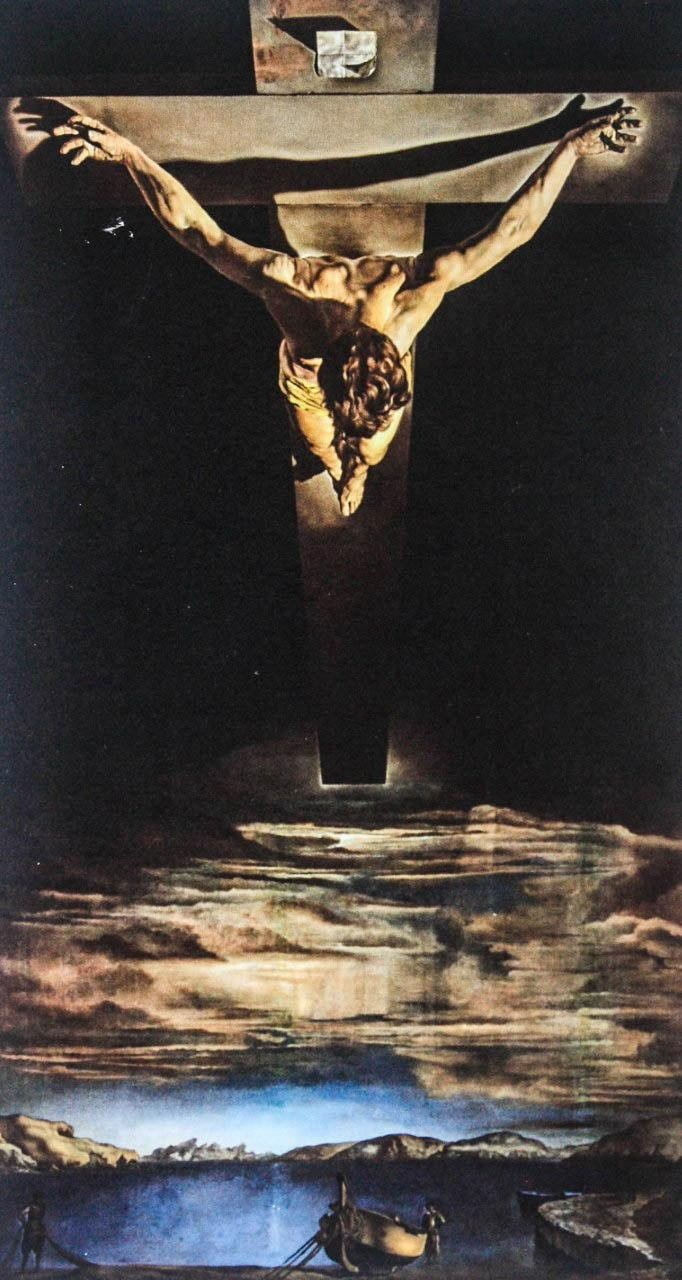 Večenaj doesn’t hold a monopoly on unique Crucifixions. The wonderfully untraditional representation created by Salvador Dalí in his Christ of Saint John of the Cross is a one-of-a-kind tour de force, too. Completed in 1951, the painting’s name derives from the basis of Dalí’s work, a drawing by the 16th-century Spanish friar St. John of the Cross. Housed by itself in an intimate room in Glasgow’s fantastic Kelvingrove Art Gallery and Museum, Dalí’s work broke with conventional portrayals of the Crucifixion by employing an unorthodox angle: from above. This unique angle of view emphasizes the pain of such an execution, which Dalí further stresses by not revealing Jesus’ face—a choice he made because he was convinced showing any agony on His face would compromise the purity of the scene. For the same reasons, Dalí opted not to include the crown of thorns, nails, or any blood. Rather, we see Jesus looking down on a body of water, with fishermen and their boat, as He remains suspended from a cross floating above it. The top of His head punctuates the bottom point of a triangle (representing the Holy Trinity) formed by the top bar of the cross and Jesus’ arms. Dalí was extraordinarily committed to getting this right: He hired a Hollywood stuntman and suspended him from a gantry to see how a body would appear from the angle he was envisioning. Dalí’s devotion to his craft paid off: This extraordinary work of art was named Scotland’s favorite painting in 2006.
#3 Crucifixion (Capitoline Museums, Rome, Italy)
 Like my two favorite crucifixes, this one also has something quite different about it. Painted by the Dutch artist Gabriel Metsu in 1664 and housed in Rome’s Capitoline Museums, Crucifixion, a brilliant artwork of high theatricality, contains not one, but several unique elements. Metsu puts a new twist on the four figures that almost always appear in a crucifixion scene, giving the two supporting players the lead roles by his bold color choices. My eye went first to Mary Magdalene, clad in a brilliant orange dress and sporting scarlet lips. Modeled after Metsu’s wife, she’s placed in a central position, clutching her breast in a display of ecstatic agony. Next to her, St. John in his striking red robe holds his hands not clasped in deep prayer or sorrow, but with fingertips barely touching. He’s active, taking a step forward and looking upward at his dead savior. I followed his gaze and only then does Jesus garner some attention. His pale body, blood still dripping from His hands, stands out against a dramatically darkened sky with a brush of an eclipsed sun. Nailed into the wood above His head is not the usual INRI (the Latin abbreviation for “Jesus of Nazareth, King of the Jews”) inscription but rather a dog-eared paper with “Jesus of Nazareth, King of the Jews” spelled out in Hebrew, Greek, and Latin. And where is Mary, Jesus’ mother, in all of this? She’s off to the side, dressed in dark cloaks that make her almost inseparable from the background save for her skin and the white kerchief she holds to wipe away tears.
#4 Calvary (Museum of Fine Arts, Ghent, Belgium)
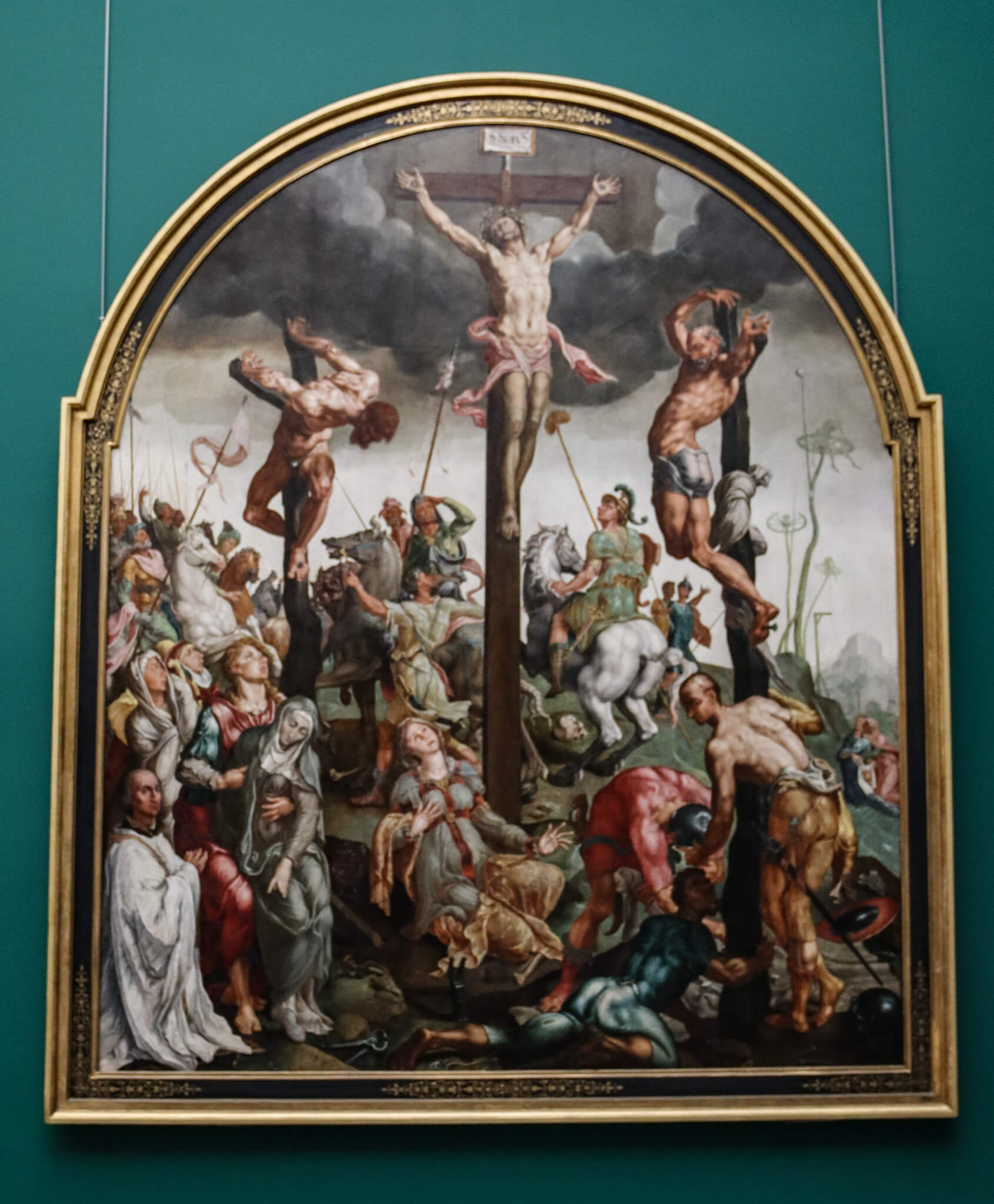 In this busy Crucifixion setting from 1543, artist Maarten van Heemskerck creates a scene of great fluidity in the actions of the figures and animals. In the center, the garments of the crucified Christ blow tumultuously in an unseen wind, perhaps from the darkening sky above Him. On either side of Him, the muscular bodies of the good thief and the unrepentant thief twist agonizingly on their crosses. Below them, a riot of figures competes for attention. A soldier raises a sour wine–soaked sponge to quench Jesus’ thirst while Longinus is about to pierce His side with a spear. Three ugly soldiers cast dice for Jesus’ clothes. An exceptionally pale Mary swoons into the arms of the St. John while Mary Magdalene succumbs to grief as she gazes up at Christ. The figure that doesn’t belong is the donor, kneeling in the foreground wearing a priest’s surplice. Look carefully for the skull at the base of Christ’s cross, representing Adam; the bag of tools used to execute the crucifixions; and, unusually, off in the background on the right side, St. Veronica holding her veil with Christ’s face imprinted on it.
#5 Crucifixion (Corpus Hypercubus) (Metropolitan Museum of Art, New York, New York)
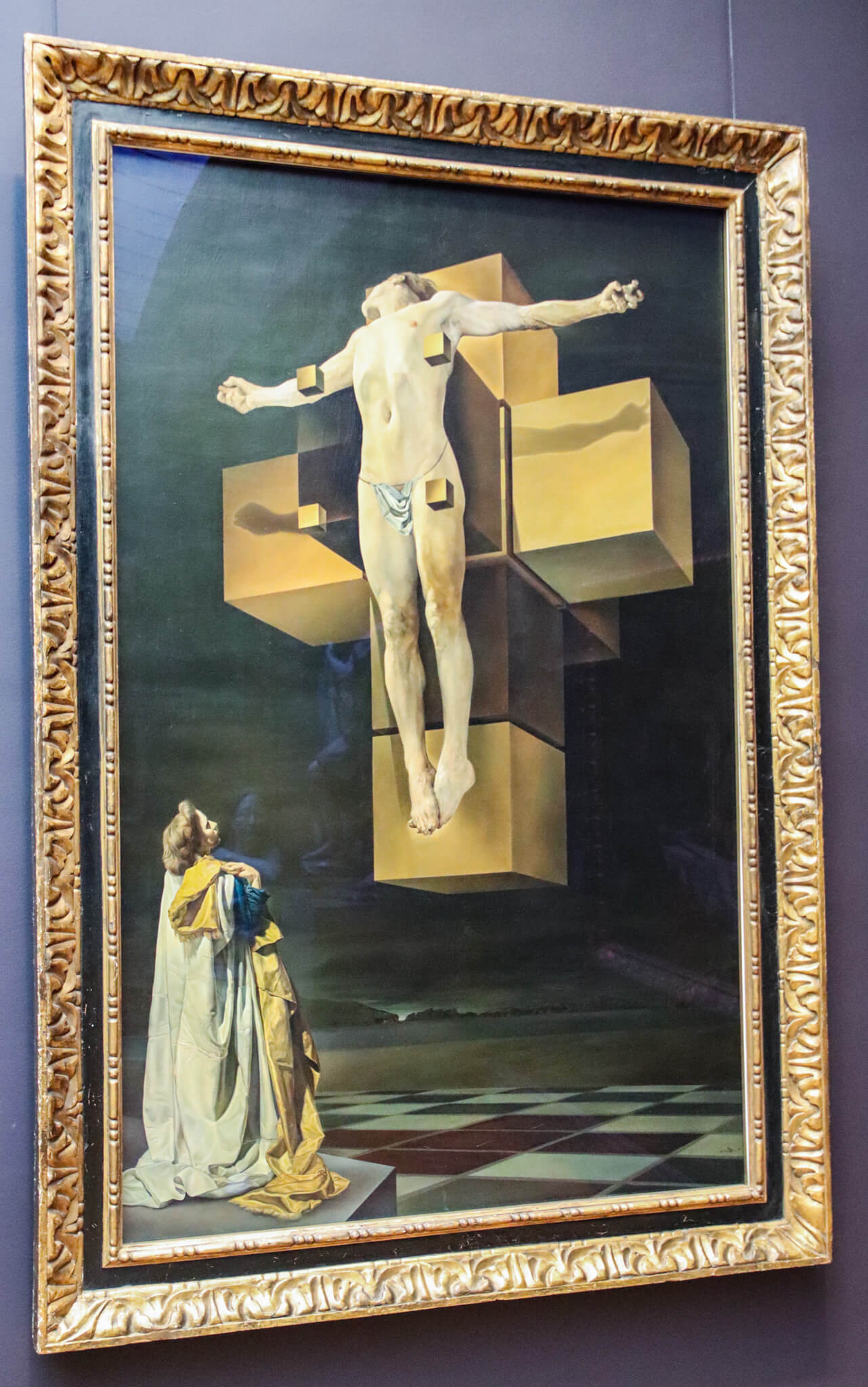 Dalí strikes again with another levitating Jesus. Utilizing his theory of “nuclear mysticism,” which fused his interests in Catholicism, mathematics, science, and Catalan culture in an effort to reestablish classical values and techniques, Dalí paints the crucified Christ detached from the hypercube cross behind Him. His face is turned severely to the side so that the viewer can’t see His features. Behind Him lies a vast, soulless landscape, with just a hint of the sun above a low-rise hilly horizon. Directly underneath, the cross casts a shadow on the boxes of the checkerboard floor, conforming exactly to the shape of the cross. The only other figure in this scene is Mary Magdalen (Dalí used his wife, Gala, as the model), standing on a cube and witnessing Christ’s transcendence from both His earthly existence and the corporeal harm He endured—His body is devoid of the crown of thorns, speared side, and nail holes, and He looks healthy, untortured. Created in 1954 and measuring more than six feet high by four feet wide, the painting was gifted to the Metropolitan Museum of Art the following year by its owner. This painting is easy to find in the museum—just watch for visitors naturally gravitating toward it.
Five Runners-up
- The Crucifixion, by Claudine Bouzonnet-Stella (Wadsworth Atheneum Museum of Art, Hartford, Connecticut)
- The Crucifixion With the Virgin, Saint John, and Mary Magdalen, by Mathieu Le Nain (Museum of Fine Arts, Boston, Boston, Massachusetts)
- Outdoor Stations of the Cross, Basilica of Sainte-Anne-de-Beaupré, Québec City, Canada)
- Station XII at St. Martin’s Cathedral (Domkerk) (Utrecht, the Netherlands)
- The mural above the altar at the Church of St. Teresa (New York, New York)

 Stephen Travels