After the Nazis razed most of Warsaw by the end of World War II, little remained standing. But Warsaw’s post-war leaders wisely decided to reconstruct many of the city’s buildings, particularly in and near the historic center, in the styles that had survived for centuries before Hitler came along and screwed up the world. So while I was roaming around this surprisingly colorful city, I kept being fooled by its churches—they look like they’re from the 1700s and 1800s, but so many of them are lovingly reconstructed beauties from the 1950s and 1960s. These are my favorites.
#1 St. Anne’s Church (Kościół św. Anny)
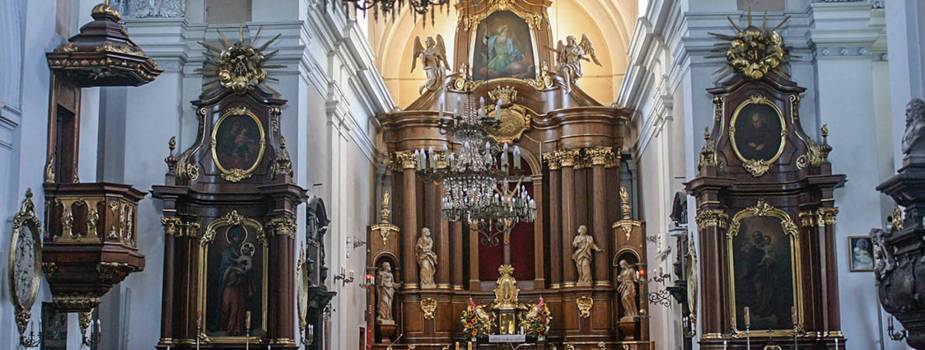
 Damaged, but not fatally, during World War II, St. Anne’s Church at the edge of Castle Square was reconstructed and redecorated at least six times since its completion in 1530, the last time in 1788 (excluding the post-war repairs). Today, the neoclassical façade, with Corinthian columns supporting an unadorned pediment, has niches in which stand statues of the Four Evangelists. The restrained exterior gives way to a spectacularly exuberant high-baroque interior. Finely painted frescoes cover the walls and barrel-vault ceiling. A wooden pulpit with gilding caught my eye, with its four seated and gesticulating monks at the base, and a pair of herms supporting the canopy, with putti surrounding a statue of Blessed Ladislas of Gielniow. The central aisle passes multiple side chapels under heavy chandeliers and leads to the rococo high altar. Make sure to turn around and look back at where you entered: Above the doors is an impossibly beautiful organ that brings the church to life with its soul-stirring sound. For an extra treat, I headed to the free-standing belfry next to the church and climbed up to the observation terrace for views of seemingly the whole city and the Vistula River, where I gained a better appreciation of the size of St. Anne’s and of how it managed to survive the Second World War when nearly everything else I was now looking at had been destroyed.
#2 Field Cathedral of the Polish Army (Katedra Polowa Wojska Polskiego)
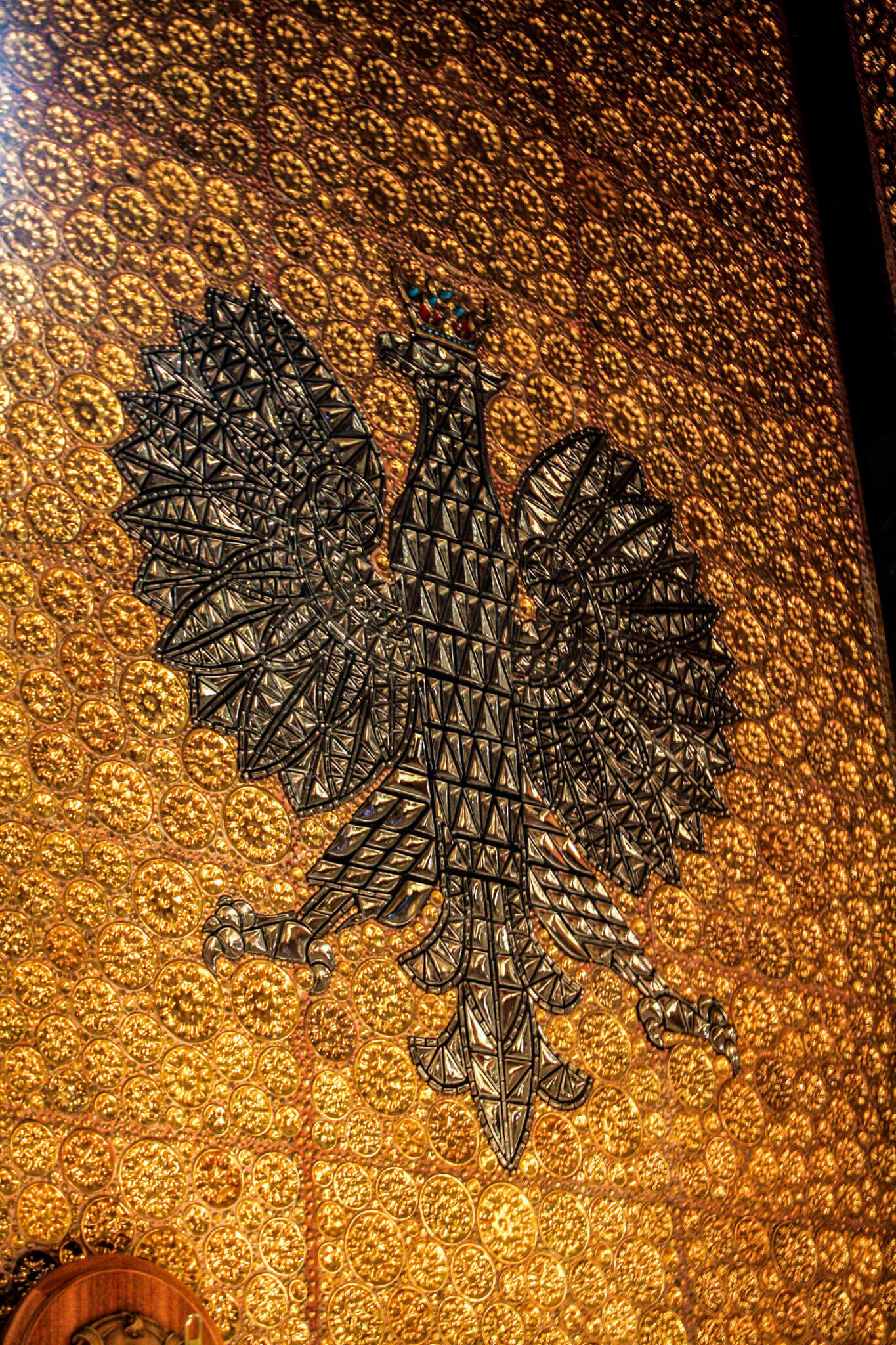 Opposite the gripping Heroes of the Warsaw Uprising Monument, the Field Cathedral of the Polish Army represents Warsaw’s phoenix at its best. Completed in 1701, the Roman Catholic church was confiscated in 1834 by the Russians, who converted it into an Orthodox church, destroying and replacing much of the interior with Orthodox frescoes and a large iconostasis, and adding large onion domes to both towers. After the Russians left in 1915 and Poland regained its independence in 1918, the church became the seat of the field bishop of the Polish Army and the former look was restored, but that didn’t last long: The church was destroyed during World War II. By 1960, however, it had risen from its nadir, rebuilt in its former glory. I stood in front of the church, a bit overcome by the violent history that unfolded exactly where I stood. I looked up at the façade, at the statue of Mary flanked by twin towers with verdigris green spires. To my left I noticed the large anchor; on my right, a propeller—symbols of two branches of the Polish armed forces. Through the bronze doors, I entered the church and passed through an elaborate screen into the sanctuary. A crowned marble statue of Mary stands behind the altar, under a vibrantly colored stained-glass window. The walls are covered with golden porcelain ceramics with enormous platinum-colored eagles, the symbol of Poland. The Way of the Cross is depicted in 14 stations, modern but classically painted, and panels of the Four Evangelists in high relief flank a fine painting of the Last Supper, in which a sour-looking, ginger-haired Judas is trying to hide his bag of silver coins. The glorious organ, renovated and modernized in 2009, is a masterpiece, topped with four angels blowing their horns. Chapels commemorating the country’s key battles and dedicated to those who fought and died for Poland include one honoring the victims of the Katyn massacre, when 22,000 Polish military officers and intelligentsia POWs were executed by the Soviets in 1940. Here, 15,000 small tablets include the names of those victims; 7,000 more remain blank, waiting to be filled in with names once their bodies are found—if ever.
#3 Church of the Holy Cross (Bazylika Świętego Krzyża)
 A left staircase and a right staircase lead up to a raised terrace at the entrance of the Church of the Holy Cross, one of the most notable baroque churches in the Polish capital. Completed in 1696, the church received its steeples, topped with weather vanes, in 1737. A statue of Christ bearing His cross stands in front of the church. When I stepped inside, it was easy to feel that I had been transported back a few centuries, but that would have been very wrong. The reconstructed church dates from only the 1950s. After 250 years of history as a religious, social, and political center, the church was severely damaged during the 1944 Warsaw Uprising and further damaged later that year when the Nazis detonated two large mines in the church, destroying the façade, furnishings, the vaulting, and the high and side altars. Not satisfied with the extent of their destruction, they blew it up altogether four months later. By 1953, the Poles had rebuilt it, finishing the main altar later, by 1972. Inside this very white church (white walls, white ceiling, white columns and pilasters), there are some very heavily gilded altarpieces and chapels with plaques and epitaphs; a wonderfully frilly, black, open, wrought-iron pulpit with a staircase that wraps around the pillar behind it; and a handsome organ. The church is also well known for a particular monument, sculpted in white Carrara marble. You can easily spot it on the side of a pillar, where you’ll find a lyre, laurel branches, and composition book under an inscription board flanked by two cherubs and topped with a bust of Chopin. If you should happen to be here on October 17, make sure to attend the solemn Mass during which Mozart’s Requiem is performed, in honor of the wishes of Chopin, whose body is buried in Paris but whose heart is immured in this pillar, placed there in an urn in 1879.
#4 Church of St. Joseph of the Visitationists (Kościół Opieki św. Józefa)
 Situated between the Tyszkiewicz Palace, which boasts some of the world’s best atlantids, and a lovely park, the Church of St. Joseph of the Visitationists somehow, miraculously, emerged virtually unscathed by the ravages of World War II all around it. Apparently, a divine power must have decided it had suffered enough: The first wooden church burned down during a war in 1656, and a fire took out the next version of it in 1695. Set far back from the street behind a deep cobblestone plaza, this church, completed in 1765, remains one of the most striking rococo churches in the city. The lower level is a playful use of concave and convex, with columns protruding from the façade and then others falling back, with empty niches in between them. The pattern repeats on the second story, but here, statues of St. Augustine and St. Francis de Sales fill the niches. The whole thing is capped with animated statues of saints Anne, Joachim, Joseph, and John the Baptist, all turned toward the figures in the central niche, Elizabeth and Mary, the key players in the Visitation. Inside, I was drawn immediately to the main altar, with its gilded columns and an oak tabernacle with ebony cladding. Above the tabernacle is a painting depicting the Visitation of the Blessed Virgin Mary. The whole arrangement is topped by an outrageously rococo canopy resting on large volutes. God sits among some gusty clouds, resting on a golden globe and holding a scepter, and kept company by angels and putti. As I walked around, I tried to listen to echoes of Chopin playing the organ during services for schoolchildren. My favorite part, however, was the pulpit shaped like the prow of a ship. Liberally gilded in gold and sporting a silver eagle with spread wings, the boat represents navis ecclesiae, the ship of the Church. Here, the ship seems to be in a bit of trouble, riding on turbulent golden waves and within golden gusts of wind emitting from stormy clouds above, doing a number on the twisting sail. But the large golden anchor at the bottom certainly reassures worshippers that, despite the turbulence, their faith grounds them in safety.
#5 All Saints Church (Kościół Wszystkich Świętych)
 This massive church, the largest in Warsaw, has a comparatively short history, but a rich one at that. With a countess’ donation of her estate, as well as substantial financial assistance, serious work on All Saints Church began in 1861. Based on designs of an Italian-born architect who considered Poland his second homeland, the church was completed in 1892. Suffering structural damages and some total losses of epitaphs, organs, bells, and paintings at both the beginning and toward the end of World War II, it was one of three Christian churches that found itself operating in the ghetto and soon helping, sheltering, and facilitating the escape of many Jews who lived there. Reconstruction of the church began after 1945 (with financial support of Jews, grateful for the role it played in aiding them during the war), continuing even through the arrest, imprisonment, and murder of the monsignor by the communist security service, which also deliberately erected large housing projects in the area to obscure the visibility of the church and erode its importance. The exterior is positively striking, with a broad staircase leading up to the entrance, twin bell towers, panels with garlands, pediment with sculptures on the upper level, and dome. Inside, three aisles lead down to a side chapel of Our Lady of Częstochowa and a gorgeous wrought-iron pulpit with curved staircase. Quiet while I was visiting, I wondered what it was like when All Saints celebrated a more joyful occasion in 1987, when Pope John Paul II celebrated Mass here, with Mother Teresa in attendance.
Five Runners-Up
- St John’s Archcathedral (Archikatedra św. Jana w Warszawie; 1390 / 1960)
- Church of the Assumption of the Virgin Mary and of St. Joseph the Spouse (Kościół Wniebowzięcia NMP i św. Józefa Oblubieńca; 1681)
- Church of St. Anthony of Padua (Kościół św. Antoniego Padewskiego; 1680 / 1956)
- Holy Trinity Church (Kościół Świętej Trójcy; 1782 / 1953)
- St. Kazimierz Church (Kościół św. Kazimierza; 1692 / 1953)
Leave a Comment
Have you been here? Have I inspired you to go? Let me know!


 Stephen Travels