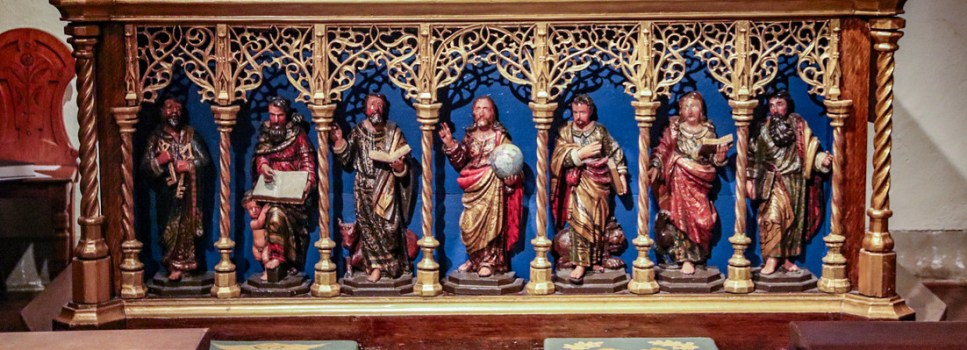
From my possibly haunted hotel in Richmond, The Commonwealth, it was an easy walk to see so many of this city’s historical treasures. There’s where Confederacy President Jefferson Davis lived, and there are the streets where Edgar Allan Poe walked, and there’s the site of a hospital that treated more than 76,000 Confederate soldiers during the Civil War, and there’s the cemetery that’s the final resting place of presidents James Monroe and John Tyler. In between them all, Richmond boasts an abundance of churches that add to the city’s historical fabric. These are my favorites.
#1 Cathedral of the Sacred Heart
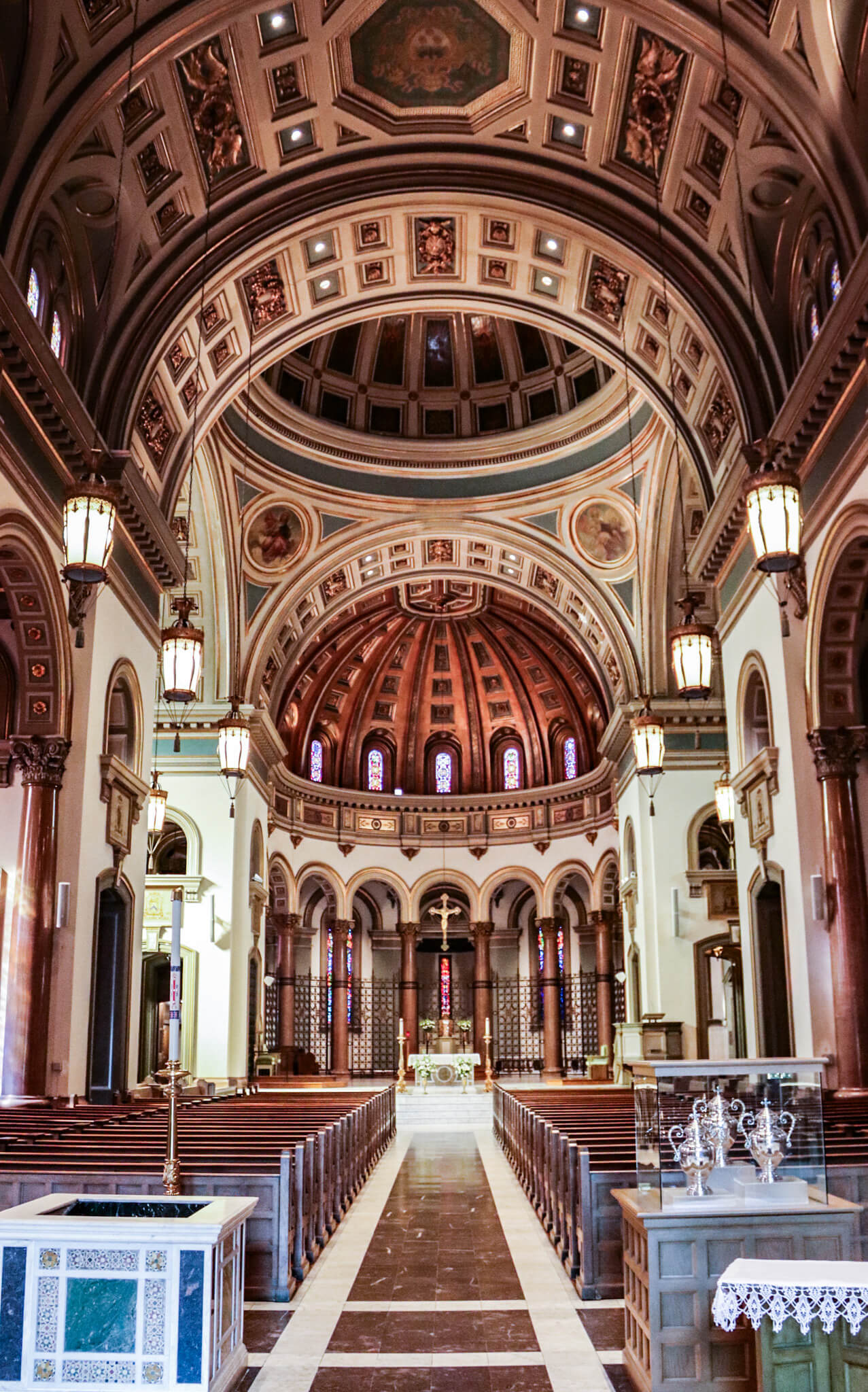 When the Cathedral of the Sacred Heart was completed in 1905, it was the only cathedral in the world to be constructed by the exclusive patronage of a single family. The Ryan family donated $500,000—that’s about $18.3 million today. When Thomas (middle name, appropriately enough, Fortune) Ryan, a railroad and streetcar baron, died in 1928, he was the 10th wealthiest man in the United States, leaving behind a fortune of more than $200 million. I was glad to see his money put to a beautiful use. The Italian Renaissance Revival–style cathedral, constructed with Virginia granite and Indiana limestone, features double 90’ bell towers and a copper dome turned verdigris green that measures 118’ across. Fluted Corinthian columns support the portico, with an entablature with the phrase “If You Love Me Keep My Commandments” and a pediment whose underside is lined with fireproof tiles designed by the prolific Rafael Guastavino. The most important feature is the cornerstone, laid in 1893, which came from the Garden of Gethsemane, a garden at the foot of the Mount of Olives in East Jerusalem where Jesus underwent the Agony in the Garden and was arrested prior to His crucifixion. Despite a good deal of foot traffic passing by, I was the only person who stepped inside. The coffered barrel ceiling is quite impressive, as is the semicircular, columned chancel. The gorgeous rose window is a fine example of stained-glass artistry, as are the vibrant windows portraying everything from the Nativity to the Marriage in Cana. And the Stations of the Cross are an outstanding example of fine sculpture. A Virginia Historic Landmark, and listed on the National Register of Historic Places in 1982, this cathedral is not only one of a trio of exceptional historic buildings fronting Monroe Park; it’s also the most beautiful church in Richmond.
#2 Grace & Holy Trinity Episcopal Church
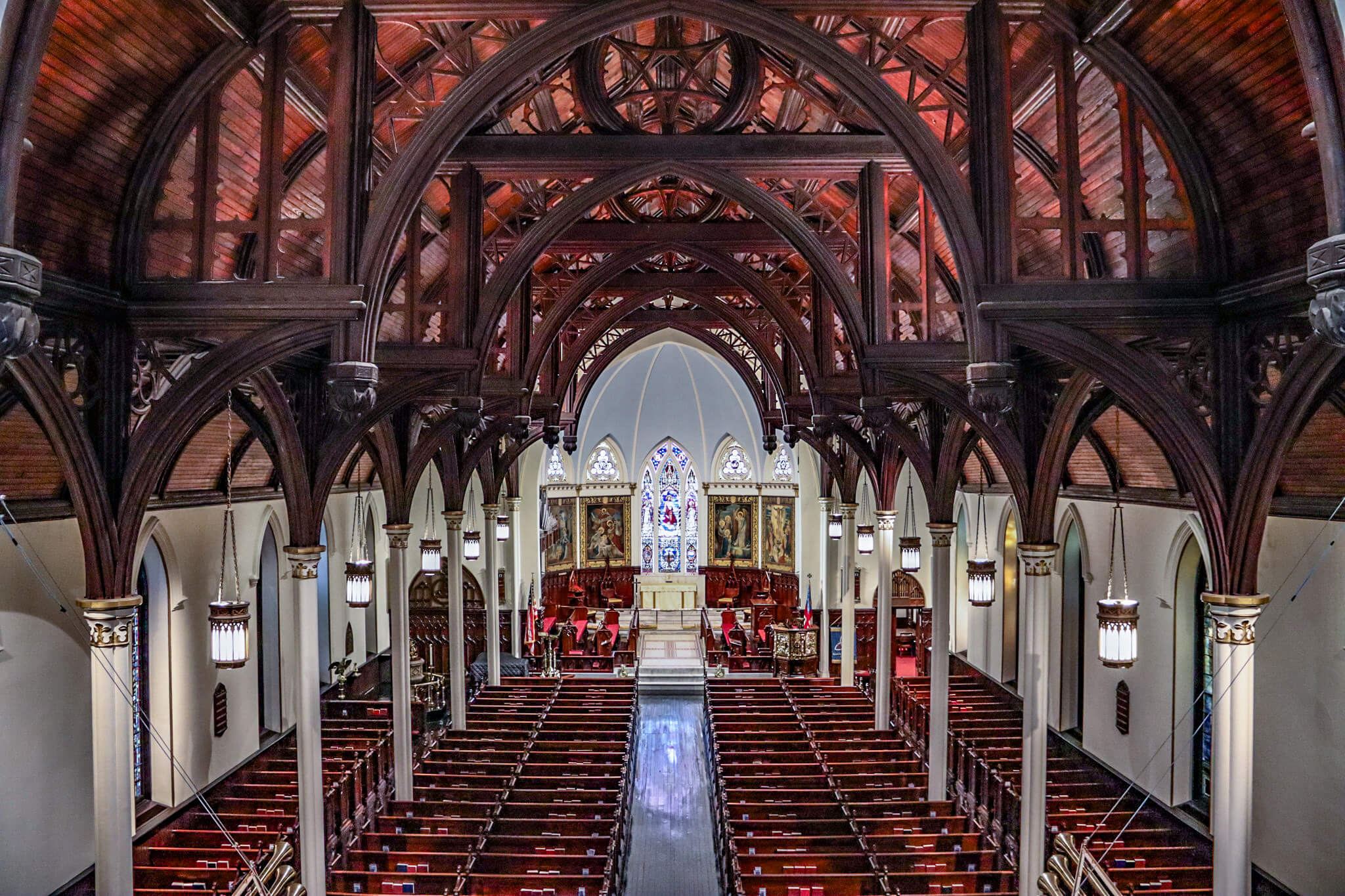 Right next door to the Cathedral of the Sacred Heart stands Grace & Holy Trinity Episcopal Church, preceding its neighbor by 18 years. Originally, this was the house of worship for Holy Trinity; a merger with Grace Church in 1924 brought them together here. With its requisite red doors for an Episcopal church, this wonderful asymmetrical church was constructed in a late French Gothic design from stone quarried in south Richmond. The corner 110’ bell tower contains 10 bells, installed in 2023 as a generous gift from an anonymous donor; it used to have a steeple, until a tornado in 1951 wrecked it. I smiled at the sole grotesque protruding from where the rounded interior stairwell intersects with the front wall, a decorative element to keep all those evil spirits away. Although the church was closed, one of the staff was kind enough to open it just for me and then proceeded to give me an informative tour. My attention was immediately grabbed by the gorgeous vaulted wood ceiling above the walnut pews—a Gothic triumph. Behind the altar, four murals have been gracing the chancel for more than 80 years. Depicting the Annunciation, the Nativity, the women at Jesus’ tomb, and the Ascension, the murals suffered damage from dirt and contaminants flowing in through open windows for decades before the advent of air-conditioning. Chemicals failed to clean them, so the solution came rather unexpectedly: A cleaner licked a Q-tip cotton swab and dabbed the canvas, stunning herself when it removed the soot. A synthetic saliva was created, and the murals are now as beautiful as they were originally. There’s also a great brass pulpit and some wonderful stained-glass windows, including the “angel window,” created by Tiffany Studios and installed in 1905. My visit wrapped up with a climb halfway up the bell tower via a claustrophobic spiral staircase, which also provided a bird’s-eye view of this remarkable structure.
#3 St. Paul’s Episcopal Church
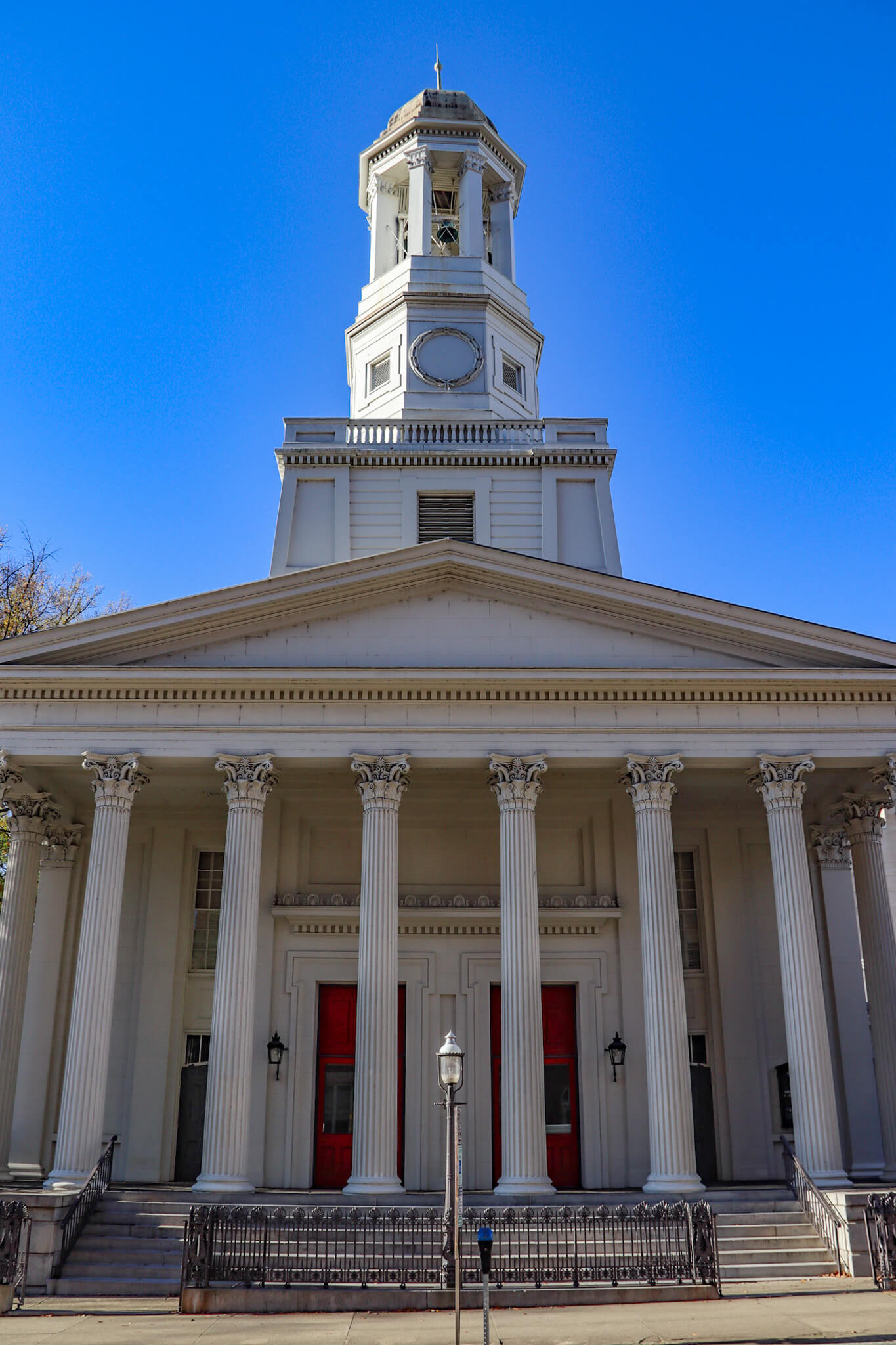 Directly across the street from the Virginia State Capitol, St. Paul’s Episcopal Church has been standing proudly since 1845. Nicknamed “the Cathedral of the Confederacy” due to the regular attendance of Robert E. Lee and Jefferson Davis, the Greek Revival–style church features two-story Corinthian columns on the portico supporting a plain pediment (matched inside by those around the chancel) and a bell tower. Originally, the tower was topped by a 250’-tall spire, surpassing the height of the capitol as the tallest building in the city until 1905, when it was removed out of concerns over its stability and replaced by the present octagonal dome, reaching a more moderate 135’. The airy interior has seen the greatest changes over the course of the church’s history. When it was built, Protestant “low church” sensibilities were in play, keeping the church devoid of ornamentation and an altar, and employing only clear-glass windows. When those policies were relaxed in the late 1880s, the church began taking on some of its current attributes. Memorial plaques were dedicated, and a brass pulpit with symbols of the Four Evangelists was added, as was the handsome organ. Clear windows were replaced by stained glass, 10 of which were created by Tiffany Studios, which also made the gorgeous mosaic behind the altar that reproduces da Vinci’s Last Supper. The church was listed on the Virginia Landmarks Register back in 1968 and on the National Register of Historic Places a year later, more than a century after 1,162 parishioners packed the church for a service—an attendance hard to imagine today.
#4 St. John’s Episcopal Church
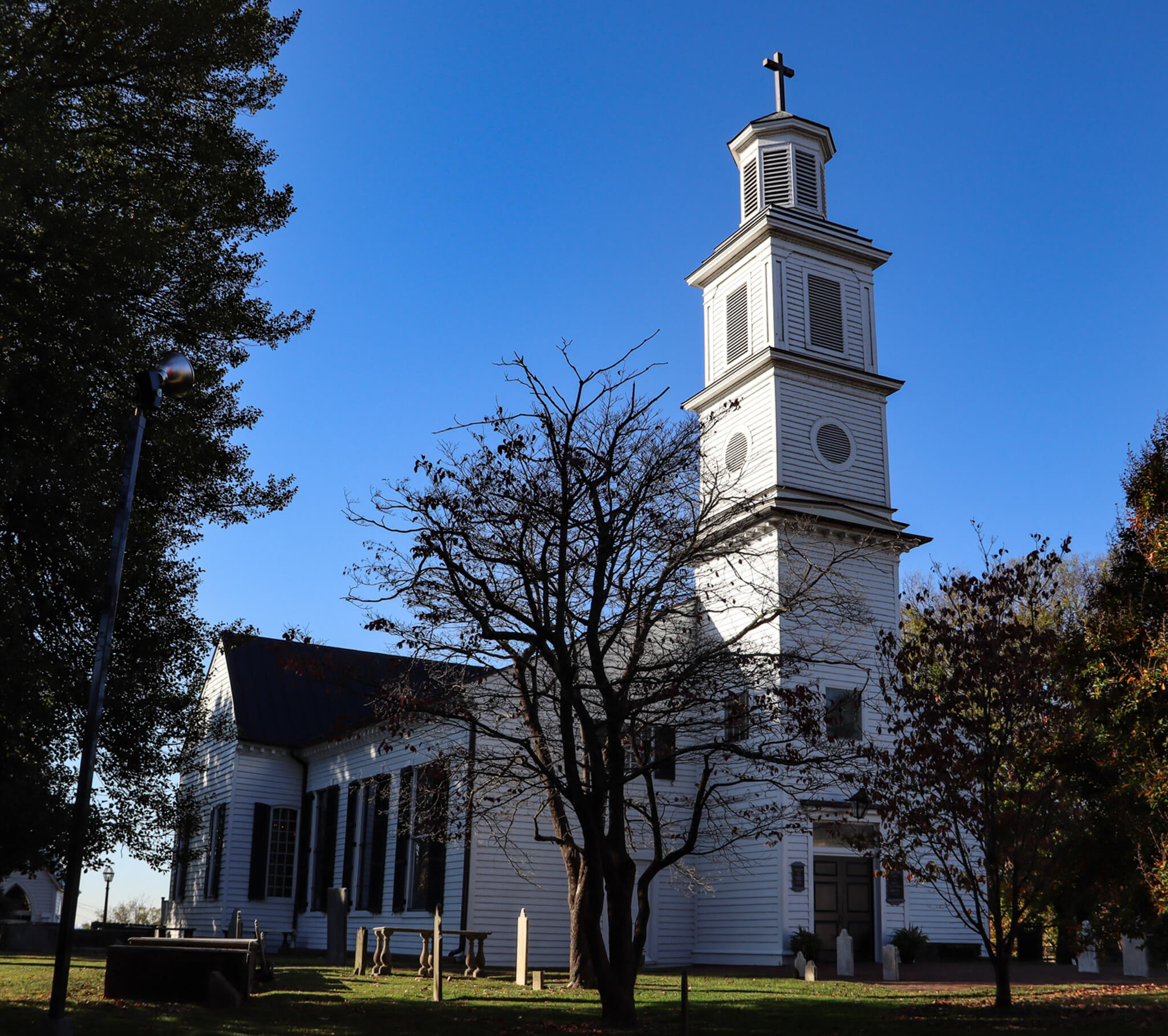 I eagerly awaited the tour of St. John’s Episcopal Church by walking around its adjacent graveyard for a while, noting the burial sites for Edgar Allan Poe’s mother and for George Wythe, the first professor of law in the United States (he taught Thomas Jefferson) and the first Virginia signer of the Declaration of Independence. The church, clad in white clapboard, features a central bell tower with a simple cross atop it. This is the oldest church in Richmond, completed in 1741 (it’s also one of the oldest wood churches in the United States), and that means it comes with tons of history. Inside, I took a seat in one of the box pews and looked around at the brass chandeliers, some lovely stained-glass windows, the prominently featured Ten Commandments, and the tastefully decorated organ pipes. Formerly known as the New Church, Town Church, Upper Church, and Richmond Hill Church, it didn’t land on “St. John’s” until 1829. All the while, it served not only the community’s spiritual needs, but also as a meeting place. I soon learned about the most important meeting the church ever held. In the 1770s, as tensions between England and the American colonies increased, the assembly of the Second Virginia Convention moved from Williamsburg to Richmond. St. John’s, the largest available public building in the city, held what would become a historic meeting. On March 23, 1775, in this very space sat George Washington and Thomas Jefferson, among other prominent Virginians, who listened to an impassioned speech by lawyer and statesman Patrick Henry, which included his now-famous words, “Give me liberty or give me death.” More than two centuries later, about 40,000 people per year come to visit this National Historic Landmark and experience the place that gave birth to one of the United States’ most famous declarations.
#5 St. Benedict Catholic Church
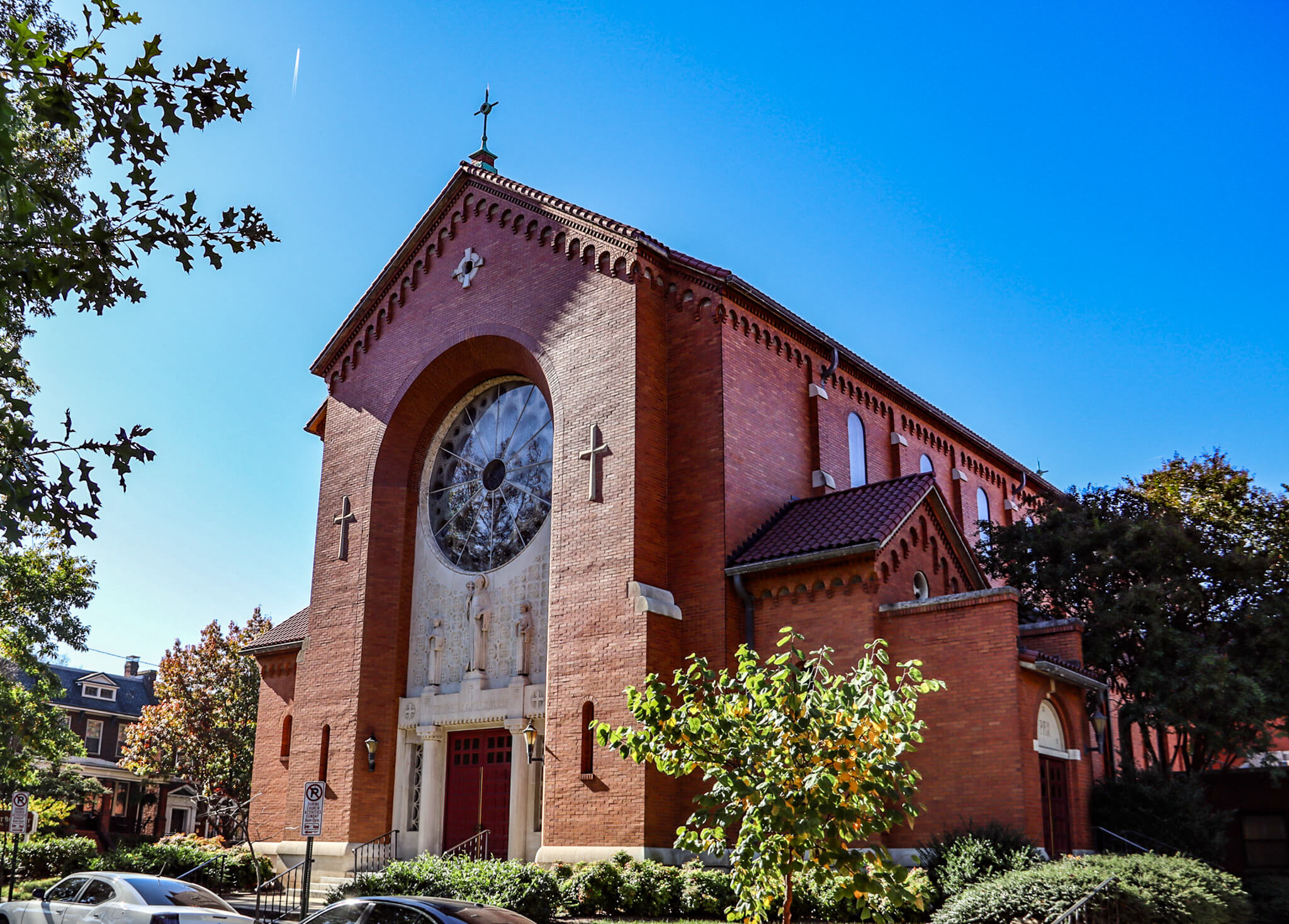 I was spending a good deal of time in Richmond’s Museum District, at the Branch Museum of Architecture and Design, the Virginia Museum of History & Culture, and the Virginia Museum of Fine Arts. But there’s another standout here—St. Benedict Catholic Church. The parish was founded in 1911 to minister to Catholics of German ancestry. When they began shifting from downtown Richmond to its western end, they needed a new church. St. Benedict was completed in 1929, just a couple of months before the Great Crash and the onset of the Great Depression. The church bears the shape of a traditional Roman basilica—a nave leading to the apse and intersecting with the transept at the edge of the apse so that the shape of the building is cruciform—with Byzantine and Gothic flourishes. The brick façade features a huge rose window—with Jesus at the center and the Twelve Apostles as the radiating spokes—set into the massive arch above the entrance. A statue of St. Benedict stands below the window, flanked by two of his missionary disciples and above the Latin motto of the Benedictine order, translated as “That God may be glorified in all things.” Inside, near the entrance, you’ll find the baptistery with the baptismal font below stained-glass windows of Adam and Eve (baptism washes away their original sin) and the baptism of Christ. Throughout the rest of the church, I was impressed by the stained glass in the nave windows and transoms depicting Benedictine saints as well as the seven sacraments. Four chapels are dedicated to Mary, St. Joseph, St. Scholastica, and Christ the King. The highlight is the sanctuary, with an ambo with two scenes from the Bible (one Old Testament, one New). The wonderful reredos is a marble bas-relief of the Last Supper, with Judas at the end looking less than pious. The colorful mural above it shows the Sacred Heart of Jesus, with Mary and St. Joseph beneath Him, and, beneath them, saints Augustine, Gregory the Great, Jerome, and Ambrose, with, of course, St. Benedict in the center.
Five Runners-Up
- All Saints Reformed Presbyterian Church (1922)
- First English Evangelical Lutheran Church (1911)
- Pro-Cathedral of St. Peter (1834)
- St. Stephen’s Episcopal Church (1928 / 1950)
- Mt. Carmel Baptist Church (1877)
Leave a Comment
Have you been here? Have I inspired you to go? Let me know!


 Stephen Travels