When I wasn’t exploring many of the quirky sights along Route 66 during my stay in Oklahoma, I was checking out some more mainstream attractions, like the magnificent Art Deco district in Tulsa, the 80th-largest house in the United States in Ponca City, and the lovely University of Oklahoma campus in Norman. In between it all, I was popping into many of the state’s churches, lured by their architectural beauty and by some rather intriguing stories. These are my favorites.
#1 Boston Avenue United Methodist Church (Tulsa)
 I headed out of downtown Tulsa and the fantastic Deco District, along Boston Avenue, drawn by the Boston Avenue Methodist Church, which rises like L. Frank Baum’s Emerald City (except for the green) in the near distance, with nothing around it to obstruct the view. This limestone house of worship from 1929 was jointly designed by an architect and his female teacher—one of only a few Art Deco buildings in the world designed by a woman. The 15-story zigzag tower, soaring up 255’, is topped by a wonderfully complicated confection. It features strong downward-moving lines in terra cotta, symbolizing the outpouring of God’s love on all those who pass underneath them, and stylized terra cotta statues and praying hands. Inside, I gaped at all the Art Deco details—the mosaics, the chandeliers, the brass banisters. I paused in the circular, sloping sanctuary with its dome ceiling and the jazzy abstract stained-glass windows that repeat the downward-flowing lines and combine them with two stylized flowers indigenous to Oklahoma: the coreopsis, which grows in the driest soil, representing the hardiness of the Christian faith, and the tritoma, with its powerful stems supporting downward blossoms, symbolizing the strength of the Church. Added to the National Register of Historic Places in 1978 and named a National Historic Landmark in 1999, it remains one of the finest examples of ecclesiastical Art Deco architecture in the United States.
#2 Holy Family Cathedral (Tulsa)
 A concentration of five churches on just two blocks in this section of Tulsa seemed excessive, unless if you enjoy looking at pretty buildings. One of them is Holy Family Cathedral. When it was completed in 1914, it was the tallest building in Tulsa, a title it held for nearly a decade. Virtually surrounded by parking lots, the church has lots of unimpeded viewing spots to take in all its beauty. Resting on a stone base, the brick cathedral employs architectural elements from American, English, and French churches. More than 200’ tall and almost 100’ across at its widest point, it’s an impressive sight. The three soaring bell towers, two at the front entrance and one rising above the crossing where the nave and transept intersect, are almost identical, save for the clock on each of the four sides of the latter. I climbed the shallow staircase and entered the colorful cathedral. Red columns and arches with red trim support the soaring vaults and ceiling. There are some wonderfully detailed stencils throughout, and the reredos is magnificent, with a crucifixion scene and plenty of thoughtful angels. The silver organ pipes in a simple casing part to leave the view of the stained-glass window over the entrance unobstructed. The stained-glass windows in the clerestory feature saintly figures, like archangel Michael slaying the dragon and Stephen holding the rocks that killed him. Along the side aisles, the very vibrantly painted Stations of the Cross occupy spaces between the fantastic stained-glass windows that depict everything from the Nativity to a young Jesus at his stepfather’s carpentry workshop to the wedding at Cana. These windows, in the style of Tiffany Studios, are copies of windows created by the Royal Bavarian Art Institute in Munich, Germany, which were destroyed in World War II. Fortunately, Tulsa’s version, now more than a century old, lives on.
#3 St. Joseph’s Old Cathedral (Oklahoma City)
 One of Oklahoma’s most beautiful churches was almost blown to smithereens when the Alfred P. Murrah Federal Building, one block away, was targeted in a senseless and deadly terrorist attack in 1995. The force of the explosion that decimated the Murrah Building also shattered most of the cathedral’s stained-glass windows on the east side; extensively damaged the pipe organ, catapulting several pipes down onto the pews below; raised the roof several inches off its steel pillars, breaking several of the rafters; caused plaster to fall from the ceiling and walls; and destroyed symbolic plaster medallions. After a closure of two years to make all the repairs, the cathedral reopened, and it was this restored beauty that I experienced during my visit. The church was completed in 1902, replacing the original wood-framed building and recycling its lumber and pews for the new building. In 1905, the pope elevated its status, and it became the first cathedral in Oklahoma. The brick Gothic Revival cathedral features a central tower and spire between two flanking towers with crenellated tops. Inside, an ornate baptismal font, with John the Baptist baptizing Christ on the lid, greets you. The white and cream walls, ceilings, and columns, with touches of various shades of reddish-orange, keep the interior bright and cheerful. Sculpted Stations of the Cross line the walls in between the old and the restored stained-glass windows. Measuring 137’ long by 64’ wide, and listed on the National Register of Historic Places in 1978, St. Joseph’s Old Cathedral remains an impressive sight in downtown Oklahoma City.
#4 First United Methodist Church (Tulsa)
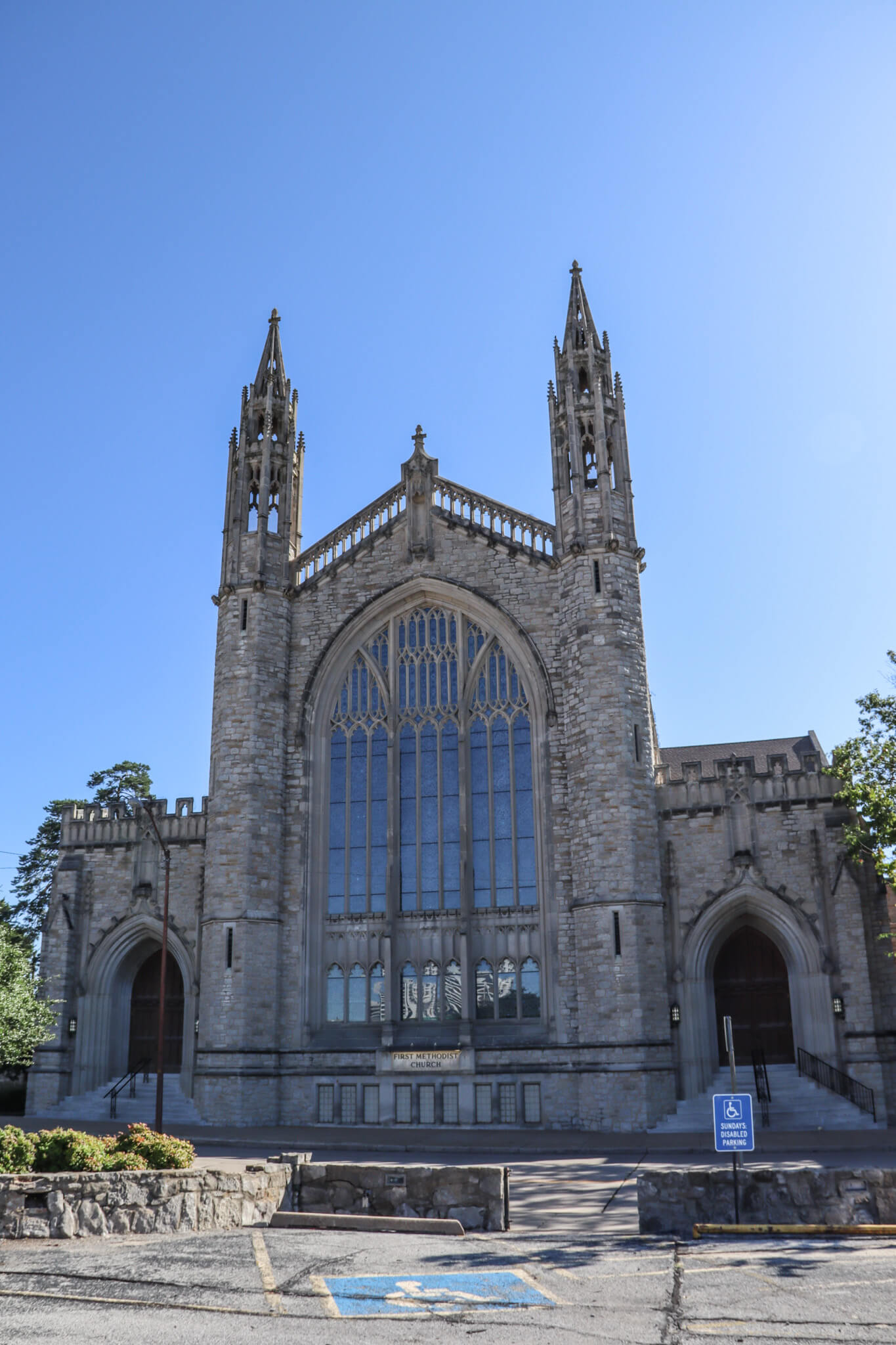 The First United Methodist Church doesn’t have a central entrance. Rather, doors to the right and left, with stone angels holding plain shields beside them, grant you access inside. The center is given to the massive stained-glass West Window, flanked by twin towers with crockets and eagles. Built in the perpendicular Tudor Gothic style, the nine-story church is clad in lovely soft-gray stone. Inside, the soaring pointed arches led my eyes up to the wonderful ceiling, painted blue and featuring gorgeous wood beams. Almost all of the stained-glass windows are figureless, produced with repeating abstract designs in vibrant gem colors. An exception is the huge, colorful window behind the altar that contains an image of Christ, surrounded by angels bearing candles and Christian symbols.
#5 Trinity Episcopal Church (Tulsa)

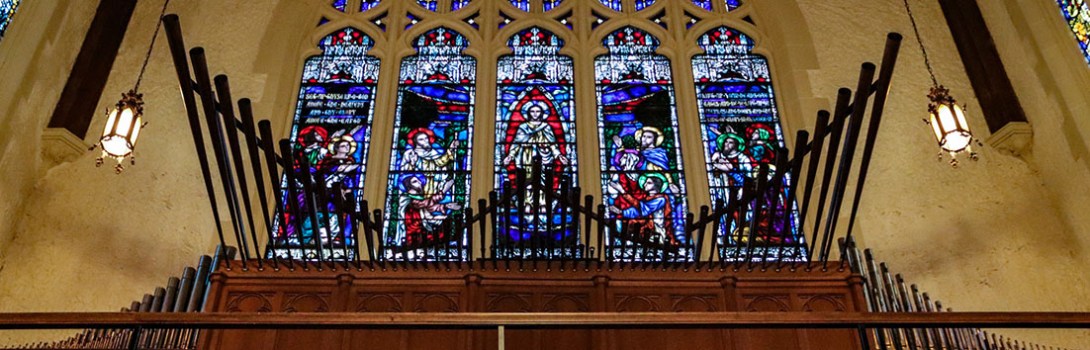
Dogs were everywhere inside Trinity Episcopal Church. Not just service dogs. All kinds of dogs, in every size and shape and color. I had arrived late in the day, just after an early evening Mass on the feast day of St. Francis, when the annual blessing of the animals takes place. Worshippers and their canine companions were attending a reception, which worked out well for me: I got to explore the church when it ordinarily would have been closed. This corner property rose up in 1926, following an initial seven-day campaign that raised $300,000 in 1921. Red doors grant access inside from several locations, including under the pair of statues with ornate canopies at the main entrance. A fleche of yellow-green adds the only other pop of color. Inside, I strode around the sanctuary as an occasional bark or two rang out from the adjacent reception hall. Gothic arches support the clerestory of stained-glass windows. Below the large stained-glass window in the choir loft, vertical organ pipes reach out horizontally, like angelic horns. There are some fine wood carvings here, too, in the pulpit and lectern. Make sure you look for, among the Apostles Creed stained-glass windows, the image of Hitler and another Nazi or two, not surprisingly in the “He descended into Hell” section.
Five Runners-Up
- First Presbyterian Church (Oklahoma City, 1950s)
- First Presbyterian Church (Tulsa, 1926)
- St. Gregory’s Abbey Church (Shawnee, 1942)
- First Church of Christ Scientist (Tulsa, 1918)
- First Christian Church (Tulsa, 1920)
Leave a Comment
Have you been here? Have I inspired you to go? Let me know!


 Stephen Travels