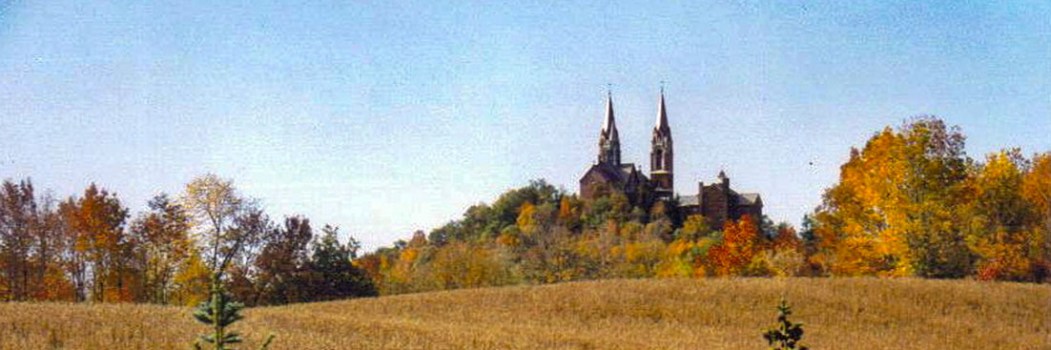
What impressed me most about the architecture in Wisconsin is how broadly the talents of architects, engineers, and artists was spread. Fantastic buildings here aren’t limited to just to a couple of categories that usually get the best, like houses of worship or government buildings. In Wisconsin, everyone gets a fair shake. These are my favorites.
#1 Basilica of St. Josaphat (Milwaukee)
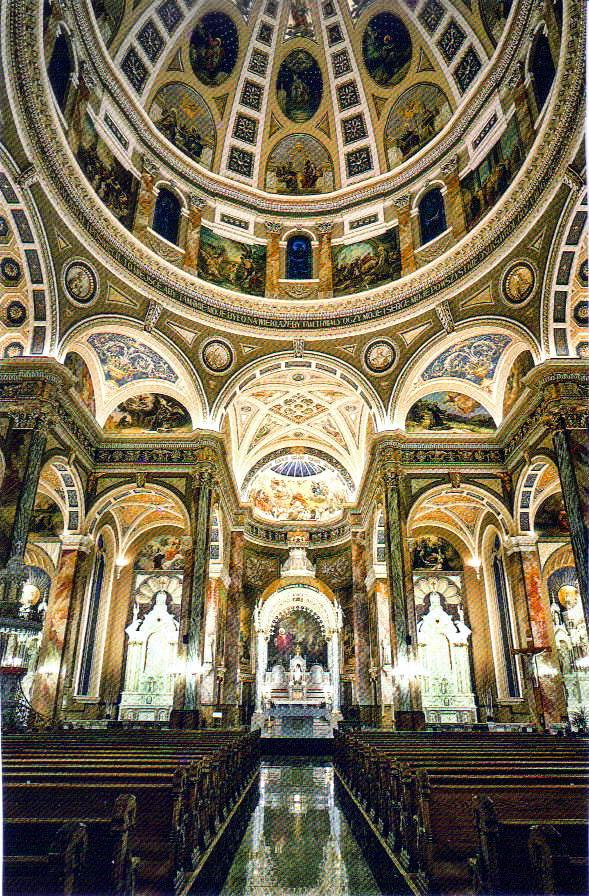 Built by poor Polish immigrants from 1896 to 1926, the eye-popping Basilica of St. Josaphat, one of the most beautiful buildings in Milwaukee, reigns as the city’s largest church. Only three years after its completion, the church was elevated to basilica status (the first Polish-American church to be raised to this honor). The basilica is dedicated to St. Josaphat, who was born in the Kingdom of Poland around 1580, and, in 1623, was hacked to death, shot, stripped, thrown to wild dogs to tear him apart, and tossed into a river with stones tied around his neck. The third named basilica in the United States features salvaged materials from the demolished Chicago Post Office & Customs House as well as what was, at the time of construction, the second-largest dome in the country, smaller only than the one atop the U.S. Capitol. This National Historic Site (listed in 1973) includes wonderful oil murals, stained-glass windows imported from Austria, ornamental plasterwork, life-size angels holding clamshells filled with holy water, and marmoreal Corinthian columns. Behind the altar, an eerie painting portrays Josaphat, more brightly illuminated than anything else, with a darker figure holding up an ax behind him, ready to split his skull open. As I admired the tremendous interior, churchgoers began to arrive for the 10 a.m. Mass. And they kept coming, until it seemed like the basilica’s capacity of more than 1,000 was breached. Sensing something special, I stayed for the Mass, which featured an exceptionally talented choir. Clearly, even after a century, this basilica maintains its importance and status as one of the best things to see in Milwaukee.
#2 City Hall (Milwaukee)
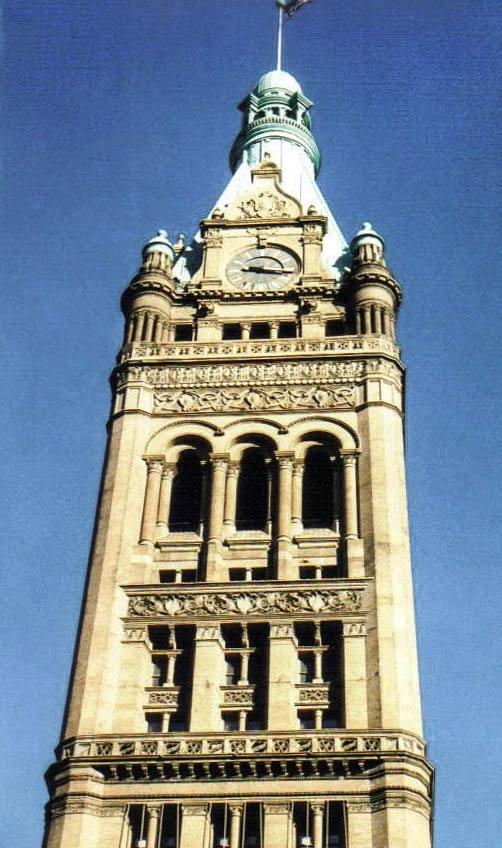 Just a block away from the Milwaukee River, I found City Hall, the city’s most iconic building, thanks, in large part, to its appearance in the opening credits of the 1970s–80s sitcom Laverne & Shirley. Completed in 1895, this Flemish Renaissance masterpiece was Milwaukee’s tallest building until 1973, with a tower rising 350’. The lowest portions are constructed of granite, while the top six floors consist of pressed bricks—approximately eight million of them—and terra cotta sculptures. That gives the building a hefty weight of about 41,000 tons. The top of the massive bell tower (one of the world’s best) with a copper spire now turned a verdigris green sports clock faces on all four sides. At 18’ in diameter, these were the third-largest clocks in the world, with opaque glass numerals that measure two and a half feet in height. With a little imagination, the four turrets flanking the clocks resemble beer steins. The tower holds a single bell, named “Solomon Juneau,” in honor of the French Canadian fur trader who founded Milwaukee and became its first mayor. The 22,500-lb. bell, cast from melted copper and tin from old church and firehouse bells around the city, chimed for the first time on New Year’s Eve in 1896. Added to the National Register of Historic Places in 1973 and declared a National Historic Landmark in 2005, City Hall is just as impressive inside as it is out. Pop in to see some of the more than 47,000 square feet of mosaic and marble flooring as well as the stained-glass windows in the Council Chamber, the fruits of a WPA project in the 1930s. Make sure to check out the eight-story open atrium, topped by a skylight—a beautiful space, but a little tragic: During the Great Depression, seven people jumped to their deaths here, and an eighth person suffered a fatal stroke after one of the jumpers nearly hit him.
#3 Wisconsin State Capitol (Madison)
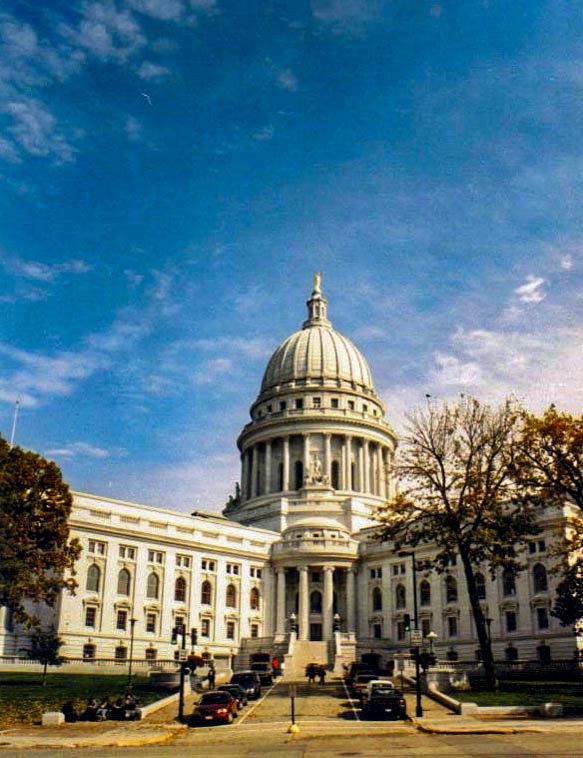 I arrived in Madison at night, with the illuminated dome and drum of the magnificent Wisconsin State Capitol shining like a beacon before me. I settled in at the Mendota Lake House B&B, a Prairie-style home built in 1911 on the shore of Lake Mendota. After a good night’s rest and wonderful breakfast, I made my first call of the day at one of the most beautiful capitols in the United States. Erected from 1906 to 1917, the building cost $7.25 million—money well spent by architect George Browne Post for one of his best works. At just three feet shorter than the dome of the national capitol in Washington, D.C. (a concession made during construction), Wisconsin’s dome was vindicated by the fact that it is larger by volume. Measured as such, it’s one of the largest and most beautiful domes in the world; it’s also the only granite dome on a U.S. capitol. At the end of each of the four wings of the building, Corinthian columns support a pediment with a tympanum filled with bas-reliefs that represent the branch of government housed in that particular wing. More than 40 kinds of stone embellish the interior, originating from places as close as Wisconsin and Minnesota and as far away as Algeria, Greece, Italy, and Norway. Stained glass and wonderful wall and ceiling murals abound, including The Marriage of the Atlantic and Pacific that commemorates the opening of the Panama Canal. Precious marble inlay surrounds the rotunda, and the floor of the Governor’s Conference Room was laid with seven different woods and not a single nail. A 34’-diameter mural, Resources of Wisconsin, spans the apex of the interior dome. And below, in the pendentives, four brilliant mosaics of 400,000 pieces of colored glass, each about the size of a quarter, depict Liberty and the executive, judicial, and legislative branches of the government—one of the capitol’s most striking splashes of color.
#4 Allyn Mansion (Delavan)
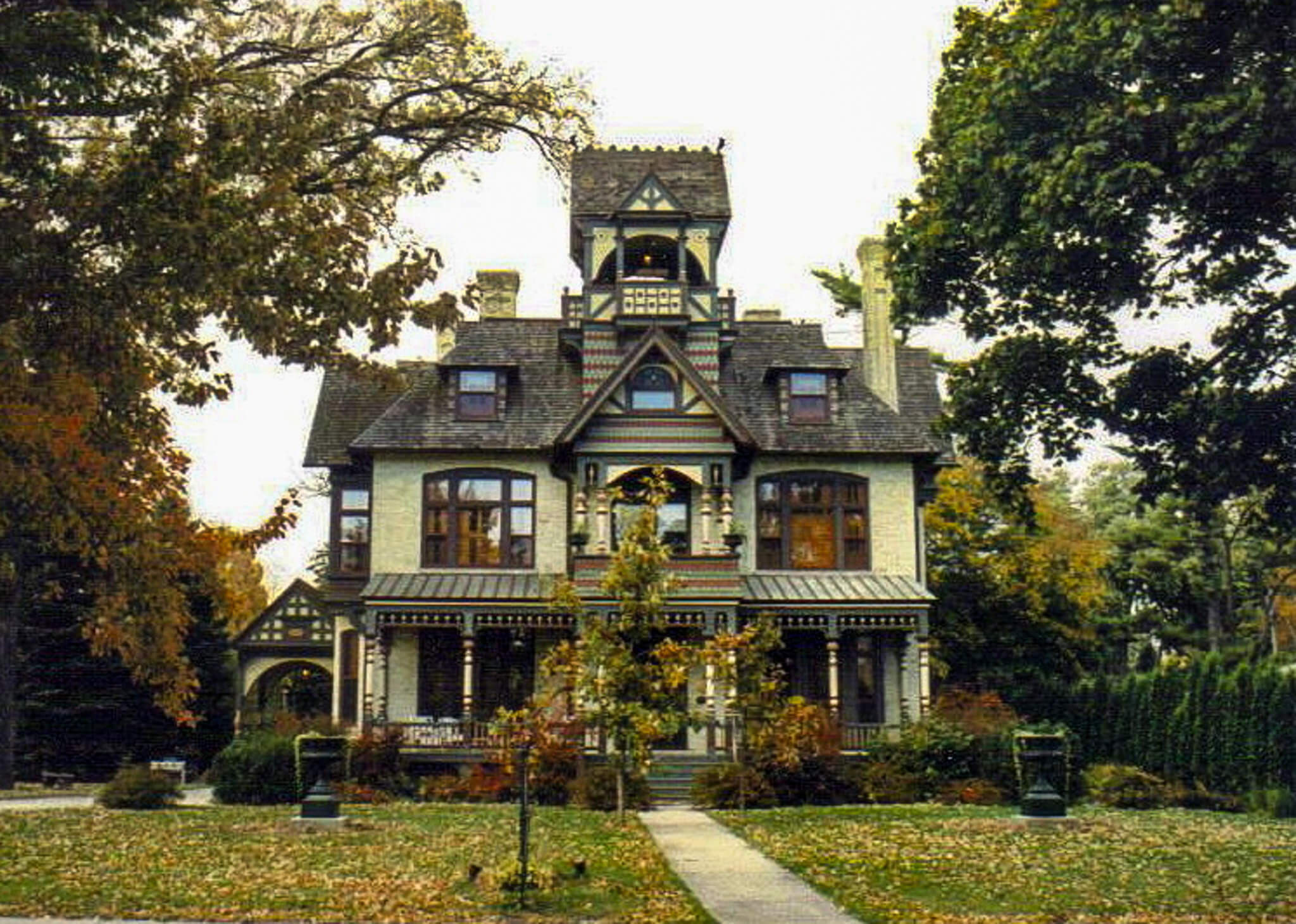 I came upon this one by accident, on my way to a cruise on Lake Geneva. And, suddenly, there it was, on the side of the road. The Allyn Mansion was built in 1885 for Alexander Hamilton Allyn and his family. Allyn had four homes, but this mansion became their principal residence. Designed by the same architect who would go on to prepare the initial design for the Kansas State Capitol, this three-story Queen Anne/Eastlake–inspired Victorian home is bound to attract your attention. Set at the end of a large lawn fronting a wide boulevard, the cream brick mansion boasts a delightful display of dormers, gables, porches, pavilions, a porte-cochere, and a full-width first-floor veranda with a spindle frieze. Above the veranda is gabled balcony, and above that, between the chimneys, is a belvedere with balconets. With its stained-glass windows, fish-scale shingles, sunburst motifs, and other ornaments, the mansion is pure perfection—but its history is far from it. After Allyn died in 1913, his wife continued living here until she died in 1939, leaving the mansion to her step-daughter, who, in turn at the time of her death in 1948, left it to her daughter, who then initiated its decline. Instead of taking care of repairs needed outside, she simply had all the problematic areas removed—the tower, balcony, porch, and porte-cochere. She sold it to the city of Delavan, which promptly sold it to a nursing home group. That necessitated major changes to the mansion, including adding a fire escape, transforming Mrs. Allyn’s bedroom into a nursing station, and tearing up the front lawn for a parking lot. The nursing home closed in 1966 and the building was vacant for three years, until it reopened as a furniture store, which further desecrated the place by painting over everything in cream paint—the original wallpapers, the stenciled walls, the frescoed ceilings. The store closed in 1983 and again the building stayed unoccupied until sold the following year. The new owners meticulously restored the mansion to its original splendor, earning it listing on the National Register of Historic Places in 1985, the Grand Prize from the National Trust in its Great American Home Awards (the highest prize in the United States for historic preservation) in 1992, and awards from the Wisconsin State Historical Society and the Wisconsin Trust for Historic Preservation in 1993. During its turn as a bed and breakfast, guests could enjoy the oak staircase with carved newel posts and fat-spindled balusters, walnut and oak woodwork, parquetry, stencil work, pocket doors with dentil and rosette moldings, and nine fireplaces with Italian marble fronts adorned with gold leaf and floral designs. Twenty-two years later, the B&B closed. And once again, it’s up for grabs.
#5 Green County Courthouse (Monroe)
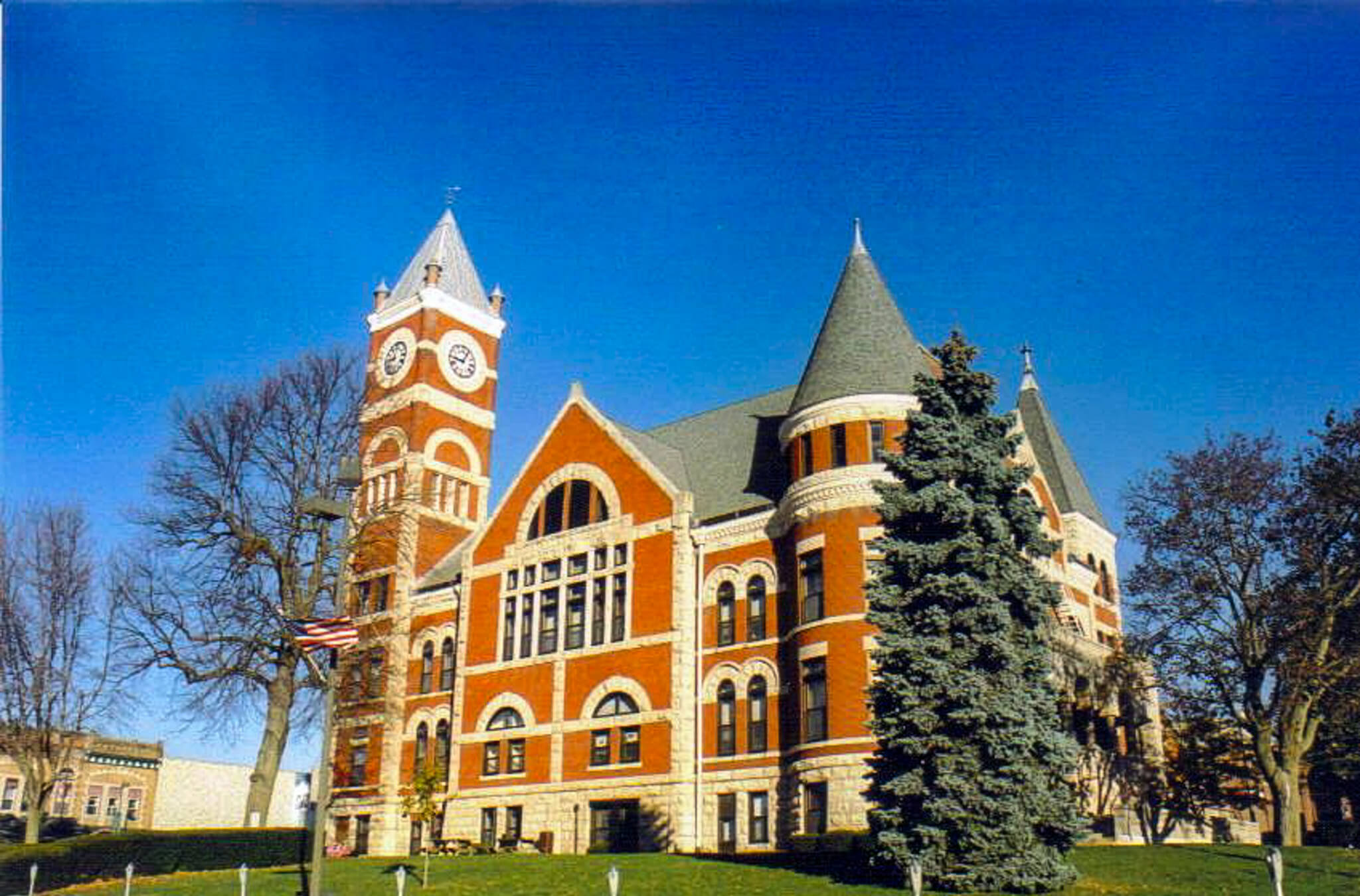 Do you like cheese? Of course you do. Then head to Monroe for the annual Cheese Days festival. Here in the soi-disant “Cheese Capital of the USA,” the 10,000 folks who call this city home get to celebrate cheese with the Green County Courthouse as their backdrop. Standing tall and proud of the middle of Courthouse Square, framed by small-town shops and restaurants, the courthouse dates back to 1891. In 1978, it was added to the National Register of Historic Places. The two-and-a-half–story Richardsonian Romanesque building is built from red brick and limestone, resting on a coarse limestone foundation. The asymmetrical building features two round corner towers with conical roofs, one square corner tower, and a 120’ corner clock tower with four clock faces and a pyramidal roof with a weather vane. Two limestone porches with balustraded roof decks and arcades supported by stubby marble columns mark the entrances. Stone trim decorates the quoins and the clocks as well as the surrounds of the windows of different sizes and shapes. There are dentils along the cornice and decorative stonework in the gable ends. Its high-spirited assemblage of different shapes gives it a playful feel without compromising the serious business conducted within.
Five Runners-Up
- Red Gym (1894; University of Wisconsin, Madison)
- Tripoli Shrine Temple (1928; Milwaukee)
- Captain Frederick Pabst Mansion (1892; Milwaukee)
- Bascom Hall (1857; University of Wisconsin, Madison)
- Basilica and National Shrine of Mary, Help of Christians at the Holy Hill (1930; Hubertus)
Leave a Comment
Have you been here? Have I inspired you to go? Let me know!


 Stephen Travels