After checking into the Hotel at Old Town, a wonderfully repurposed accommodations that began its life in 1906 as the largest warehouse in Wichita, Kansas, I went directly across the street to the Museum of World Treasures, an oddball collection of everything housed in an old three-story warehouse. It was a pleasant introduction to a city that earned its nickname “Cowtown” back in the 1800s and “The Air Capital of the World” in the 1930s. I’m not sure what it’s called these days, but it’s a rather pleasant city with some terrific buildings. These are my favorites.
#1 Cathedral of the Immaculate Conception
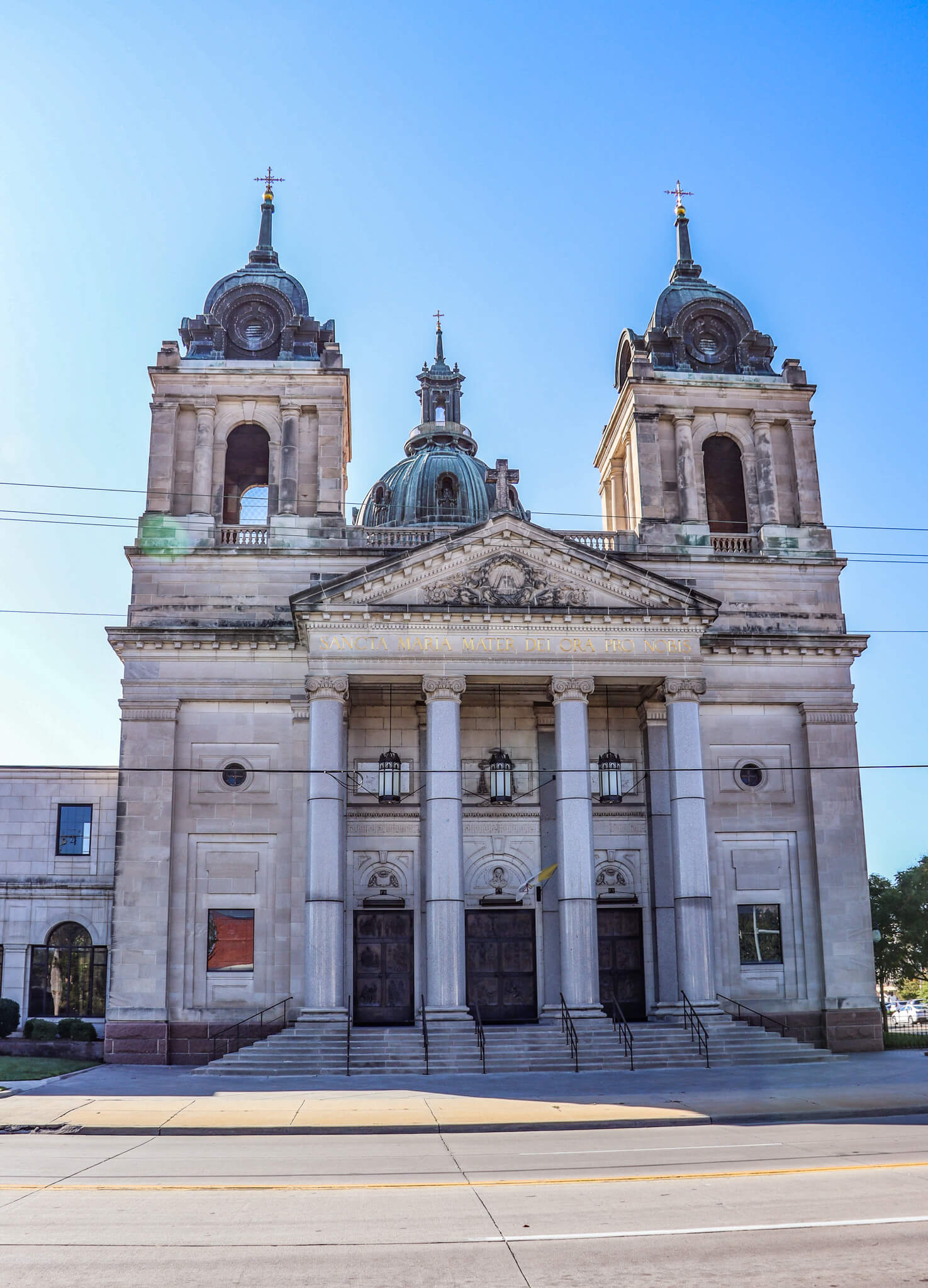
Located, appropriately enough, across the street from The Lord’s Diner, the gorgeous Cathedral of the Immaculate Conception took six years to complete, in 1912—but that included two full years of inactivity for the foundation to settle. Constructed of Bedford limestone from Indiana, the cathedral measures almost 170’ long and 100’ at its widest. It’s an impressive sight, especially from the front: a dome that rises 135’ from the ground, single-piece granite columns saved from the demolished old post office in Chicago supporting a pediment with dentils, twin bell towers, and a trio of sculpted bronze doors designed and created in Italy. Installed in 1997, the central doors depict five critical moments in Christianity, from The Agony in the Garden to the Crucifixion. The doorknobs are doves.
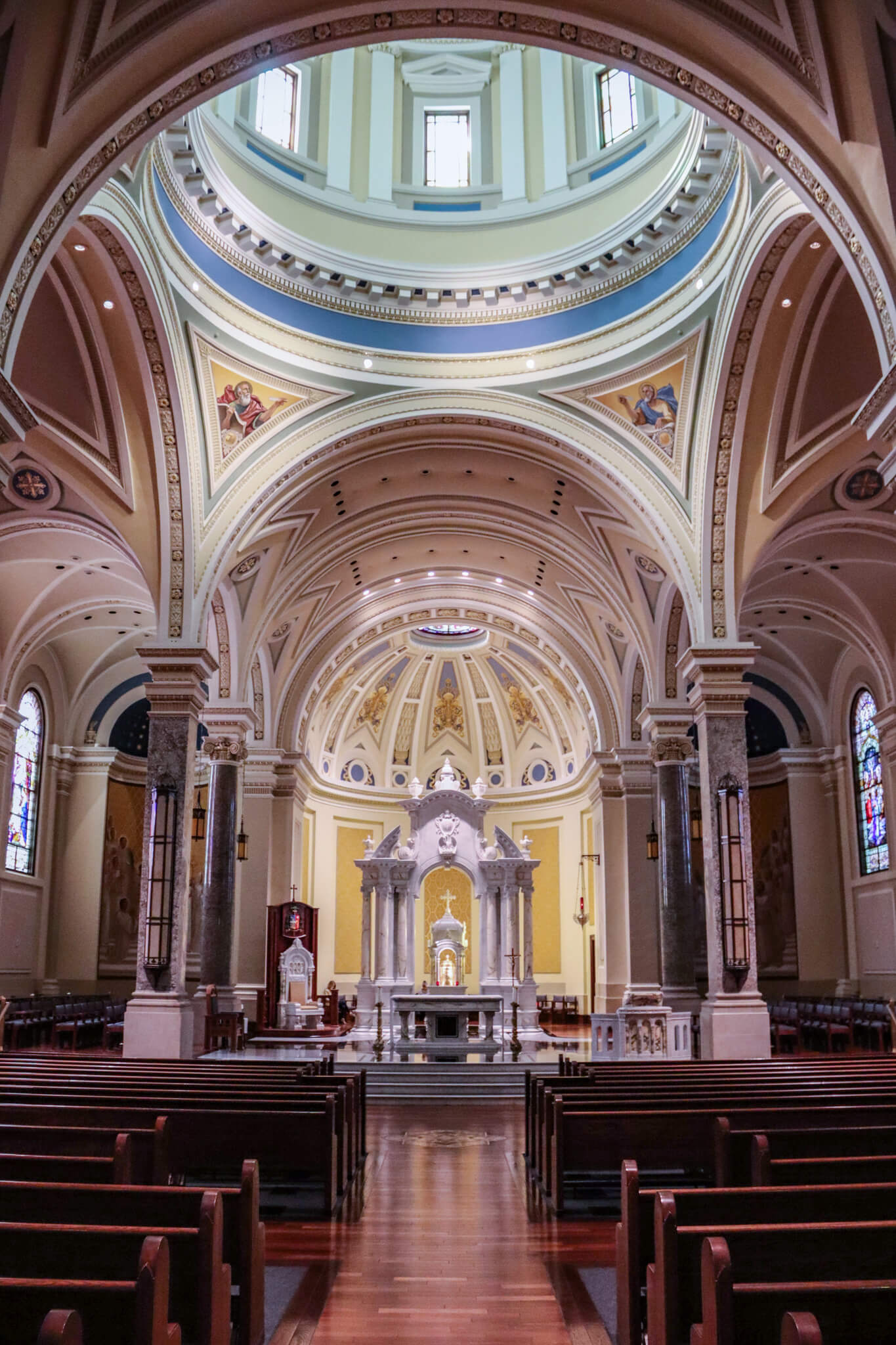
I stepped inside the bright interior and made my way down the central aisle, flanked by more granite columns supporting arches with detailed soffits, to the slightly elevated sanctuary. The uniform use of white marble in the altar, ambo, tabernacle, cathedra, and reredos (decorated with a shield bearing the letters IHS, the Latinized abbreviation of the first three letters of Jesus’ name in Greek, and a pelican, an ancient Christian symbol for the Holy Eucharist—a mother pelican will feed her chicks with her own flesh and blood when nothing else is available) creates a cohesive display.
I looked up into the dome, at the image of God the Father in a billowing red cloak with welcoming outstretched arms above a cloud and seven stars, a reference to the seven churches cited in the Book of Revelation (all found in present-day Turkey). At the top of the pillars holding up the dome, images of the Four Evangelists can be found in the pendentives, each holding a feathered quill as they write their gospels.
The beautiful stained-glass windows, designed in Germany, made their way to the cathedral in 1927. They depict two mysteries of the Rosary—the Joyful and the Glorious. Of the 10 windows, I was most curious about the Nativity scene. Mary and a perfectly contented baby Jesus welcome three shepherds in a familiar manger scene. Joseph presents a question. Holding a lantern in one hand, he shields his eyes with the other from the light pouring down from the angel above as he gazes east, not focusing on any other figures but on something at a distance, perhaps waiting for the imminent arrival of the magi.
On my way out, I made sure to stop at the large crucifix in one of the shrines. A larger-than-life-size Jesus, at 7’ 6”, weighs 500 lbs. The cross, made of fiberglass, steel, and wood from Israel, resembles rough-cut logs. The plate above Him reads “Jesus the Nazorean, the King of the Jews” in Aramaic, Greek, and Latin. The dozen stones at the base of the crucifix were taken from the Jordan River. The wall mural behind the crucifix is a simple sky scene, with light breaking up dark clouds and with, just like the dome, seven stars. The Crucifixion is the end of Christ’s journey on earth, and this statue itself underwent a journey to arrive here—the artist loaded it onto a trailer from his base in Oregon and drove it halfway across the country in a diesel-powered pickup truck.
#2 Old City Hall
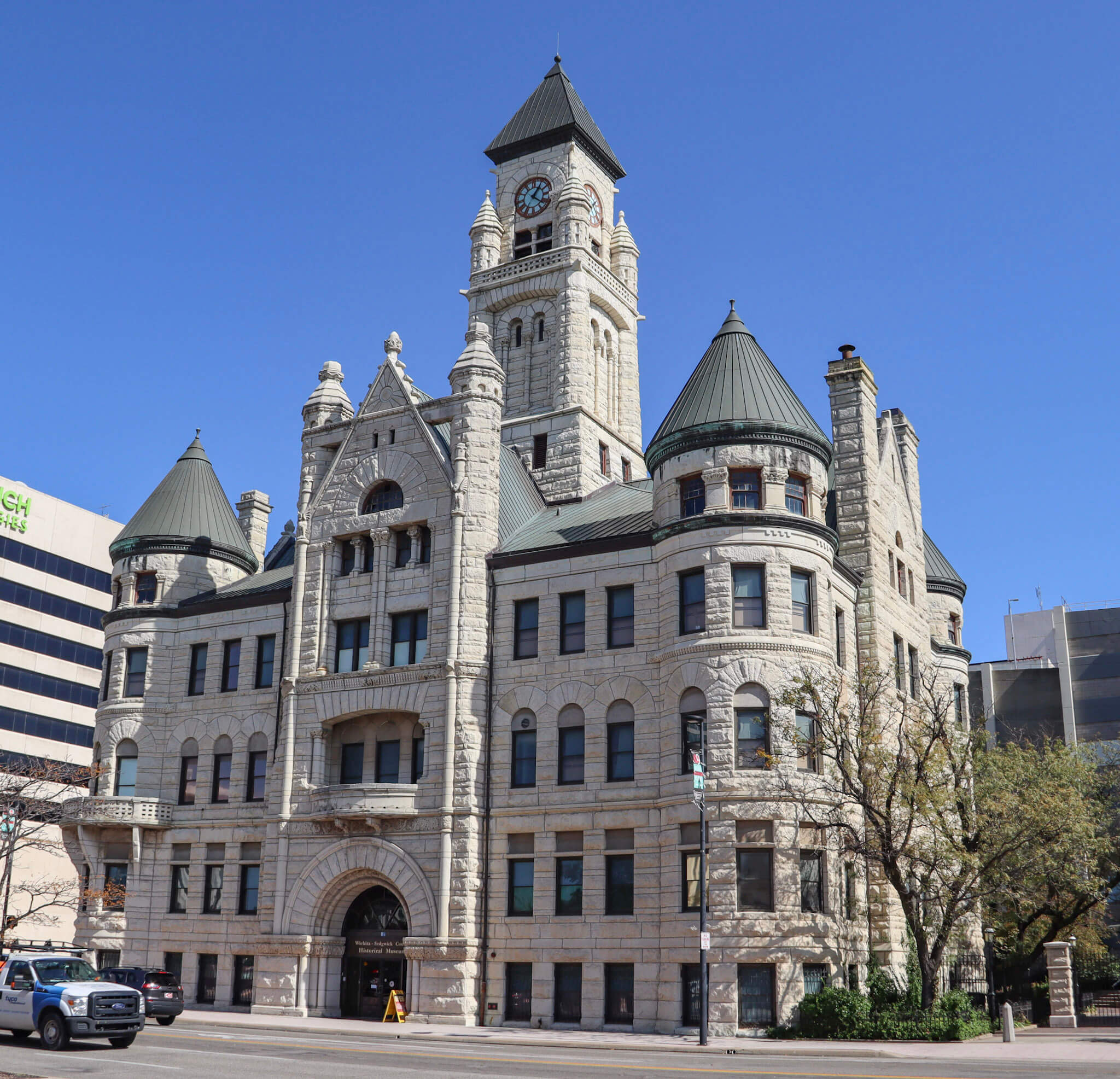
Parking on the street in downtown Wichita for two hours cost me exactly 25 cents. I was already excited. I was here to visit the Wichita-Sedgwick County Historical Museum, with its exhibits that included a history of Wichita, a recreated old drug store (complete with wacky remedies), the story of a locally manufactured car (the Jones Light Six) that cost $995, and a hand-carved walnut grandfather clock from 1871 that cost a whopping $450 at the time. But the building itself, completed in 1892, proved to be just as engaging. Nicknamed the “Palace of the Plains,” City Building (not yet officially City Hall) was intended to be a symbol of the city’s prosperous 1880s. At a total cost of $100,000, the funds ran short during a recession, and the building’s crowning 170’-tall clock tower and its 1,000-lb. bell weren’t added until 1917. City offices, including the police and fire departments and the city’s first public library, were housed in the building. In the 1960s, plans to build a new city hall put the existing building on the chopping block, but public support for its preservation secured it a listing on the National Register of Historic Places. After the city offices moved out in 1975 and a few years of construction and renovation, the museum moved in in 1981 and the five-story building was saved. That means we get to enjoy this limestone beauty that features a bold Richardsonian Romanesque style. The round corner towers are lovely, especially the one on the corner of the street, which features a small balcony that wraps around. Look for sculptures of human heads and winged creatures, gable rooflines, and squat columns, and, inside, for fine stained-glass windows. And if you’re losing track of time, just throw your head back to look at any of the four clocks in the tower that measure eight feet in diameter.
#3 Wichita Scottish Rite Center
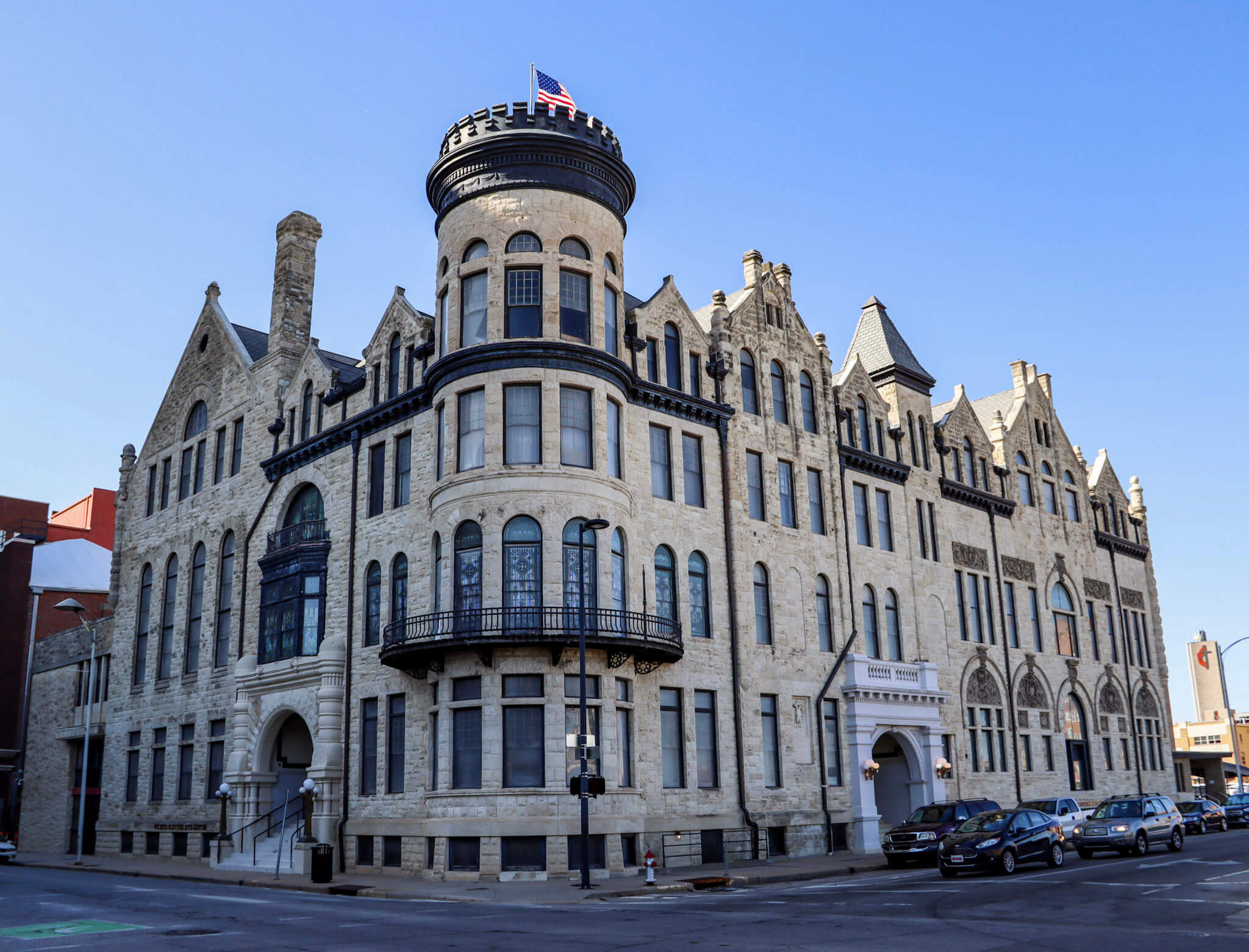
Wichita Scottish Rite Center began its life in 1888 as a YMCA—but that didn’t last very long at all. Only a decade later, suffering from a loss of financial support and reeling from a price tag of $60,000 that exceeded the budgeted $36,000, the YMCA was forced to sell it. The Scottish Rite Freemasons purchased it in 1898 and made expansions in both 1905 and 1956, including a stage and a 300-seat auditorium. Added to the National Register of Historic Places in 1972, the Romanesque-style building features an eye-catching battlemented tower with iron grillwork and stained-glass windows. The roofline is a jumble of chimneys and gables. The arched south entrance has clusters of short columns and is topped by a bay window featuring stained glass; the other arched entrance features an entablature with dentils and a balustrade resting on brackets. To its right, the first-floor stained-glass windows are topped by stone shields and arches with beautifully carved keystones and panels. Solely through the efforts and donations of the center’s membership has this building managed to maintain its status as one of the most beautiful in Wichita.
#4 Rock Island Depot
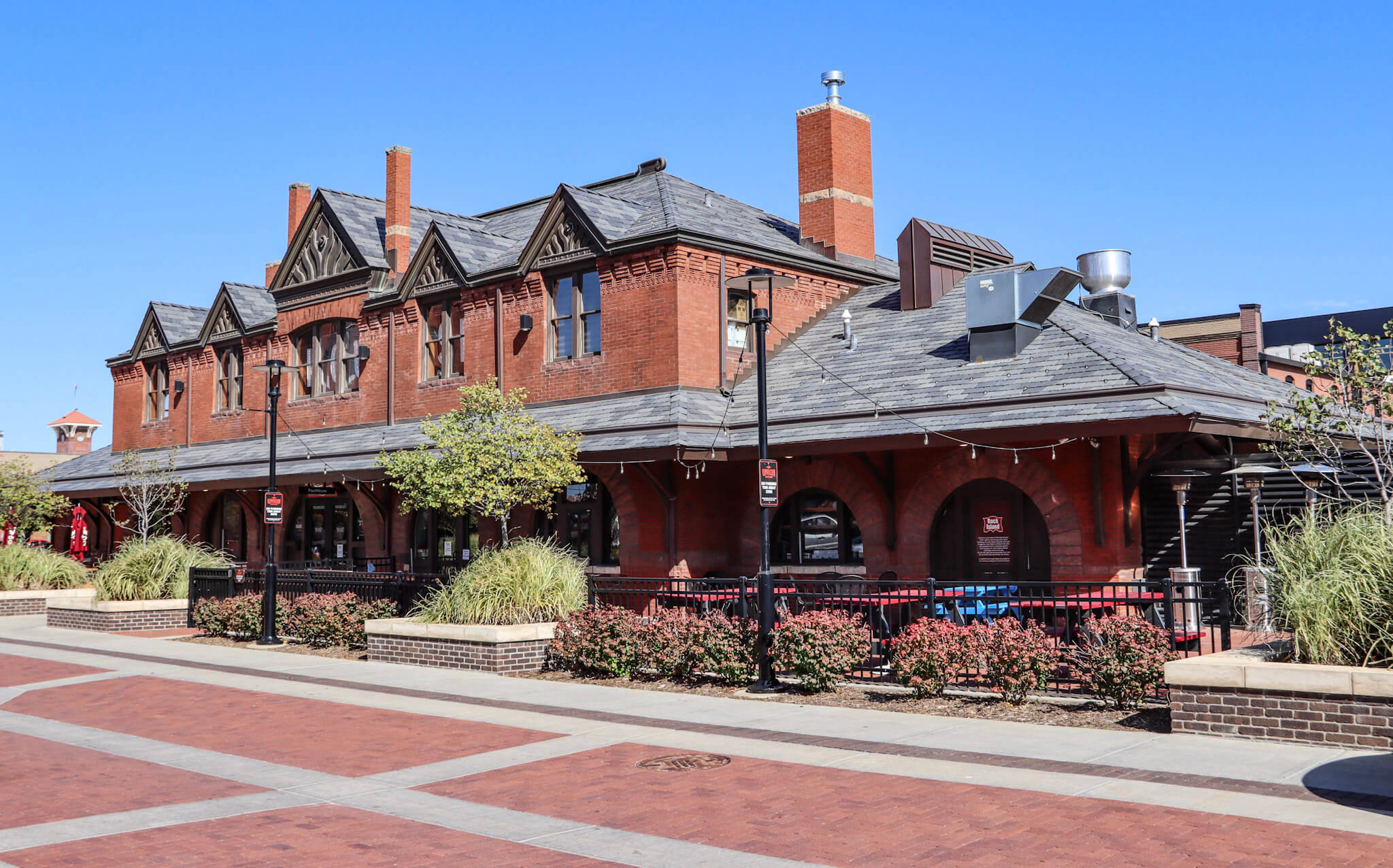
The utterly charming Rock Island Depot stands just a block from the train rails that brought wealth and prosperity to Wichita. Completed in 1887 in the late Victorian style for no more than $10,000, the depot has seen lots of transformations over more than a century since it was built as a freight and passenger station that handled the 42 passenger trains that rolled into town in 1899. Private waiting rooms for ladies and gentlemen became a thing of the past; the failing dining room morphed into a common waiting room, while the kitchen became a lunch counter. The telegraph operator eventually lost his area—today, it’s a pizza and tapas restaurant. Despite all that tumult, the depot largely looks the same. The two-story brick depot with two wings sports four chimneys, a slate roof, arched ground-floor windows protected by a deep eave, and a lovely cornice with dormer peaks. Added to the National Registry of Historic Places in 1973, it still stands as a fine contrast to its larger, newer neighbor across the street—another rail station that also serves a different function today.
#5 Union Station
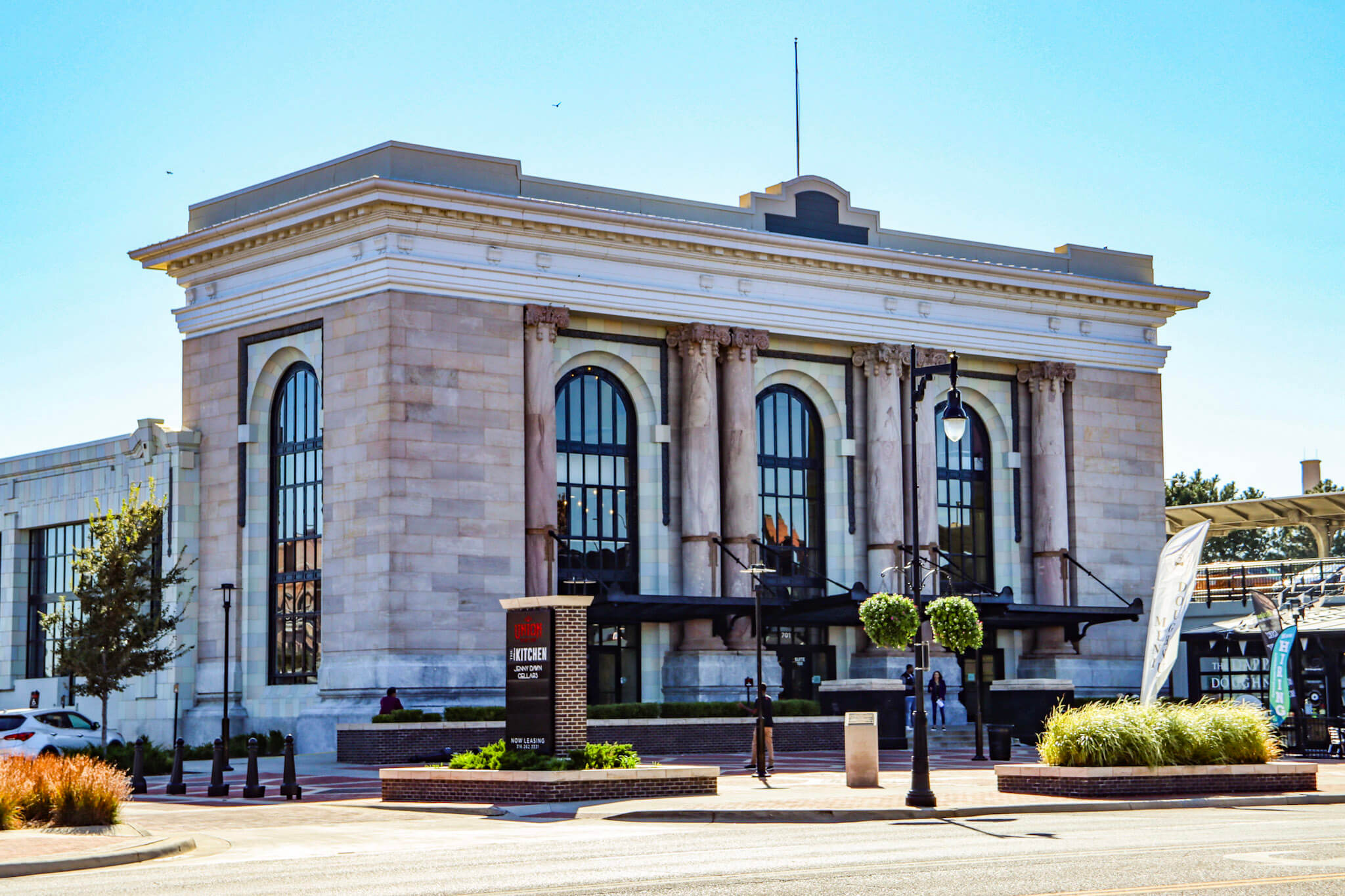
In the 1800s, there were no rules on how long trains could block traffic on Wichita’s streets. To resolve the problem, and to unite multiple different rail lines under a single roof, in 1909 the city’s mayor proposed elevating the tracks so that pedestrian and vehicular traffic could pass safely underneath. That meant building a new train station, and by 1914, Union Station was open for business. This wonderful Beaux Arts–style station, erected at a cost of $2.5 million, employed such materials as gray Bedford stone, gray terra cotta, plaster, and lots and lots of glass, so much so that the station was dubbed the “Daylight Station of America.” The main waiting room, measuring 165′ long, 125′ wide, and 25′ high, was flooded with so much light that one could read in any corner of the station on a bright day without the need for artificial lighting, and the huge windows also helped to showcase the decorative elements inside. Passengers would approach the main entrance, a lovely façade with soaring arched windows, each framed by a pair of Corinthian columns, via a circular driveway that allowed cars and carriages to drop them off under a weatherproof arcade. Inside, three meticulously maintained clocks would keep them on schedule while they shopped at the newspaper and fruit stand (long gone), snacked at the soda fountain (also gone), or dined in the state-of-the-art Harvey House dining room, which housed the station’s only stained-glass windows as well as a marble lunch counter and marble-topped tables (only the stained glass remains). As rail travel decreased, Union Station began to fade and show its age, and the last passenger train departed in 1979. After a stint as a telecommunication company offices, the newest owners have transformed it into a destination space, with retail, offices, and restaurants. The approach was redeveloped as a welcoming plaza with a pleasant brick and cement pattern, and the façade has been spruced up, making Union Station relevant, and beautiful, once more.
Five Runners-Up
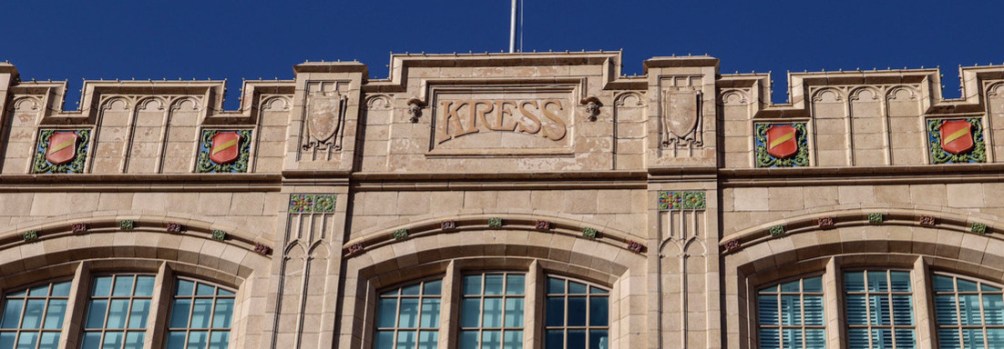
- Kress Building (1929)
- St. Anthony of Padua Roman Catholic Church (1905)
- Campbell Castle (1888)
- Orpheum Theatre (1922)
- Pratt/Campbell House (1887)
Leave a Comment
Have you been here? Have I inspired you to go? Let me know!


 Stephen Travels