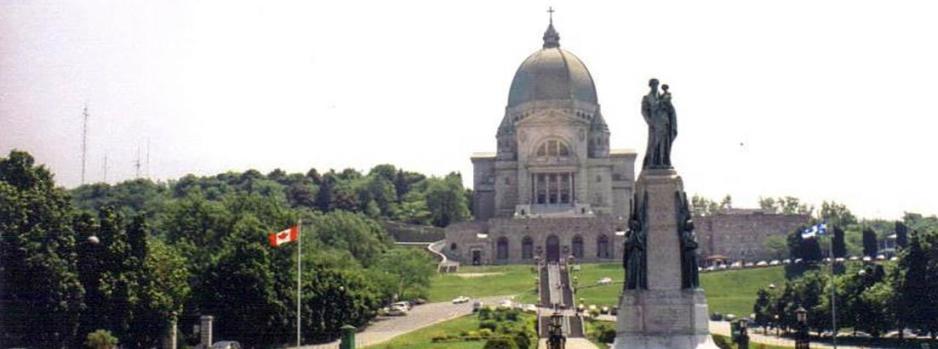
I was spending a particularly hot week in Montreal, shuttling between the rooftop pool at my hotel and the cool interiors of some of the city’s most spectacular buildings. With a bell tower almost always within sight, it was easy to duck into one building after another and escape the unseasonably steamy weather, until I ventured out again and came across another fantastic edifice. Once inside, of course, I forgot all about the temperature as I admired the outstanding architecture and craftsmanship of each and every one of them. These are my favorites.
#1 Notre-Dame Basilica of Montreal (Basilique Notre-Dame de Montréal)
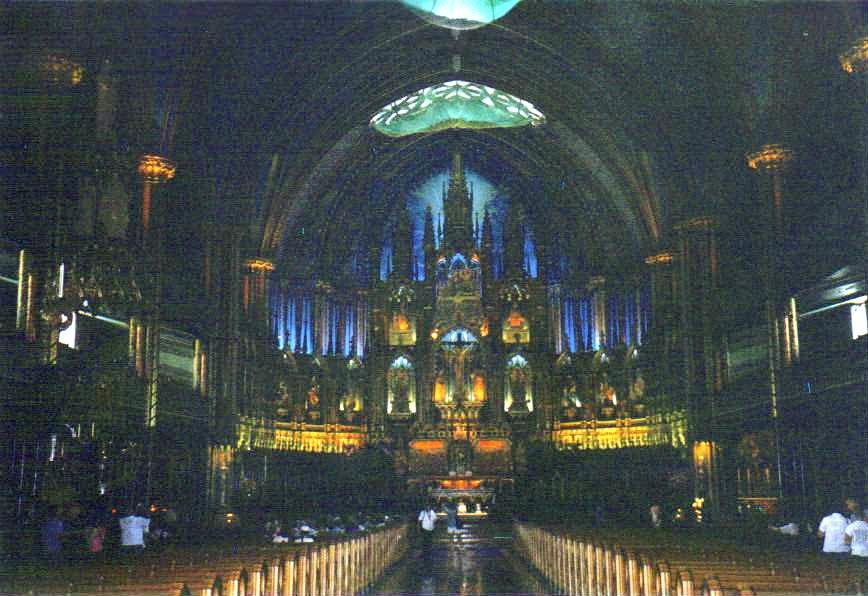 The powerful effects of merely stepping inside Notre-Dame Basilica, one of the city’s most recognizable buildings, can be traced back to 1830. Construction had ended the year before, and the architect, James O’Donnell, was so transformed by his experience in building the basilica that he converted from Protestantism to Roman Catholicism upon his deathbed. He remains the only person buried in the crypt. Canada’s first Gothic Revival church, with two almost oversized bell towers named Perseverance (which houses a 12-ton bell, one of the largest in North America) and Temperance that were added in the 1840s, remained the largest cathedral in North America for 50 years. Three statues in niches above the arched entrance—the Virgin Mary, St. John the Baptist, and St. Joseph—represent Montreal, Québec, and Canada, respectively. The tremendous interior, which can seat 4,000 worshippers, is awash in painstaking details. Although somewhat dark inside, the azure, gold, red, purple, and silver colors soon start to pop, especially the vaults’ exquisite blue ceilings decorated with golden stars. A double-level gallery runs along the sides of the church, joining in the rear at the fantastic organ from 1891. Intricate wooden carvings range from the pine statues in the choir to the decorative motifs in black walnut to the linden wood ceiling in a chapel, not to mention the beautiful pews and the gorgeous pulpit, adorned with religious figures and symbols. The stained-glass windows in the sanctuary depict scenes from the religious history of Montreal rather than the Bible. The floor slopes down to the main altar, which was hand-carved from a linden tree. As I made my way behind the altar to the more intimate and brighter Chapel of the Sacred Heart, I overheard a tour guide, a chap named Lucien who spoke exactly like Celine Dion (who was married here in 1994), relaying to his group how the chapel was restored and modernized in 1982 with a massive bronze altarpiece after a baleful miscreant with a can of gasoline and a match had his way.
#2 St. Joseph’s Oratory of Mount Royal (Oratoire Saint-Joseph-du-Mont-Royal)
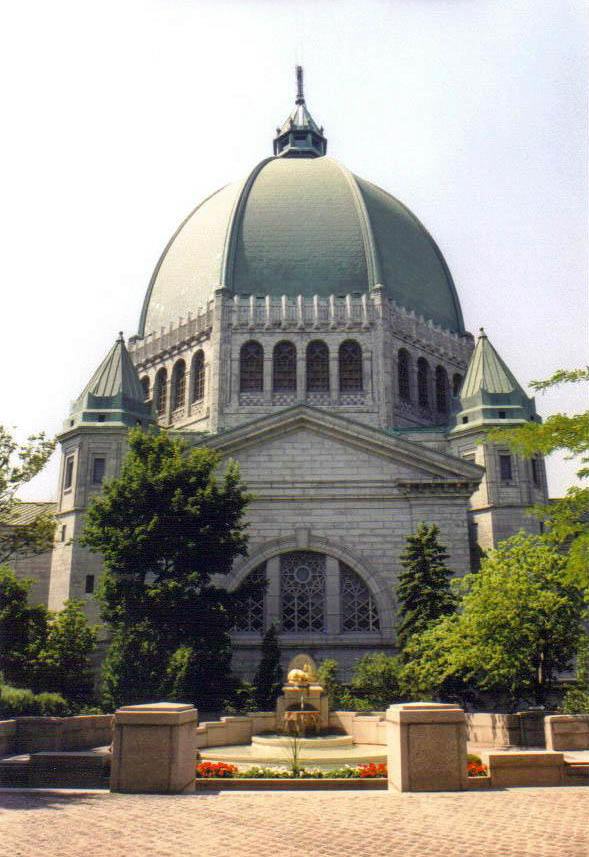 A short ride on the Metro from downtown Montreal brought me to St. Joseph’s Oratory, an absolutely enormous basilica with a giant copper dome turned verdigris green—the third highest in the world. It sits atop a hill that I climbed via one of three staircases, the third for pilgrims who choose to ascend 283 concrete steps on their knees. The largest shrine in the world dedicated to St. Joseph was completed in 1967 after decades of construction. Like the Basilica of Sainte-Anne-de-Beaupré, there is a display of thousands of crutches left by those who had come to the basilica and were healed through the miraculous intervention of Brother André Bessette, who was canonized in 2010. His heart remains in a reliquary in the church museum. An informative self-guided tour led me throughout the building, with its bright colors, stained glass, and unique multi-angled arches, and outside to the peaceful Way of the Cross and the simple chapel that Brother André built originally before starting on the basilica, which can now hold up to 10,000 people.
#3 City Hall (Hôtel de Ville)
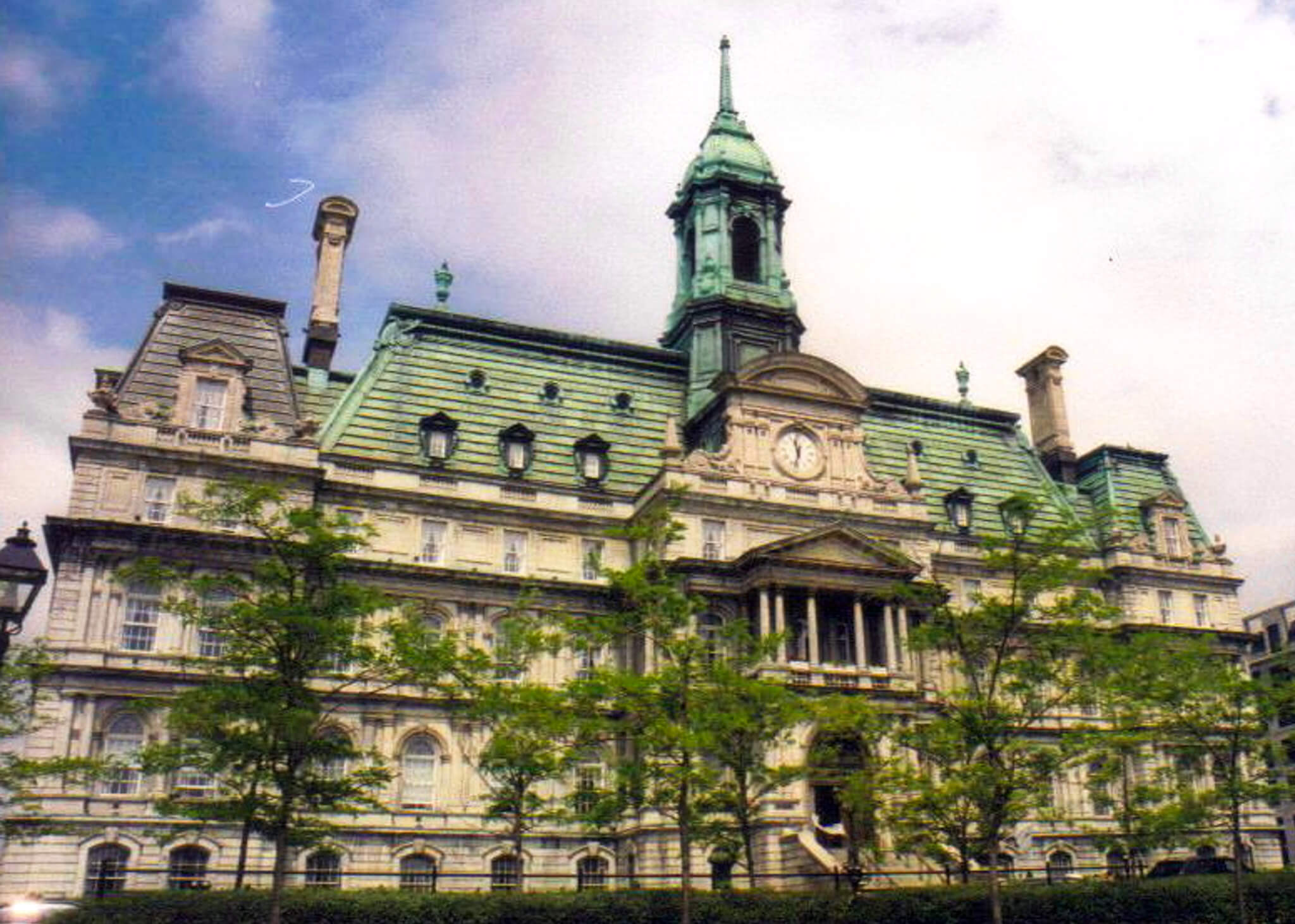 Directly across the street from the former governors’ home, Montreal’s City Hall was the first Canadian city hall to be constructed exclusively for municipal administration. It’s quite literally a shell of itself. Completed in 1878 in the Second Empire style, the five-story building was gutted by fire in 1922. Only the outer wall survived. The architect hired to rebuild it chose to create a completely new building inside the shell of the ruins. Modeled after the city hall in Tours, France, this handsome building features a central section flanked by two projecting wings, all of which are topped with a copper mansard roof with dormer windows and balustrades, and two unique chimneys that rise high above it. The central entrance sports an unadorned pediment supported by Corinthian columns, and the gable above it has volutes and a clock. Particularly attractive is the central campanile, an ornate 30’ tower in moulded and sheet copper. The new building opened in 1926 and was designated a National Historic Site of Canada in 1984.
#4 Mary Queen of the World Cathedral (Cathédrale Marie-Reine-du-Monde)
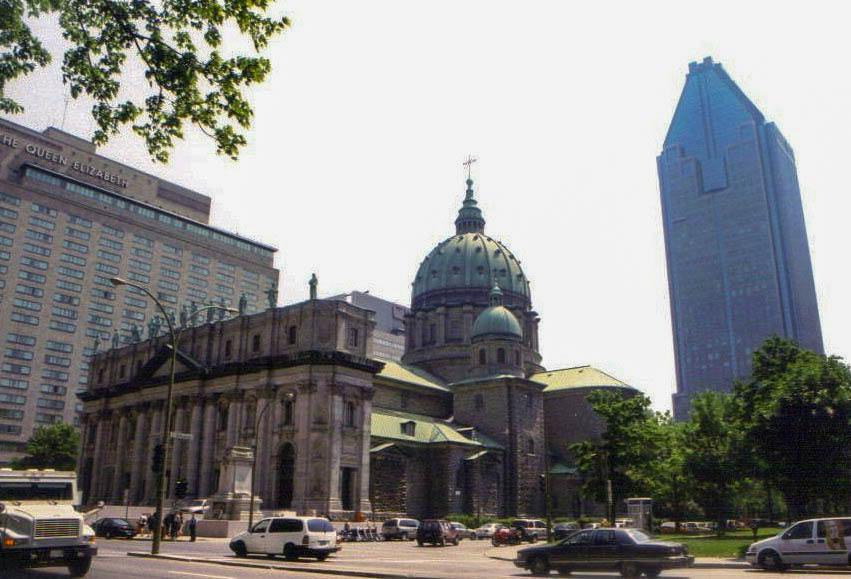 The splendid Mary Queen of the World Cathedral brings more than a little bit of the Vatican City to Montreal—it is, in fact, a replica of St. Peter’s Basilica, at one-quarter the size. Mostly completed by 1894, this minor basilica cost more than $1 million to erect, the first building in Montreal to reach that price tag. The façade certainly does evoke St. Peter’s, with its columns and pediment, and the dome rising behind it, but it’s missing the two clocks. Like the Vatican, statues stand at the roofline, but, unlike their originals, these are not the Apostles; rather, they represent the patron saints of 13 Montreal parishes that donated them, all sculpted by the same artist. Inside, plenty of similarities abound, although on a less grand but nevertheless impressive scale: the coffered barrel-vaulted ceiling above the nave, Corinthian columns, and the twisted columns of the baldachin on the altar among them. This cathedral has pews, however, allowing visitors like me to sit and take it all in: the paintings depicting historical events in Montreal, the great organ, and Biblical texts written in gold letters. One of the more curious details is the crucifix above the marble baptismal font: Sculpted in stucco, this material gives the impression that Christ’s flesh is decaying, and the sign above Him identifying him as the Nazarean is written backwards.
#5 Bonsecours Market (Marché Bonsecours)
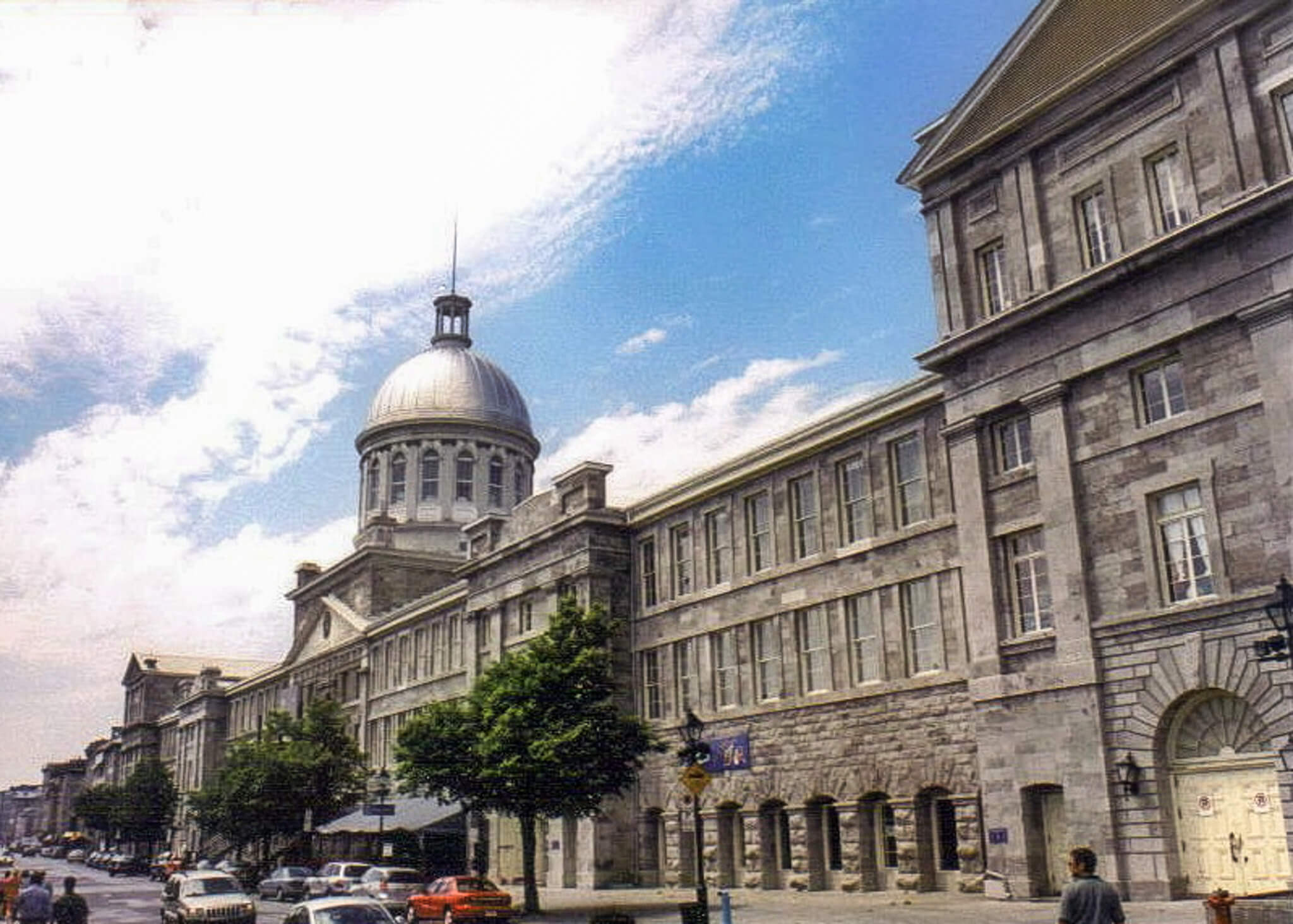 Throughout its illustrious history, Bonsecours Market was the city’s main public market for more than a century, from when it was completed in 1847. It has also served as the city hall chambers, Parliament’s meeting space for one session in 1849, a music recital hall, and the municipality’s housing and planning offices. Influenced by Dublin’s Customs House, Bonsecours Market is a long three-story building, spanning nearly 600’, with various recesses and projections along the way. The central bay features a pediment with the original 1833 coat of arms of Montreal, which features four images representing the city’s European founding factions—the rose is English; the thistle, Scots; the shamrock, Irish; and the beaver, French. The Latin motto reads Concordia Salus (“Salvation through harmony”). Above it is a magnificent silver dome, with a drum filled with windows. It seems somewhat ridiculous that after the market was closed in 1963, the building was slated for demolition. Fortunately, it survived, and it now houses cafés, restaurants, and boutiques as well as municipal office space and rental space for banquets. Designated a National Historic Site of Canada in 1984, it’s a great space to pop in to escape the heat of a Montreal summer or the iciness of a Montreal winter.
Five Runners-Up
- Montreal Memory Center (Centre des mémoires montréalaises, former Central Fire Station, 1904)
- St. George’s Anglican Church (1870)
- Our Lady of Good Help Chapel (Chapelle Notre-Dame-de-Bon-Secours, 1771)
- Erskine and American United Church (Église Erskine and American United, 1894)
- H. Vincent Meredith House (1897)
Leave a Comment
Have you been here? Have I inspired you to go? Let me know!


 Stephen Travels