
I broke up my drive from Atlanta to Savannah with a short stop in Macon. I arrived early on a Saturday morning, and it looked like Macon hadn’t woken up yet, except for a little café that served up some tasty snacks. With my treats in hand, I walked around the pleasant heart of the city, admiring the wide streets and the attractive buildings that flanked them. These are my favorites.
#1 Johnston-Felton-Hay House
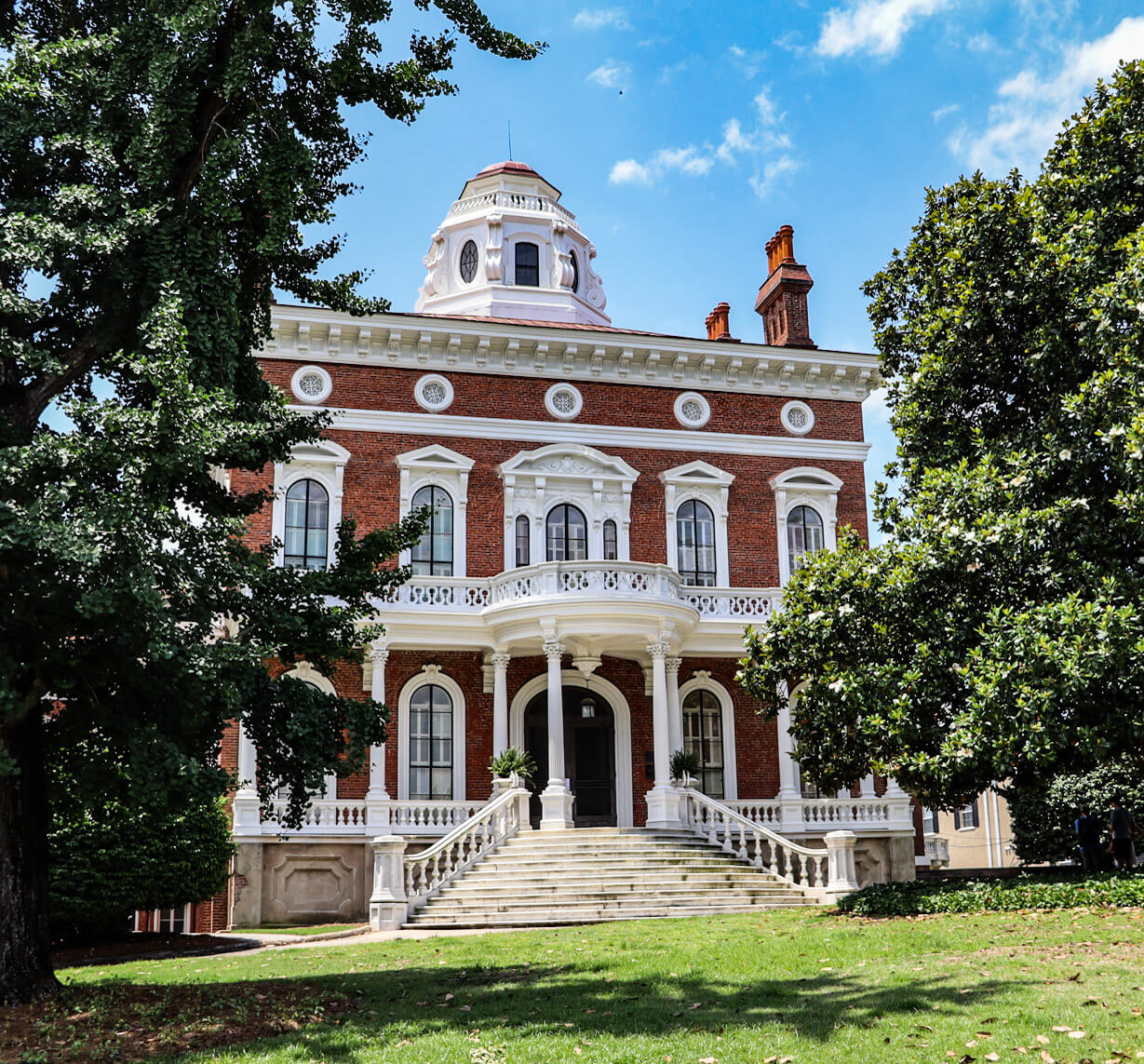
The handsomest house in Macon dates back to 1859 and was declared a National Historic Landmark in 1974. This Italian Renaissance Revival–style home arrested my attention as I arrived at the head of Mulberry Street, a wide boulevard with a park-like meridian. The four-story Johnston-Felton-Hay House covers a whopping 18,000 square feet. The brainchild of wealthy investor William Butler Johnston and his wife, the “Palace of the South” incorporated technological amenities that were unmatched at the time: hot and cold running water, central heat, gas lighting, a speaker-tube system, an in-house kitchen, and an elaborate ventilation system. In 1888, their youngest daughter married William H. Felton, and they became the house’s primary owners. Following their deaths, their heirs sold the house in 1926 to Parks Lee Hay, and after his wife died in 1962, her heirs operated the mansion as a private house museum, a tradition that continues today, but under the ownership of the Georgia Trust for Historic Preservation since 1977. Two wings flank the central block. A tapered staircase leads up to the main entrance, protected by the portico above that curves out at the front door and runs the width of the building, supported by a series of Corinthian columns. Each level features a unique balconet. Windows on the entrance level are arched and capped with a keystone, while those on the upper story alternate between pointed and curved pediments, with the central one combining both, and all supported by a pair of brackets. Five ocular windows run across the top floor, underneath the heavily bracketed cornice. The roof is dominated by four sets of chimney stacks and a two-story octagonal cupola with both lozenge and arched windows, separated by volutes, that serves both as an aesthetic draw and a practical purpose—as part of the ventilation system, it functions as a chimney, drawing hot air up and out of the house. Make sure to go inside, and you’ll see one of the most gorgeous interiors in Georgia.
#2 St. Joseph Catholic Church
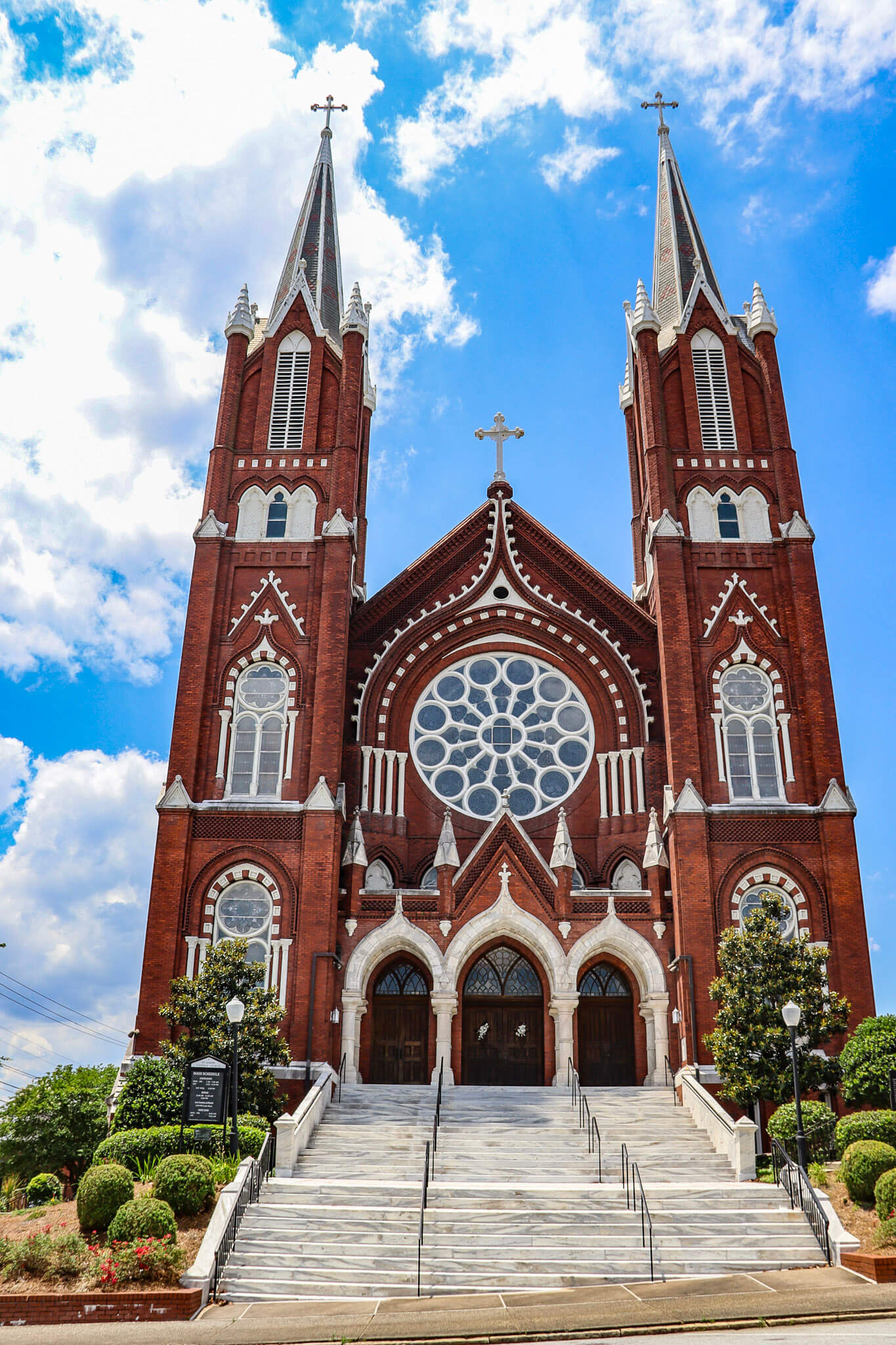
The November 15, 1903, edition of the Macon Telegraph wrote this about the church on the day of its dedication: “If architecture may be fittingly described as frozen music, St. Joseph’s Church, to be dedicated today, is a symphony.” I’d say that’s pretty accurate. After 14 years of construction, the majestic St. Joseph Catholic Church emerged as the third tallest building in Macon, boasting the city’s tallest twin bell towers, reaching a height of 200’. Like a beacon visible from fairly far away, the neo-Gothic church (along with its next-door neighbor, the First Baptist Church of Christ), drew me to its massive structure. A long marble staircase leads up to the trio of entrances in the central block. Above, a massive rose window is flanked by an ogee arch that rests on four columns on both sides and tapers up to a cross. Crosses also top the spires of the bell towers on either side. You can completely circumnavigate the entire church, which enables you to take in its sheer size as well as the form of the side chapels and the dome. Listed on the National Register of Historic Places in 1971, the church also features five dozen stained-glass windows, an organ with 1,000 pipes, and a white Carrara marble altar, pulpit, and Stations of the Cross.
#3 Bibb County Courthouse
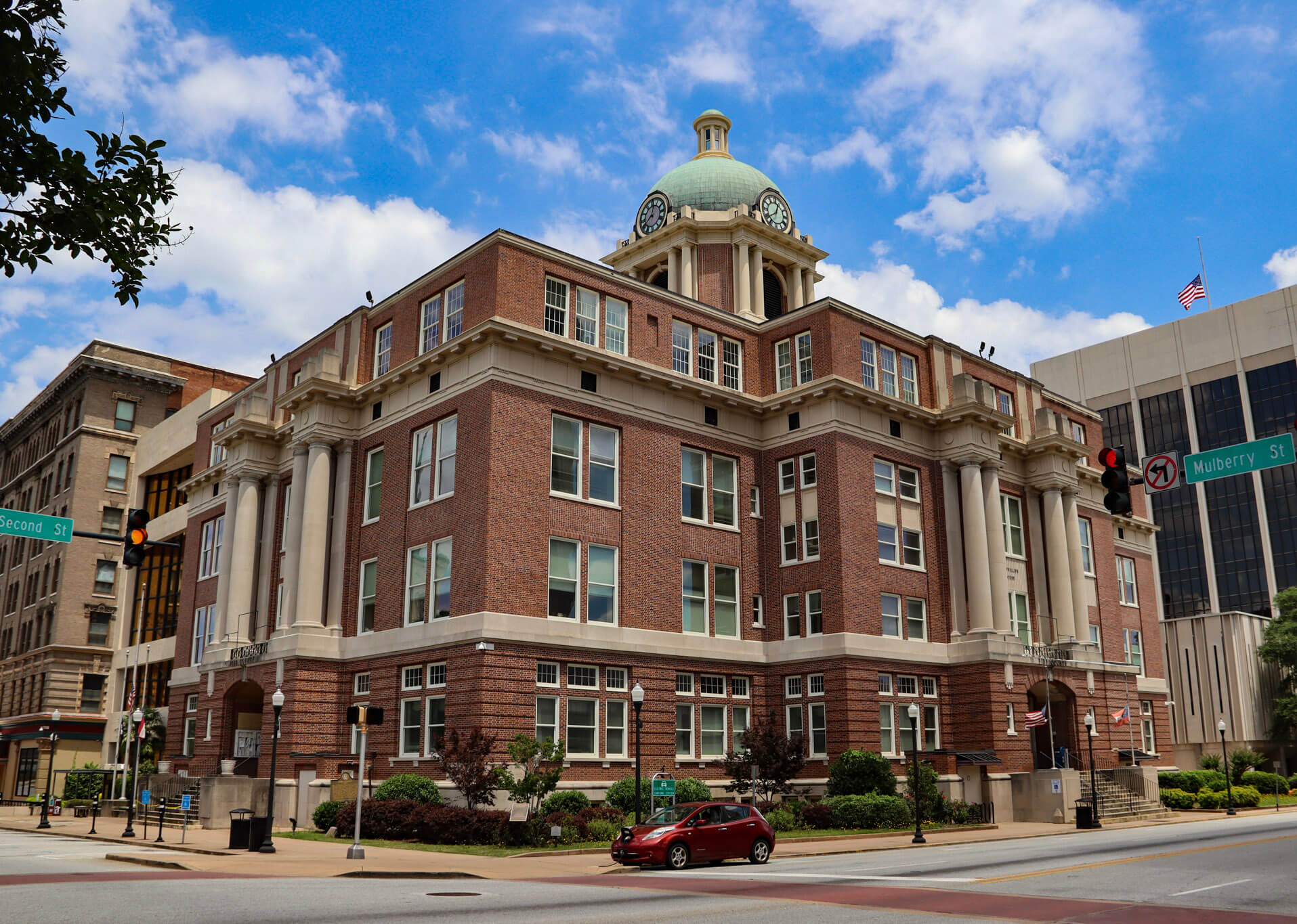
Completed in 1924 and entirely remodeled in 1940 as a WPA project, the Bibb County Courthouse looks even newer than that. The Neoclassical Revival brick structure’s corner location grants it two entrances, each approached via a staircase to an arched entry. Above, two sets of two Doric columns rise two stories and anchor the entablature that encircles the building and sets off the top story. The columns are repeated on the roof, supporting an arched cupola with a verdigris-green dome, four clocks, and a lantern. It reminded me more of a high school than a courthouse, and it presents an attractive façade to Mulberry Street, especially when juxtaposed with the adjacent bland new addition pressed hard against it on its northwest wall.
#4 Mulberry Street United Methodist Church
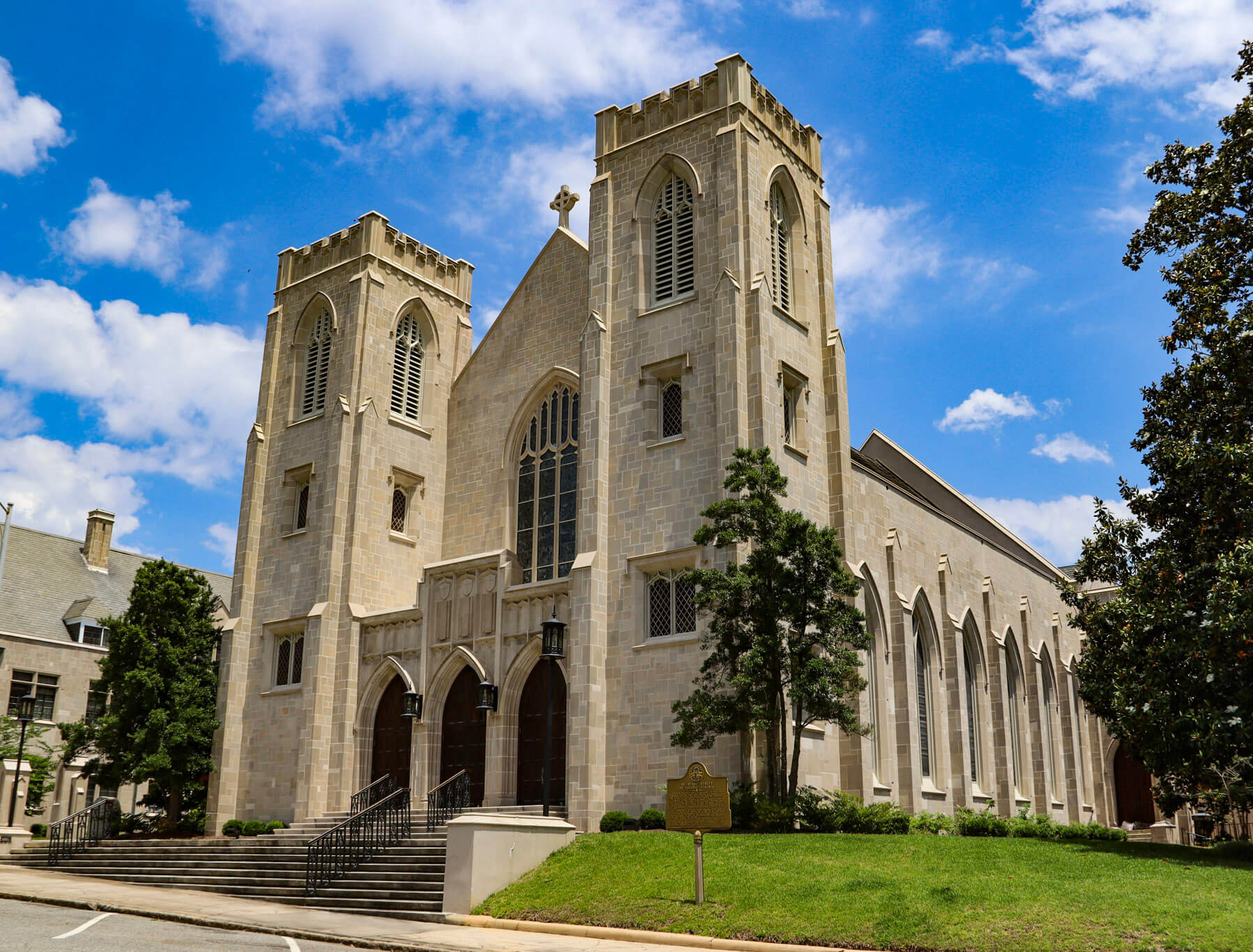
One block north of the courthouse, Mulberry Street United Methodist Church has been a presence in Macon since 1826. The current structure is the third church building here. The first, completed in 1828 (including a large gallery to be used by slaves), quickly outgrew its usefulness and was replaced only 20 years later. The second lasted until 1965, when, after a series of expansions, renovations, and remodeling, a fire destroyed the sanctuary. The newest church, which bears the vibe of an English church, opened in 1968 and incorporated its predecessor’s stained-glass windows, which miraculously survived the fire. A front staircase leads up to a trio of pointed-arch entrances. A pair of bell towers flank the main entrance, topped with battlements. The monochromatic cream-colored stone façade is a warm presence on Mulberry Street for all to admire.
#5 Grand Lodge of Georgia
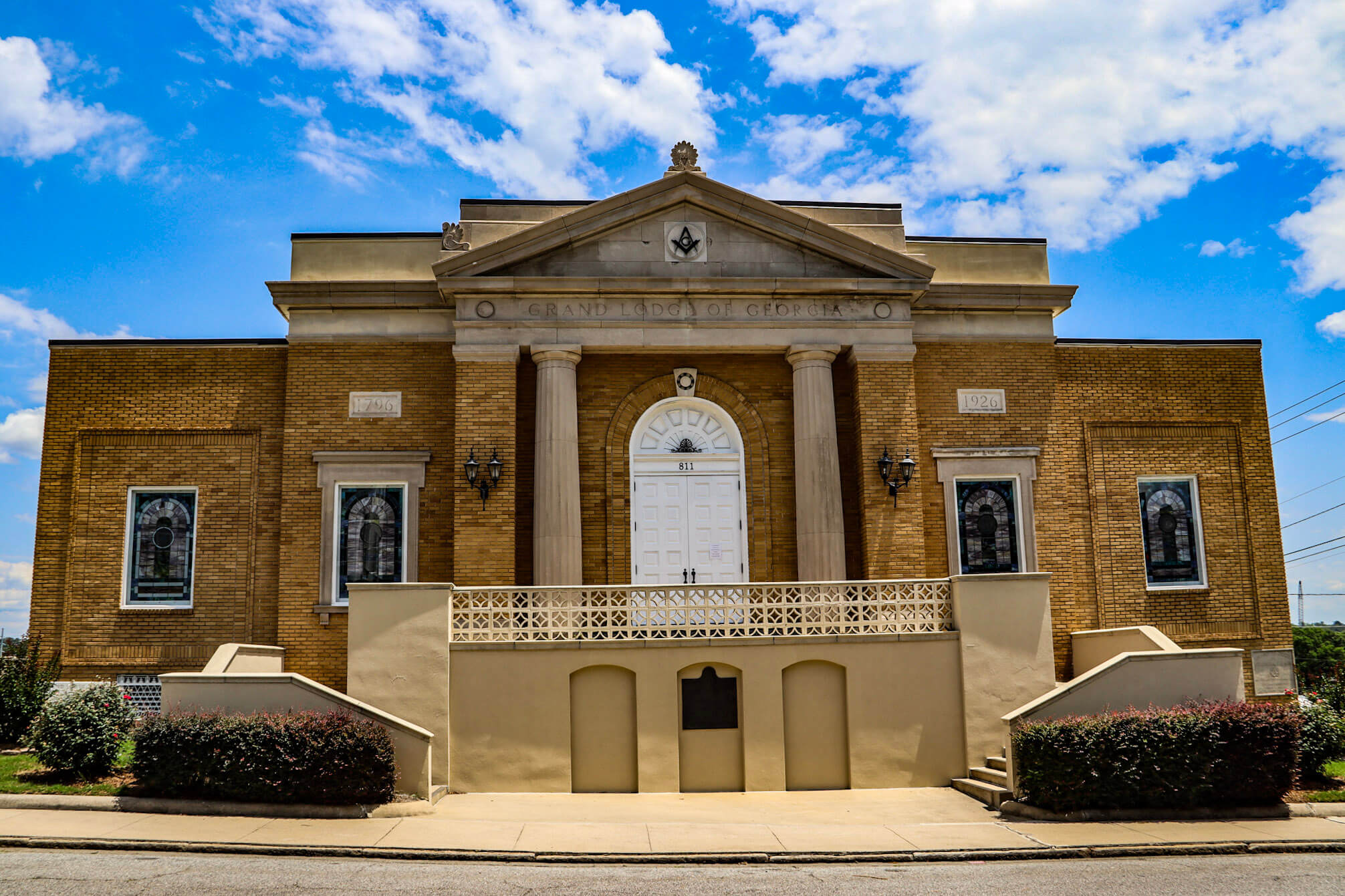
Another block north along Mulberry Street brought me to the Grand Lodge of Georgia. Built in 1926 for the Free & Accepted Masons, it serves as the offices of the Freemasonry, one of the world’s oldest and most historic membership organizations. For more than three centuries, it has been a global fraternity of individuals dedicated to self-improvement and community service. Stained-glass windows comprise the bulk of the fenestration of the building, faced mostly with warm, honey-colored brick. A split staircase joins at the large white entrance doors. Flanking the doors, fluted Doric columns that look like they came off an Egyptian temple (the Freemasons were heavily influenced by ancient Egypt’s architects and monumental structures) support the pediment, with the Masonic symbol—the square, the compass, and the letter G—inserted into the plain tympanum. That G serves a dual significance—it stands for both geometry and for the Great Architect of the Universe, not necessarily God, as the Freemasonry doesn’t require the belief of any specific deity for its members.
Five Runners-Up
- Cannonball House (1853)
- 964 Georgia Avenue (1890)
- Harris-Hall-Bennett House (1902)
- Al-Sihah Shrine Temple (1931)
- Furman Smith Law Library, Mercer University (1965)
I’d Love to Hear From You!
Have you been here? Have I inspired you to go? Let me know!


 Stephen Travels