As I walked through Spanish Town, a historic district in Baton Rouge, Louisiana, I could still feel the vibes of the Mardi Gras celebration a few days prior. Beads still hung on fences and porch railings, decorations remained planted in small front lawns. It’s a unique place, just like many others in Louisiana, reminding you that this state possesses a fascinating history that comes to life through its wonderful buildings. These are my favorites.
#1 Oak Alley Plantation (Vacherie)
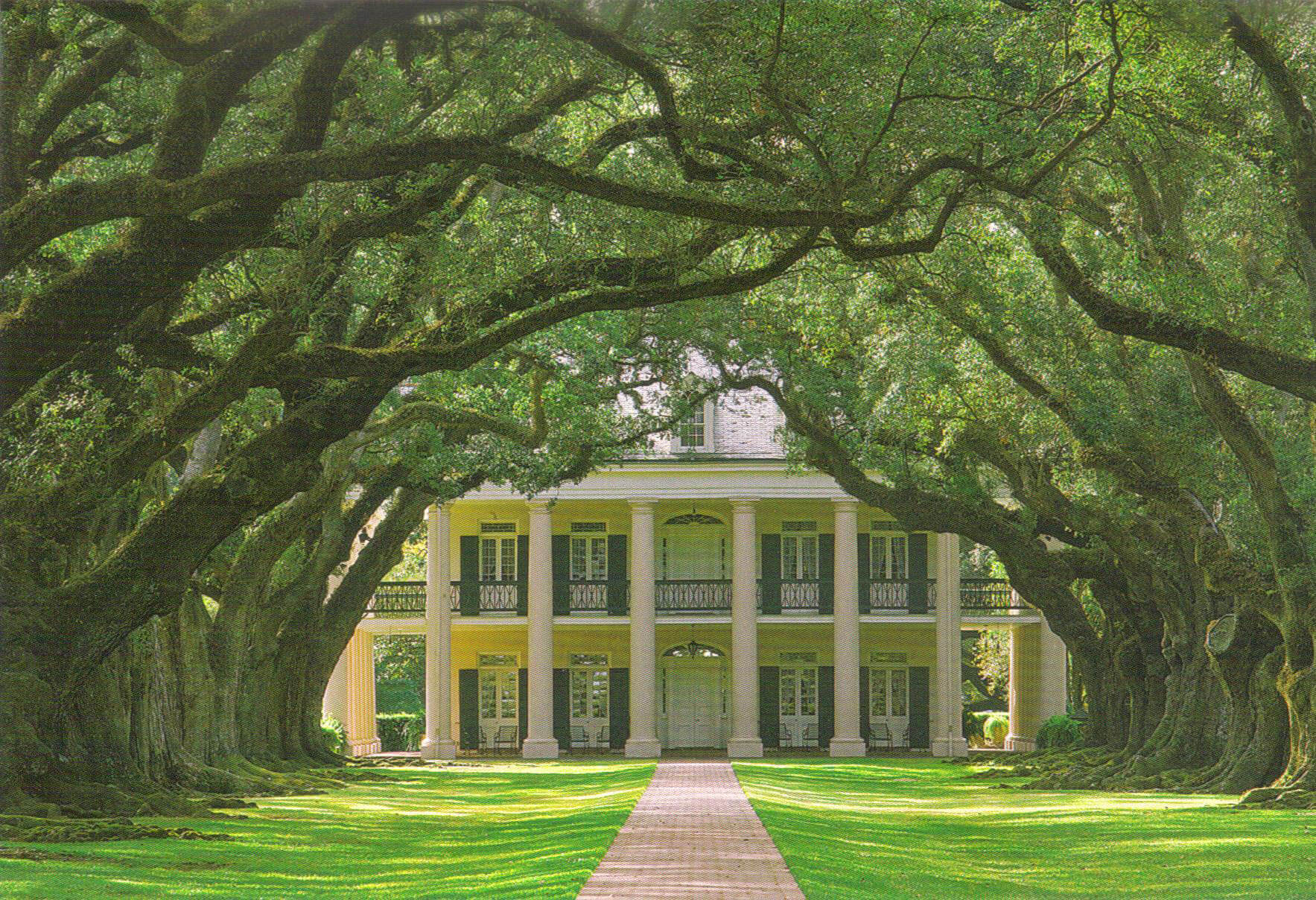 Plantations are a tricky entity: They’re gorgeous buildings with an ugly history. For the sake of this article, let’s put aside the shame of slavery and concentrate on the actual structures themselves. Oak Alley Plantation was established on more than 1,000 acres to grow sugarcane. Twenty-eight live oak trees, which were planted before the plantation house was constructed, flank the allée leading from the Mississippi River to the Big House, forming a cool interconnected canopy above. This plantation in Vacherie was built in 1839 by slaves for businessman and sugar planter Jacques Telesphore Roman. After Roman died, his poorly equipped wife bankrupted the estate, which was then rescued by her better-qualified son. The Civil War spared the plantation, but the end of slavery made it no longer a viable economic entity. Sold off to a series of different owners and morphing into a cattle ranch in the early 1900s, the plantation eventually passed from private to public ownership. Sugarcane was reintroduced in the 1960s, and today the restored plantation is open for visitors. Named a National Historic Landmark in 1974, the Greek Revival–style house features a colonnade of 28 Doric columns (deliberately the same number as the oak trees along the approach) and a veranda that wraps around all four sides on two stories. Constructed of bricks made on the site, the 16” walls are finished with stucco and painted white to resemble marble. Three dormer windows pop out of the hipped roof on all four sides. Inside, a central hall runs from the front to the rear on both stories, and the rooms feature high ceilings and large windows. The interior has been fully restored and furnished, from the elegant living room to the four-poster beds. The dining room features a punkah fan hung over the table and, attached to a rope and pulley, would be manually operated by a servant or slave during the entire meal to cool the guests and to shoo away flies. The position was tiring, and precarious: The operator had to make sure not to blow out the candles. Be sure to note the most meaningful and thoughtful feature of the planation: When you’re on the second floor, look out at the drive that swoops around a plot of grass, shaped like a teardrop and created to symbolize the plight of the slaves who toiled here—an addition made by one of the White women who lived here.
#2 San Francisco Plantation (Garyville)
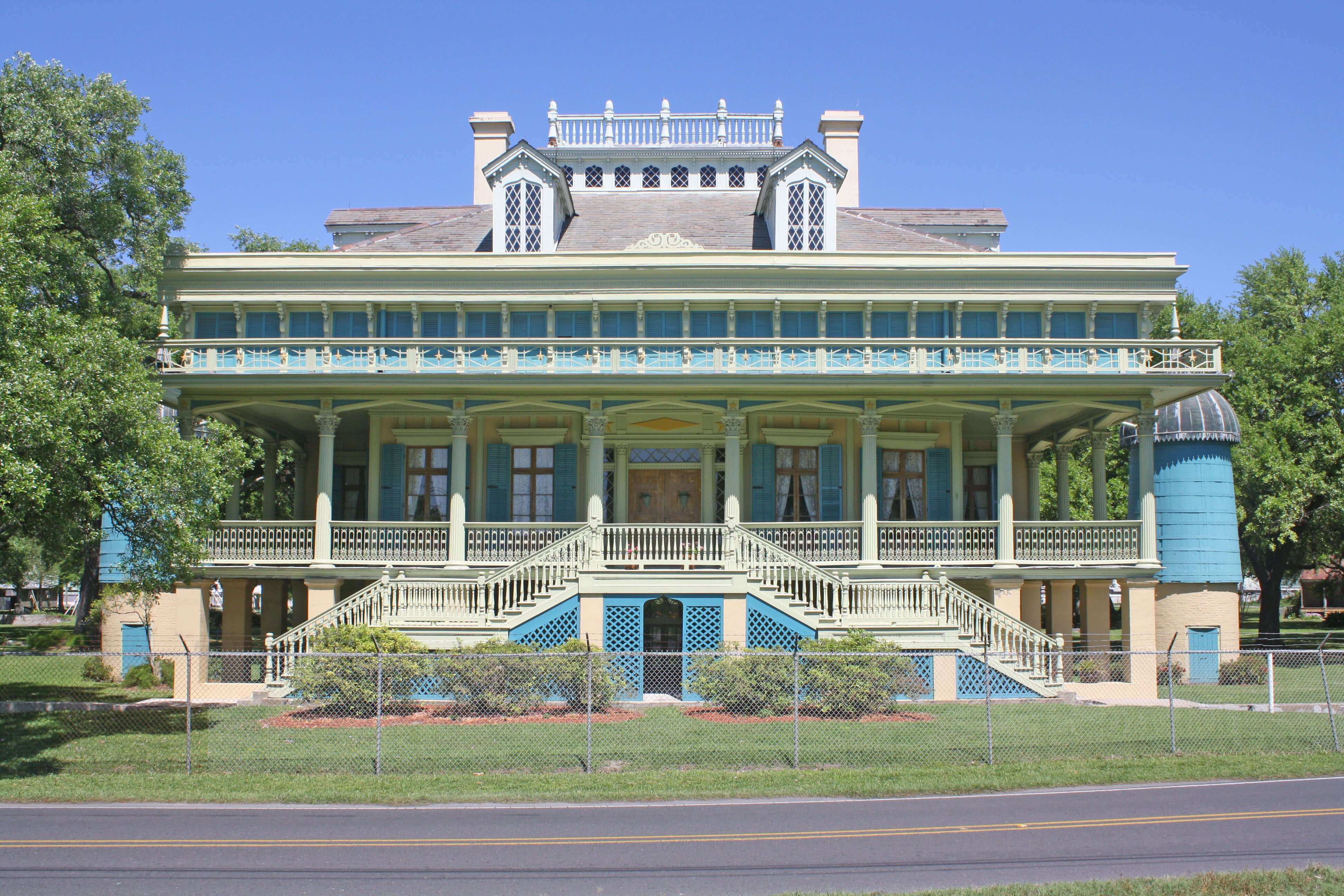 About 40 minutes outside of New Orleans, I drove along the River Road (which, thanks to the levee, makes the river no longer visible) to San Francisco Plantation in Garyville. Now surrounded by a Marathon Petroleum Corporation refinery, San Francisco was built in 1856 by sugar planter Valsin Marmillion and his Bavarian wife, Louise, and got its name not from St. Francis but from the French sans frusquin (“without a penny in my pocket”), a half-hearted lament Marmillion often made about Louise’s expensive tastes when building and decorating the place. It’s a frilly, galleried house in the old Creole style, with gingerbread trim in blue and cream, two enormous cisterns, side-facing divided staircases leading up to the main floor almost completely encircled by a deep porch, and a 20’ attic used for ventilation, topped by a widow’s walk. Inside, foldable doors could convert three rooms into one (saving the Marmillions on taxes that were based on the number of rooms). There’s fake marble and fake wood throughout, hand-painted ceilings, and a boudoir (literally, a pouting room). Here, I learned the origin of the phrase “mind your beeswax”: Ladies who had suffered from scarlet fever and were left with pockmarks on their face would fill in the holes with beeswax. Standing next to a fireplace, however, even with a handheld heat fan, could prove disastrous. Thus, minding your beeswax became a critical reminder for society’s ladies. I also learned the origin of the phrase “getting the short end of the stick”: A young man who was courting a young woman would be invited by her father to dinner. After the meal, the couple went into the parlor, where the father would place a courting candle into a screwable stand and light it. The couple could be together until the candle melted to the top rim of the corkscrew. If Dad liked the young gent, he set the candle higher, so it would take longer to melt. If he did not, the candlestick was set lower: The short end of the stick meant he was not in favor and would not be invited back. In the dining room, look on the table for the fly jar, which was filled with molasses and a little arsenic. Flies would go in, drink the poisonous mix, and die. But, since no one really wanted to see that during a meal, a white cloth was placed discreetly over the jar. Make sure you check out the grounds, where you’ll find a small one-room school for White slaves of European ancestry—a phenomenon ignored in the history of U.S. slavery. Designated a National Historic Landmark in 1974, San Francisco Plantation is both highly attractive and immensely educational.
#3 Louisiana State Capitol (Baton Rouge)
 The tallest state capitol in the United States, as well as the tallest building in Baton Rouge and once the tallest in the South, the Louisiana State Capitol took only 14 months to complete, in 1932. One of only four U.S. capitols built as skyscrapers, it rose under the order of Governor Huey Long, who was assassinated in the building in 1935 and is buried under a statue of him on the grounds. I approached this art deco limestone beauty via the well-manicured grounds in front of it, affording an unobstructed view of all of its 450’ stretched over 34 floors. The tower rises from a broad base, adorned with a frieze depicting the actions of Louisianans during peace and war, from colonization to the First World War. Let your eyes wander up to the top and spy colossal statues, eagles, and pelicans. Enormous sculptural groups, Pioneers and Patriots, flank the monumental staircase, where each step up to the entrance is etched with the name of a state, in chronological order of admittance to the Union. Keep looking and you’ll find reliefs and panels of figures representing the rulers of Louisiana (Spain, France, the United States, and the Confederacy), alligators, smokestacks, and sugarcane, among others. Pass through the bronze doors, each weighing a solid ton, with sculpted panels representing events in the state’s history, and enter the striking Memorial Hall, with a gorgeous ceiling, chandeliers, and a bronze relief map of the state with its parish borders, industries, exports, flora, and fauna. I rode the elevator up to the observation deck on the 27th floor, where I was rewarded with unimpeded views of the entire city, from the heavy industry to the north, to the parkland to the east, to the rest of the city to the south, to the Huey Long Bridge and Mississippi River, with its myriad vessels, from cargo ships to paddle wheelers, to the west.
#4 Old Louisiana State Capitol (Baton Rouge)
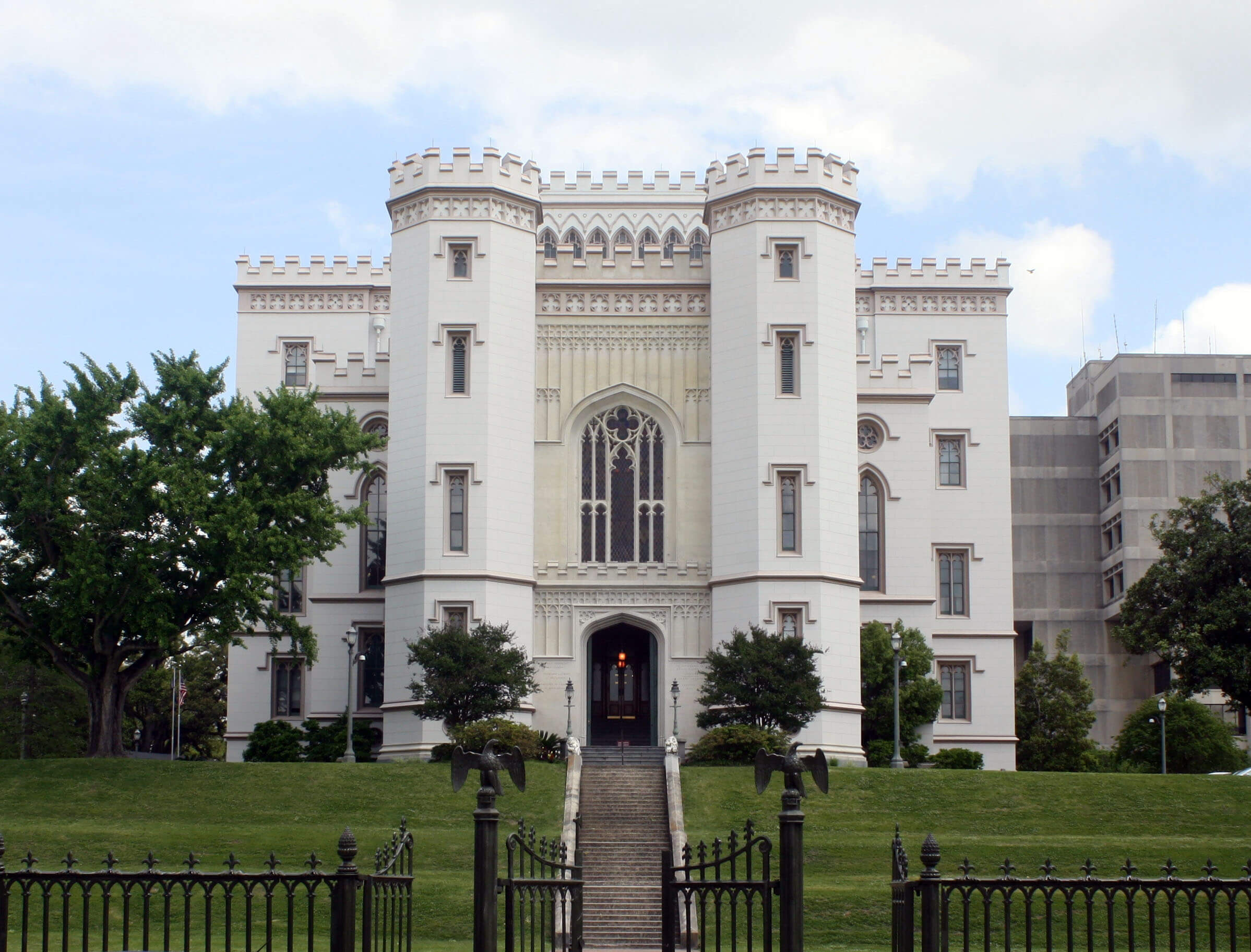 High on a bluff overlooking the Mississippi River stands the Old Louisiana State Capitol. Home of the Louisiana State Legislature from the year it was built, 1852, until it was replaced by the newer capitol (above), this Gothic Revival eye-catcher was designated a National Historic Landmark in 1974. Built to resemble a medieval castle, with two towers at the top of a long staircase, and a crenellated roofline, the building was occupied by Union forces during the Civil War and used first as a prison and then as a garrison, during which time it caught fire (twice), completely gutting it. It received its most defining interior elements during the rebuild and restoration in the 1880s and 1890s: the wide, cast-iron spiral staircase that is truly a work of art, and the stunning stained-glass dome supported by a column that flares out at the top. Although you’ll want to continually look up, don’t forget to look down: The floors in the main public area are black and while fossilized marble.
#5 Cathedral-Basilica of St. Louis (New Orleans)
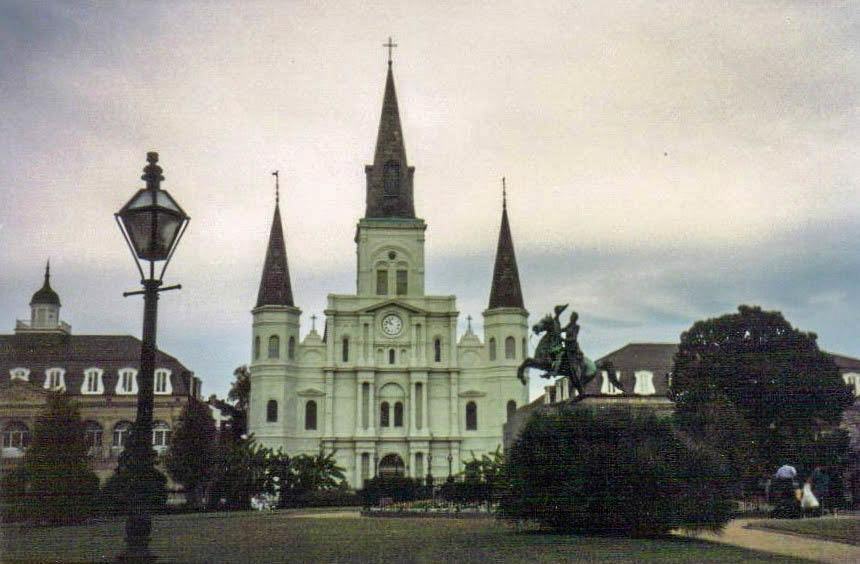 One of the Crescent City’s most iconic buildings stands at its very heart, Jackson Square. As the oldest cathedral in continuous use in the United States, St. Louis dates back to 1718, although the current building, the third incarnation, was completed in the 1850s. Its fairly simple off-white symmetrical façade features three steeples—the two on the sides feature crosses and a star among the tiles of different shapes, while the central tower has louver dormer windows. Inside, the stenciled barrel vault ceiling is a work of art, supported by Ionic columns with gilded capitals along the upper galley. Two cherubs holding shells filled with holy water greet you as you make your way down the central aisle on your way toward the altar and the impressive mural above it. When you visit one of the top five things to see in New Orleans, you’ll be following in the footsteps of Andrew Jackson, Zachary Taylor, and Pope John Paul II.
Five Runners-Up
- Old Post Office (Baton Rouge, 1894)
- Bradish and Louisa Johnson House (New Orleans, 1872)
- St. Joseph Cathedral (Baton Rouge, 1856)
- Old Governor’s Mansion (Baton Rouge, 1930)
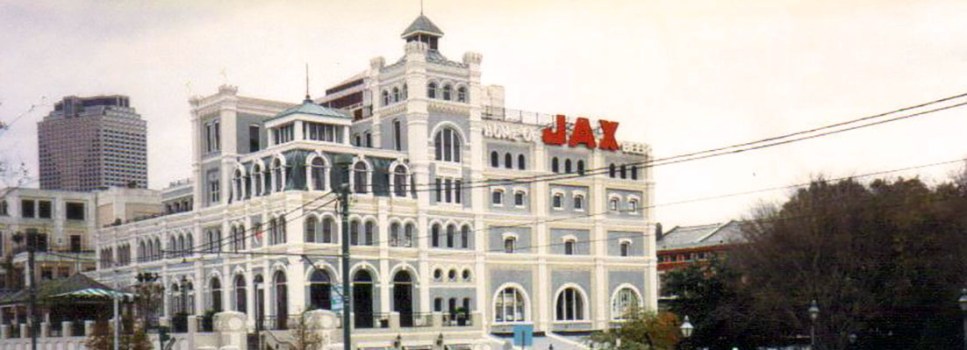
- Jackson Brewery (New Orleans, 1891)
Leave a Comment
Have you been here? Have I inspired you to go? Let me know!


 Stephen Travels