Although it’s the second-largest city in Delaware, Dover has never been large, even if its population has grown steadily in every decade since 1870. Founded in 1683, it still had fewer than 20,000 people by 1975, and today it hovers around 39,000. That makes it a wonderfully compact city to take in its major sights—and there are lots of them, filled with important historical events and some striking architecture, particularly among its private homes. These are my favorites.
#1 “The Castle”
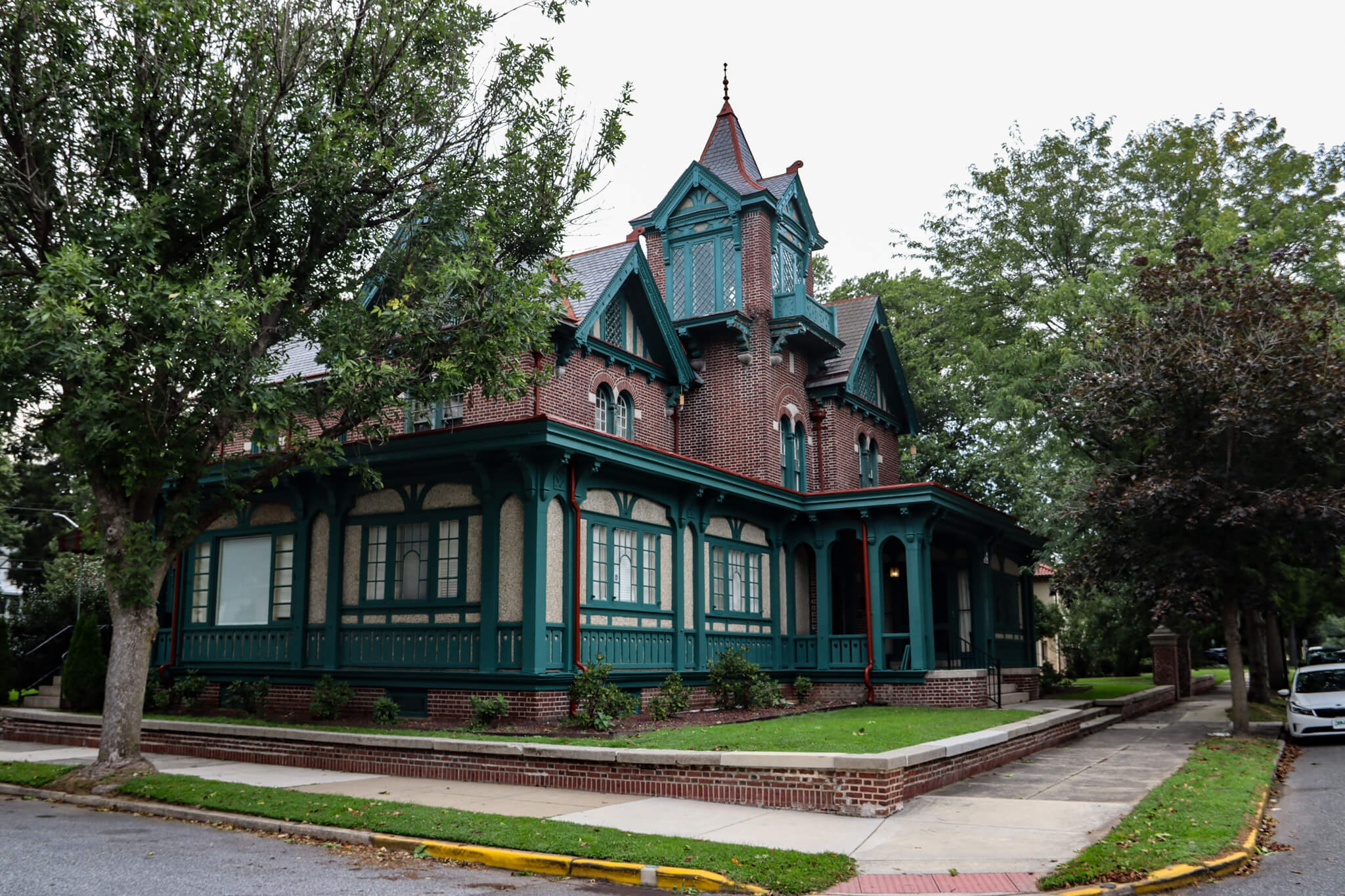
Every morning, I would rise from my comfortable bed at the State Street Inn, a Tudor-style bed and breakfast built as a private home in 1911. I would enjoy my morning meal on the inviting front porch, watching the sun slowly announce its arrival over the trees and houses across the street in the Victorian Dover Historic District, where strolls through this gorgeous residential area with spectacular homes mostly from the late 1800s running up and down State Street block after block after block are positively mandatory. And every morning I would gaze across the street at the grandest of all the homes I would see, appropriately nicknamed “The Castle,” a Victorian Gothic mansion built around 1885. Owners have switched hands a few times since its construction, including a canning millionaire who was elected to the U.S. Senate in 1904. A proposal to convert it into a hotel never came to fruition. Instead, in the 1930s its original 57 rooms were divided into rental apartments, now numbering 11 spread out over 55 rooms. Despite its transformation, it still retains its half-timber façade, gables, intricate brickwork, three-story tower, and finials at each roof peak. Framed by small lawns with brick retaining walls, the building features tall chimney stacks and porches at both the entrance and the side. A morning view couldn’t be lovelier.
#2 Richardson Hall

With 482 contributing buildings in the Victorian Dover Historic District, I was excited to aimlessly roam around to appreciate their style and history. Richardson Hall is by far one of the major standouts, exactly why, after it was converted into office space, the new occupants became the very appropriate State Historic Preservation Office and the Delaware Division of Historical and Cultural Affairs. Listed on the National Register of Historic Places in 1979, Richardson Hall was built in 1882 and shared a parallel life to “The Castle.” It, too, was constructed for a wealthy local entrepreneur, Harry A. Richardson, who ran another major cannery in the city and who was also elected to the U.S. Senate, in 1907, after serving as president of the First National Bank. He originally shared his home with his sister-in-law and three African American servants. By the turn of the 20th century, the household expanded to include Richardson’s wife, daughter, son, and daughter-in-law. Eventually, the family home was sold to nearby Wesley College, which used it for classrooms and eventually a dormitory. Threatened by neglect and with unthinkable demolition, the Delaware Division of Historical and Cultural Affairs stepped in and rescued it. A shallow brick staircase leads up to the arched entrance of the three-story building, clad in brick on the lower two levels and wooden fish-scale shingles on the top. A porch with uniform spindlework wraps around three sides, leading to the enclosed rear porch, including around the round corner tower, capped by a conical roof topped with a twisted verdigris-green spire. An open balcony on the second floor occupies the space above the entrance below, while the third floor is adorned with a slender eyebrow window and a sheltered balcony below the gable with an ocular window. Dover and I are grateful the wrecking ball didn’t succeed here.
#3 Dr. Henry Ridgely House
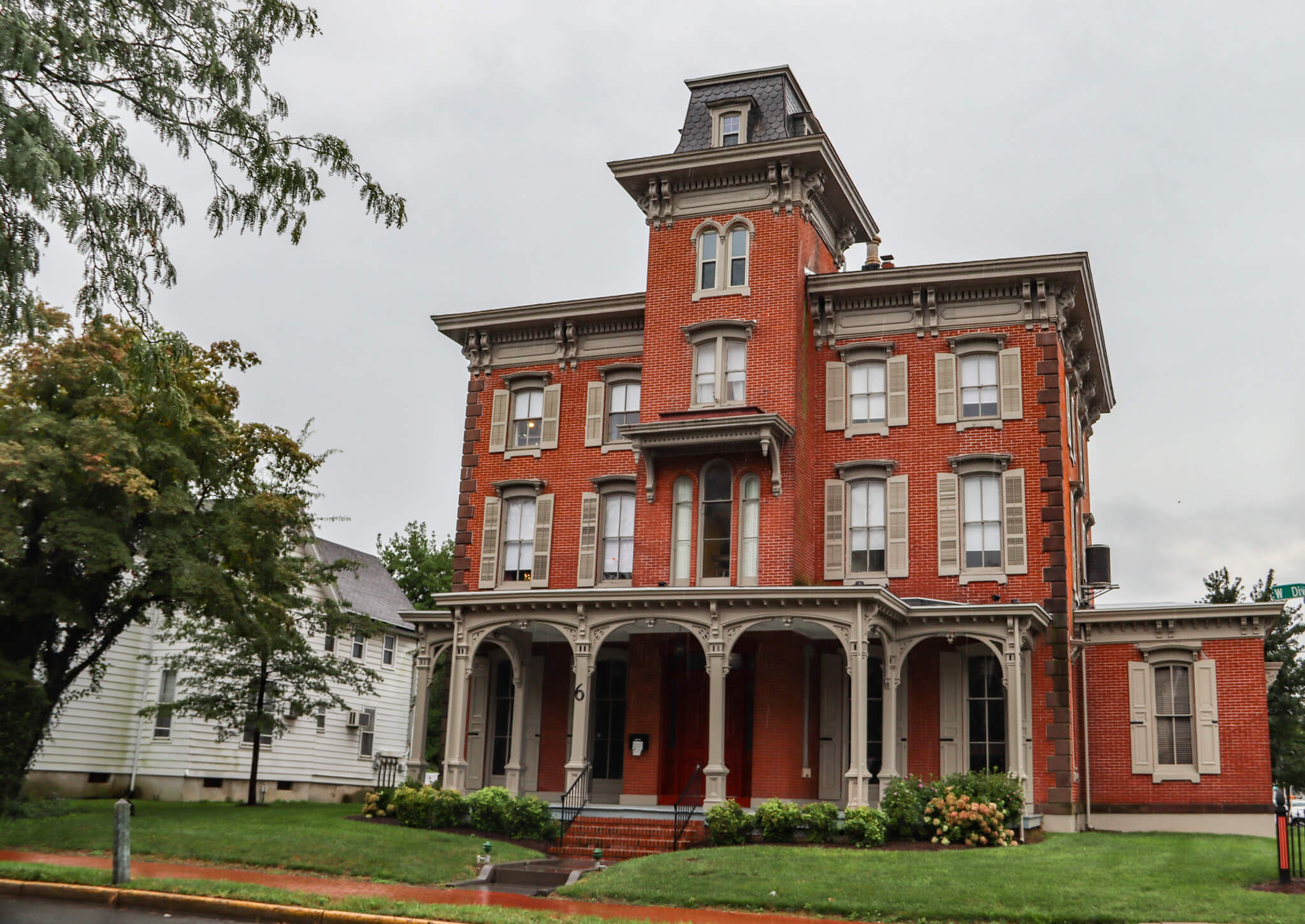
If you have a good imagination, and are at a certain age in life, the Italianate-style Dr. Henry Ridgely House looks like it’s straight out of a spooky episode of Scooby-Doo, especially when it’s illuminated at night. If not, then it’s simply a truly remarkable building, built in 1869 as a residence and physician’s office. Ridgely was 57 years old when his home was constructed, complete with offices and waiting and examining rooms on the first floor. The three-story house is clad in brick, with stone quoins. The square five-story central tower features paired consoles supporting a cornice with dentils and a windowed mansard roof with fish-scale shingles. The wonderful wooden front porch boasts arched openings between box columns and fan brackets. Most of the round- and segmental-arched windows with bracketed hoods feature shutters. There are two wooden bays on the north side, one with stained-glass upper windows, and a bay window on the south side. It’s a glorious structure, now serving as offices for a law firm.
#4 Mifflin House
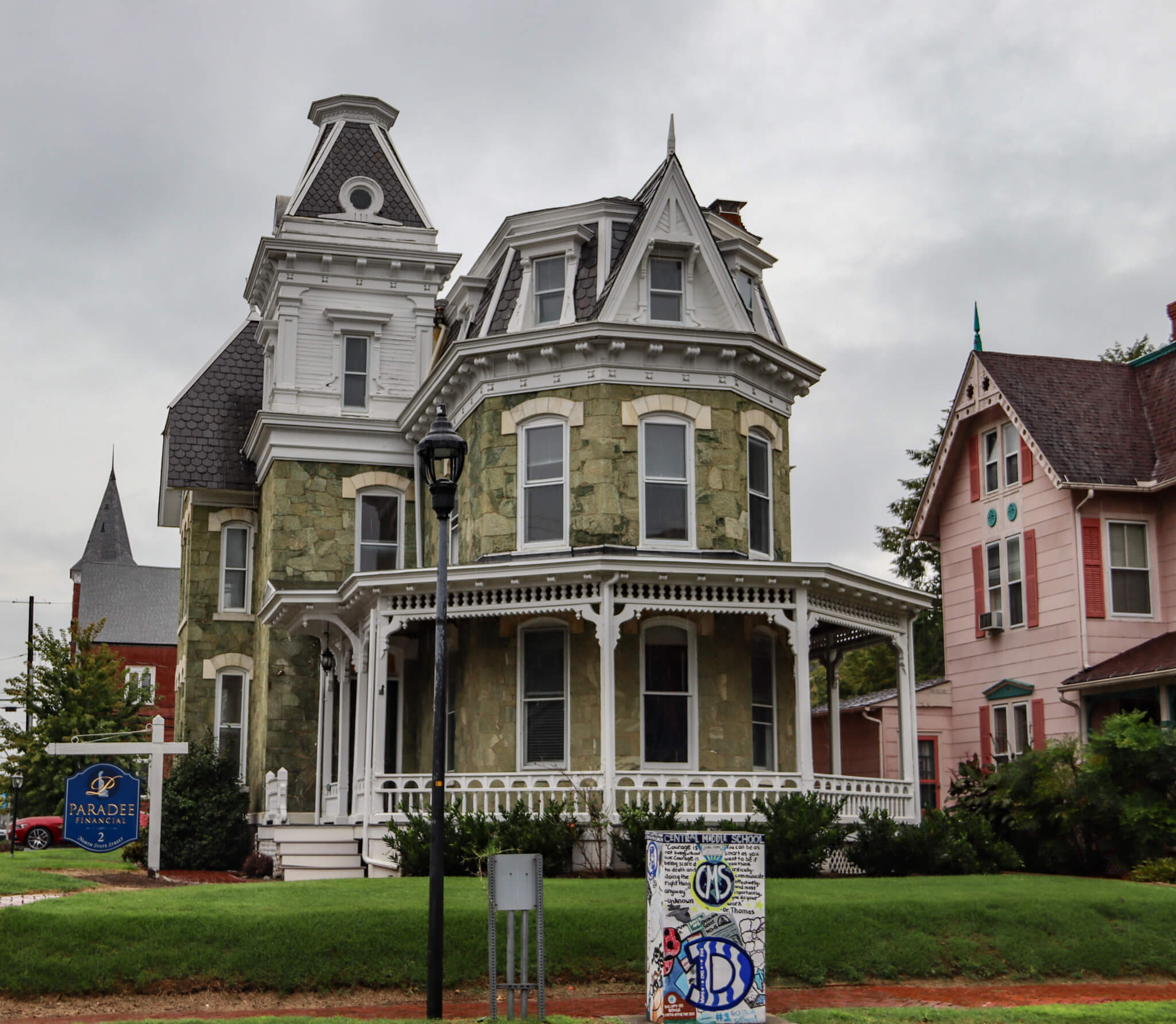
Directly across the street from the Dr. Henry Ridgely House stands another beauty, the Mifflin House, completed in 1885. By now, I was hardly surprised that it was built for a canner magnate, this time a canner of peaches. Indeed, the Delmarva Peninsula, including Dover, was the center of the canned-food industry in the United States for a century, starting in the 1840s. By 1919, there were 111 canneries in Delaware alone, employing more than 1,800 people. The Mifflin House was built with brick, in the rear, but the bulk of it employs serpentine stone, a greenish gemstone that was popular as a building material around this era, valued for its color but ultimately phased out due to its porous nature that contributed to its own deterioration as water that was absorbed repeatedly froze and thawed, compromising the structural integrity. Listed on the National Register of Historic Places, the two-and-a-half story building features lots of fanciful wood trim painted white, a wrap-around front porch, a mansard roof with gray fish-scale shingles, a tower with ocular windows, and a curved stone staircase at its corner leading to a brick pathway up to the house. Like the other buildings on my list, the Mifflin House has been converted to something else: offices for a financial services company.
#5 Old State House

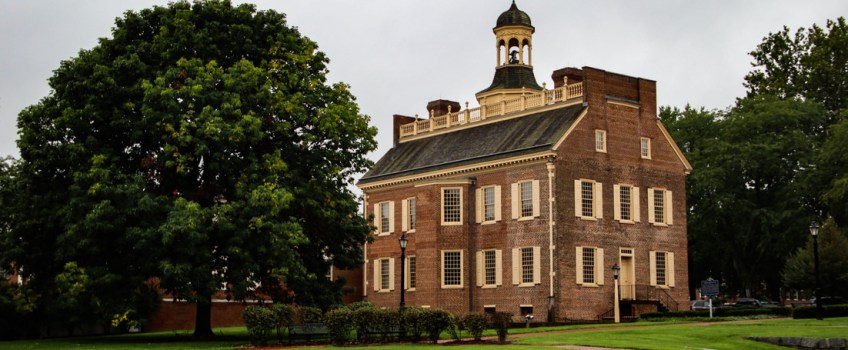
Laid out in 1717, the Dover Green—today a National Historical Park—was created as the locus for the growing town. Surrounded by government buildings, shops, homes, and taverns, it was the site where 30 delegates from Delaware’s three counties met and ratified the U.S. Constitution, becoming the first state to do so. One of the most important buildings framing the green is the Old State House, completed in 1791. It served as the Delaware capitol until 1932, when its small size necessitated the construction of a larger one. The elegant Georgian-style structure features five bays, the central one highlighted by a Palladian window above the fanlight over the entrance door. The front is laid in Flemish bond, the sides in Liverpool bond—distinctive styles of brickwork and masonry. The shingled side-gabled roof is topped with an octagonal cupola with a single bell and a rooster weather vane. Windows are topped with marble lintels. I hopped on the small tour of the interior, which features a double staircase framing the Palladian window. While the second floor houses the former chambers of the state legislature, it’s the 18th-century–style courtroom on the first floor that’s of more interest: Two spear-like poles, one with a white tip and the other with a red, would be, once a verdict was reached, turned to the open front doors of the building so that the crowd outside could find out if the person being tried was innocent or guilty.
Five Runners-Up
- 227 North State Street (1907)
- 341 North State Street (1902)
- 34 North State Street (1880)
- 505 North State Street (1912)
- 129 North State Street (1883)
I’d Love to Hear From You!
Have you been here? Have I inspired you to go? Let me know!


 Stephen Travels