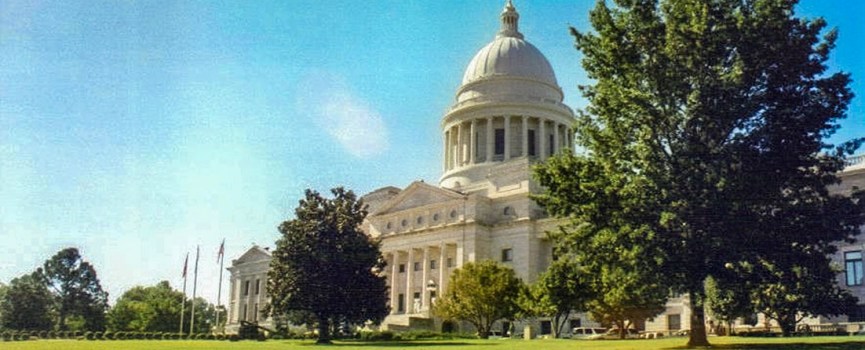
Although most of my autumnal vacation to Arkansas centered on outdoor activities, where fall foliage was blazing in glorious colors, I made sure not to neglect the state’s urban centers. Little Rock, for instance, has about two dozen historic districts (including one of the best in the United States). How can you resist that? By spending a bit of time in cities, I didn’t miss out on some remarkable structures with equally remarkable stories. These are my favorites.
#1 Hornibrook House (Little Rock)
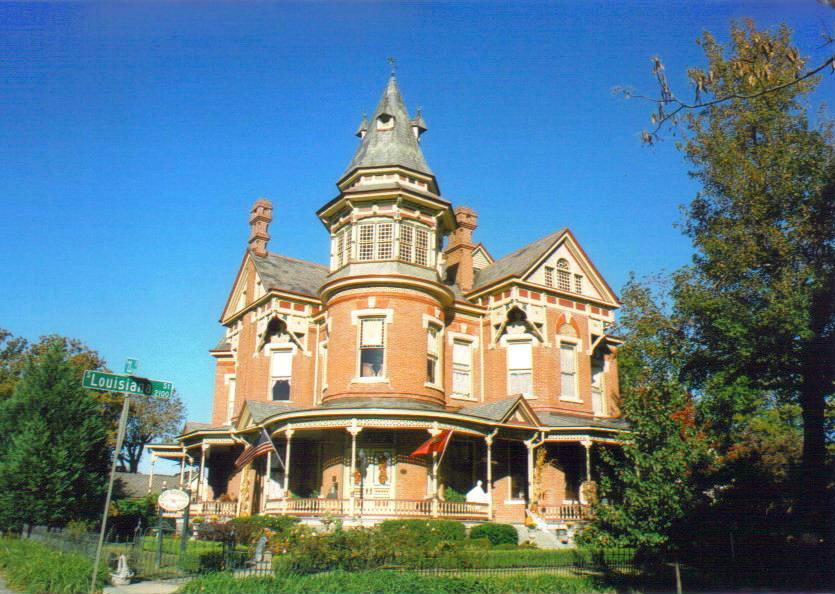 The Quapaw Quarter Historic District of Little Rock teems with gorgeous homes, and for as little as $185 per night, you can stay at the most stunning of them all: Hornibrook House, fittingly renamed The Empress of Little Rock when it was converted to a luxurious bed and breakfast in 1994, 20 years after it was added to the National Register of Historic Places. Completed in 1888 after seven years of construction for $20,000 (that’s about half a million today) for a Canadian immigrant and his wife, this corner property literally stopped me in my tracks during my stroll. The striking exterior drips with all the elements of flamboyant Gothic Queen Anne style: a three-and-a-half-story tower, wraparound porch with gracile posts, ornate chimneys, windowed gables, and the original iron fence and gate. Inside the 7,200-square-foot home, octagonal rooms, a stained-glass skylight, a wine cellar, and parquet floors of six different types of wood captured the opulence of the era. But Mr. Hornibrook and his wife didn’t enjoy their lavish residence for very long: He died in 1890, and she followed three years later. Over the following century, the house served a variety of less elegant purposes, including as the Arkansas Women’s College, a rooming house for women, a halfway house, and a nursing home. Now fully restored and modernized without compromising its historical significance, the Hornibrook House remains the city’s pre-eminent grand dame.
#2 Anthony Chapel (Hot Springs)
 Garvan Woodland Gardens occupies a peninsula that juts into Lake Hamilton in the Ouachita River, lending it a perfect location to spend some time outdoors. I was intending to just take a leisurely stroll through some nature, but surprise after surprise turned this little walk in the woods into a memorable afternoon. Run by the University of Arkansas, Garvan opened to the public when local resident and self-taught gardener Verna Cook Garvan bequeathed the property upon her death in 1993, specifying that it be used to educate and serve the people of Arkansas, and noting that she hoped it remain a natural preserve to counter the environmental devastation encountered throughout much of the 20th century. Garvan got her wish. Today, it is one of the world’s top 10 botanic gardens. My biggest surprise here came when I turned onto a trail that led to the great Anthony Chapel. Dedicated in 2006, this gorgeous 160-seat chapel made me want to get married right on the spot; indeed, it’s one of the most requested wedding venues in all of Arkansas, the site of more than 200 nuptials annually. Blending harmoniously into its surrounding, the chapel is an architectural feat. Yellow pine beams and columns support the steeply pitched 57’-high roof, which almost appears to float in the middle of the forest thanks to floor-to-ceiling windows. I stepped inside and walked down the flagstone aisle to the simple altar, with the windows bringing nature—the perfectly blue sky, the autumnal yellows and oranges of the changing leaves, the green conifers—right inside. I imagined it must be as beautiful in winter, illuminated by exterior lights and inside sconces against a cobalt-blue dusk sky—and it was the very last (and most memorable) thing I expected to see in a botanic garden.
#3 Pulaski County Courthouse (Little Rock)
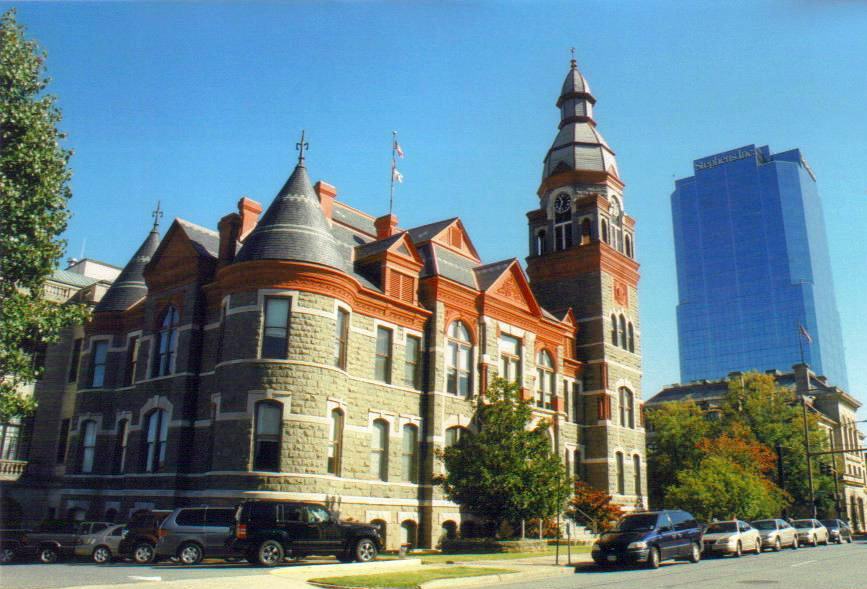 Two different buildings compose the Pulaski County Courthouse: a Romanesque Revival building from 1889 and a Beaux Arts annex structure from 1914. The former—the first permanent courthouse in the county—was designed by an alumnus of the U.S. Naval Academy with only a few years of architecture experience but who clearly had a knack and some natural talent for creating wonderful edifices. The imposing asymmetrical structure utilized materials from Arkansas almost exclusively. The facade is a collection of rich-textured stone walls, square and round towers with conical roofs, and ornamented red brick, including medallions and arches. A violent storm in 1961 destroyed the courthouse’s signature feature, its corner square clock tower. Prohibitively high costs prevented its restoration at the time, and a shorter tower was erected. Fortunately, a campaign was launched 30 years later to restore the tower, and in 1995, the building regained its architectural integrity when the tower, which rises 65’ above the roof line of the rest of the building and features four identical clock faces, was unveiled.
#4 Quapaw Bathhouse (Hot Springs)
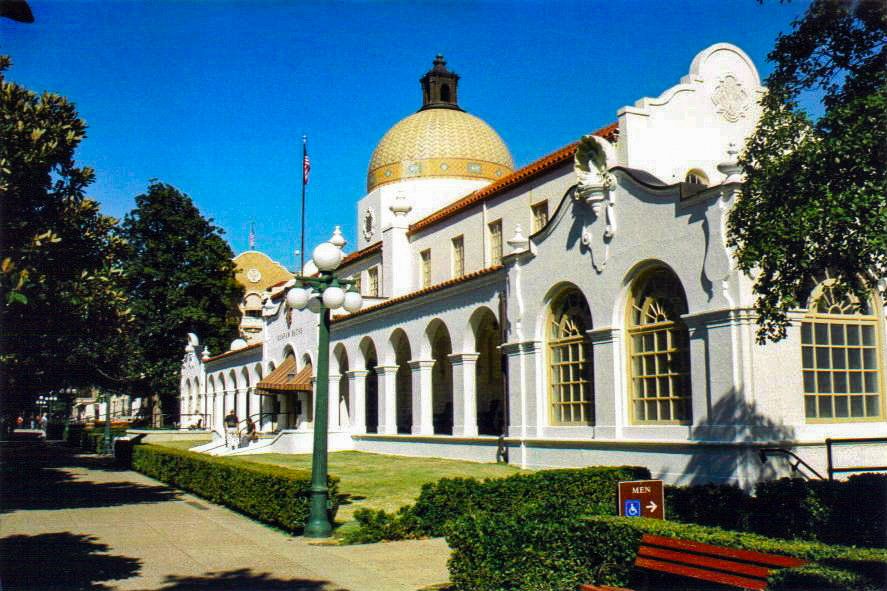 Bathhouse Row, part of Hot Springs National Park, which was founded in 1832 and protects 47 hot springs, is a strip of about seven bathhouses, only two of which are still operating as such. Quapaw Bathhouse is one of them. This beautiful Spanish Colonial Revival–style building replaced two previous bathhouses on the same site. Completed in 1922 and named after a Native American tribe that once held land in this area, the entire bathhouse is covered in white stucco. A central arched portico bears a cartouche with a carved image of presumably a Quapaw, set in a decorative double-curved parapet. A gorgeous mosaic-tiled dome, atop an octagonal base at the Spanish-tile roof and capped with a copper cupola, framed by two large finials, remains one of the city’s defining architectural highlights. From this entrance, arcades run in both directions, leading to two wings, also with double-curved parapets, capped with scalloped shells with small spiny fish. It’s a fantastic place to enjoy a treatment, whether you want to soak in a thermal pool under stained-glass skylights or take a steam in the manmade cave, built in the 1920s over a natural thermal spring so that the radiant heat from the 143˚ water gathers in the room and releases all your worries.
#5 Ragland House (Little Rock)
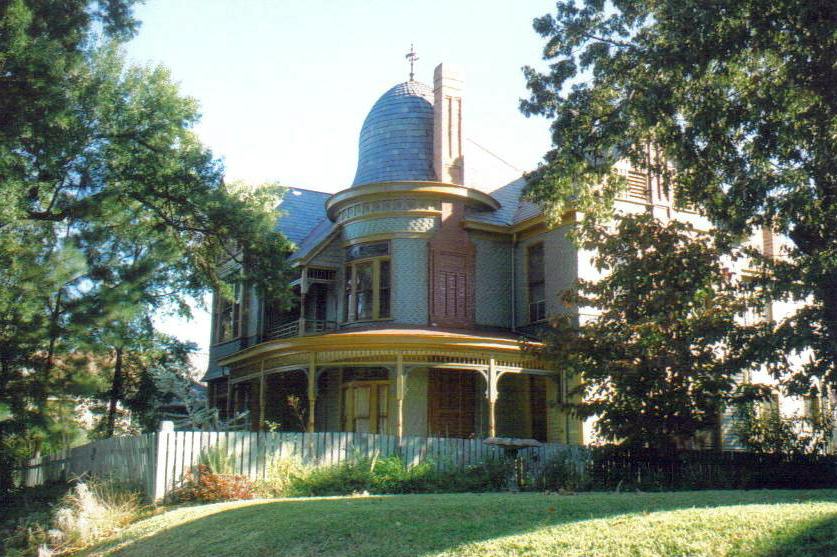 Another Quapaw Quarter gem that made it to the National Register of Historic Places, Ragland House features so many lovely elements that I wasn’t sure which was the one that attracted my attention first. Ultimately, I concluded that it was a collaborative effort. The color palette certainly engaged me: light and darker teal clapboard siding and shingles, yellow for the ornamental woodwork, and bold red chimneys with corbelling and geometric patterns. I loved the stained-glass transom windows on both levels of the two-story home as well as the waffle-patterned gables. A porch with a fine railing curves around the dominant corner tower, topped with a bell dome and a finial. Built in 1892 for banker and stockbroker William Ragland and his wife, this Queen Anne beauty—an 11-room house with a wine cellar—remained their home for only six years, until they moved to Alabama and sold the house to her parents, and it stayed in the family for another six decades. The most interesting thing about Ragland House, however, turned out to be the fact that it was designed by an architect who was only 21 years old.
Five Runners-Up
- Arlington Resort Hotel & Spa (1924, Hot Springs)
- Dibrell House (1892, Little Rock)
- Arkansas State Capitol (1915, Little Rock)
- Fordyce Bathhouse (1915; Hot Springs)
- Army-Navy Hospital (1933; Hot Springs)
Leave a Comment
Have you been here? Have I inspired you to go? Let me know!


 Stephen Travels