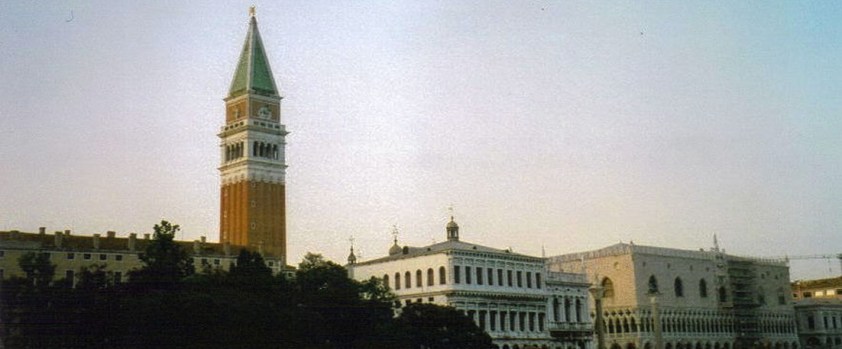
It could be a call to prayer or to attend a religious service, an announcement for a wedding or a funeral, the mark of a special day of remembrance, an update for college students on the time of day while they’re on campus, or, formerly, a fire alarm. Whatever the purpose, the ringing of bells makes you take notice. And the height of bell towers, whether they hold a single bell, a group of bells, or a carillon, guarantees that the sound will travel to everyone who needs to be alerted, and that you’re bound to notice their beauty, as they stand tall amid their neighbors. These are my favorites.
#1 Leaning Tower of Pisa (Torre Pendente di Pisa, Pisa, Italy)
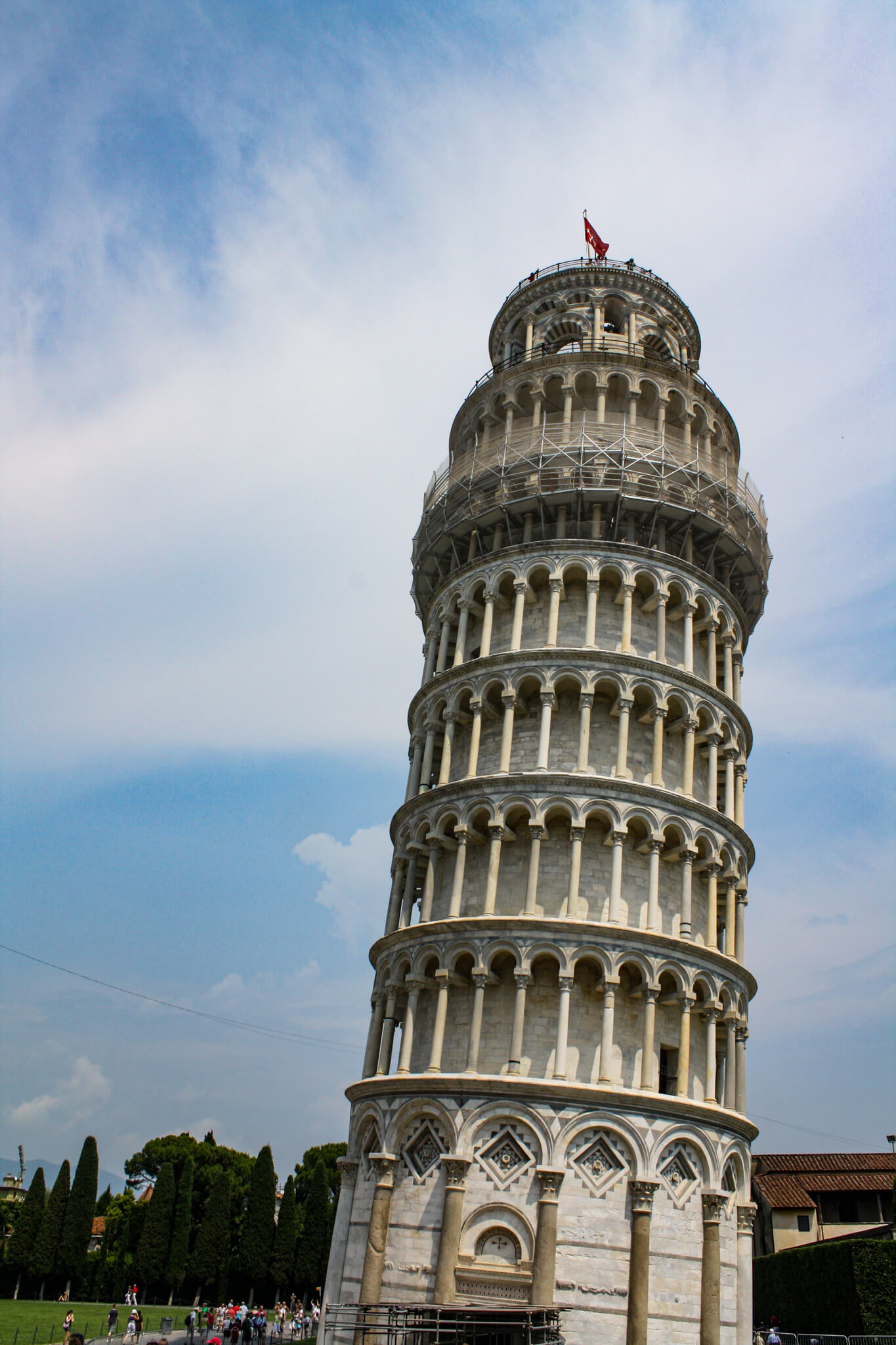 I refused to strike the overused and unoriginal pose of holding my hands up to pretend I’m supporting the Leaning Tower of Pisa; it’s far too touristy. But, like other visitors here, I couldn’t help but gaping at this beautiful mistake. Along with Pisa Cathedral and the Pisa Baptistry (which has one of the world’s most beautiful baptismal fonts), the freestanding tower is one of the three elements of the city’s Cathedral Square. Construction lasted for 199 years, from 1173 until its completion in 1372. Two centuries of work resulted in a magnificent structure. The ground floor features a plain blind arcade with Corinthian columns. Above that, six levels of columned arcades circle the marble tower (all totaled, there are 207 columns), leading up to the top chamber that houses seven bells ranging in weight from 661 lbs to nearly 8,000. At about 184’ tall, the tower boasts eight-foot-thick walls at the base and weighs approximately 14,500 tons. Some of the fine details include faces and figures in column capitals, flower pendants, and reliefs of animals. During the course of its history, the tower saw Galileo Galilei conduct his experiments in the late 1500s as well as World War II intrigue, when a U.S. Army sergeant, sent to investigate suspicions that the Germans were using it as an observation post, was so impressed by its beauty that he refrained from ordering an artillery strike against it. Of course, the tower’s most infamous claim to fame is its tilt. The circular shape and great height of the campanile were unusual for their time, and things began to go awry almost from the start, when, in 1178, as only the second floor was being constructed, it began to sink and slant, due to the weak, unstable subsoil on which its foundation rested. A century of wars halted the construction, which benefitted the tower by allowing the underlying soil to settle, most likely preventing it from toppling over. When construction resumed, the engineers built the upper floors with one side taller than the other to compensate for the tilt, but conditions only worsened, until the tower was leaning by 5.5 degrees by 1990. Stabilization and remedial work throughout much of the 1990s reduced the tilt to just under four degrees—the tilt was deliberately maintained due to the tower’s critical role in the city’s tourism industry. In an irresistible bit of irony, the tower’s very critical flaw is also the thing that has saved it. Since 1280, the tower has survived at least four strong earthquakes, able to withstand the tremors because, if you understand the science, the height and stiffness of the tower combined with the softness of the foundation soil enabled it not to vibrate with earthquake ground motion. Thus, the architectural boo-boo that could have resulted in disaster at any given moment over the past 600+ years actually helped one of the world’s most recognizable buildings survive.
#2 Basilica of St. Francis (Basilica de San Francisco, Salta, Argentina)
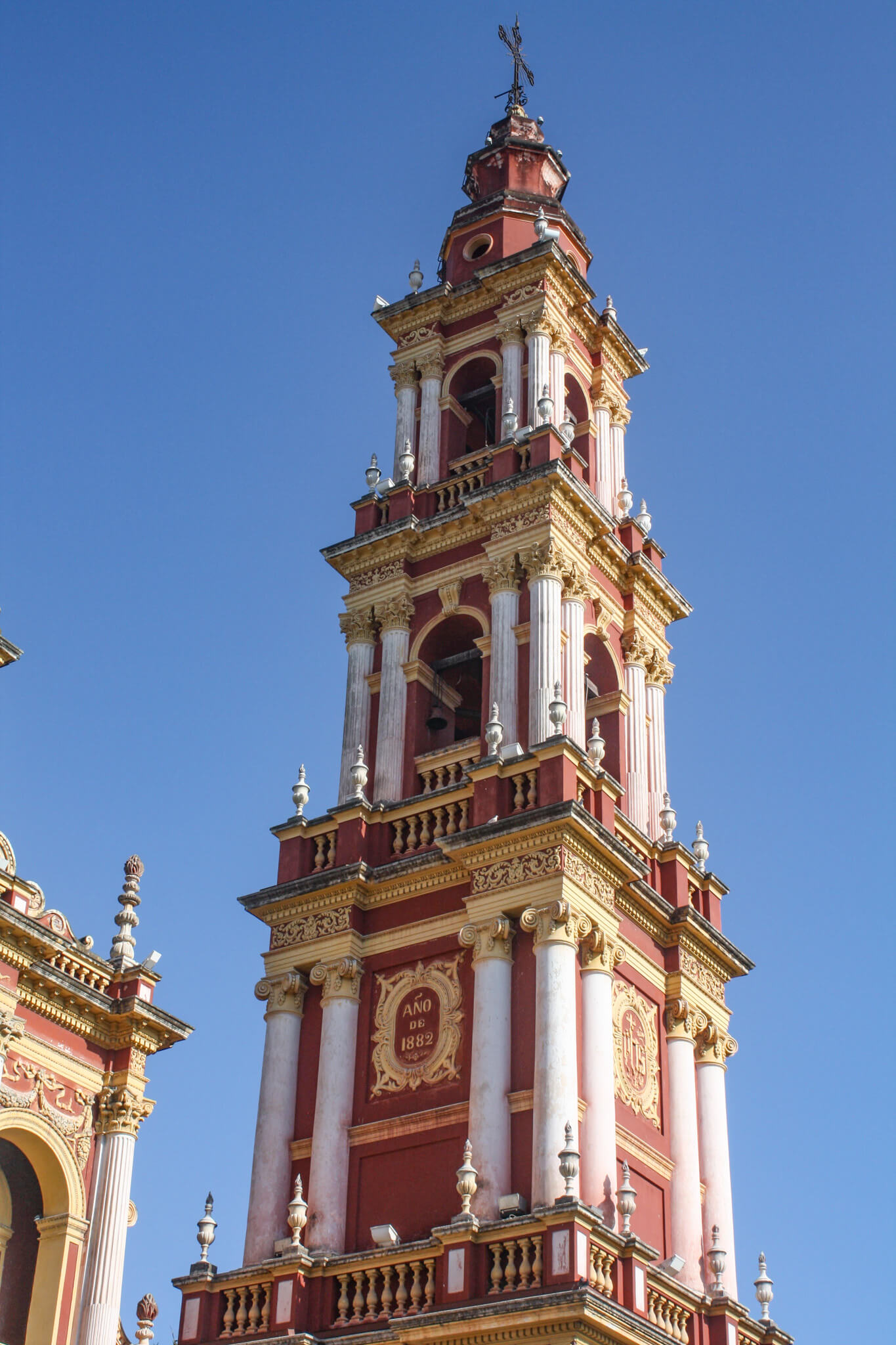 Only two blocks away from my accommodations in Salta, Hotel del Antiguo Convento, the Basilica of St. Francis stands as one of the most beautiful churches in Argentina, what with its pillars, arches, festoons, volutes, carved panels, dome, prominent frieze, and false curtains made of stucco above the three entrances. Next to it rises the spectacular 164’ bell tower, completed in 1882 as the tallest belfry in South America. Sporting bold deep-salmon and yellow colors on the terra cotta façade, the tower blends neoclassical and baroque styles. It rises for four stories of decreasing height. The bottom level features plain Doric columns supporting a frieze with panels with religious imagery, from the Ten Commandments to winged cherub faces. Above, gleaming white columns increase in complexity at each level, with plain then fluted Corinthian columns. Balusters and urns embellish each of the upper levels. The very top features a spire on an octagonal drum with circular windows, capped by an iron cross. The tower houses a bronze bell made from cannons used during the Battle of Salta during Argentina’s War of Independence. I had the pleasure of passing by this beauty every day during my stay in Salta, and it’s even more alluring at night, when it’s illuminated in a fiery glow.
#3 Giotto Campanile (Florence, Italy)
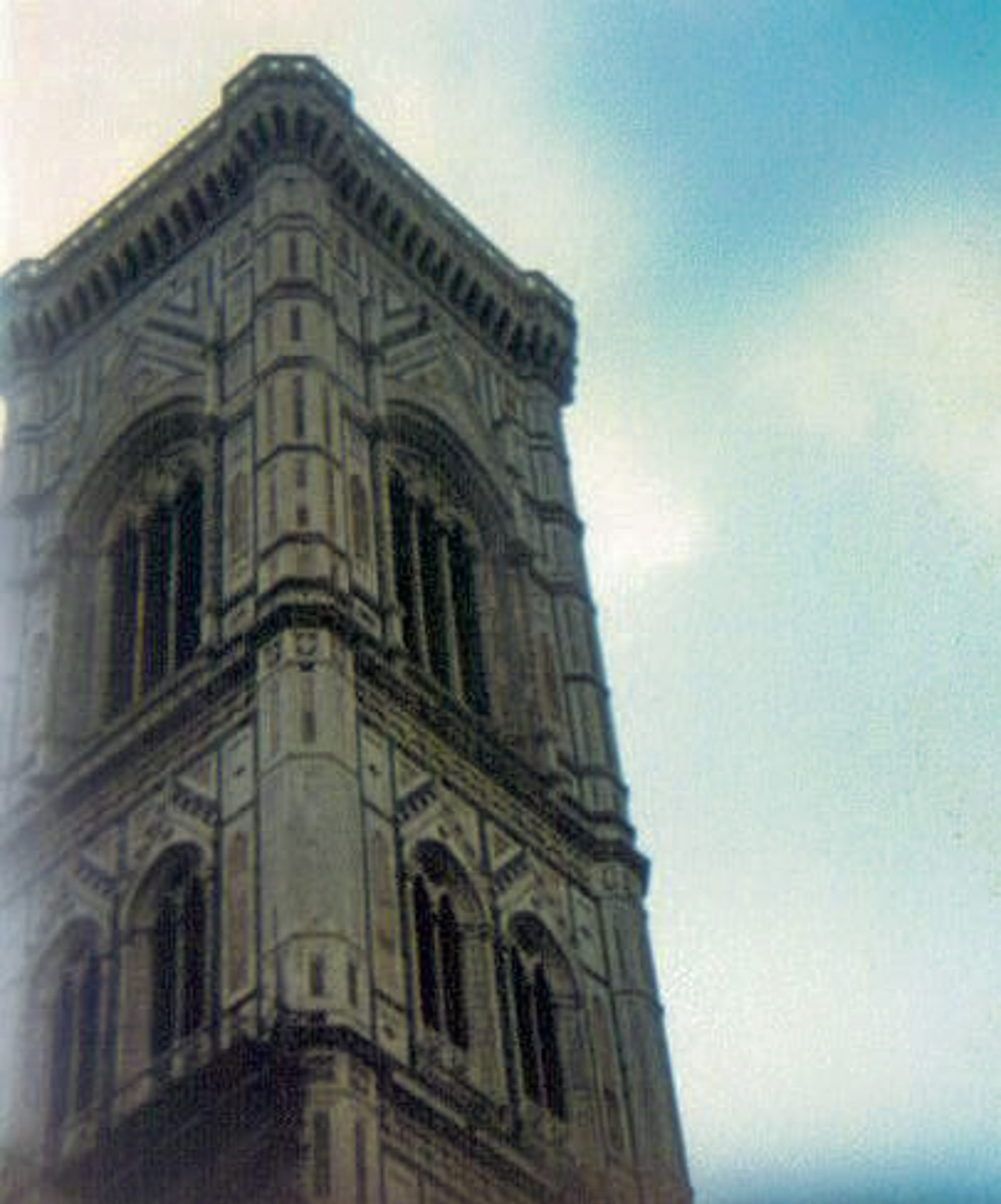 When Giotto di Bondone died at about age 70 in 1337, his freestanding campanile was nowhere near complete. But, despite the work of the two architects who followed him, the bell tower was named after its original designer. Built to accompany the Basilica of Santa Maria del Fiore (with its game-changing dome) right next to it, Giotto Campanile was completed by 1359. It’s a strikingly beautiful structure, square in plan, measuring about 47’ on each side. It’s divided into distinct levels over its height of nearly 278’. Giotto harmonized his design with that of the polychromy of the cathedral, adding chiaroscuro and a surface of white, green, and red marble in geometric patterns. Taking in all the details is a wonderfully time-consuming event. On the first level, bas-reliefs in hexagonal panels depict the history of mankind, beginning with the Book of Genesis—the creation of Adam and Eve, Noah as the first farmer (but looking quite intoxicated, lying next to a wine vat)—and moving on to astronomy, architecture, festivals, grammar, hunting, legislation, medicine, navigation, painting, and sculpture, among others. The next level up features diamond-shaped lozenges with marble figures against a background of blue majolica. The allegorical figures represent everything from the planets to theological and cardinal virtues, from liberal arts to the more realistically presented Seven Sacraments. On the next level, four statues stand in niches on each side. Here you can find David, Solomon, Moses, and an abundance of prophets. The top levels play with perspective—each is larger than the one below it, yet, from street level, they appear to be the same height. At the top, the final architect neglected to add the spire that Giotto had intended, replacing it with a large projecting terrace. As for the bells, the campanile houses seven of them, the first cast in 1705 and the final in 1956, with each successive bell decreasing in both size and weight.
#4 Western Church (Westerkerk, Amsterdam, the Netherlands)
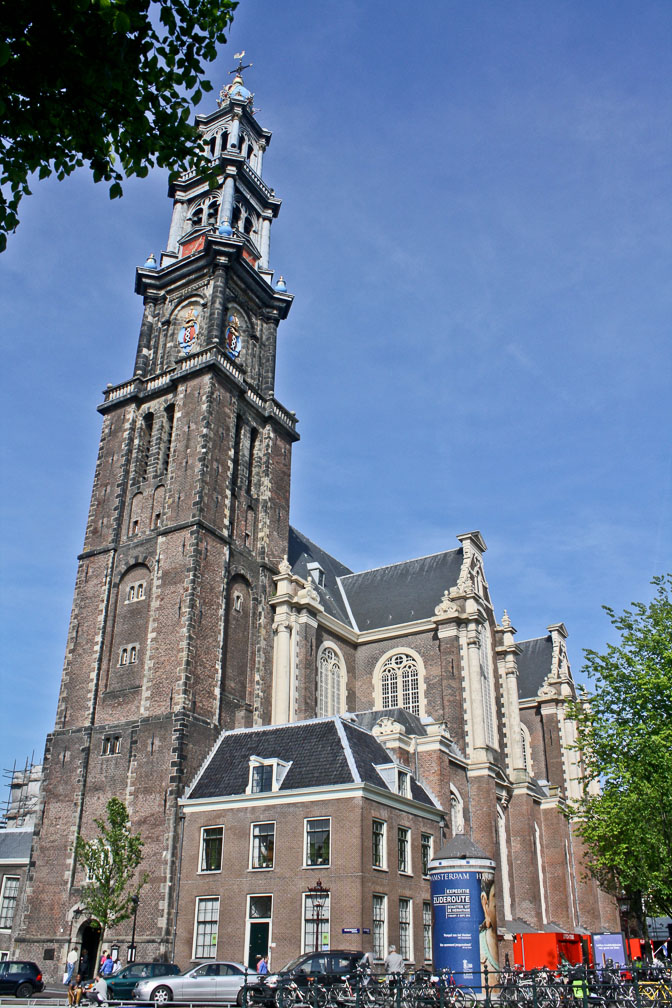 Constructed between 1620 and 1631, Western Church—one of the most beautiful churches in Amsterdam—was the biggest Protestant church in the world at the time, and at 190’ long and 95’ wide, it remains the largest Protestant church in the Netherlands today. The tower wasn’t part of the original construction, added several years later, in 1638. From various vantage points around the neighborhood, I could spot it soaring above the rooflines of the canal houses, like a giraffe above a treeline. Facing the Prinsengracht canal, the 278’ tower is Amsterdam’s highest. Four red clock faces with gold numbering and hands provide a splash of color, as do the blue and gold urns; the red, blue, and gold city crests; and the blue and gold Imperial Crown of Austria of Maximilian I that tops the spire. The 51-bell carillon can be heard several times a day, played by hand by volunteers from the congregation and university students. That not only provides a mellow musical background to your stroll around the neighborhood, but it was also a source of comfort for doomed Anne Frank, whose house was just blocks away (although she wouldn’t recognize some of the songs played every Tuesday afternoon, when a carillon concert rings out such tunes as “Stairway to Heaven” and songs by the Beatles).
#5 City Hall (Milwaukee, Wisconsin)
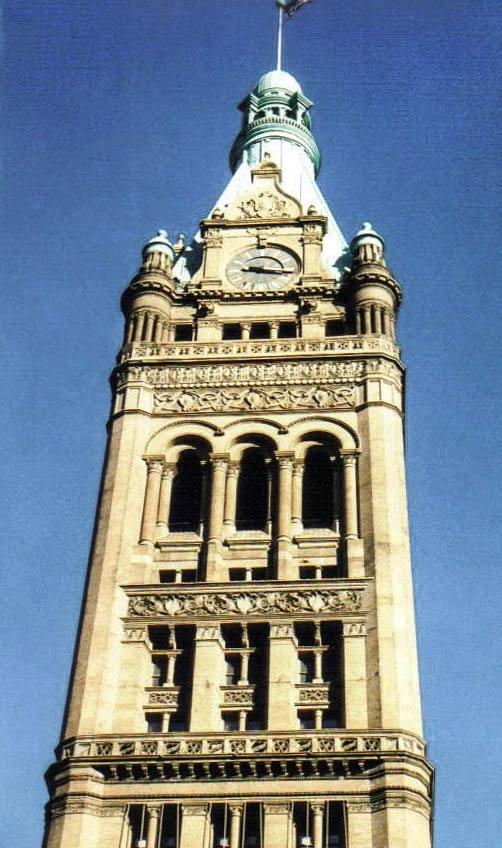 Just a block from the Milwaukee River stands one of the most beautiful buildings in Milwaukee. Completed in 1895, this Flemish Renaissance masterpiece was Milwaukee’s tallest building until 1973 (and the second tallest in the United States, outreached only by the Washington Monument), with a bell tower rising 350’. Brought to the attention of a much broader audience thanks, in large part, to its appearance in the opening credits of the 1970s–80s sitcom Laverne & Shirley, City Hall was constructed of granite, terra cotta sculptures, and eight million pressed bricks, giving the building a hefty weight of about 41,000 tons. Anchoring the southern end of the building, the bell tower features three board arches that grant entry inside. The top of the 353’ tower with a copper spire now turned a verdigris green sports clock faces on all four sides. At 18’ in diameter, these were the third-largest clocks in the world, with opaque glass numerals that measure 2.5’ in height. Way up top, with good binoculars, you can spy animal heads, fleur-de-lis, and, with a little imagination, four turrets that resemble beer steins flanking the clocks. The tower holds a single bell, named “Solomon Juneau,” in honor of the French Canadian fur trader who founded Milwaukee and became its first mayor. The 22,500-lb. bell, cast from melted copper and tin from old church and firehouse bells around the city, chimed for the first time on New Year’s Eve in 1896. Designed and crafted by early pioneers in the creation of diving chambers and suits near the Great Lakes, it was the third-largest bell cast in the United States, and it was struck manually by a bell ringer, who lived with his family in an apartment in the tower, which made it the country’s tallest habitable building. It remains the 11th-largest bell in North America, and the tower itself still stands as one of the best things to see in Milwaukee.
Five Runners-Up
- Belfry (Bruges, Belgium; 1240 / 1822)
- St. Mark’s Campanile (Campanile di San Marco) (Venice, Italy; 1912)
- Peace Palace (Vredespaleis) (The Hague, the Netherlands; 1913)
- Cathedral of St. Domnius (Katedrala Svetog Duje) (Split, Croatia; 1100 / 1908)
- Church of the Clerics (Clérigos Church) (Porto, Portugal; 1763)
Leave a Comment
Have you been here? Have I inspired you to go? Let me know!


 Stephen Travels