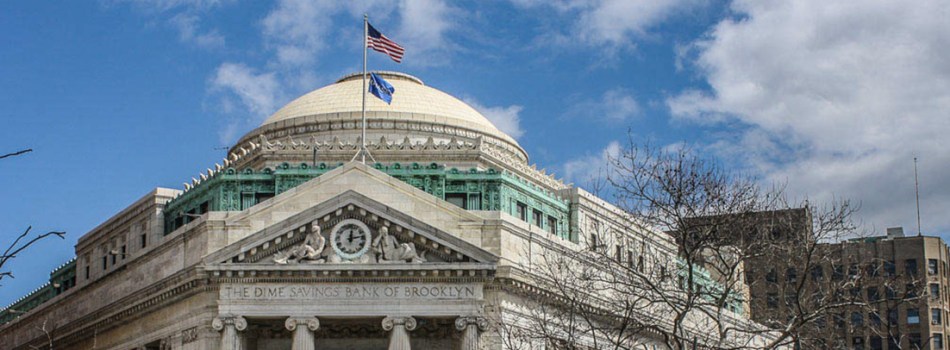
I was so impressed by the bank buildings in Scotland when I was there in 2015 that I wrote this blog article about them. But my interest in banks goes back to my childhood, when my father worked in one. He didn’t work in an ordinary bank, however, but, rather, in a New York City landmark and, at one time, the tallest building in Brooklyn (41 stories reaching up 512’) (see #2, below). Since then, I’ve kept an eye out for banks, even when not in need of dollars or euro or pesos or krone. These are my favorites.
#1 Former National Bank of Belgium (Antwerp, Belgium)
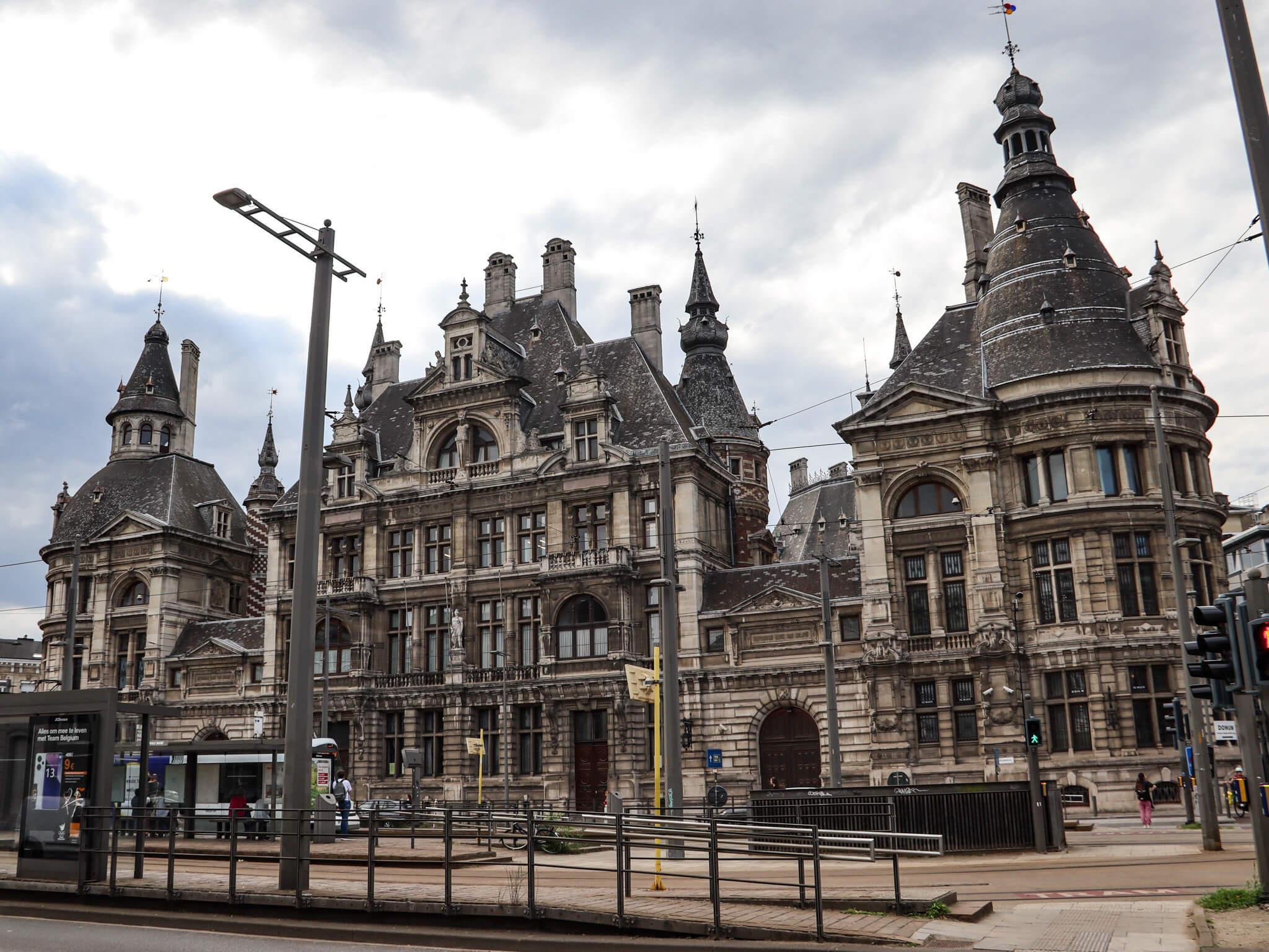 The National Bank of Belgium ended its banking activities in this building in 2013. But, up until then, the world of finance was conducted in this most spectacular building. The NBB was created in 1850, originally operating in a townhouse. As Antwerp expanded, the old Spanish defensive walls were demolished, broad avenues were created, and space opened up for a new NBB location. In 1879, this massive structure, eclectic in style with a nod toward the neo-Renaissance, opened for business. As I stepped off the streetcar directly in front of it, I was instantly bowled over. Triangular in shape, the bank looks more like a Loire Valley castle than a financial institution. The central section is a riot of brackets, statues, balconies with balustrades, griffins, gables, chimneys, big and tiny dormer windows, and a steeply pitched roof. Two low arms, with the name of the bank etched in a panel above the heavy arched wood doors, connect to monumental corner towers with different roofs, both topped by whimsical weather vanes.
#2 Former Williamsburgh Savings Bank (Brooklyn, New York)
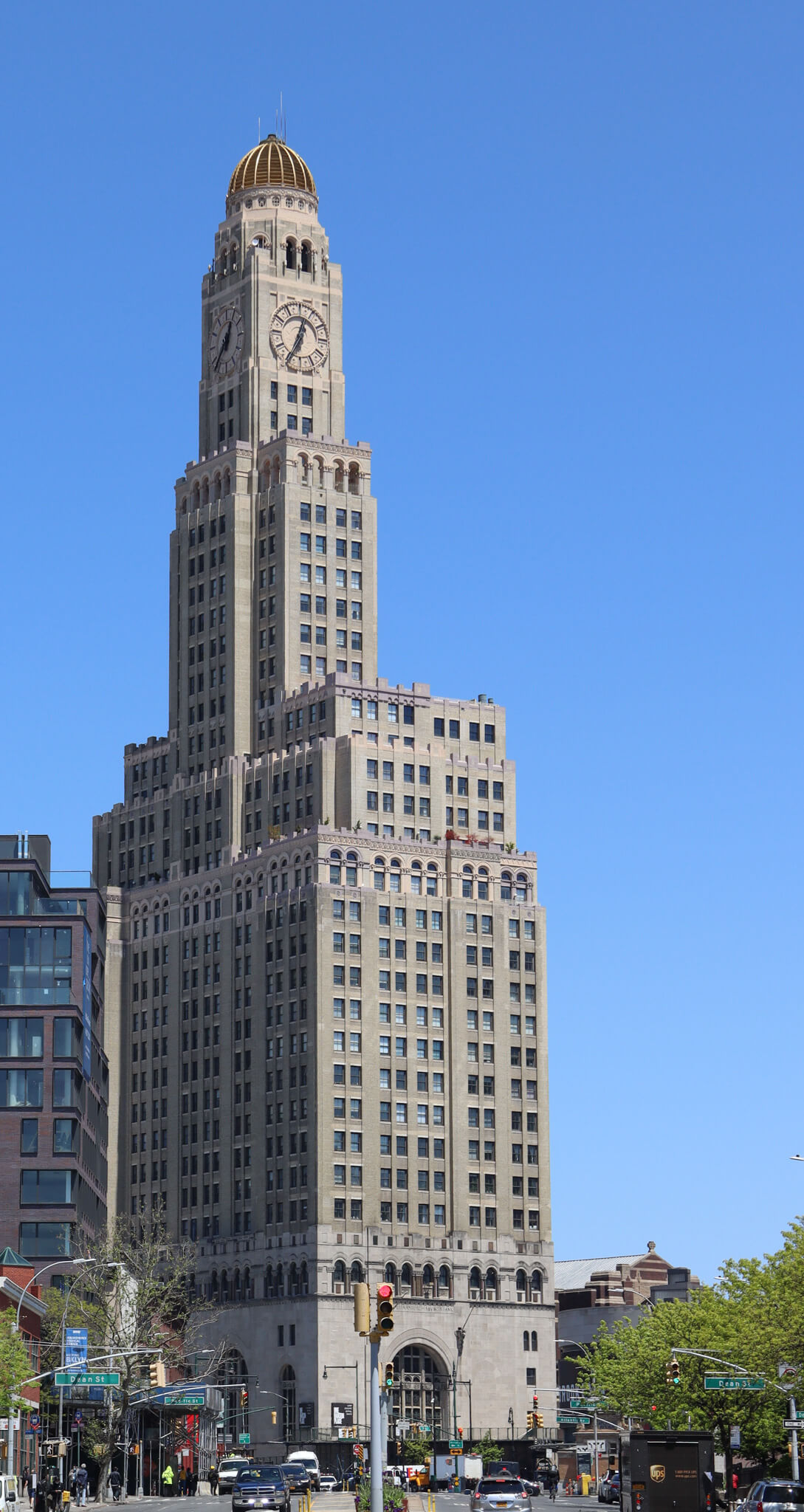 Completed in 1929, the Williamsburgh Savings Bank stood as the tallest building in Brooklyn for 80 years. It served as the headquarters of the bank and leased many of the upper floors to dentists. It’s now luxury condos and an event space, but that wasn’t the case when my father worked here and I occasionally accompanied him to his job. This art deco skyscraper, which incorporated Byzantine and Romanesque styles, could be seen for miles, long before downtown Brooklyn surged into hyper-development, reflecting the original urban plan for more skyscrapers here when this building arose, a plan that died with the onset of the Great Depression. The first six stories of the tower are clad with limestone and feature three round-arched doorways and three 40’-tall windows, flanked by smaller arched windows. The window frames are ornately decorated, with half-round mullions. It’s fun to hunt for the other carved details here—beehives; squirrels storing nuts; the head of Mercury, god of commerce; wise owls; seated lions whose paws protect the bank’s lockbox; and a burglar trying to break in. Four continents are represented in the windows’ carved grilles. Buff brick and terracotta details are used to visually separate the base from the setback upper section that rises up to the topmost square section of the building, which sports large clock faces on each side on the 30th through 32nd floors. With faces measuring 27’ across, these were the largest clocks in New York and ranked among the largest in the world. At the very top, an octagonal drum supports a gilded dome.
Inside, a mezzanine with the former ladies’ lounge overlooks the main lobby, with segmental arches that separate it into 11 bays. Be beguiled by the masonry, brass, bronze, copper, silver, steel, 22 types of marble, mosaics, and plasterwork. Carved figures on the doors leading to the banking room represent six types of workers who might open accounts at the bank, while floral decorations represent all 12 months of the year. Segmental arches divide the lobby’s ceiling into 11 saucer vaults, which are covered with blue-hued mosaic tiles that represent the sky. Gold stars are overlaid onto the ceiling, and globe-shaped lighting fixtures hang from some of the vaults. Now being encroached upon by other boring skyscrapers, the Williamsburg Savings Bank still stands unique and unmistakable.
#3 Former Noble Bank (Tallinn, Estonia)
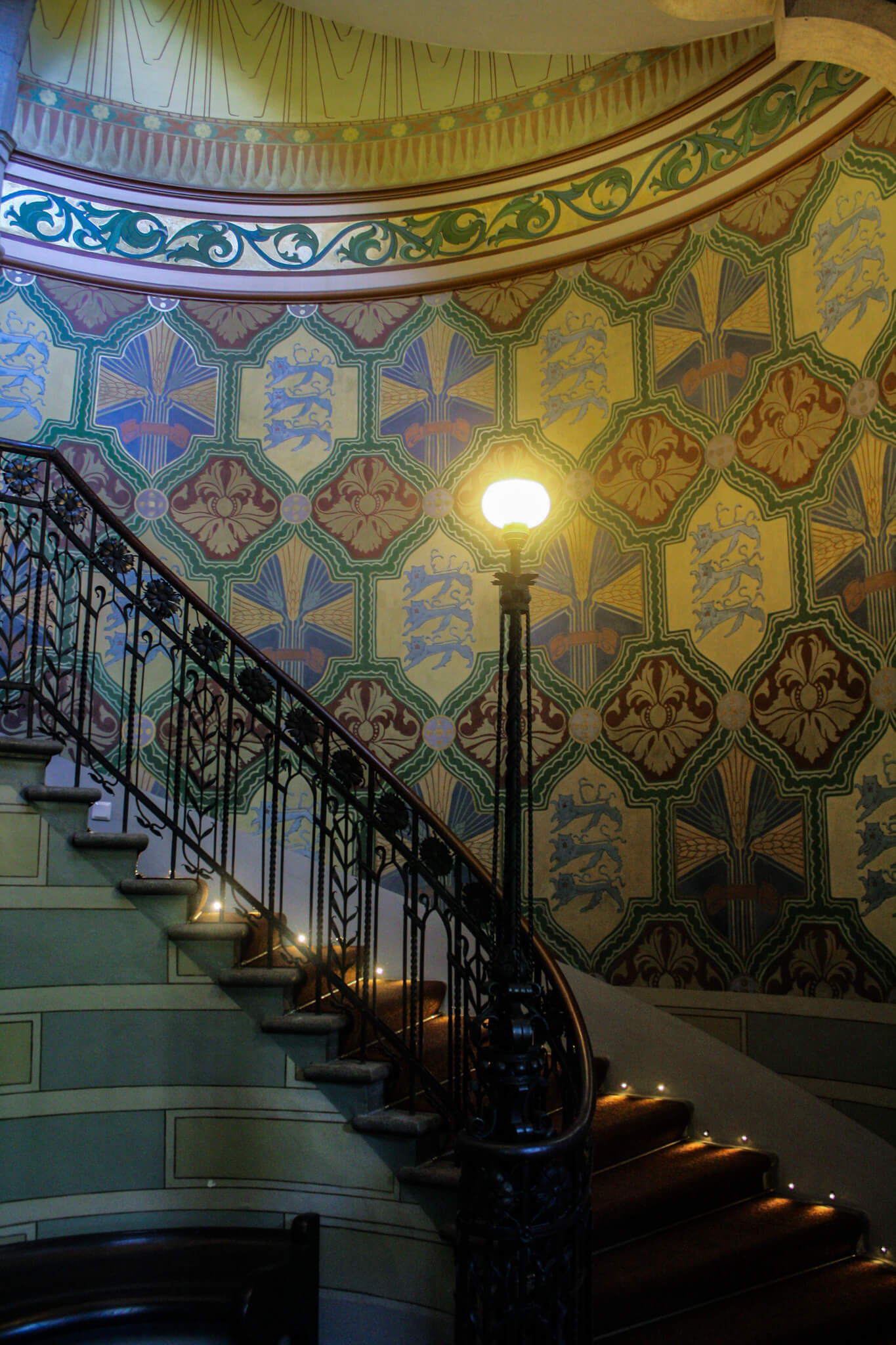 Located just outside the walls of Tallinn’s Old Town, the former Noble Bank is a delightfully playful building. Completed in 1904 as the first modern special bank building in the city, the façade features red brick, wrought-iron grilles on the windows, and stylishly finished doors. The eye-catching corner tower (picture Rapunzel letting her hair down) features a witch’s hat roof topped by a lion-shaped weather vane. Underneath it, mosaic coats of arms of half a dozen Estonian cities wrap around it, and at the street level, a coat of arms with the symbol of the governorate of Estonia hangs above the main portal. I gained access to the interior by visiting the Eesti Pank Museum. Even if you have zero interest in a bank museum, step inside anyway to check out the impressive spiral limestone staircase after you pass under the stone dragon carved above the entrance door. Let your eyes wander up the stairs (which once lead to private apartments) from the original Art Nouveau wooden bench, along the colorful wallpaper with the trio of lions from the Estonian coat of arms and the beautiful wrought-iron floral banister, past the stained-glass windows (one of which bears the coats of arms of Baltic German families and a motto translated as “He who builds on the street needs to let people speak”), all the way to the top and the gorgeous chandelier and fine stenciling on the inside of the dome that looks like you’re staring up through the roof of a Victorian greenhouse.
#4 Former Hipotecario National Bank (Mendoza, Argentina)
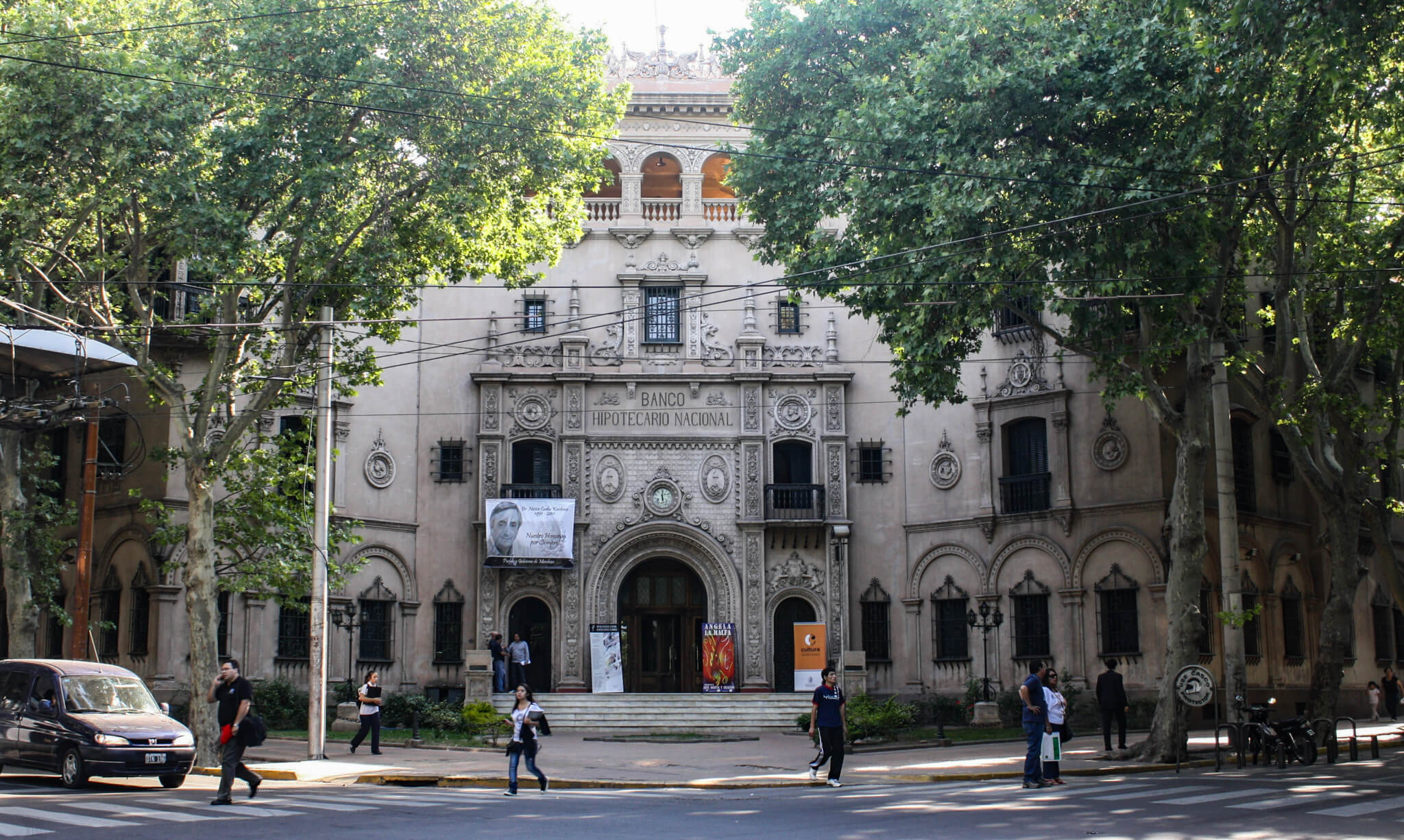 In the wonderfully leafy city of Mendoza, across the street from Plaza San Martin, one of the city’s five beautiful main plazas, I came across the striking former building of the Hipotecario National Bank. After five years of construction, the bank opened in 1929, its inauguration attended by businessmen and ladies of high society. Situated on a corner, the bank is set back from the street, allowing for an open plaza with mini–stone gardens with ornate lampposts. The main entrance, from which two wings stretch out at an angle, is an ornate display done in the neo-Plateresque style, a Spanish artistic movement that reflects the European splendor of colonial times. The opulent façade is adorned with polished stone, shields, pilasters, cartouches supported by mythological animals, arches, railings and balconies with silver details, medallions with busts, garlands, and the Argentinian coat of arms. Toward the top, an arcade of five arches, with winged angel heads at their bases, runs under the roofline decorated with cherubs and dragons. When the building is open (it now functions as the Ministry of Culture), step inside to check out the grand main hall with arcades and the tile wainscoting.
#5 Former Buffalo Savings Bank (Buffalo, New York)
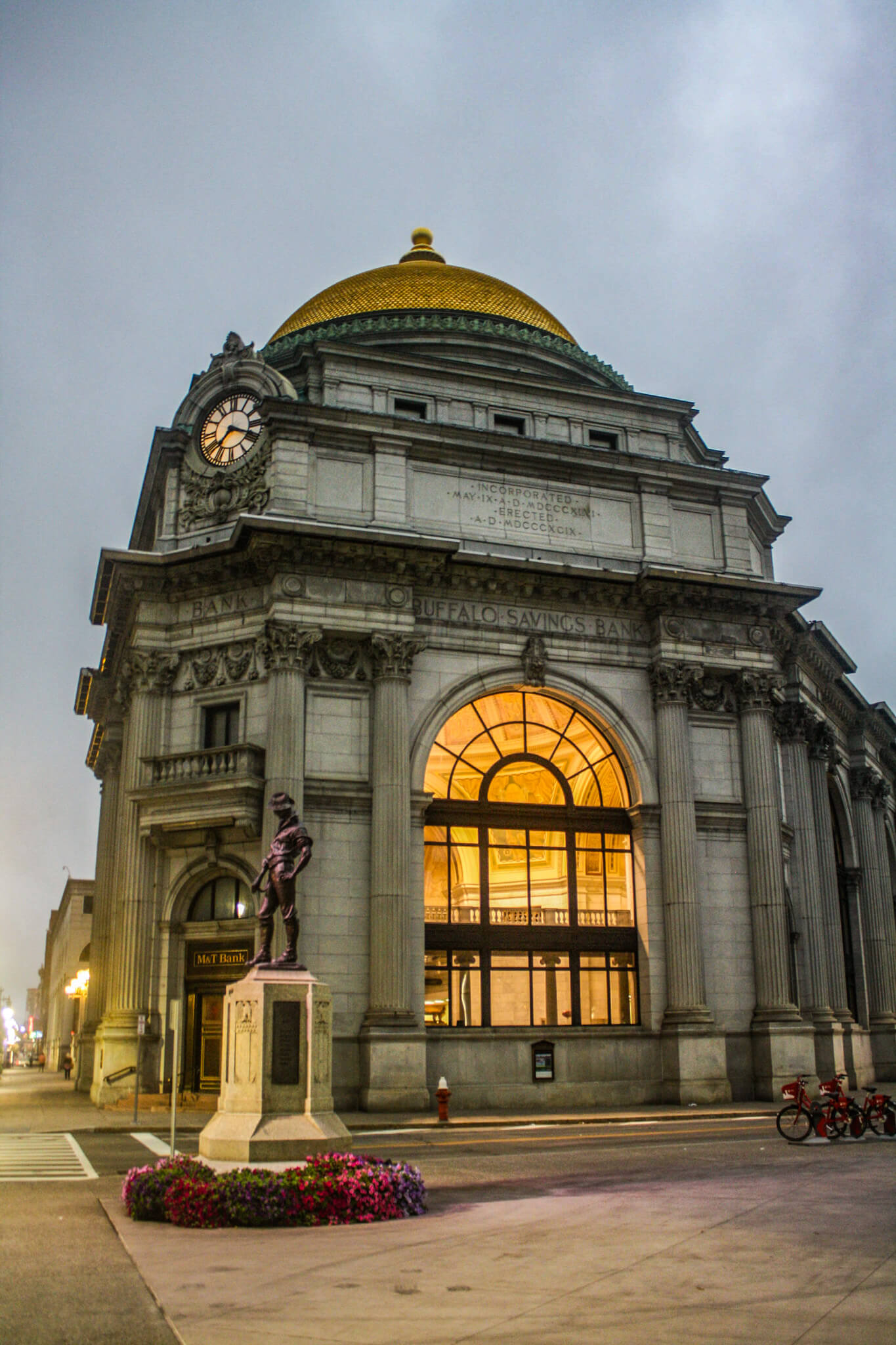 I knew the Buffalo Savings Bank, across the street from my hotel in the city’s downtown, would be special when I climbed the three steps to its entrance, the middle step bearing “Steps to Success” in metal letters attached to its riser. Competed in 1901 on a corner lot, this neoclassical, Beaux-Arts–style building features giant arched windows, fluted Corinthian pilasters, garlands, and a 9’ clock above the main entrance. Its signature feature is the beautiful dome, measuring 23’ tall and 56’ wide, and covered with 13,500 terracotta tiles. The dome’s last restoration used 140,000 wafer-thin sheets of nearly 24-carat gold leaf, at a cost of $500,000—more than the initial cost of the entire building. I’ve never received as warm a welcome at a bank as when I stepped inside. Not only did the staff encourage me to take photos (just not of the security cameras) upon learning I was visiting Buffalo for the first time, they also handed me a complementary, nicely produced souvenir booklet about the bank’s illustrious murals. I stepped into the grand main banking hall and was immediately impressed by the massive mural of the Founding of Buffalo on the east wall, while the north wall displays Buffalo Harbor, 1846. Then I looked up into the magnificent dome. Nestled between the dome’s supporting ribs are 16 arabesques filled with mythological and symbolic figures representing the successive stages of upward human endeavor, from aspiration and struggle to growth and crowning achievement, as well as the 12 signs of the zodiac, suggesting the passage of time. The four pendentives contain murals—Commerce, Industry, the Arts, and Power; look for Niagara Falls in the latter, the very source of the city’s economic boom.
Five Runners-Up
- First National Bank (San Antonio, Texas; 1886)
- Skånenbanken (Stockholm, Sweden; 1900)
- Dime Savings Bank (Brooklyn, New York; 1908)
- Florida First National Bank (Key West, Florida; 1897)
- Albany Trust Company (Albany, New York; 1904)
Leave a Comment
Have you been here? Have I inspired you to go? Let me know!


 Stephen Travels