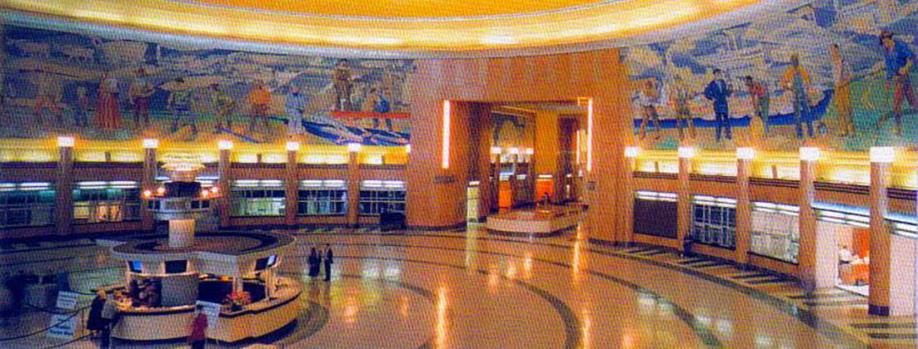
What is Art Deco (besides my favorite architectural style)? In 1925, Paris hosted the Exposition Internationale des Arts Decoratifs et Industriels Modernes, which displayed modern furnishings and designs that accentuated trends that were au courant in art, design, fashion, and architecture, favoring bold expression of form and color. The term “Art Deco” itself wasn’t coined until about 1966, when it referred back to this all-too-brief style that spread around the world, lasting only from the 1910s to about the late 1930s, when World War II disrupted everything.
Characterized by strong lines, daring colors, and exquisite details in the form of, for instance, eagles, stylized figures, and reliefs, Art Deco represented luxury and glamor, based in the post–First World War ebullience of the times and the promise of social and technological progress. Art Deco both utilized rare and expensive materials, like ebony and ivory, and introduced new ones, like stainless steel and chrome plating. It also looked away from Europe for inspiration—to Mesopotamian and Mayan art, for example. From low-rise buildings to some of the world’s most recognizable skyscrapers, Art Deco transformed and embellished city skylines across the globe, and in some cases entire cities themselves, like Miami Beach, Florida (which has the world’s largest concentration of the style), and Napier, New Zealand, rebuilt in the style after a devastating earthquake decimated the city in 1931.
Art Deco lent itself to every kind of building imaginable—hotels and theaters, restaurants and factories, office buildings and museums, and so on. I’ve had the good fortune to explore some of those structures, by catching a movie at the Fargo Theatre in Fargo, North Dakota, and a show at Radio City Music Hall in New York City; grabbing a quick dinner at the Elwood Bar & Grill in Detroit, Michigan; staying at the Hotel Le Plaza in Brussels, Belgium, and the Hotel Phoenicia in Floriana, Malta; and strolling through the Seattle Asian Art Museum.
Many Art Deco buildings survive to this day, regardless of whether they’re still serving their original function or have been repurposed for new needs (such as my own building in Brooklyn, New York, which was built as a hotel in 1930 and converted into cooperative apartments in the 1980s). These are my favorites.
#1 Guardian Building (Detroit, Michigan)
Just as New York City has a Cathedral of Commerce—the gorgeous Woolworth Building—Detroit has its Cathedral of Finance. The Guardian Building, originally called the Union Trust Building, was designated a National Historic Landmark in 1989. In a city with a rich inventory of architectural treasures, including its outstanding churches, the Guardian Building stands out as particularly special. If I had to work in an office building anywhere in the world, this is where I’d want my office to be.
Right from its origins, the Guardian was going to be unique. The entire endeavor was an all-Michigan affair: Michigan architect (Wirt C. Rowland), Michigan contractors, Michigan artisans. Their collective talents produced a majestic structure, but it was one that was almost immediately doomed. Completed in 1929, when Detroit was roaring along and it was the fourth-largest city in the United States (now it’s no. 26), the Guardian’s fate took an abruptly unexpected turn. Only six months later, the stock market crashed, igniting the Great Depression. The Union Trust Company was one of its early victims, and in 1932 it went into receivership. Investors who were bullish on Detroit’s future rescued it and reorganized the company into the Union Guardian Trust Company, and the newly christened Union Guardian Building survived, morphing into the Guardian Building moniker it goes by today.
Occupying a full city block and rising 36 stories with two asymmetric towers, one that extends the building an additional four stories, this 496’ treasure rises from a granite and stone base and is clad in 1.8 million tangerine-colored bricks. The custom-made color was afterward marketed as “Union Trust Brick” and then “Guardian Brick.” The choice of both color and material was unusual, as most buildings of this size from this era employed granite and limestone. As such, the Guardian became the world’s tallest masonry structure when it was completed.
At the main entrance, two relief sculptures symbolizing Safety and Security (created by a Detroit sculptor) flank the half-dome swathed in tiles in a Native American design with corresponding symbols (produced by a Detroit pottery maker). Over-scaled polychromed terracotta on the upper stories and especially on the north tower are easily visible from street level.
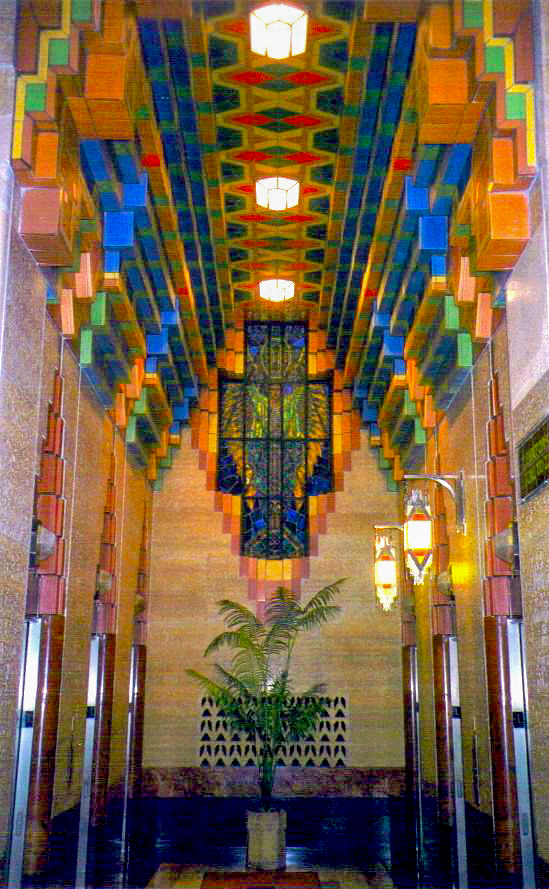
Rowland explained the incorporation of a broad color spectrum: “We no longer live in a leisurely age…The impression must be immediate, strong, and complete. Color has this vital power.” He abided by this vision in the most spectacular way inside the Guardian. The luxurious interior is nothing short of a masterpiece, and I was bowled over as soon as I entered the 150’-long, three-story lower lobby. I felt as if I had just stepped into the grandest Aztec temple imaginable. An explosive array of vibrantly colored interlocking hexagon tiles covers the barrel-vaulted ceiling. Ziggurat arches between columns of Italian Travertine marble are awash in reds, greens, and yellows in an Aztec design. Two other types of rare marble embellish the lobby: black marble from Belgium, from mines that are now exhausted of this type, and blood-red Numidian marble, which required Rowland to go to Africa to pick out what he needed from a mine that had been closed for three decades and reopened just for him. Stained-glass figures representing Fidelity and Aztec-inspired lanterns adorn the elevator lobbies. These elevators represent the first use of the technology that allowed them to automatically stop the cab level with the floor and to open the doors without the assistance of a human operator, ushering in the demise of the elevator man (although that rebelliously carries on in one of Seattle’s Smith Tower’s elevators).
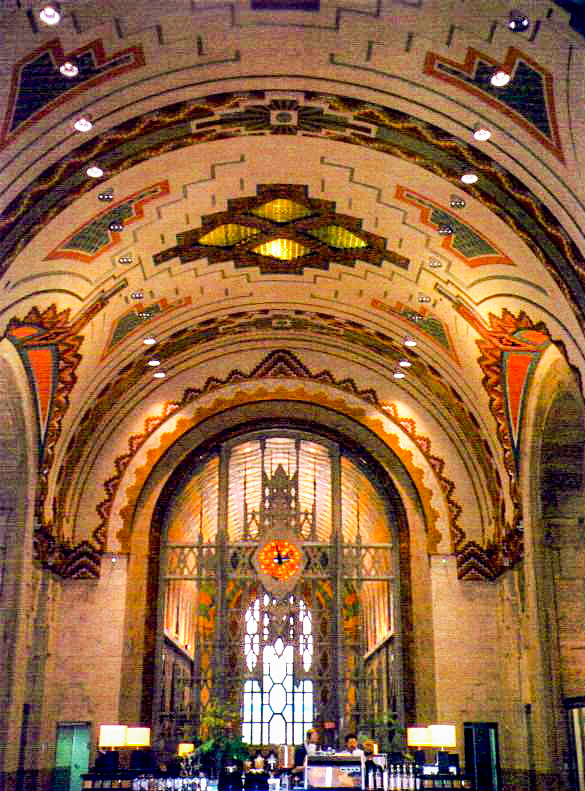
Further into the lavish lobby, I stopped at the reception desk to read the large wall mosaic of a pine tree and text describing the original bank’s purpose, set against a deep blue background. I followed the Travertine marble steps up to the massive Art Deco ornamental Monel metal screen, with a lovely glass Tiffany clock (one of only four extant clocks of this type), that divides the lower lobby from the banking hall. This was another of Rowland’s innovations: He employed this type of metal for all the Guardian’s exposed metalwork instead of more commonly used brass and bronze—a revelation that was subsequently widely adopted, including in New York’s iconic Chrysler Building, another Art Deco gem.
The delights continue in the main banking hall. My attention was immediately drawn to the mural of a map of Michigan at the far end of the hall. A Native American goddess of bounty stands in the middle of the state’s Lower Peninsula, surrounded by three of the five Great Lakes and symbols of and people engaged in the state’s agriculture, finance, fishing, manufacturing, mining, and commercial industries.
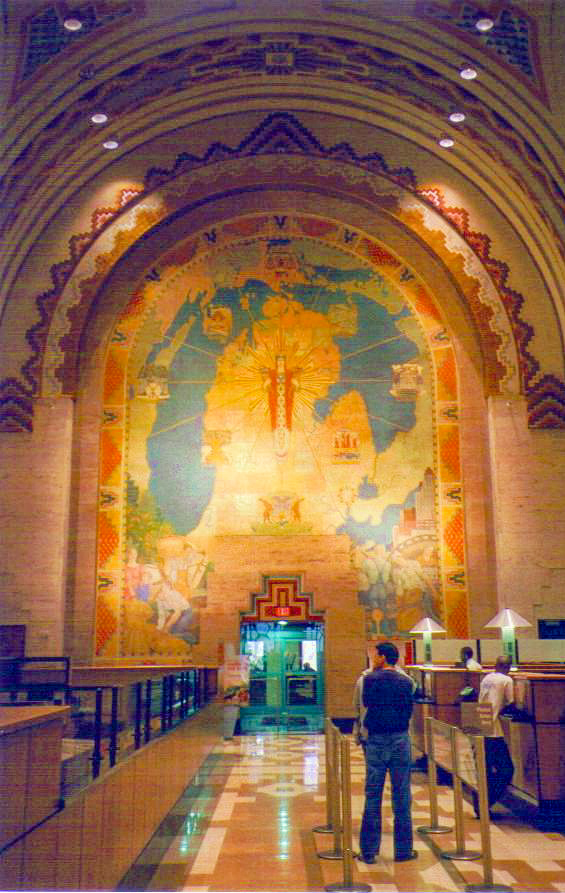
A hand-painted canvas covers the cement-plaster ceiling. This wonderful stenciled ceiling features an Aztec motif in 16 colors that extends down to the sunburst arches of the main space. Quartets of simulated skylights, arranged in a diamond pattern of four diamond-shaped glass tiles, run along the ceiling, a design mirrored in the column piers. Underneath the canvas, a ¾” mat of horsehair was installed to dampen the noise and absorb the sound, making this hub of activity a quiet space to conduct business.
Forty artisans contributed to the accents and designs of the interior—the murals, ceilings, tile work, mosaics, stained glass, and marble fixtures. Even detail-obsessed Rowland had a hand in the finer elements: He designed furniture for the bank’s offices as well as the tableware, linens, and waitress uniforms for a restaurant within the building.
With its long history of bankruptcies, leaseback contracts, auctions, and different owners, and its even longer list of tenants over the course of nearly a century, including the U.S. Army, which used it as its command center for wartime production during World War II, it’s miraculous that it survived at all, much less prospered. The Guardian Building reopened to the public in the early 2000s after a 25-year ban and a $14 million improvement and restoration project. You no longer have to work here to come in and gape at the grandeur of this masterpiece and its beguiling color and craftsmanship, but I was jealous of everyone who did.
#2 Nebraska State Capitol (Lincoln)

Like the state capitols in Florida, Louisiana, and North Dakota, Nebraska’s capitol is a single tower, rising from a broad base. Nicknamed “Tower on the Plains,” it can be seen from 20 miles away. Completed in 1932 and declared a National Historic Landmark in 1997, this Art Deco marvel just gets better and better, a masterpiece that was paid in full during the height of the Great Depression, at a cost of $9.8 million. Sculptures of everything from Abraham Lincoln to Moses, from Nebraskan Native American tribes to wagon trains to the signing of the Magna Carta, Declaration of Independence, and Kansas-Nebraska Act decorate the limestone exterior. A dome covered with the original clay ceramic tiles coated with 20-carat, gold-painted glaze tops the 400’-tall tower. Blue and gold thunderbirds symbolically lift the dome, which is capped by a 19’-tall, nine-ton statue, The Sower—a man sowing seeds of grain by hand, standing atop a pedestal or corn and wheat.
Inside, I decided to take the wonderfully informative tour of this fabulous building. Amid the soaring arches, Art Deco chandeliers, busts of notable Nebraskans, and three large murals, added in 1956, that depict labor of the hand, the head, and the heart, my guide confirmed my suspicions: Due to a deplorable lack of skill, imagination, and talent, architects and engineers simply could not build this structure today—an assertion verified by the very architects and engineers who take this same tour.
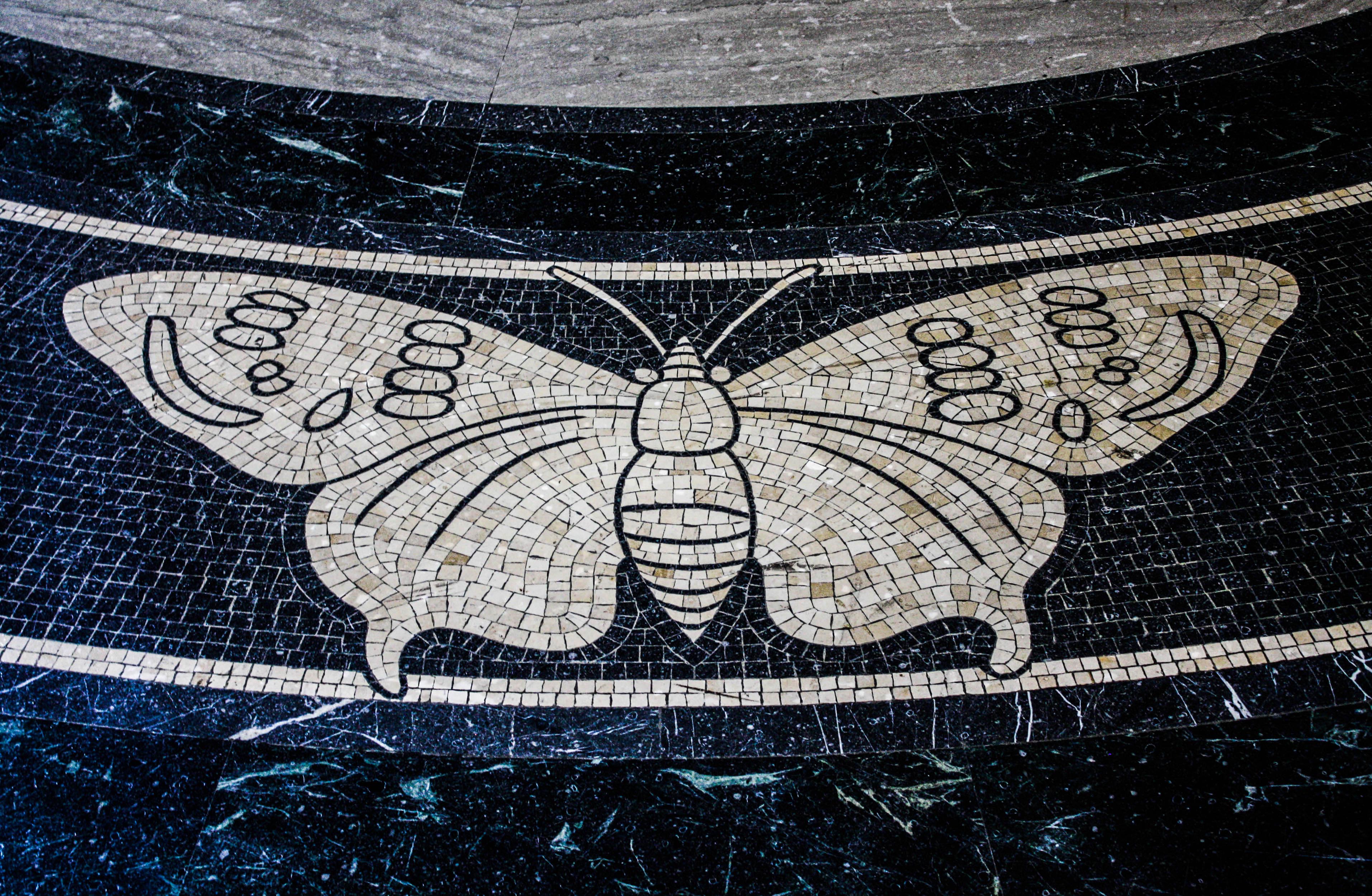
One of the world’s top 10 doors marks the entrance to the Warner Chamber. The sculpted and colorfully painted doors feature a male and a female Native American facing each other, with two corn-cob door handles and the lock in the center of a sunflower. Another chamber boasts marble columns of various colors that signify different races who have settled in Nebraska, and a ceiling with details that represent the state’s Spanish and French history. Throughout, cattle heads, birds, and corn stalks grace the marble rails. Accents of corn husks and sunflowers, and representations of the three branches of government, adorn the acoustically perfect Supreme Court. Perhaps the most striking feature is the glistening white and black marble mosaic floors with images of Mother Earth, the four elements, and prehistoric mammals, crustaceans, insects, and birds from the state’s past.
On the 14th floor, the Memorial Chamber is dedicated to “the forms of heroism called for in the public service and in devotion to humanity”—a notion depicted in eight murals, split between four military themes and four civic themes, with a quote from Lincoln’s Second Inaugural Address running beneath them. The dome above the black marble walls is painted to represent the evening sky, with the chandelier standing in for a star. The chamber grants access to the observation deck, where I was rewarded with views of the city and beyond. Here, I reflected on the deep thoughtfulness and brilliantly executed artistry that was devoted to this building and that clearly makes the tallest building in Lincoln the most beautiful U.S. capitol.
#3 General Electric Building (New York, New York)
After COVID-19 hit and the world was in lockdown, I knew that, tragically, travel would be off the table for an unknown duration. During this time, to keep my sanity, I decided to take mini “vacations” around my hometown of New York and venture to each of the city’s more than 350 neighborhoods in the city—a very long-term goal that I still have not achieved.
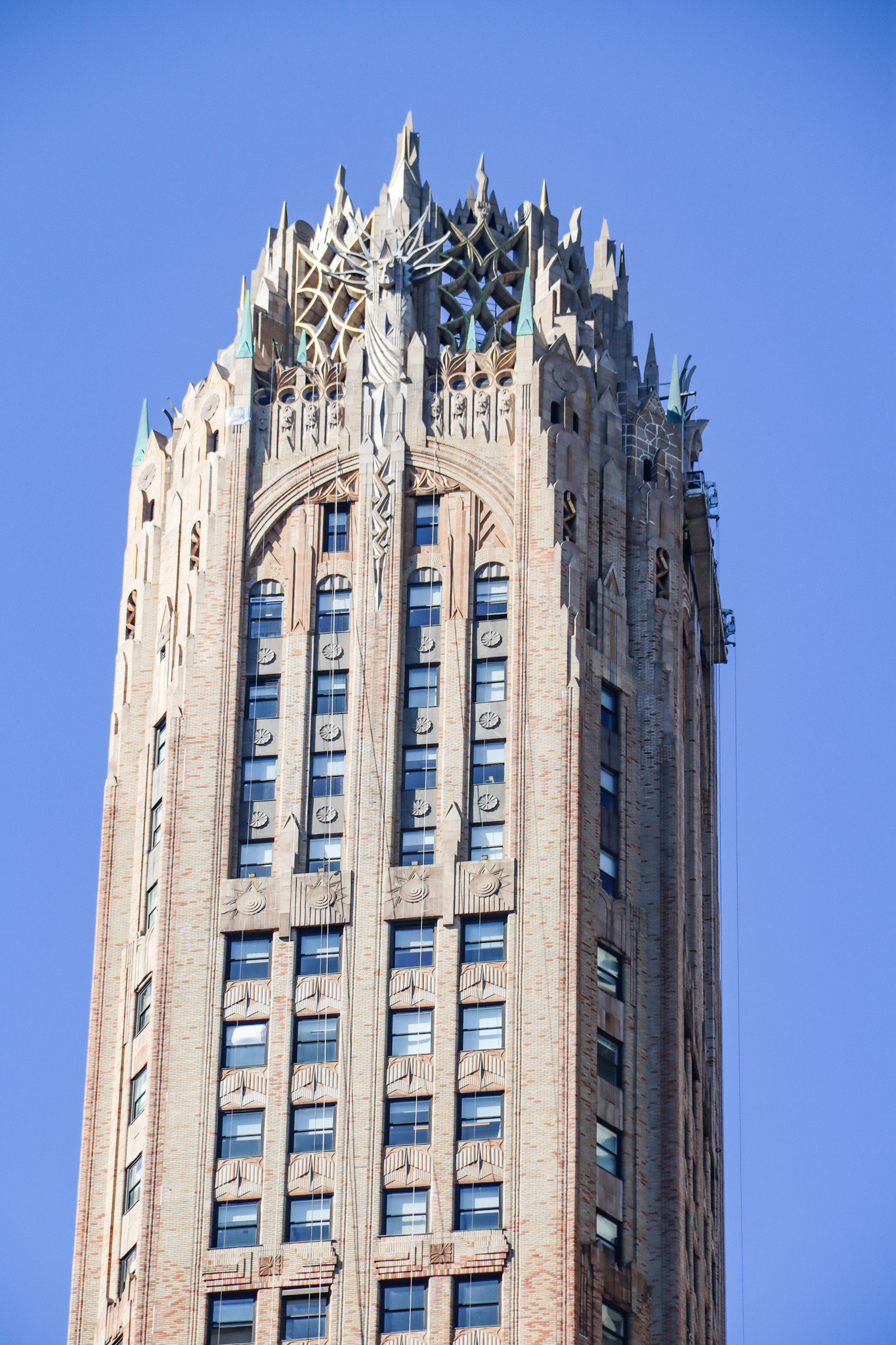
While I was ambling around Midtown Manhattan on one such trek, I took note, for the first time, of the General Electric Building. Constructed as the RCA Victor Building in 1931 (although, through a series of legal and corporate arrangements, RCA cancelled plans to move in even before the building was completed), this structure is a visual feast from the ground floor to its crown.
At about 640’ tall, the GE Building towers over its neighbors via a series of setbacks that rise to its spectacular crown. On the outside, bricks in buff, orange, and tawny colors were laid out in such a way that, from a distance, give the impression of a rich bronze color; the lowest section is made of reddish granite.
Terracotta takes over in the windowsills, corbels, spandrels, and the details such as the reliefs that depict lightning—a nod toward electricity produced by GE. On the upper stories, the terracotta is sprayed with 14-carat gold.
The fun begins right at ground level. Red marble frames containing reeded jambs surround the display windows and loading dock. Above each window is a triangular pediment with a fluted tympanum and a niche in the pier above the center of the pediment containing an abstract Art Deco representation of “the electric spirit.” The Art Deco details continue in the zigzag design of the push-plate on each of the entrance doors. At the curved corner pier, I appreciated the clock with the cursive GE logo and a pair of disembodied silver arms clutching bolts of electricity, a detail modified and repeated on either side by electric bolts held only by fists.
I let my eyes slowly travel up the sides of the building, taking in its rounded piers, chevrons made of fluted bars, additional sculptures of those electric spirits, raised circles with aluminized finishing, and an arch over each side of the 49th floor. Above that, I marveled at one of New York’s best skyscraper toppers. Four 50’-tall figures depict a deity with “forked lightning”—a flourish of Gothic tracery touched with gold intended to represent electricity and radio waves.
I made sure to pop inside the vestibule, which retains many of the original Art Deco elements—decorative radiator grills with tall rectangles with angular tops, a wave mosaic, metal sconces, and an Art Deco chandelier. The lobby, with its lune-shaped vault ceiling, features a terrazzo floor with geometric designs, torch-shaped sconces, a metal Art Deco screen topped with a clock with a red-marble face, and a metal Art Deco mailbox.
Named a New York City Landmark in 1985 and added to the National Register of Historic Places in 2004, the GE Building continues to electrify visitors and admirers with its unique design.
#4 American Radiator Building (New York, New York)
Whether you’re on your way to or from the main branch of the New York Public Library, or shopping your way through the Holiday Market in Bryant Park in December (or soaking in the sun in the park in June), the American Radiator Building is always right there to greet you.
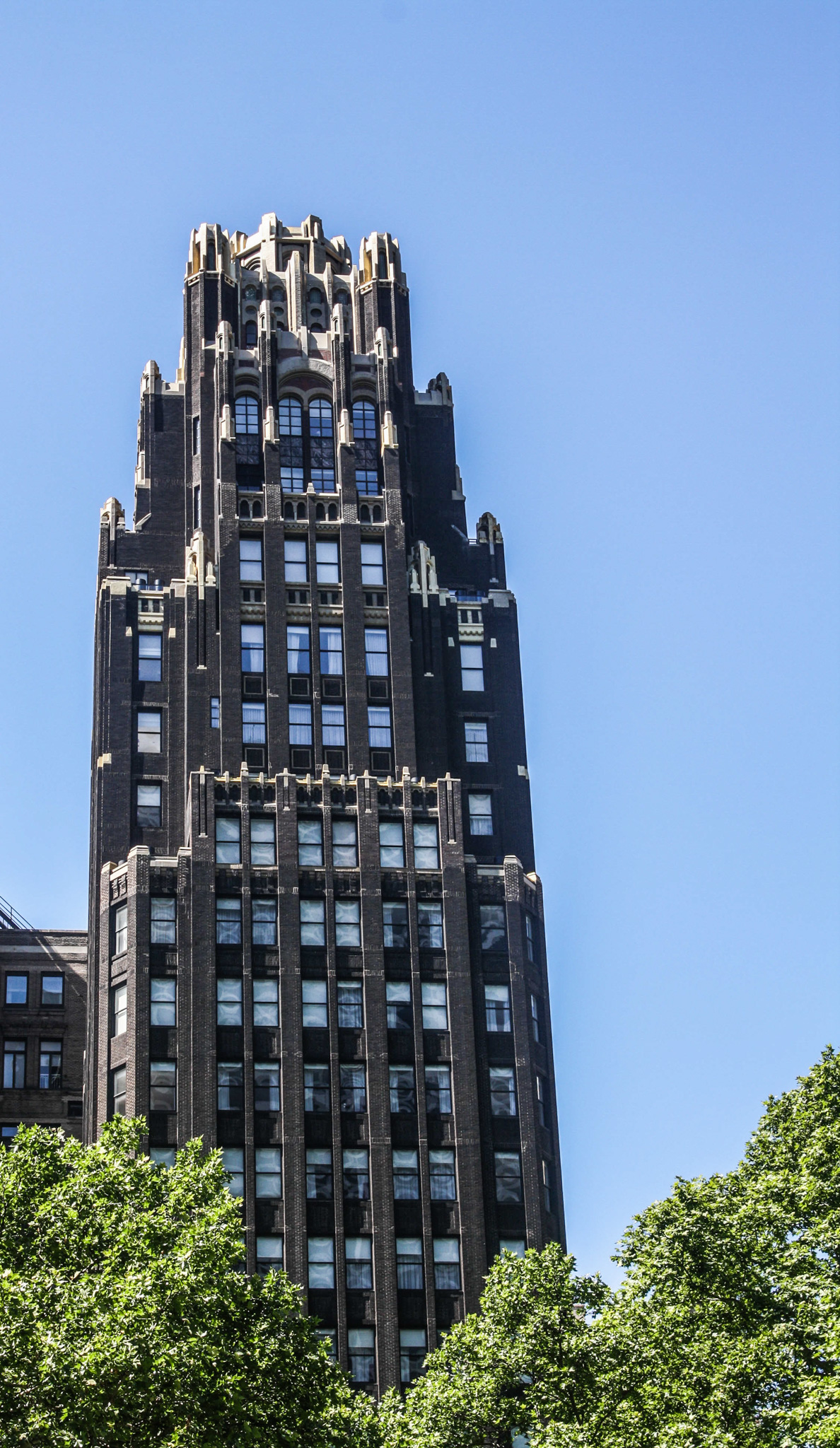
This wonderful 18-story tower soars above the tree line to a height of 338’. Resting atop a five-story base, it stands out from so many other buildings because of a daring color choice by the architect, Raymond Hood. Bored by the monotony of conventional office buildings’ use of white-masonry facades and dark glass windows, Hood made a bold choice: He used black bricks for most of the façade, enhanced by gold-colored decorations for the building’s pinnacles and setbacks. His choices weren’t completely arbitrary: The black signifies coal and the gold suggests fire—exactly what you’d expect in early radiators.
At street level, the base of the building is clad with polished black Swedish granite and is accessed via the entrance with a round-arched opening. A delightful cornice with corbels and modillions runs across the width of the second story. Ornamental figures—half-clad voluptuous women and muscular men, inspired by medieval grotesques—enhance the corbels. Some of them depict human emotions and conditions (the woman clutching her breast is clearly lust), while others relate to the building’s original purpose, like the pipefitter or the man pouring water into a box to create steam.
The tower remains visually interesting via its setbacks on the fourth, 12th, 17th, 22nd, and 23rd floors; cornices on the 16th and 20th stories; and the terracotta pinnacles and peaks clad in gold leaf that are illuminated at night, a feature to not only assertively announce American Radiator’s prominence but also done thoughtfully—it gives the appearance of a heated radiator.
Completely unoccupied during the 1990s, the building began its next life as the Bryant Park Hotel, opened in 2001. That means you can gain easy access to the interior, including the Célon Bar & Lounge, which combines “the elegance of Casablanca with the allure of a speakeasy.” It was the perfect place for me to meet up with friends to finish my time exploring this New York City landmark.
#5 Buffalo City Hall (Buffalo, New York)
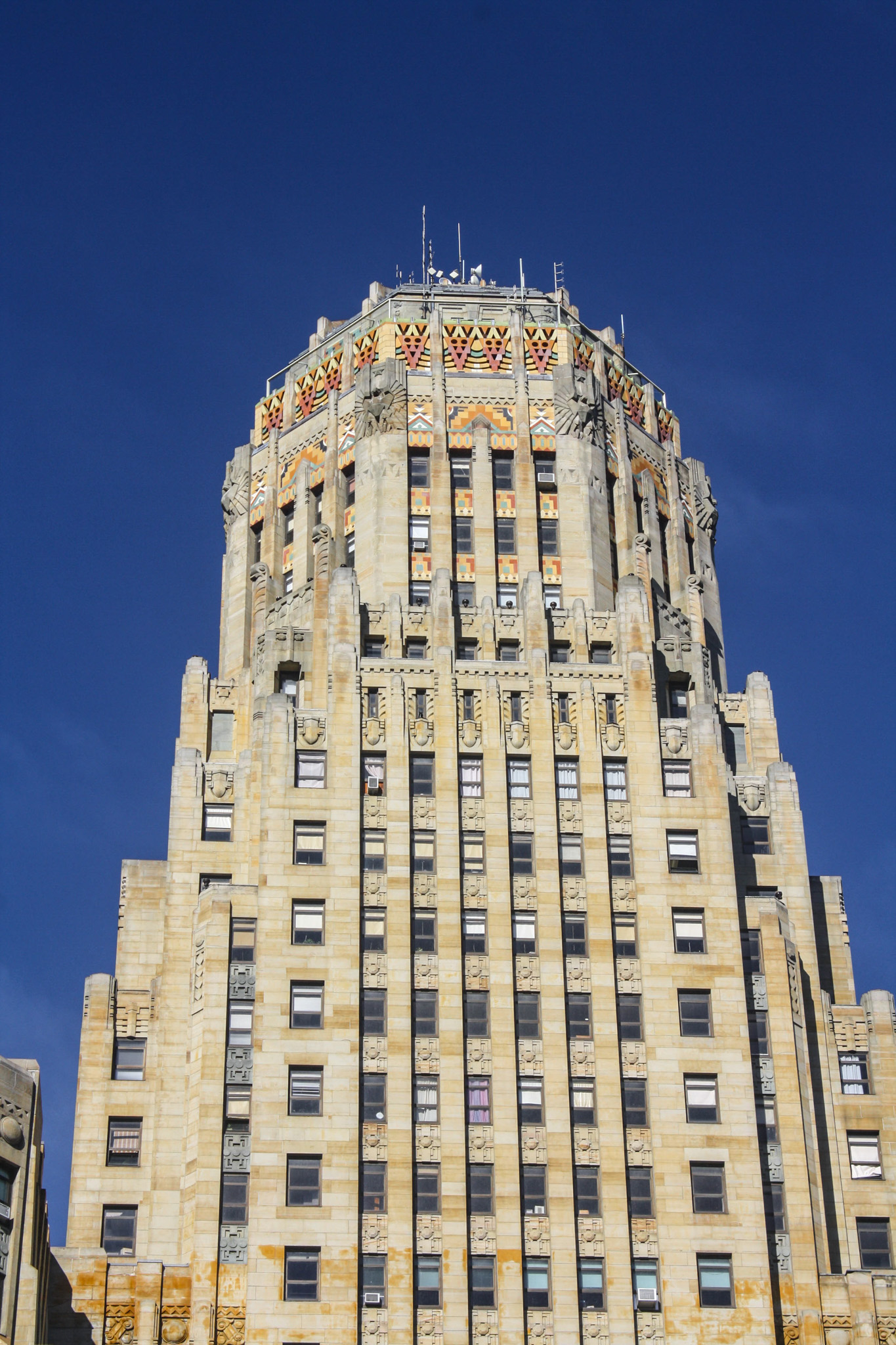
Unobstructed by any neighboring building, Buffalo’s City Hall can be admired from every angle. Completed in 1931, one of the largest and tallest municipal buildings in the United States rises 32 stories to a height of nearly 400’. Its unusual shape, with angled sections on the lower floors and plenty of recessed and projecting towers, allows plentiful sunlight to flow through all of its 1,520 windows. Sitting on a base of gray granite, the building employs tawny sandstone and gray limestone for the façade. Along the upper floors and around the crown, decorative polychromatic terracotta tiles—inspired by Native American headdresses and featuring geometric patterns—add splashes of color in between stylized eagles.
City Hall is awash in details, and it became evident as soon as I approached the main entrance. On either side of the entrance, I admired the sculpted eagles and stars; the figures, including an Iroquois Indian, wedged into window jambs; and sculptured panels representing, among others, agriculture and fruitage. The entrance itself boasts eight unique columns that support a lintel of zigzags, representing a saw, a reference to the city’s industry. Above, a fantastic frieze encapsulates the history of Buffalo through its images of people engaged in the steel, electric, science, medical, shipping, law, education, aviation, and train industries.
Up the stairs, I found four sandstone panels over the doors that portrayed the American Pioneer, including men and women harvesting, deer hunting, weaving a basket, and constructing a log cabin. City Hall is open to the public, so I continued on into the vestibule and lobby, where I found columns with Indian symbols of The Four Windows, including thunder and storm. The magnificent lobby with its tiled barrel ceiling features sculptures, etched brass elevator doors, and murals depicting everything from charity to Buffalo’s industries to the friendship between Canada and the United States.
Up on the 13th floor, I entered the Common Council Chambers, with a domed ceiling featuring Native American designs and piers topped with different human heads above such virtues as Fortitude, Prudence, and Faithfulness. The main attraction here is the spectacular semi-circular stained-glass skylight in the form of a blazing sunburst.
Last, I rewarded myself with unending views from the observation deck, where I took in vistas of Lake Erie as well as the entire city and beyond. Listed on the National Register of Historic Place in 1999, City Hall is pure architectural eye candy. Make sure to come back at night when it’s closed—and when it’s all lit up, especially up top in the red, white, and blue of the crown.
Five Runners-Up
- Chrysler Building (New York, New York; 1930)
- Williamsburgh Savings Bank (Brooklyn, New York; 1929)
- Cincinnati Union Terminal (Cincinnati, Ohio; 1933)
- Marine Building (Vancouver, British Columbia; 1930)
- Fisher Building (Detroit, Michigan; 1928)
I’d Love to Hear From You!
Have you been here? Have I inspired you to go? Let me know!


 Stephen Travels