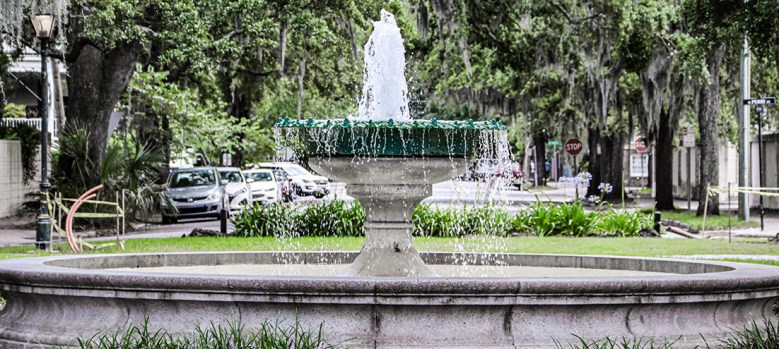
Pardon me for gushing, but I love, love, love Savannah. Each time I visit this spectacular city in southeastern Georgia, I am more and more beguiled by it. It has become a monomania—a perpetual smile appears on my face as soon as I arrive, and I can’t get enough of it, driven by a compulsive determination to constantly discover new places and stories, and to house hunt for a place to live once I retire, still years in the future.
My introduction to the city (apart from a brief mention in a high school history course that touched on how local authorities negotiated a peaceful surrender to save Savannah from General Sherman’s scorched-earth policy during his March to the Sea in the Civil War that devastated the rest of Georgia) came not from a visit there, but through a book. John Berendt’s Midnight in the Garden of Good and Evil (the book is so much better than the movie) was wisely recommended to me by a colleague, to whom I am forever grateful. It’s one of the very few books I’ve ever read that I literally could not put down. Just another chapter before bed, I would say and repeat after every chapter.
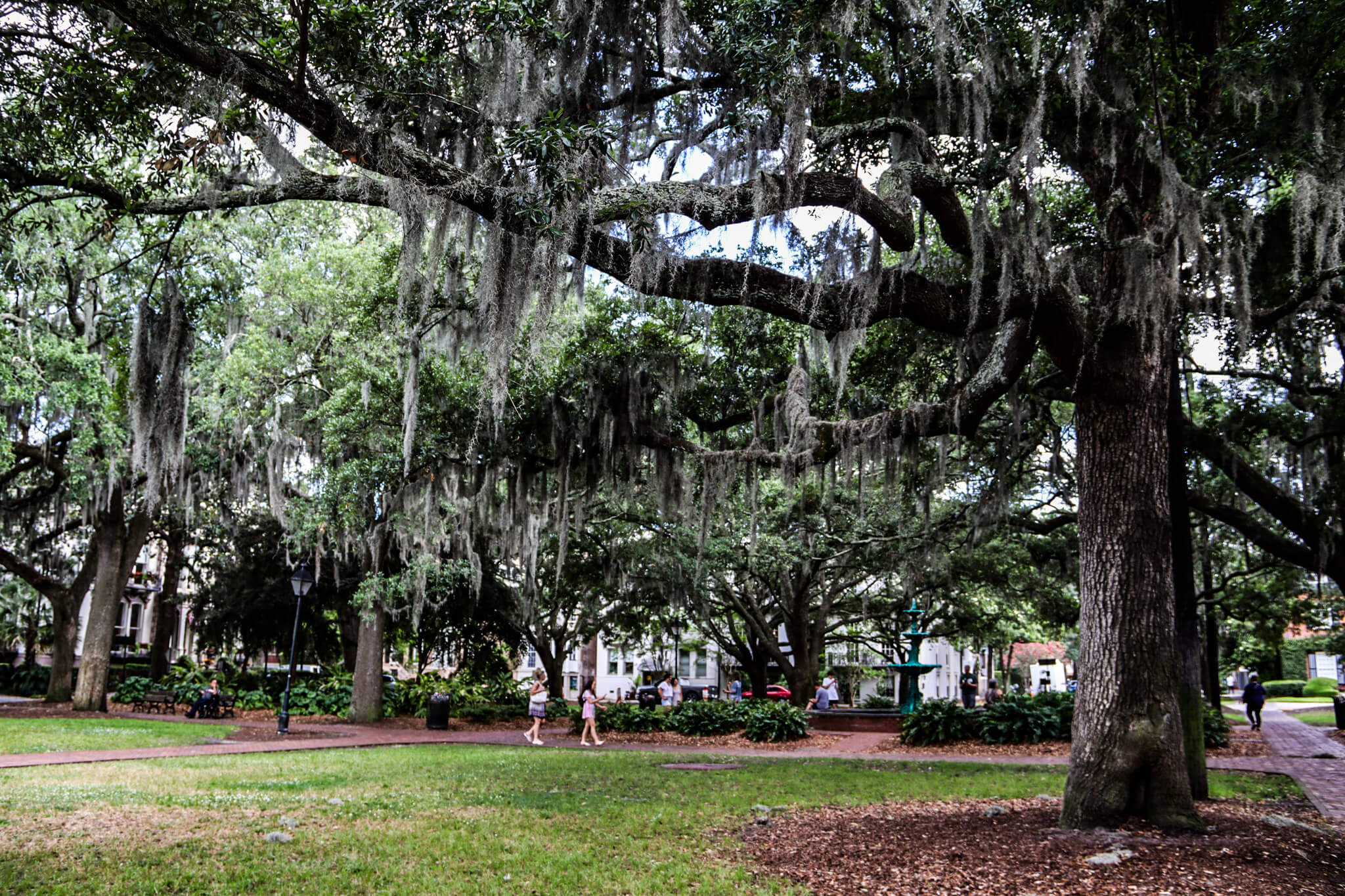
Lush vegetation and Spanish moss are characteristic of Savannah’s 22 squares.
“The Book,” as it’s referred to by locals in Savannah, has been both a blessing and a curse for those who live in this incomparable city. It has brought renewed popularity, interest, industry, and tourism dollars to the city, but that comes with a price, as many residents aren’t too pleased with the tremendous growth in the number of out-of-towners and claim it’s over-touristed. Indeed, since the book was published in 1994, the number of visitors escalated from about 5.5 million to about 15.5 million today, bringing in $3.3 billion.
I’d have to disagree with their gripe, and not just because I’m one of those visitors. Whenever I was there, I never found it to be overcrowded by any means. Even the main tourist drag wasn’t oppressive. In fact, there were many places where it was just me and a handful of others.
One of those places is, collectively, the city’s squares within the most beautiful historic district in the United States. Originally laid out in 1733 as America’s first planned city, Savannah grew and grew as it prospered as a port and a center for the cotton industry. The layout of a square and its surrounding blocks was called a ward, part of a plan that included gardens and farms. As the city expanded and became more urban, these wards abandoned their agrarian nature. In 1851, 118 years after the first square was laid out, the last square was completed, bringing the total number of squares to 24, of which 22 survive today.
What makes them so special? Well, they’re simply gorgeous. In a city dripping with history, romance, mystery, and atmosphere, as well as Spanish moss on its live oak trees, these squares offer cool, shady, green oases of relaxation in the midst of the city’s exceptional architecture and busy society.
Each square measures about 200’ from east to west, but their north-south dimensions vary, from about 100’ to 300’. No more than two or three blocks separate them, so as you roam around the city, you’re never very far from a place to sit or lie down and relax.
Each square also provides a little history lesson, with its statues and monuments and obelisks. Some have fountains to help cool you off on a notoriously hot and humid Savannah summer day. As if that wasn’t enough to completely charm you, they have an added benefit that none of the city’s original founders and developers could have foreseen: They slow down vehicular traffic. All of the streets that run to a square approach it at its center. Thus, drivers have to slow way down or stop and then make three turns to go almost completely around the square to continue further along the same street.
I was staying at the Forsyth Park Inn, directly across the street from Forsyth Park and its iconic fountain—the perfect location to walk to the squares, or to hop on the free shuttle that loops around the historic district every 15 or 20 minutes. The squares should be enjoyed at a leisurely pace, letting the city’s laid-back vibe envelope you. Starting with the northern squares, just a few blocks from the bluff that rises above the Savannah River, you’ll want to spend time in:
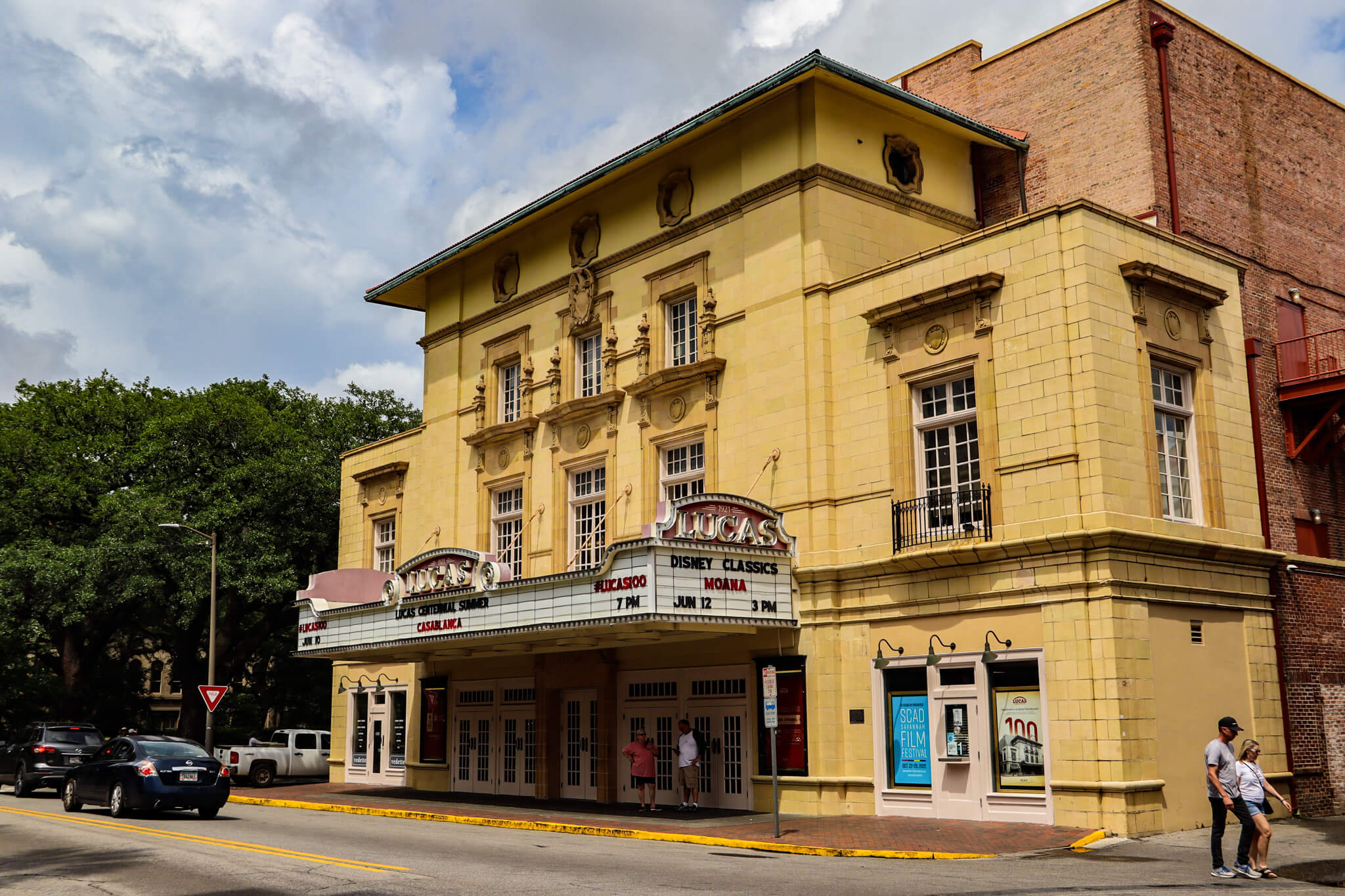
Historic Lucas Theatre, across from Reynolds Square, was the first public building in Savannah with air conditioning.
Franklin Square—The only square without grass, Franklin Square is a shady brick square that dates back to 1790. Named for Benjamin Franklin (who served as an agent for the colony of Georgia for a decade), the square used to be the site of the city’s water tower. Today, it includes a memorial for Henri Christophe as a 12-year-old, long before he became commander of the Haiti army and then the first and only king of Haiti in the autarchy he built. From here, you can take in the First African Baptist Church (the oldest black church in North America) before you begin your shopping and dining stroll down the adjacent pedestrian blocks of City Market.
Ellis Square—At the opposite end of City Market, you’ll find Ellis Square. One of the original four squares, Ellis Square is named for Sir Henry Ellis, the second royal governor of the colony of Georgia. With trees only around its edges, it’s the sunniest of all the squares, at least weather-wise; historically, it has a dark side, as the site of a slave market. Today, it has a water spray area, illuminated in different colors at night, to keep you cool (or to drench you, if you walk through the spouts or just stand next to one) as well as a statue of Savannah native songwriter-lyricist Johnny Mercer, leaning against a fire hydrant.
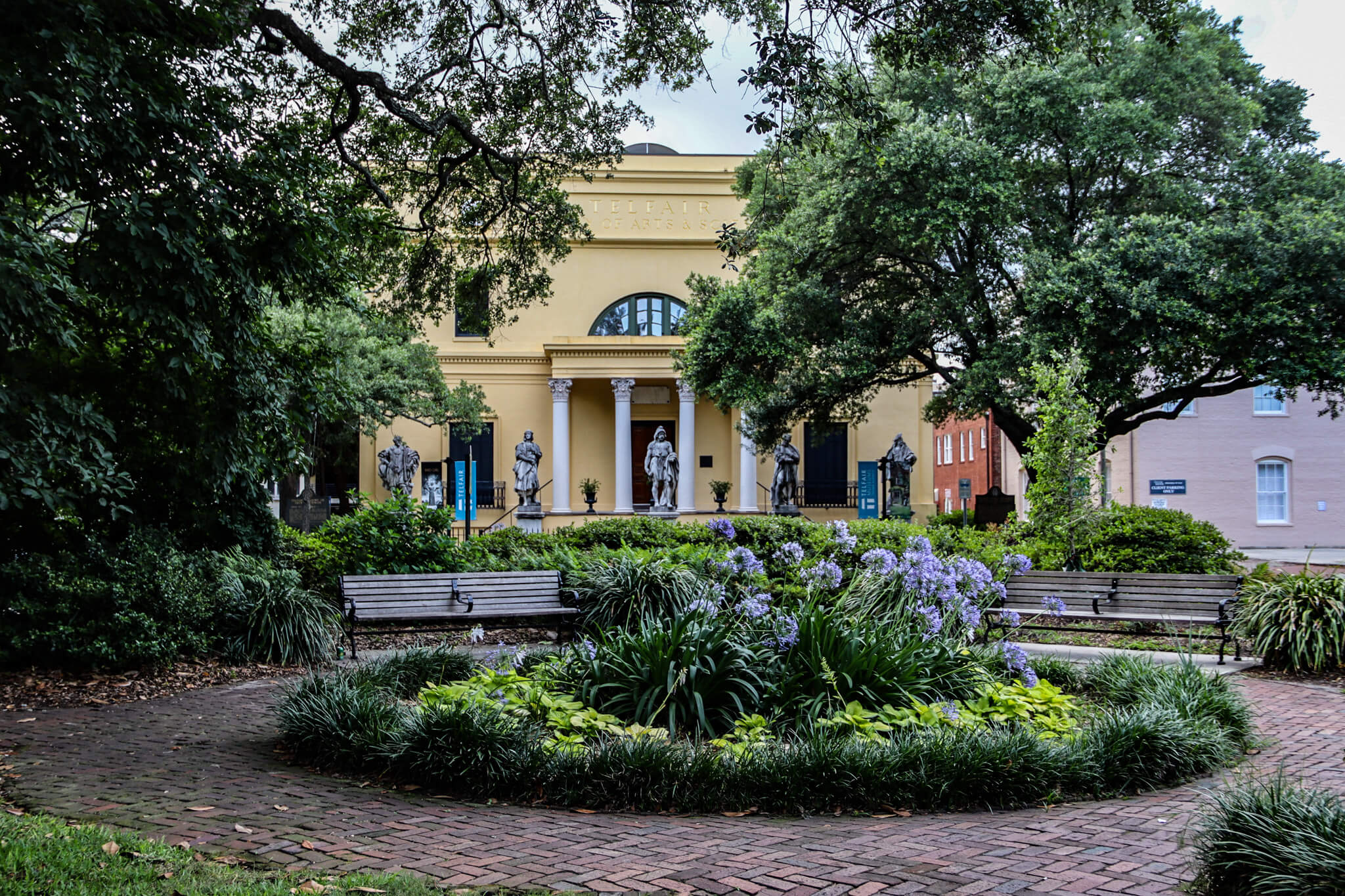
The oldest art museum in the Southeast faces Telfair Square.
Johnson Square—Savannah’s first square remains its largest. Brick paths in herringbone pattern cut through the square at right angles. There’s a great view of City Hall, one of the most beautiful buildings in Savannah. Around the square, you’ll find a couple of classical bank buildings, Christ Episcopal Church (the first church established in the Province of Georgia), and the historic Manger Building, a former hotel that was the city’s finest accommodations and the first to offer fully air-conditioned guest rooms. Inside the square itself, the Nathanael Greene Monument is the final resting place for the Revolutionary War general (not in his eponymous square, below). In between the benches and lush vegetation, there are two fountains, a sundial, and black lampposts decorated the holly and red bows during the Christmas season.
Reynolds Square—Named for the governor of Georgia who served in the mid-1750s, Reynolds Square is the perfect place in which to relax or gather before catching a movie or live performance at the historic Lucas Theatre (now managed by the Savannah College of Art and Design (SCAD)) on one side of the square, or a meal or a drink at the Olde Pink House (dating to 1771) on another. In the center of the square stands a bronze statue of John Wesley, founder of Methodism, who served as the Anglican minister of the Georgian colony and who founded the first Sunday school in America.
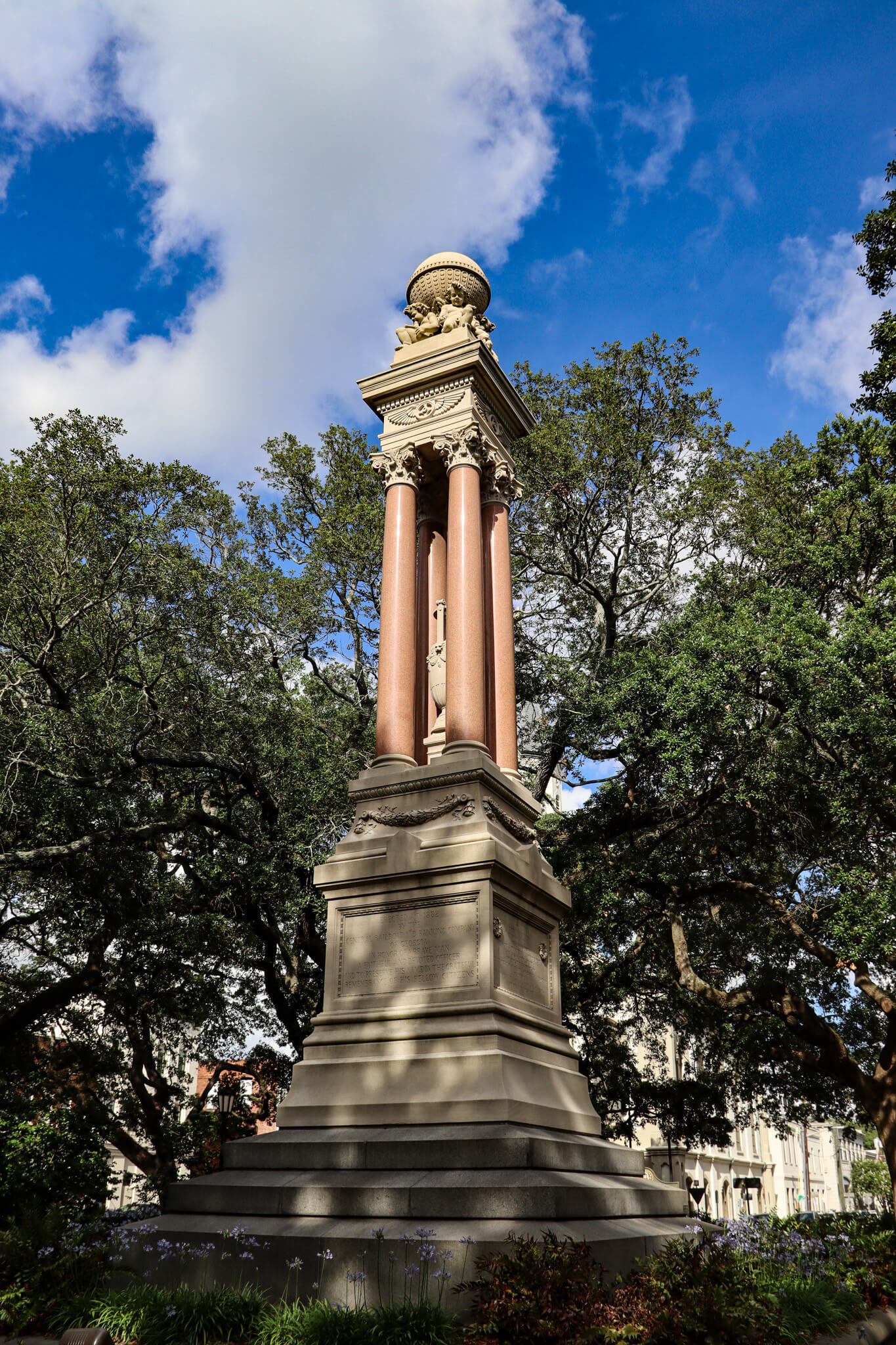
The Gordon Monument honors an influential Savannah mayor in Wright Square.
Warren Square—The plainest and probably least-visited square (and thus the quietest), Warren Square is surrounded by lovely private homes and one not-so-lovely low-level parking garage. It’s named for Joseph Warren, a general who was killed at the Battle of Bunker Hill during the Revolutionary War and the man who enlisted Paul Revere to spread the word that the British were coming.
Washington Square—Named for George Washington, this square was built in 1790 on the site of what had been the Trustees’ Garden, where colonists grew a variety of experimental crops, including mulberry, hemp, and indigo, most of which failed. Another quiet square with lots of well-trimmed grass, it’s located in a primarily residential district noted for its New England style of its architecture. It’s a pleasant spot to stop and have, say, a Coke, the appropriate beverage for this square—the largest building on the square is a former cotton warehouse built in 1860 that became, in 1902, Savannah’s first Coca-Cola bottling factory.
Telfair Square—Originally named St. James Square when it was created in 1733, this square received a name change 150 years later to honor three-time Georgia governor Edward Telfair and his family. It’s the only square to honor a family rather than one individual. The west side faces old Savannah—Trinity United Methodist Church (from 1848) and Telfair Academy, an art museum (the oldest one in the Southeast, and one of the first 10 in the United States) housed in the old Telfair family home, from 1818. The east faces new Savannah, with two modern federal government building. The square is home to two small monuments, one to the chambered nautilus (perhaps the most unusual monument in all the city’s squares), and the other to the founding of the Girl Scouts of the USA, created by Juliet Gordon Low, a daughter of Savannah.
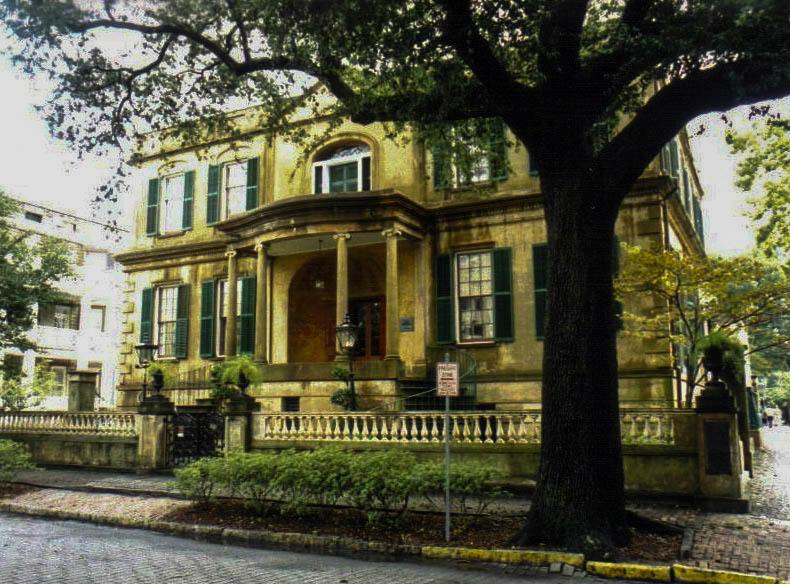
The Owens-Thomas House is one of the city’s finest house museums.
Wright Square—The second of Savannah’s squares was renamed in 1763 in honor of James Wright, the third and final colonial governor of Georgia. Bookended by a stately federal building and courthouse on the east and both the Lutheran Church of the Ascension (1878) and the former, and wonderful, Chatham County Courthouse (1889) on the west, and by shops and restaurants to the north and south, Wright Square is a popular place. In the middle stands a monument to William Washington Gordon, a Savannah mayor who was also the father of Girl Scouts founder Juliet Gordon. It’s one of the squares’ best monuments, a granite pedestal supporting four marble columns, with an urn between them, and a globe on top. A carving of a train on a trestle bridge on one side acknowledges Gordon’s role as a railroad baron and the founder and president of the Central of Georgia Railway. Less conspicuous is the large boulder that marks the grave of Tomochichi, the Yamacraw Indian chief who welcomed James Oglethorpe and the first colonists to his land.
Oglethorpe Square—After I visited the Owens-Thomas House and Slave Quarters (the finest example of English Regency architecture in the United States and one-time overnight accommodations for Marie Joseph Paul Yves Roche Gilbert du Motier, Marquis de Lafayette, in 1825), I crossed the street and took a seat on one of the benches in the square. Named for the British founder of Savannah, Oglethorpe Square is also a misnomer—there’s no monument to him here; it’s actually in Chippewa Square (below). Rather, this exceptionally shady square contains a marker to the Moravian missionaries who began settling in Savannah in 1735 before they uprooted and relocated to Pennsylvania just about five years later.
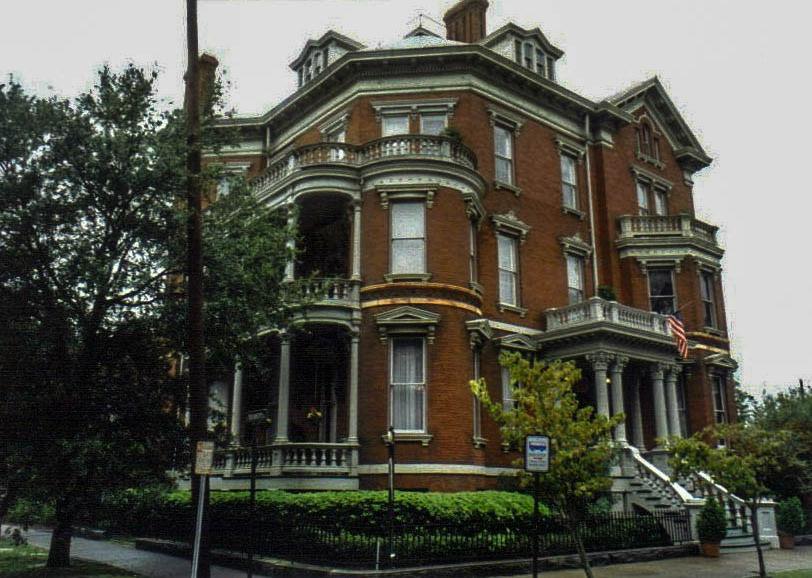
The Kehoe House is one of Savannah’s most beautiful buildings.
Columbia Square—Created in 1799, this square was named for the female personification of the United States. Around it stands one of the best buildings in the city, the Kehoe House (1892), now a gracious inn. In the center you’ll find a lovely fountain with a brick basin. Decorated with vines, leaves, flowers, and other woodland motifs, the fountain was rescued from Wormsloe Plantation, an early Savannah settlement (and the oldest standing structure in the city) whose ruins you can visit just a short drive from here, noted especially for its amazing 1.5-mile oak roadway flanked by more than 400 live oak trees, feathered with Spanish moss and forming a breathtaking canopy over the road.
Greene Square—One of the easternmost squares, Greene Square honors Revolutionary War General Nathanael Greene (although his monument is in Johnson Square (above)). It’s one of the less remarkable squares, with just a few benches around its rim. The square was, at one time, the center of the city’s African-American community; the Second African Baptist Church still stands across the street, with a sign that notes that General Sherman was a guest here in 1864.
Orleans Square—Laid out in 1815 to honor the heroes of the Battle of New Orleans during the War of 1812, Orleans Square features the lovely German Memorial Fountain with a circular basin, surrounded by four stone benches, that commemorates early German immigrants to the city. Installed and dedicated in 1989, it marked the 250th anniversary of Georgia and the 300th anniversary of the arrival of 13 Renish families from Philadelphia. That’s not the only reason to enjoy this square. At the southeast corner stands the Harper-Fowlkes House, an 1842 Greek Revival mansion that’s one of the city’s finest structures.
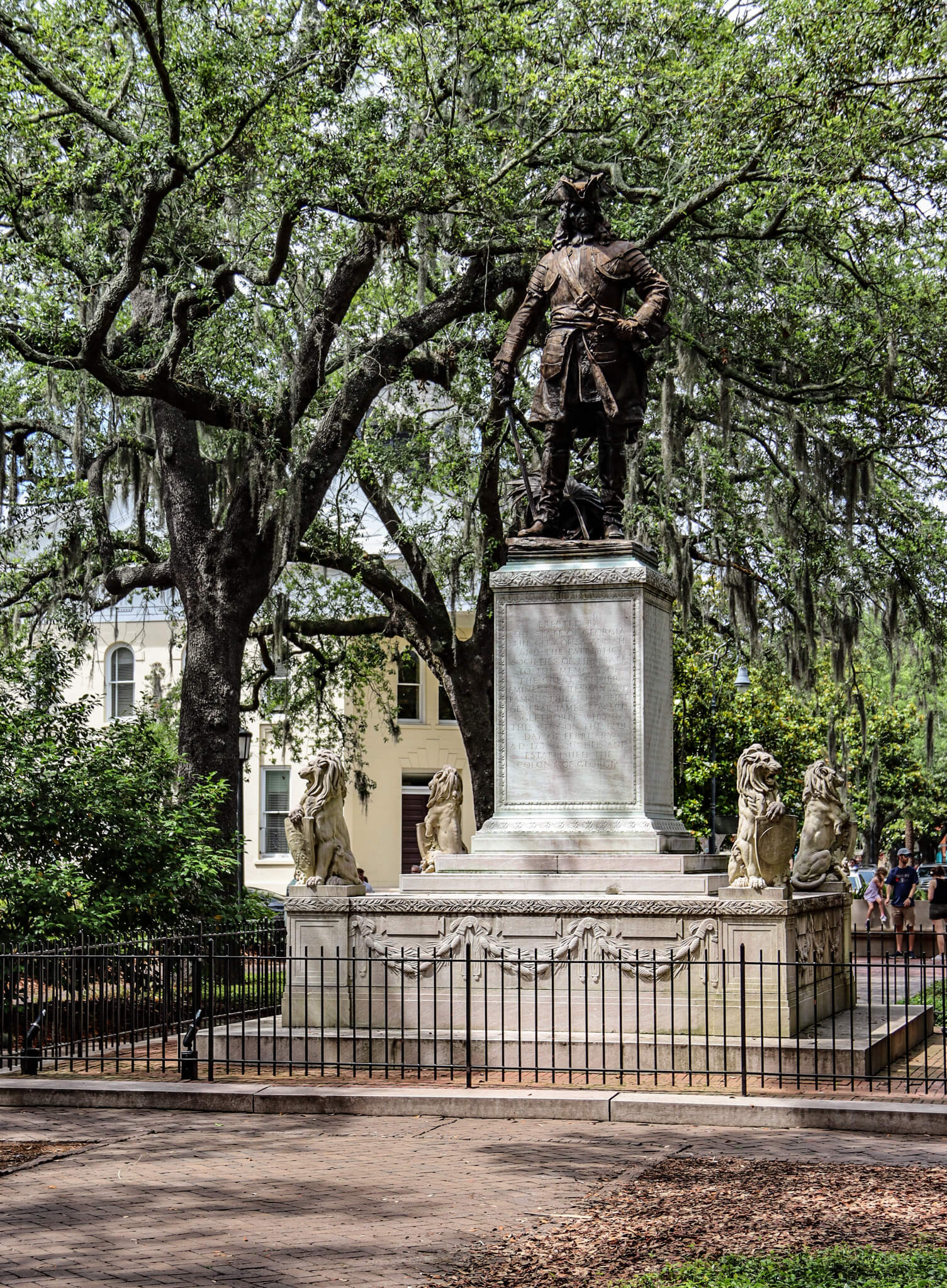
The founder of Georgia stands tall in bronze in Chippewa Square.
Chippewa Square—The War of 1812 gets recognized again here in Chippewa Square, designed in 1815 to commemorate that war’s Battle of Chippewa. Surrounded by beautiful homes, the Art Deco Savannah Theatre, and First Baptist Church, the square lures you in with its inviting benches, abundance of greenery, and, at the center, the James Oglethorpe Monument. Created by renowned sculptor Daniel Chester French and architect Henry Bacon (they collaborated on the statue of Abraham Lincoln in the Lincoln Memorial in Washington, D.C.) and unveiled in 1910, the founder of Georgia, cast in bronze, faces south on a pink-gray marble pedestal, with his sword drawn in defiance of the one-time menace in that direction, Spanish Florida. He’s surrounded by four lions, each of which holds a shield, one with Oglethorpe’s personal coat of arms and the others with the seals of the city of Savannah, the colony of Georgia, and the State of Georgia. The square is arguably the city’s most recognized—the park bench scenes with Tom Hanks in Forrest Gump were filmed here (but don’t bother looking for the bench itself—it was a prop brought in for the film and now resides in the Savannah History Museum).
Crawford Square—This square is unusual for many reasons. Designed in 1841, it was named in honor of a historical figure of lesser recognition but with a hefty résumé: William Harrison Crawford—judge, U.S. Secretary of War, U.S. Secretary of the Treasury, minister to France during Napoleon’s reign, and unsuccessful presidential candidate in the 1824 election, coming in third place behind fellow nominees John Quincy Adams and Andrew Jackson. It’s also the smallest of Savannah’s squares, and it’s the only one of two with a gazebo, the perfect place to relax after you’ve just played some basketball on the court next to it, also unique to the city’s squares. During the Jim Crow era, it was the only square in which African Americans were permitted. And, to this day, it’s the only one that has retained both its cistern (a leftover from early firefighting practices) and the fence that surrounds it, the other squares having lost theirs over the years.
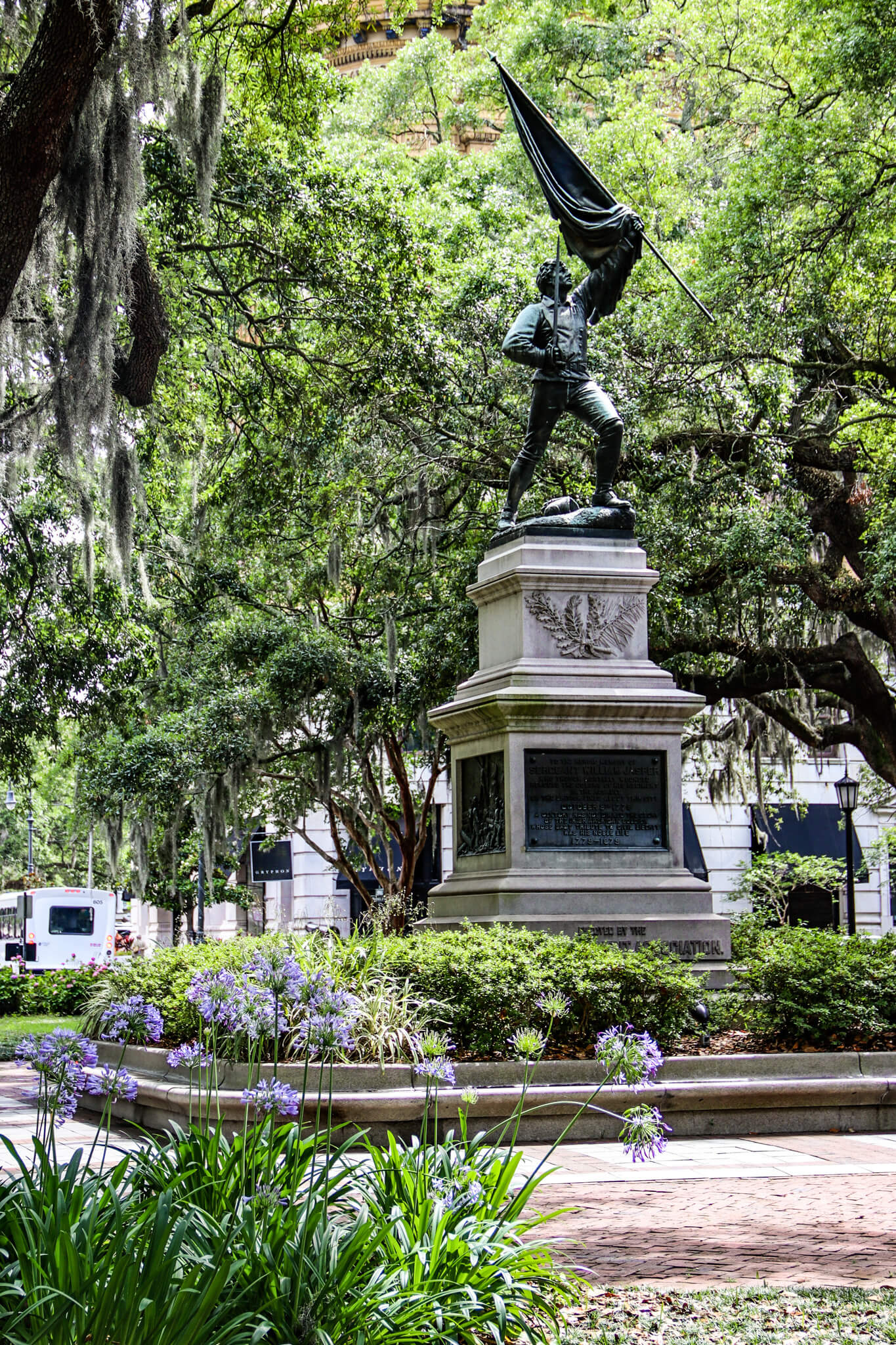
In Madison Square, Revolutionary War Sergeant William Jasper raises the flag despite his fatal wound.
Pulaski Square—The Polish-born Revolutionary War hero Casimir Pulaski died in 1779 from wounds he received fighting for America during the siege of Savannah. In 1837 he was honored with this eponymous square. But, like some of the other individuals being honored in Savannah’s squares, his monument is in a different square, Monterey Square (below). The square bears no monuments at all, or any other architectural features. Rather, it’s a lovely green oasis with lots of grass, thick ivy groundcover, and some of the most beautiful live oaks in the city.
Madison Square—On the south side of this square, laid out in 1837 and named for President James Madison, you’ll find two terrific buildings, both now part of SCAD: the old Savannah Volunteer Guard Armory (from 1892), now Poetter Hall, and the old Scottish Rite Temple (pop in to the ground-floor Gryphon Tea Room (formerly a pharmacy) for superior Italian wedding soup). At the northeast corner, make sure to visit the friendly and well-stocked E. Shaver Booksellers. There’s also the lovely St. John’s Episcopal Church, from 1853, as well as a haunted house or two. At the center of this welcoming square stands the dramatic monument to Revolutionary War Sergeant William Jasper, here depicted raising his company’s banner even though he was mortally wounded (and died just steps from the square) and holding his fatal wound with the other hand, his bullet-ridden hat at his feet. Each frieze on the four sides of the base depicts key moments in his military career. A couple of vintage cannon from the Savannah Armory are also in the square.
Lafayette Square—You can spend an entire day in this square, named in honor of Marquis de Lafayette, the French general under George Washington during the American Revolutionary War. If you manage to get a reservation, you’ll start your day at the Hamilton-Turner Inn, a gorgeous bed and breakfast completed in 1883 as a private mansion, the first residence in Savannah with electricity. Then you can take a tour of the home of author Flannery O’Connor before taking another tour of the Andrew Low House to see where the Girl Scouts’ founder lived. Of course, you’ll need to stop in at the Cathedral of St. John the Baptist, a French Gothic–style beauty with 34 murals, an 8,000-lb. baptismal font, 81 stained-glass windows, and the highest twin steeples in downtown Savannah. The square itself features cobblestone paths and holds one of the city’s prettiest fountains, Semiquincentenary Fountain, commemorating the 250th anniversary of the founding of the colony of Georgia. Be here on March 17, when the water in the fountain is dyed green on St. Patrick’s Day as part of one of the largest celebrations of the Irish saint in the United States.
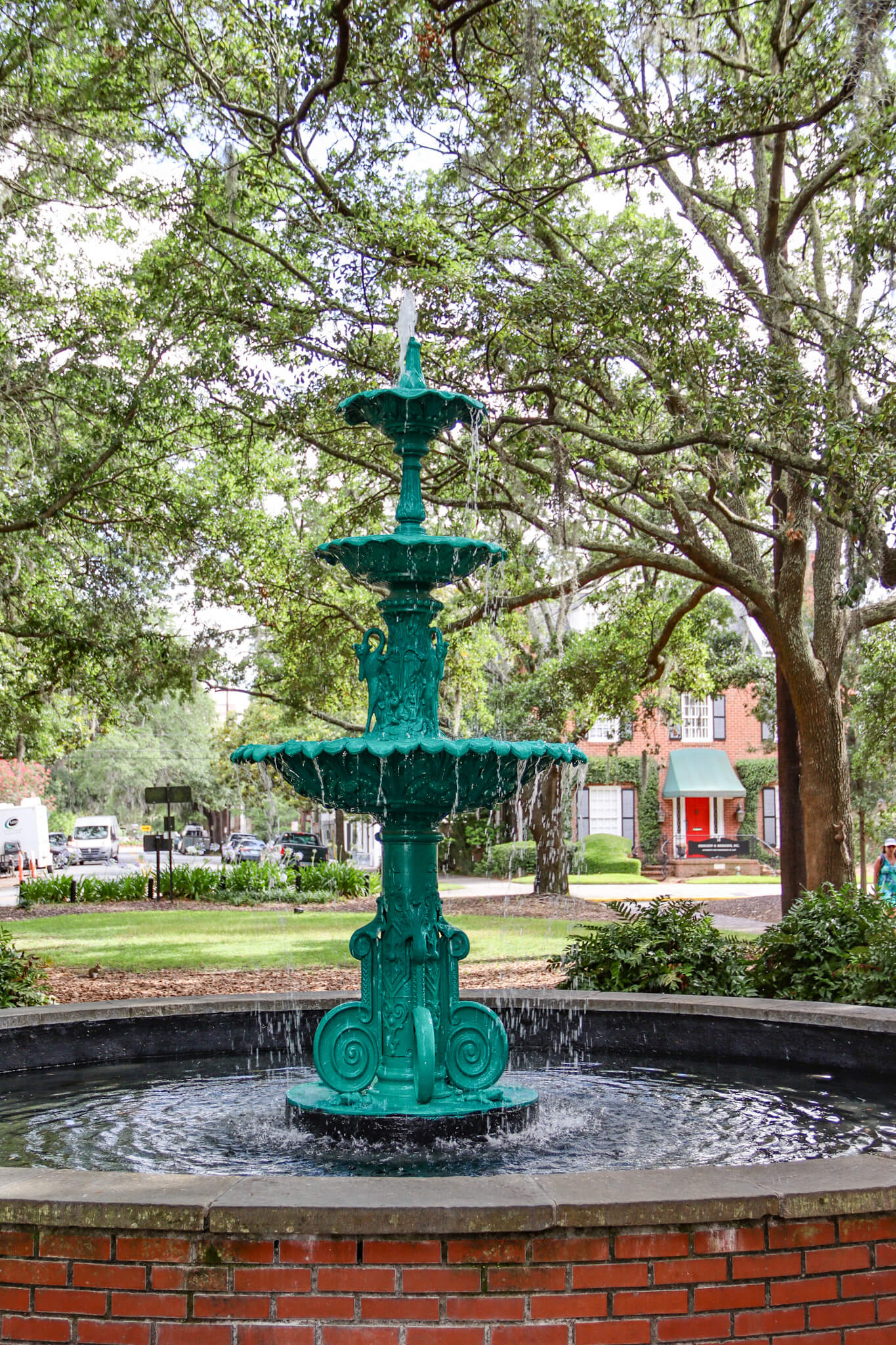
One of Savannah’s prettiest fountains, marking Georgia’s 250th birthday, stands in Lafayette Square.
Troup Square—Across the street from Unitarian Universalist Church (whose one-time music director James Lord Pierpont wrote “Jingle Bells”) is Troup Square, one of the smaller of Savannah’s squares, named for a Georgia governor, Congressman, and Senator. In the center stands a modern sculpture, the Armillary Sphere (1968), a model of objects in the sky with a framework of rings representing longitude and latitude, zodiac signs, and six turtles supporting the whole structure on their backs. Equally delightful is the Myers Drinking Fountain, with two basins just a few inches off the ground so your canine companions can get a drink.
Chatham Square—This quiet square, laid out in 1847, is named for William Pitt, 1st Earl of Chatham, an early supporter of the Georgia colony. Its sundial is dedicated to Louis Burke Toomer, an African-American native of Savannah who not only founded The Carver Savings Bank but was also appointed Register of the Treasury by President Eisenhower. SCAD has a presence here, too, on the square’s northwest corner, having taken over the 1910 Mediterranean Revival–style Barnard Street Grammar School and renaming it Pepe Hall.
Monterey Square—During the American Revolution, Polish General Casimir Pulaski died from his battle wounds about a half mile from this square. Its name commemorates the Battle of Monterey during the Mexican-American War. At its center stands the tower monument to Pulaski, the only one in Savannah’s squares that still has a railing around it. Made mostly from Italian marble with a bit of granite, the monument stands 55’ tall and is topped by a statue of Liberty, with the stars and stripes banner. The bas relief, under an eagle holding the coats of arms of Georgia and of Poland, shows the moment of Pulaski’s death, still mounted on his horse. On one side of the square stands Congregation Mickve Israel, a Gothic-style synagogue from 1878 built for the oldest congregation practicing Reform Judaism in the United States, the Spanish and Portuguese Jews who landed in Savannah in 1733. On the other side you’ll find the Mercer House, the setting for the murder in “The Book,” Midnight in the Garden of Good and Evil.
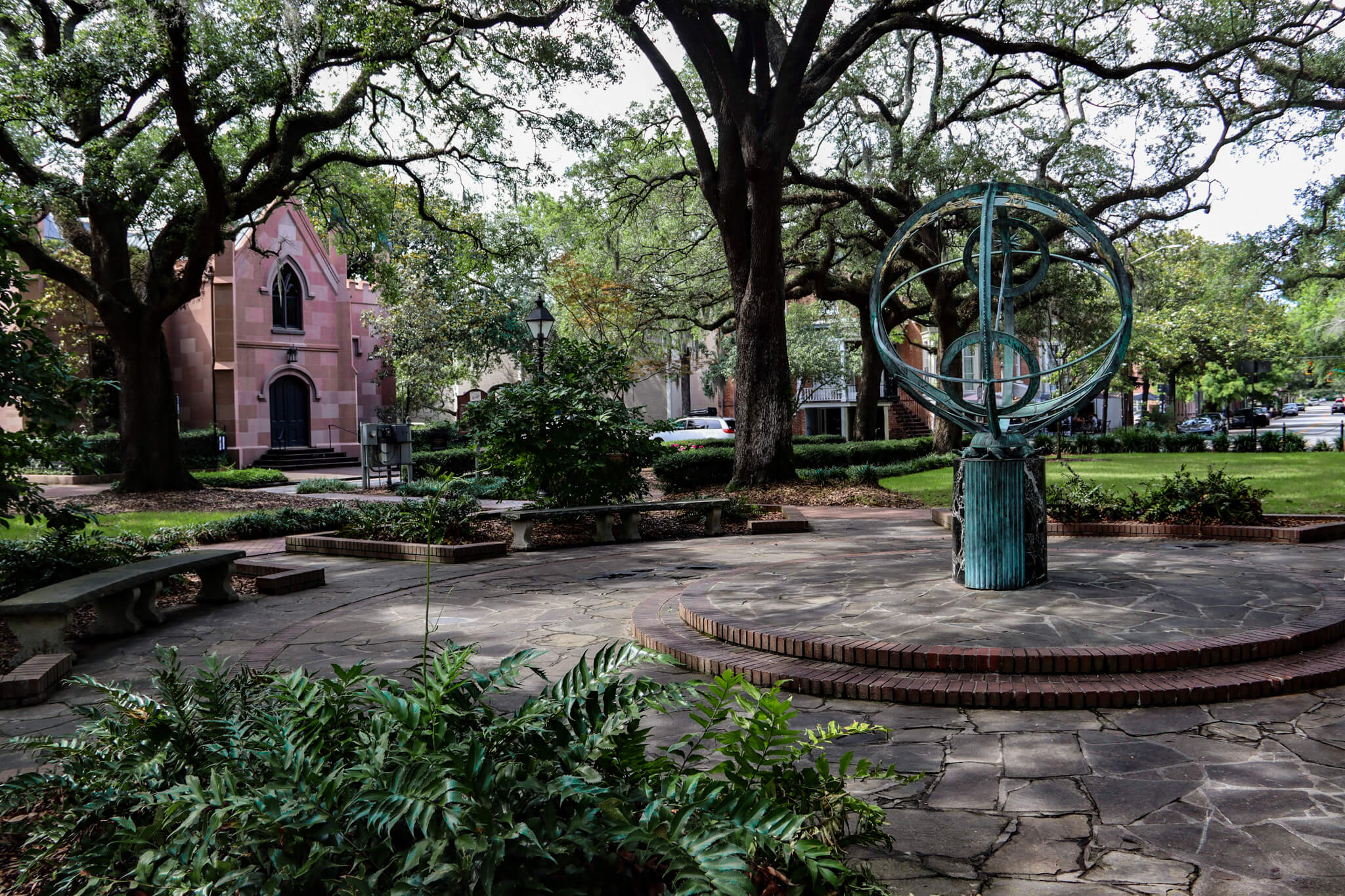
Troup Square has one of the squares’ few modern works of art.
Taylor Square—Anchoring one of the square’s corners is Wesley Monumental United Methodist Church (1890), patterned after a church in Amsterdam, with a double staircase and big enough to hold 1,000 parishioners. It received its name only about a year ago. Originally, this was Calhoun Square, dedicated to South Carolina statesman John C. Calhoun, who served as Secretary of War, Secretary of State, and Vice President under both John Quincy Adams and Andrew Jackson—and who was a staunch defender of slavery. Before it became a square in 1851, this was a small burial ground for slaves. In 1855, the remains of two slaves were exhumed, and more than a century later, in 2004, a skull was found. This prompted aspersions to Calhoun’s reputation and a call to rename the square for someone less controversial. Thus, it now honors Susie King Taylor, the first black nurse during the Civil War.
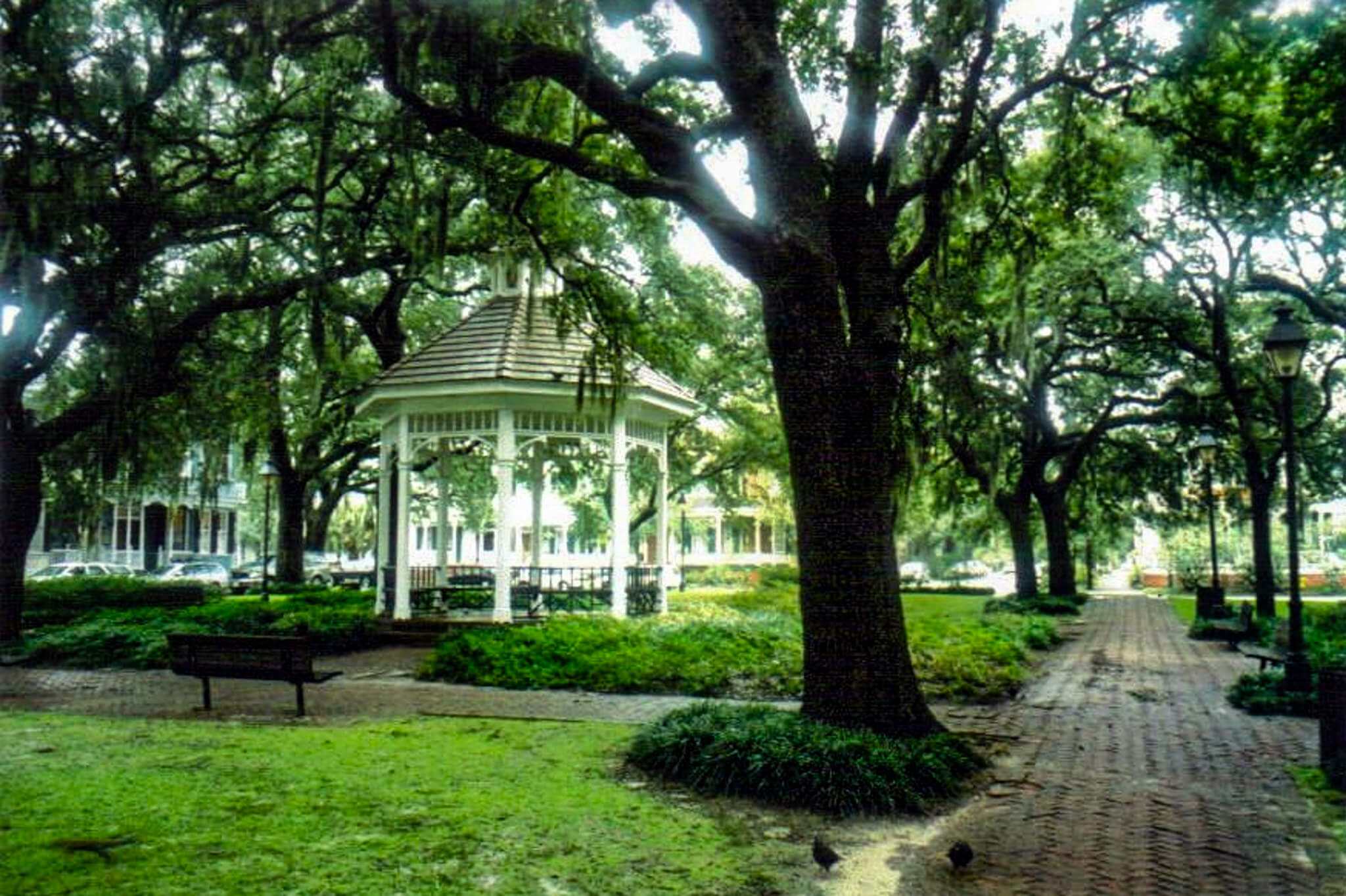
A gazebo provides extra shade in Whitefield Square.
Whitefield Square—Homes with terrific front porches surround most of this square, the latest square to be laid out, in 1851. The square is named for the Rev. George Whitefield, founder of the residential education program Bethesda Home for Boys, which is still in operation in the city’s south side. An abundance of azalea flowers and the Victorian gazebo in its center, under live oaks with Spanish moss, make this square a popular spot for wedding ceremonies and photography.
Leave a Comment
Have you been here? Have I inspired you to go? Let me know!


 Stephen Travels