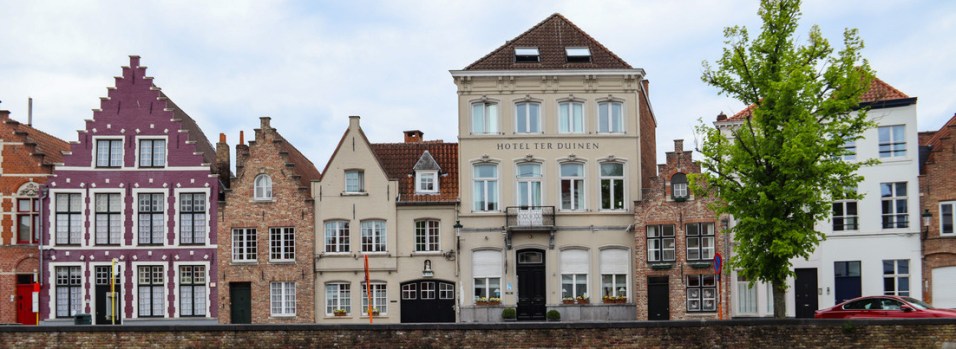
From the main train station in Bruges, I hopped on a city bus that, quite conveniently, brought me directly to the doorstep of my canalside hotel. That was just a fortuitous happenstance when I chose to stay at a hotel out of the tourist-laden heart of medieval Bruges. Hotel Ter Duinen boasts an enviable location on the Langerei Canal in the quiet northern part of town. Although it’s only about a 15-minute walk to the city’s historic core, it feels like a completely different city here, and it’s easy to imagine what Bruges was like during its golden age in the 12th through 15th centuries.
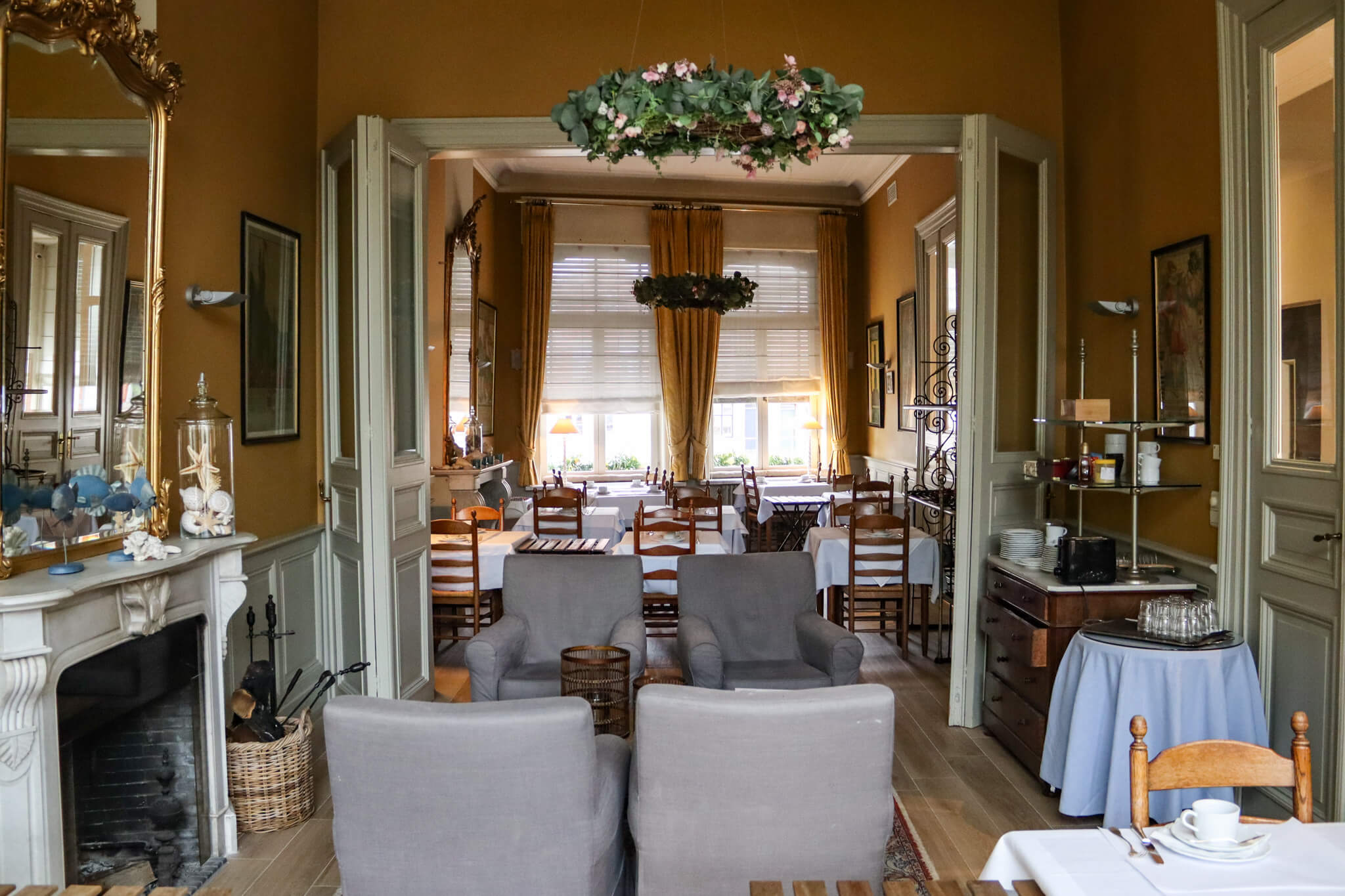
Enjoy your first meal of the day in the lovely breakfast room.
Husband-and-wife co-owners Marc and Lieve have been running the place for an impressive 41 years, and it was Marc who greeted me upon my arrival in the hotel’s main building. After checking me in, he escorted me to my room, across a little alley to a second building. I was instantly charmed by the two potted shrubs flanking the door to my room under the glass and wrought-iron awning, the small sconce illuminating my room number, and the only window to the room supporting a blossoming flowerbox.
My room itself was fairly basic but spacious and spotless, and, with no direct sunlight and tucked into the alley away from the street, wonderfully cool, quiet, and dark at night—exactly what I was hoping for.
I was eager to explore one of Europe’s best preserved medieval cities, and I spent my day amid the formidable crowds of tourists clustered around Bruges’ two main squares. Encircled and crisscrossed by the waterways and canals that linked Bruges to the North Sea and made it an economic powerhouse for centuries, the city suffered when those same waterways silted up and Antwerp became the go-to city for trade. Bruges struggled and eventually became an unimportant backwater, which turned out to be its savior. Frozen in time for 400 years, it began to attract wealthy tourists from England and France, until both World Wars disrupted travel. Spared any significant damage, the city spruced itself up, ushering in a surge of tourists, now topping eight million visitors annually, who, like me, are enamored by its undeniable appeal.
At the end of the day, on my way back to Hotel Ter Duinen, the throngs thinned, and with each passing block I became more attuned to what Bruges was like during the 1300s and 1400s. The handful of restaurants and bars near the hotel seemed geared more toward locals, adding to the authenticity of this part of Bruges. Along the romantic, quiet canals lined with medieval architecture and down winding alleys, I was being successfully wooed by the seductiveness of the city. And, despite the ongoing drizzle, overcast skies, and chilly air temperature, I was quite smitten.
I crossed the bridge with three arches over the canal to the hotel. Quiet greeted me, so I made my way into the main building toward the living room in the rear. Muted light from the gray sky poured in through the glass skylight and wall that opened onto the green courtyard, filled with shrubbery and potted plants, a gorgeous wisteria tree, tables and chairs, and a paved walkway with a compass inset. The room was warm and cozy, and it didn’t take very long for me to nod off on the comfortable sofa.
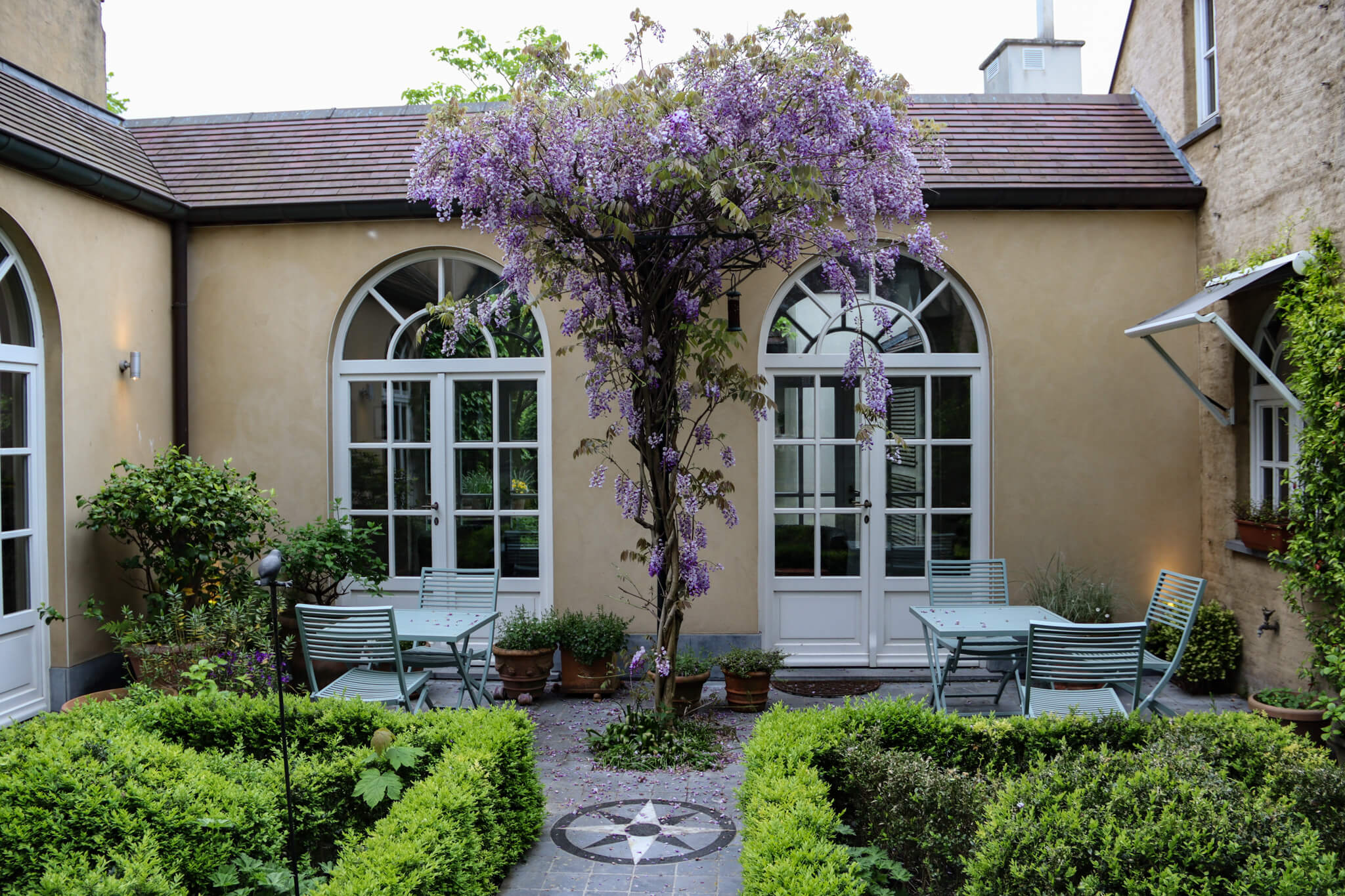
The charming courtyard is perfect for relaxing outdoors.
Lieve’s entrance awakened me, and I was soon enjoying a congenial conversation with her that ultimately turned to how she and Marc bought the place and turned it into the desirable accommodation it is today. She brought out a photo album with pictures documenting the herculean project of converting this former tax office, which itself had been the former home for a doctor and his family, into the hotel. The extensive excavation, demolition, reconfiguration, and construction—all accomplished with plenty of hands-on assistance from their family and friends—documented in the photos was a testament to the couple’s dream of owning and operating a hotel; no one with any doubts or trepidation would have embarked on such a massive and expensive journey.
The following morning, yet another gray Belgian day that greeted me was relieved by the wonderful meal awaiting me. The lovely breakfast room, with a white fireplace, dark mustard-yellow walls that matched the drapes, and wreaths that hung from the ceiling medallions, faced the picturesque canal. I took a table at the window and watched Bruges wake up—bicyclists on their way to work, horse and buggies being driven to awaiting tourists in the fantastic Market Square, the city bus picking up a passenger or two every ten minutes.
Marc and Lieve were on hand to serve me a generous breakfast comprising juice, a soft-boiled egg, a selection of cheeses and nuts, a variety of fresh breads that I used to construct a ham and cheese sandwich, a fruit pastry, a soothing cup of tea with honey, and a mélange of blueberries, pineapples, strawberries, and watermelon.
Exuding the warmth and charm that’s also reflected in the rooms, the décor, and the building itself, my hosts provided the pleasant experience I was hoping for—a peaceful three-night stay away from the bustle of the city center, complete with a rewarding breakfast and attentive service, all of which combine to make Hotel Ter Duinen an ideal destination for visitors to this unforgettable city.
Leave a Comment
Have you been here? Have I inspired you to go? Let me know!


 Stephen Travels