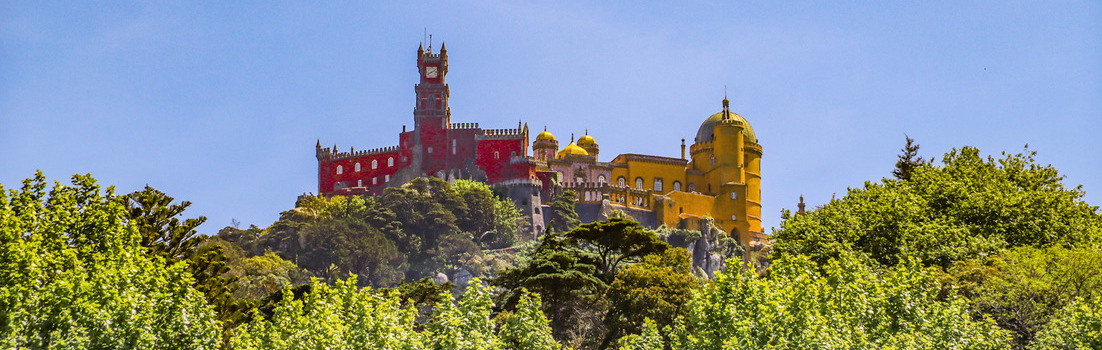
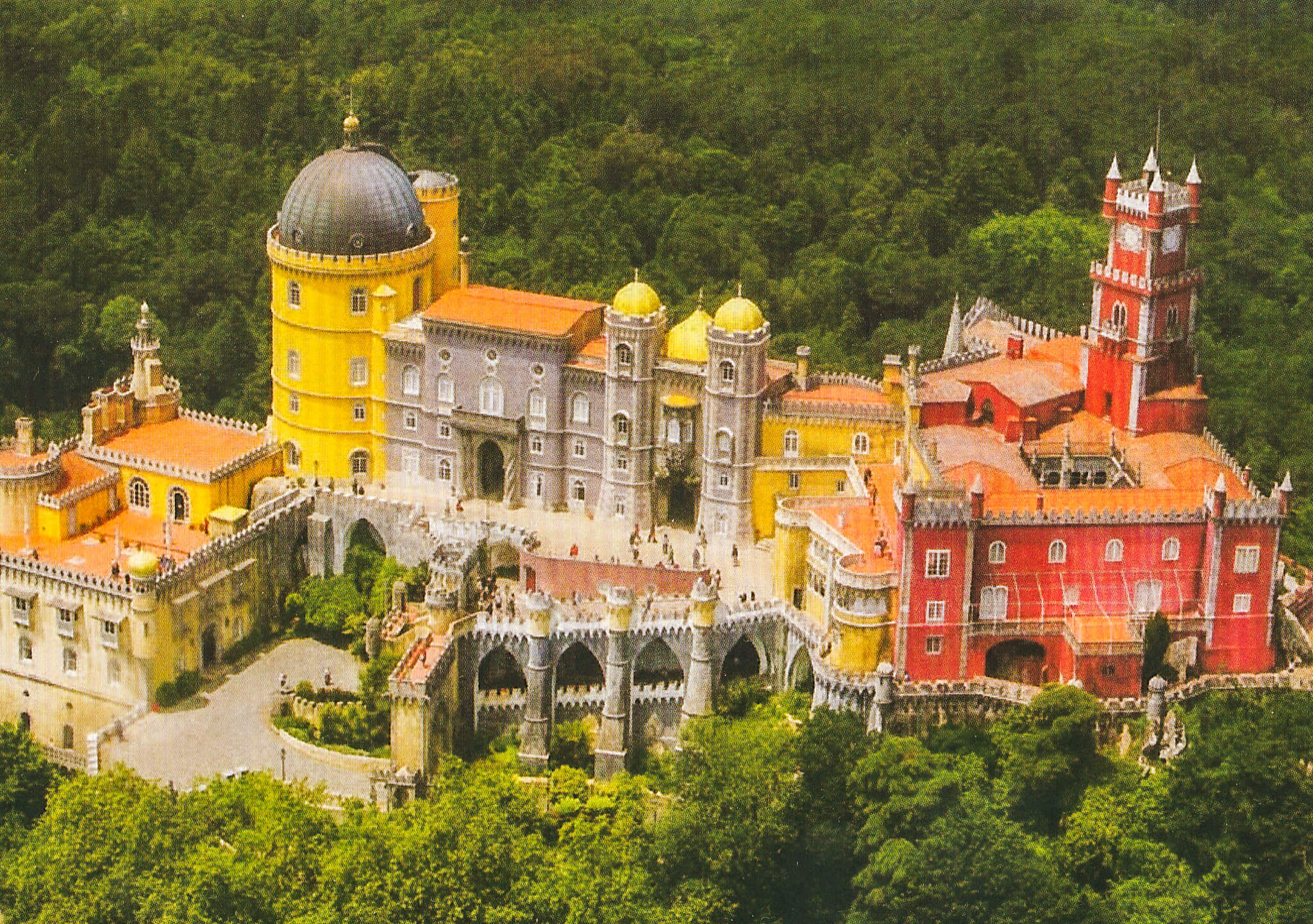
The mountaintop castle in all its fairy-tale wonder.
I had wanted to visit the National Palace of Pena ever since I first saw a photo of it, several decades ago, sitting majestically atop a peak in the Sintra Mountains. Its playful red, yellow, and blue colors reminded me of my LEGO blocks, a toy that I spent countless hours with as the child architect in me created buildings and cities. Now that I was in Portugal, I was excited to see the real thing.
I hopped on a commuter train in Lisbon’s Rossio Station for the 40-minute ride to the adorable train station in Sintra, from which I boarded a bus for a steep, hairpin ride up to the entrance of the palace. It was still fairly early in the morning, and the ticket line was rather short. (Come back a couple of hours later and you’ll be surrounded by actual mobs.)
I had about an hour to kill before my timed entry, so I chose to walk uphill at a leisurely pace until I reached the base of the palace. As my entry time arrived, I watched hundreds and hundreds of people forming multiple lines. I took a deep breath and dove in.
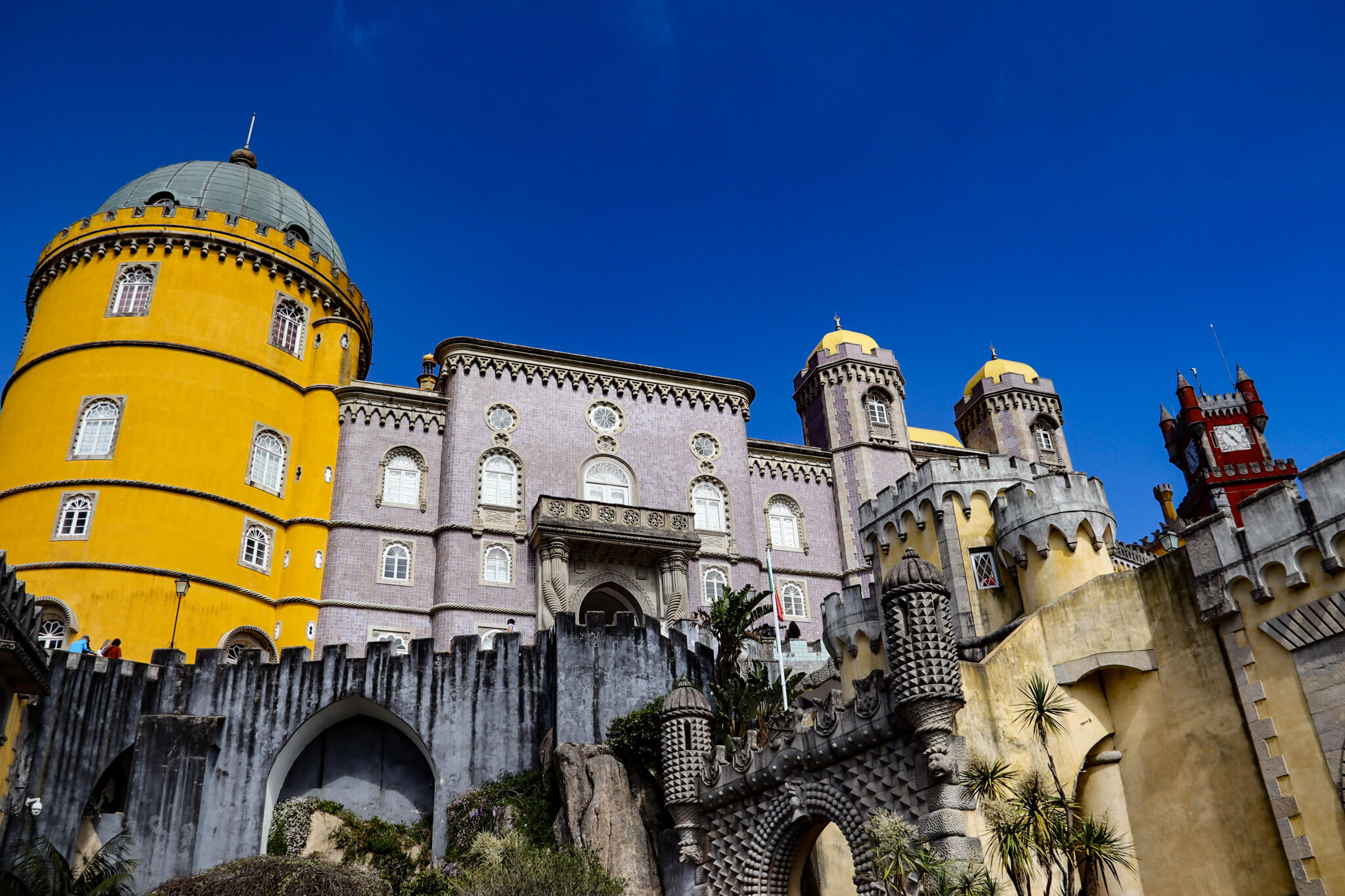
Its bold colors and eclectic styles add to the palace’s uniqueness.
The 1775 earthquake that devastated Lisbon and ushered in the end of the Portuguese Empire also took out the monastery that was here originally, at this fantastic mountaintop locale. The monastery remained active, however, until 1834, when it was abandoned following the abolition of religious orders in Portugal. A few years later, King Ferdinand II—an intelligent and artistically minded man with modern and liberal ideas who served as the president of the Royal Academy of Sciences and the Arts and who had recently married Queen Maria II—used his personal funds to buy the ruined monastery as well as the lands surrounding it. The ruins were razed, and the new palace, completed in 1854, arose as the summer residence for the royal family. It remained so until the Republican Revolution of 1910, which overthrew the monarchy. Now owned by the Portuguese State, and declared a National Monument in 1907 and a UNESCO World Heritage Site in 1995, the National Palace of Pena is open to the public to savor its history and its splendor.
My line crawled along the fortress-like foundations of the palace until I entered the first of many courtyards, which offers sweeping views of the surrounding countryside. From here, the palace rose before me, an amalgamation of styles—German (thanks to its German-born architect), Portuguese, Neo-Gothic, Neo-Renaissance, Neo-Manueline, Neo-Islamic. It’s a hodgepodge of lookout towers, domes, parapet paths, terraces, minarets, even a drawbridge. To my right stood the cheerfully painted and exotic yellow building that looks like it’s from the set of Aladdin. Above me, the blue-tiled central section rose into the sky, and to the right, the red-painted clock tower peaked over the walls ahead of me.
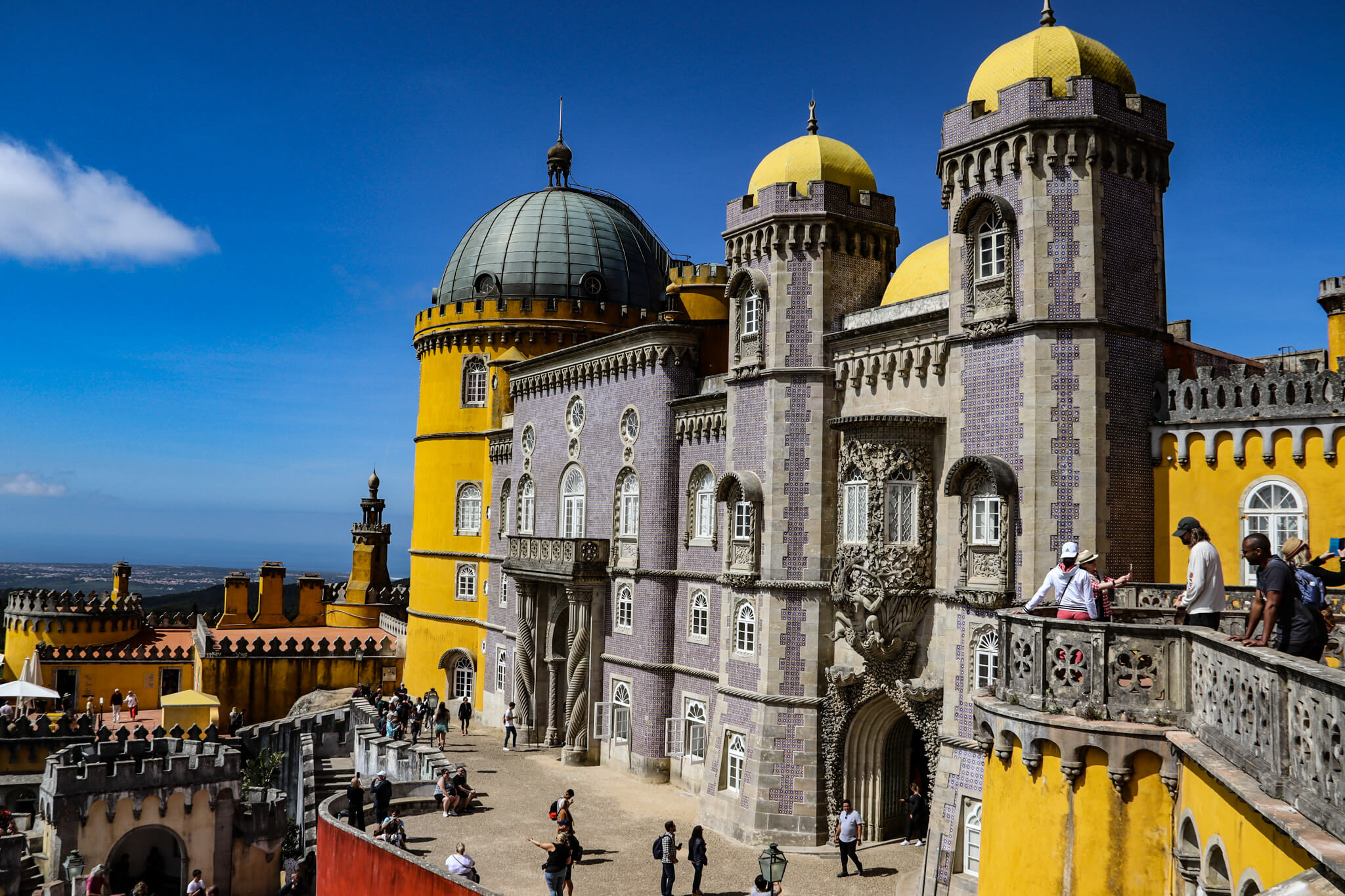
Terraces on multiple levels provide a variety of perspectives.
During the several hours I spent here, I was continually flowing in and out of the building, through arches and portals, into passageways and sumptuous rooms, out to terraces and courtyards, up and down steps to different levels.
Outside, I passed through the spiky entrance arch with a pair of bartizan turrets and a keystone featuring a knight’s helmet topped with feathers. I made my way through a passageway to the Upper Courtyard. The courtyard abuts two exceedingly impressive entrances. To the left, a pair of heavy Solomonic columns support a carved balconet. To the right, between two towers topped with yellow-tile domes, is the outrageously fussy oriel window, with a fearsome Triton squatting in a clam shell—above him, stone grapes and grapevines grow around the windows; below him, coral flows down to the ground, flanking the recessed arch. The entire section of this part of the palace is swathed in blue azulejo tiles with a Moorish geometric pattern, but a closer inspection reveals yellows, greens, whites, and violets.
Passing under Triton, I entered Arches Courtyard, so named for the series of Moorish-style arches that frame unending views of Portugal and the Atlantic Ocean. The views behind me were pretty impressive, too—the ornate ornamentation around the window over the short passage (Triton’s Tunnel) from which I had just emerged, which, itself, is covered in azulejo; the red clock tower completed in 1843, with a face on each side and topped with four bartizans and a battlement; and the chapel steeple, covered in white and emerald-green tiles.
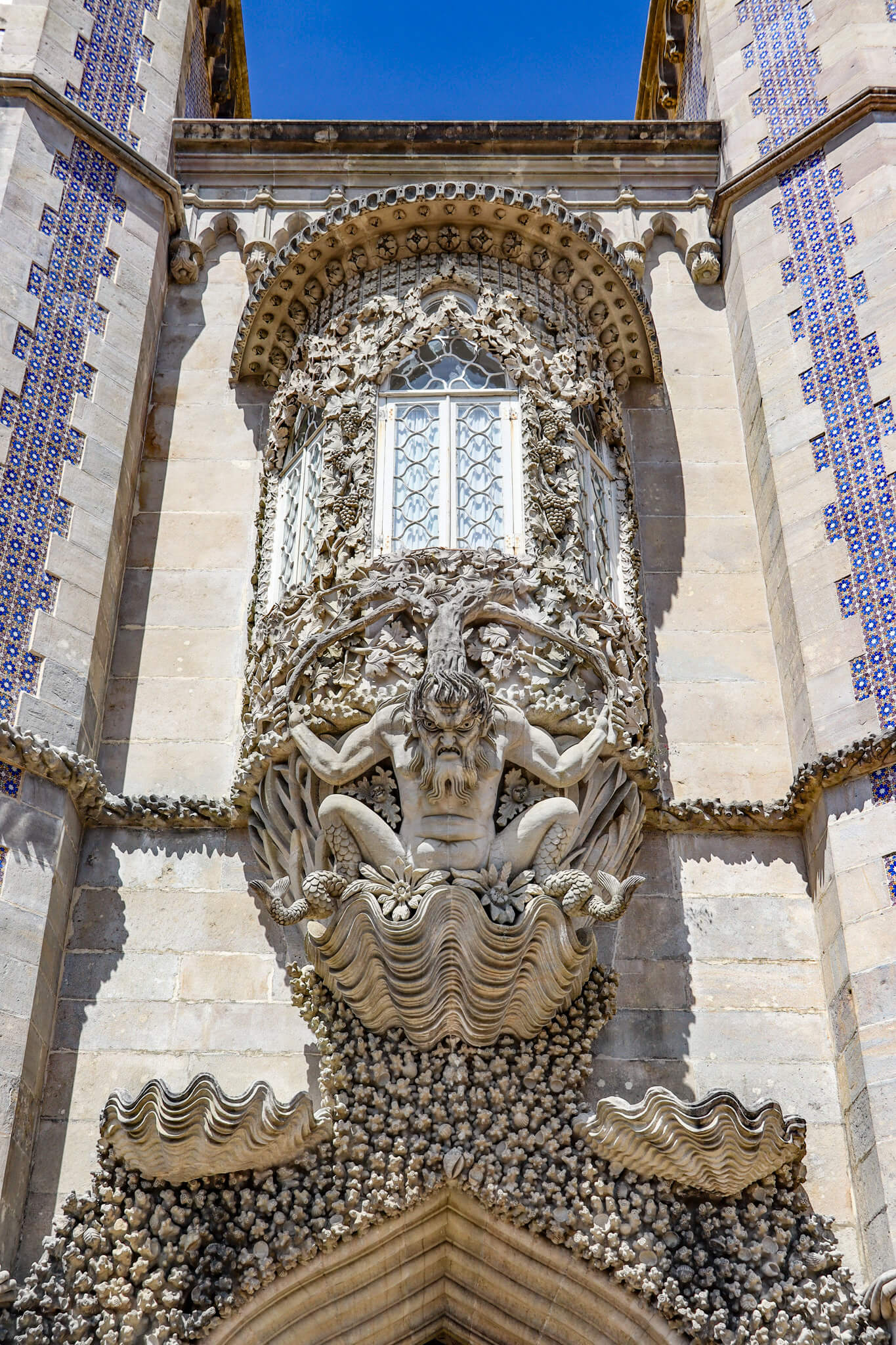
The Triton watches over you as you enter the palace.
Another exterior space, the Manueline Cloister, features a double-level arcade. Standing next to the stone carving of an open shell, resting on the backs of four turtles, that’s positioned in the center of the blue-and-white–tile floor, I gazed up at the torsade band running along the azulejo-covered walls while stone human and animal heads looked back at me.
All of that prepared me for the visual feast waiting inside—the chambers and bedrooms, with lavish ceilings, ostentatious furniture, spectacular chandeliers, tilework, and painted surfaces in trompe l’oeil.
The Green Room is one of the spaces that provide a brilliant example of trompe l’oeil. The deceptive paint, in a greenish hue, replicates flowers, branches, and architectural carvings that appear to be three-dimensional but are completely flat. The Arab Reception Room is an even better example, and I did a double-take and had to look very hard at the walls to see that the series of columns and arches opening up to another room were nothing more than a superb paint job on a flat surface, and that there wasn’t another room at all. The effect made this room appear much larger than it really is; it also made me smile at an artist’s ability to make me question my reality.
You’ll also question the abilities of today’s artists, who I’m quite sure could never match the achievements of yesteryear’s. One look at the headboard of a bed would testify to that—it’s so elaborate it would probably take at least an hour to dust. Then there’s the magnificent jade phone cabinet in the Telephone Room, where a single early telephone hangs attached to the wall, the size of about 20 of today’s smartphones. Although the expertly sculpted panels of the cabinet are purely European—the Four Evangelists are depicted—the jade itself adds a Chinese flair to the room, as do the two dragons on the wall on either side of this striking piece of furniture.
I felt positively regal as I stepped into the Great Hall, the largest compartment in the palace and the scene for royal events and receptions at the height of an extravagant lifestyle: high ceilings, flamboyant decorations, opulent furnishings, and luxurious draperies. The four petroleum lamps, the torch-holder candelabras, and the 72-candle chandelier—all in gold-plated brass—would have lit up the room in excessive style.
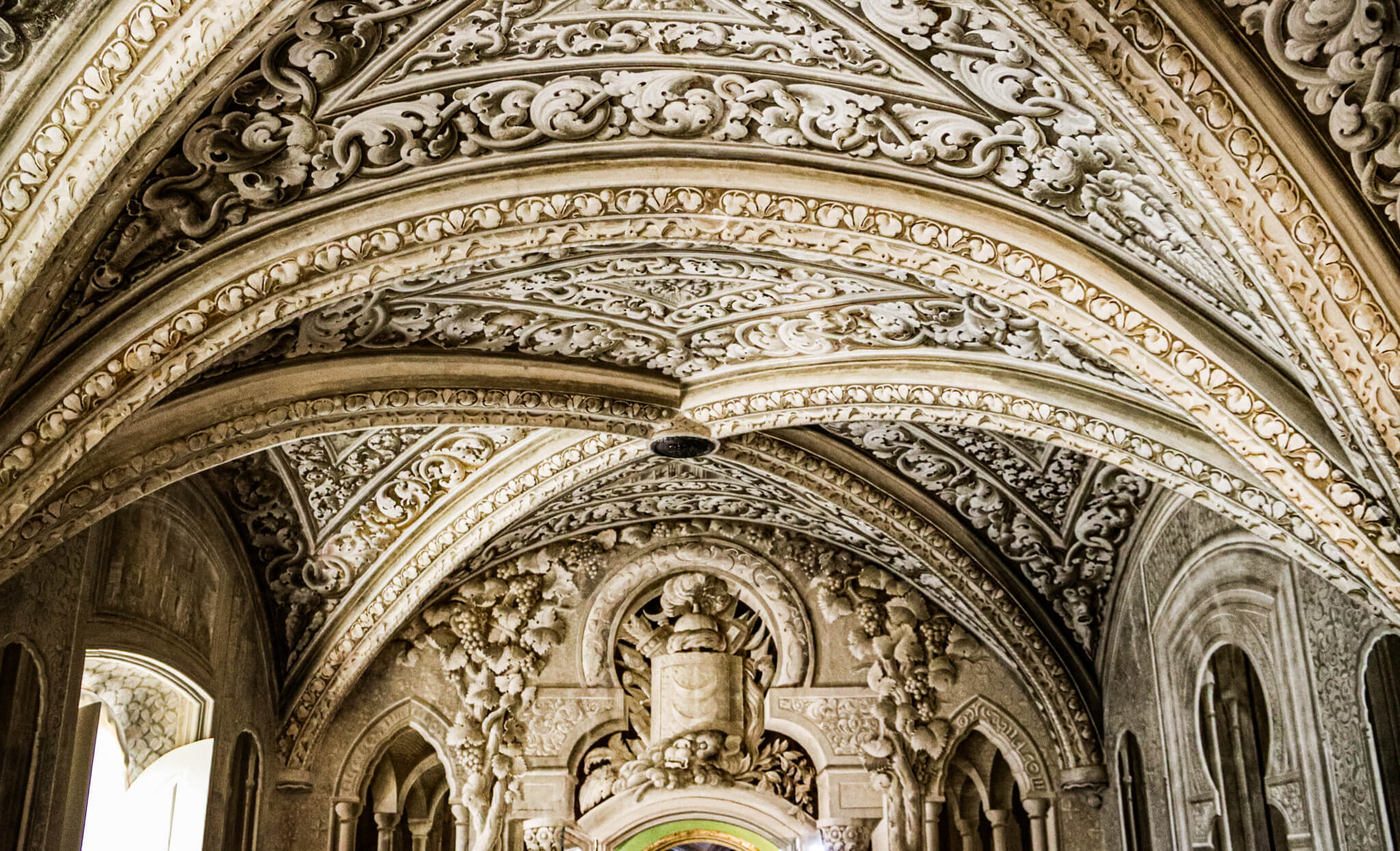
Beguiling optical illusions abound.
The gorgeous chapel is a survivor of the monastery that wasn’t destroyed in the earthquake and dates back to the early 16th century. It features walls covered in polychromatic tiles and a groin ceiling with sinuous ribs. Silver candelabra stand on the altar in front of the beautiful reredos of alabaster and black marble, created in 1532 and populated by expressive figures. A stained-glass window combines both religion and the secular, with the top panels depicting the Virgin Mary and St. George while the bottom pair portrays King Manuel I and Vasco de Gama, with Lisbon’s Belém Tower in the background.
The Smoking Room—which often doubled as the Music Room—sits under an Islamic dome awash in Mudéjar art. Intricate textures, replicating the look of traditional Indian lacework, cover the walls. Hanging from the ceiling is a unique neo-rococo chandelier, wrapped in Venetian glass in the form of ivy twisting all around the wrought-iron frame and of morning glory flowers, from which the candles sprout. The chandelier is a good reminder to always look up when you’re here. Throughout the palace, the intricate stucco ceilings attest to the meticulous craftsmanship of the 19th-century artisans. Their elaborate and finely detailed patterns reflect the various architectural styles of the palace, adding even more richness to the luxuriant rooms.
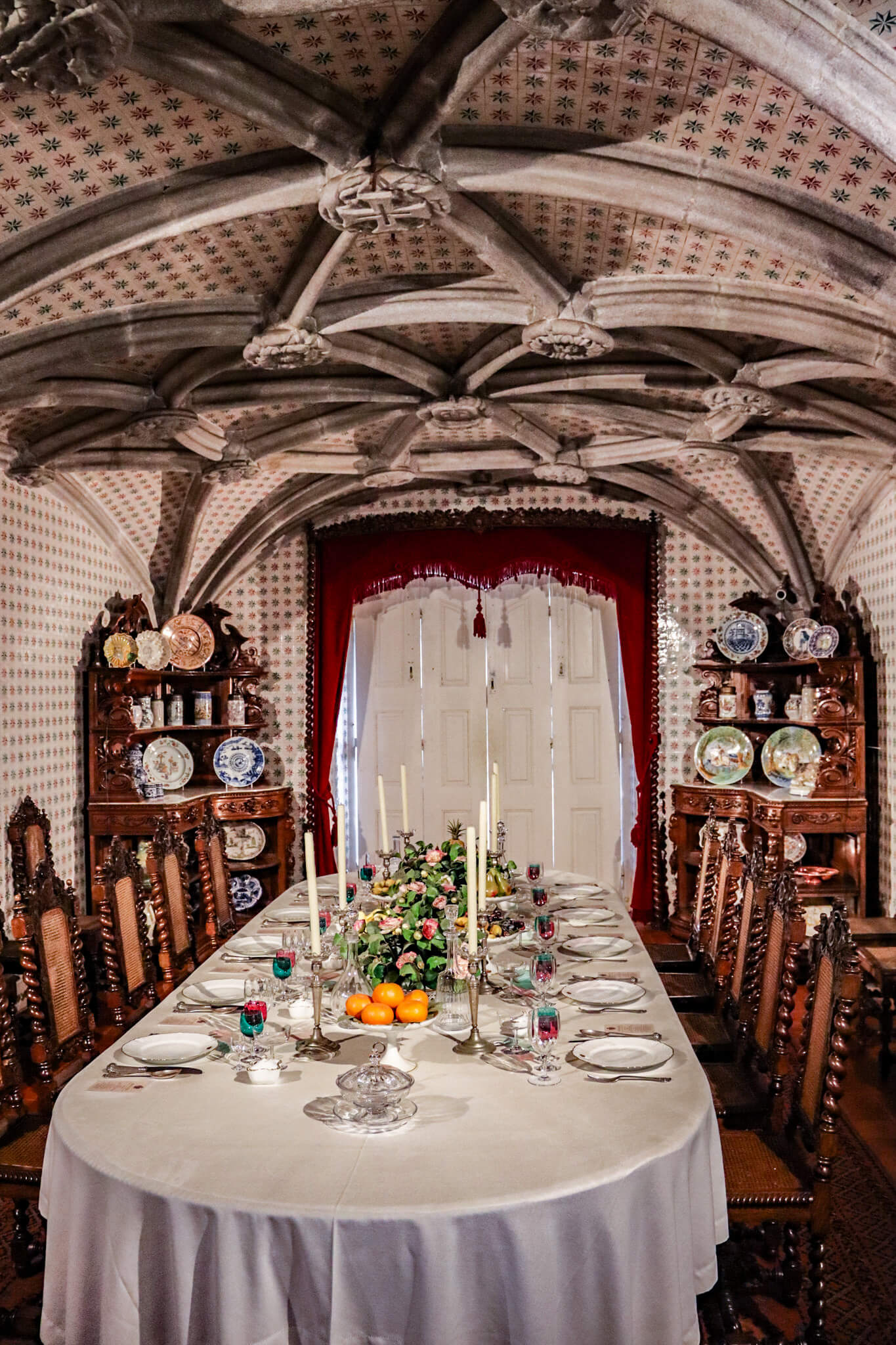
Dining in style.
A prime example of these ceilings is in the dining room—a ribbed ceiling lined in tiles and sporting bosses with paterae or crosses. Underneath, a table is set for 10 (although it’s extendible to seat 24), laden with porcelain plates, silverware, trays of fruit, and glassware the red and green colors of the Portuguese flag. Each piece of furniture was specially made for this room, with images of native Portuguese forest animals carved into the chair backs.
My final room was the kitchen—a shocking contrast to the rest of the palace. There are no tiled walls or artistic ceilings or masterful furniture here. It’s just a room with a plain groin ceiling—a very, very, very big room, filled with multiple ovens, dozens of copper pots and pans, hand-operated tools, barrels, and hanging spoons, ladles, and spatulas. Given its size, I could only imagine how busy this kitchen must have been during the royal years, and how hard those servants must have worked.
When I was ready to leave, I exited through the Door of Alhambra, inspired by the Door of Justice in Granada’s Alhambra. With its horseshoe-shaped arch and colorful tiles, it served as a final parting gift from this fantastical palace. And when I took a final look back and noticed the crocodile waterspout high above me, I truly realized just how fantastical it is.
Leave a Comment
Have you been here? Have I inspired you to go? Let me know!


 Stephen Travels