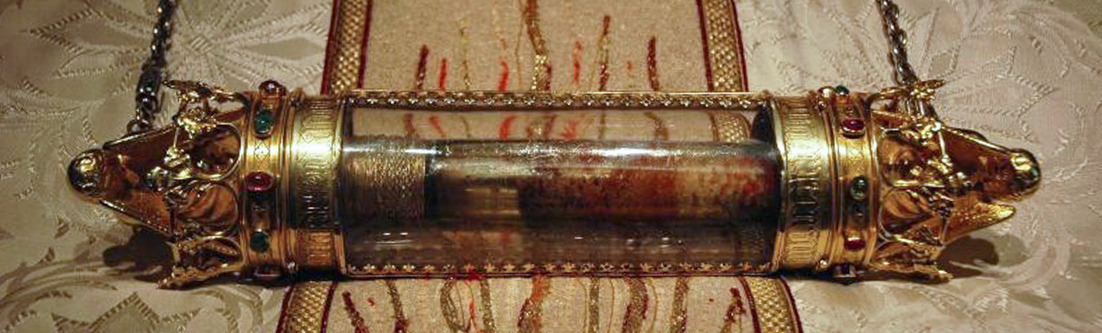
If cleanliness is next to godliness, then the Basilica of the Holy Blood is next to God Himself.
It’s a pilgrimage destination with which I was unfamiliar. But when I found out that this basilica reputedly houses drops of Jesus’ blood, I quickly decided it was something to see.
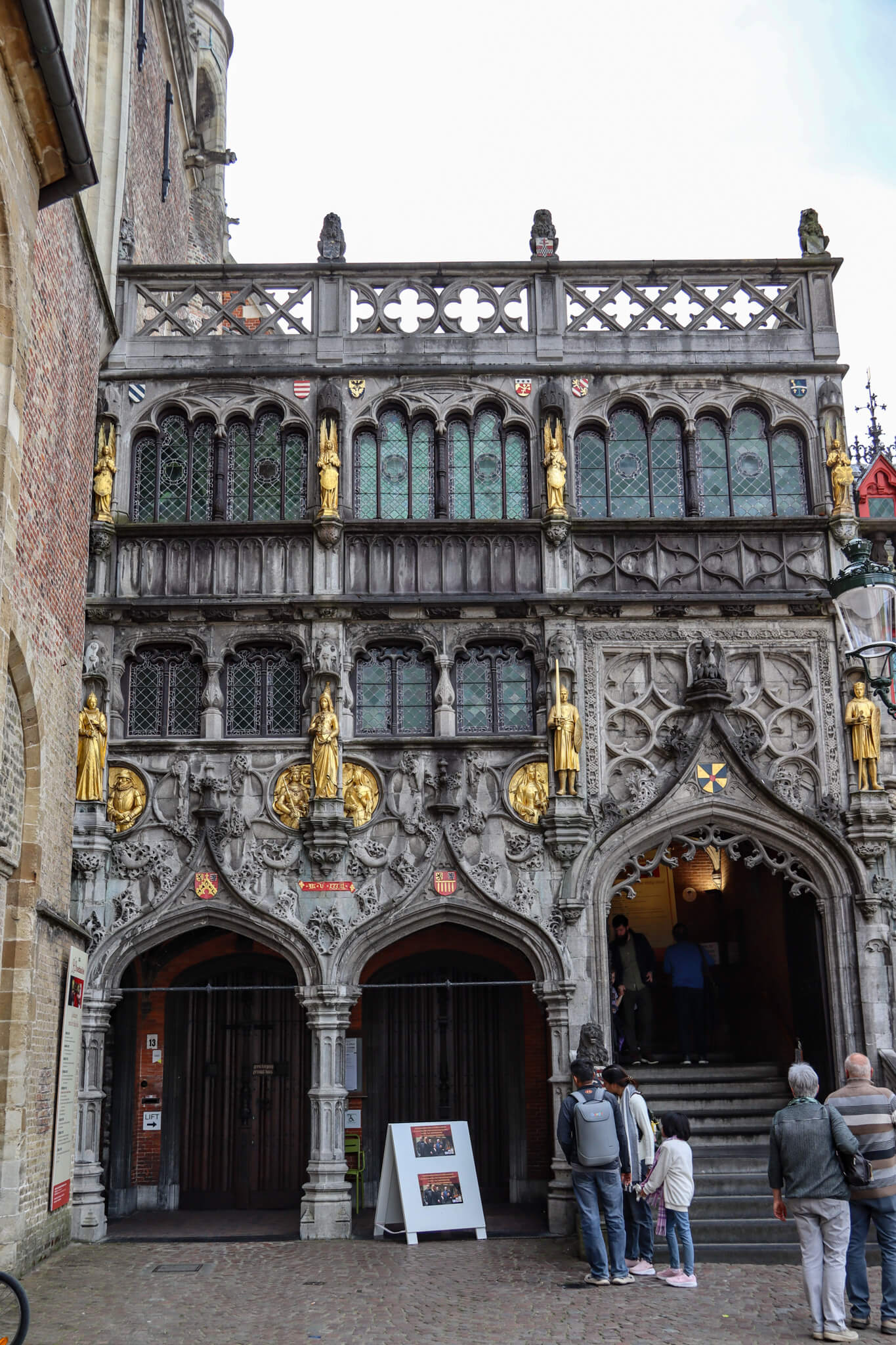
From my lovely hotel, Hotel Ter Duinen, I strolled along Bruges’ romantic canals into its very heart, where a collection of fantastic buildings can transport you back in time. I was beguiled by the visual treats in one of the city’s main squares, Burg Square—a 1700s courthouse with one of the world’s most beautiful fireplaces, the striking City Hall, and, tucked almost unobtrusively in a corner, the Basilica of the Holy Blood.
The façade, only three bays wide, explodes with wonderful details: quatrefoil cutouts in the roofline balustrade, lions holding shields, sculpted ornamentations that look like pumice and frisée lettuce, gilded angels, and gilded bronze statues and half medallions of key historical figures.
As I entered, I was faced with a choice at the broad spiral staircase with brick walls and groin ceilings: up or down. I chose the latter.
The lower basilica dates back to 1157 and is dedicated to St. Basil the Great, a Greek doctor of the Church who lived in the 300s. Stocky stone pillars support brick arches and ceilings in this Renaissance space, where I found two impressive wooden statues, created around 1900: a Pieta, with a distraught Mary holding the lifeless body of her son, and Christ on the Cold Stone, an often-depicted image of Jesus sitting down with his wrists bound and wearing the crown of thorns, after the flagellation, as He awaits His march up Calvary, the story of which is told in Stations of the Cross in Catholic churches everywhere.
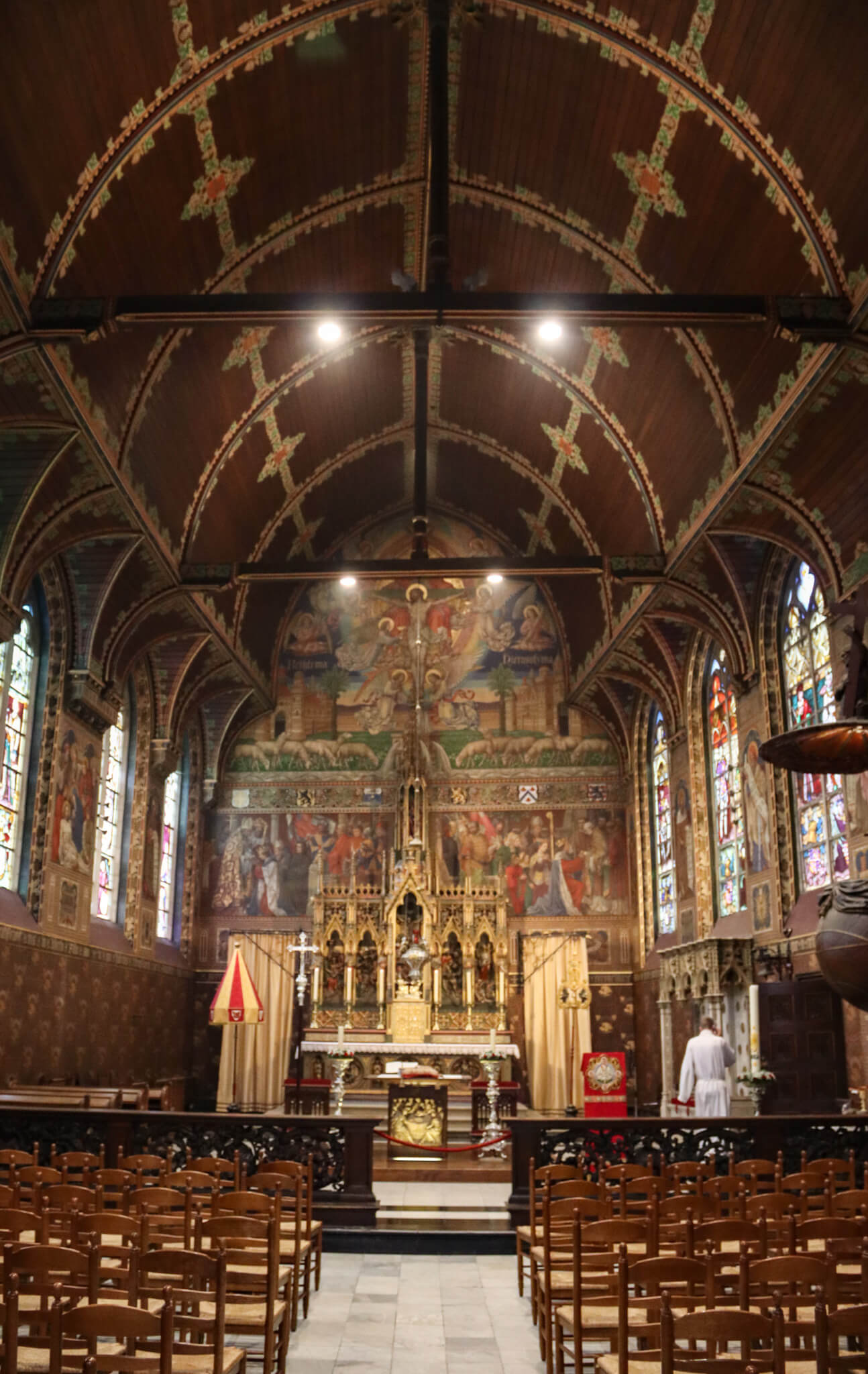
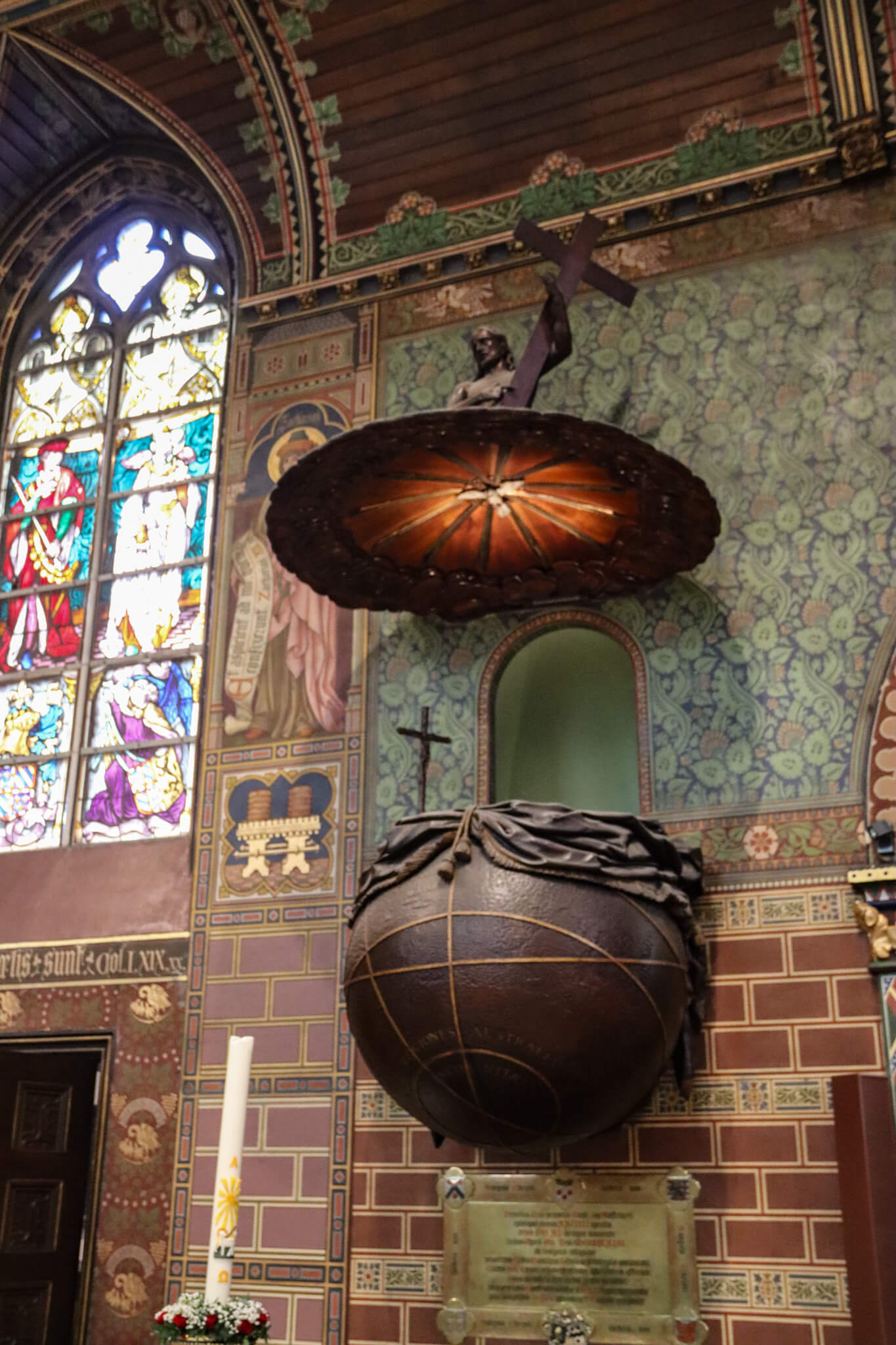
This lower basilica supports the upper chapel, refitted in a Gothic style in the late 15th century. Although it’s a comparatively small space, it still impressed me. A wooden barrel ceiling rises above the very non-religious stained-glass windows representing sovereigns who ruled Flanders, including Maria Theresa, Empress of Austria. There are wonderful painted Stations of the Cross, a fantastically sculpted oak altar rail, a pulpit from 1728 in the form of a globe, and an alabaster relief of the Last Supper from the 17th century under the altar and illuminated from below.
Behind the altar and the reredos filled with figures rises a large wall fresco, added in 1905. The upper part depicts the mystery of the Cross, where Christ shed His blood on His Crucifix, upright before God. There are plenty of sheep and angels as well as the town walls of Bethlehem, where Christ was born, and of Jerusalem, where He died.
It’s the bottom part, though, that tells the story that has made this basilica famous. On the left, the Count of Flanders receives a relic—Christ’s blood, in a glass vial—from the King of Jerusalem; on the right, he hands it off to the chaplain.
Now, all of that would have been reason enough to visit this church. But then there’s the legend. As the Bible explains, Joseph of Arimathea placed the body of Jesus in an unused tomb in his garden. He kept the blood-soaked clothes and wrapped the body in a clean shroud. Jesus rises from the dead, leaving behind the empty tomb. That’s pretty much where the story ends regarding His corporeal existence, and then things get fuzzy.
Centuries later, somehow the Count of Flanders received the relic in 1150—a story put forth by a 14th-century monk who often played fast and loose with the truth. Now widely, although not universally, discredited (there’s no record of the blood being in Bruges in the entire 12th century), the legend morphs into something different, with historians linking the relic to the fall and looting of Constantinople in 1204, where it had been and from where it was hauled back to Bruges. How it ended up in Constantinople is lost to time, but some historians suggest that it was part of the stash that St. Helena of Constantinople (Constantine the Great’s mother) took from Jerusalem back to Constantinople.
Regardless of how it came to Bruges, once it arrived the miracle occurred—the dried blood would liquefy for the faithful every Friday. Then–Pope Clement V gave his official stamp of approval for the validity of the miracle in 1310. But an unspecified blasphemy occurred that same year, and the blood stopped liquefying. It did so only once more, in 1388 (why then is another mystery), and has been dry ever since.
Whether any of this is true, Bruges has been celebrating the Procession of the Holy Blood, during which the relic is carried around the city, since 1291, when it is first mentioned in a document of one of the city’s guilds. The rest of the time, it resides here, and that was what the long line of people off to the side of the chapel’s nave were waiting to see.
Photographs are verboten in this section, and conversation discouraged. I joined the queue, the spirituality tangible all around me. The procedure to view the relic is simple, and strictly adhered to. Believers, doubters, and the simply curious pass under one of the three arches with colorfully painted banded columns and slowly progress toward the six-step staircase. When their turn comes, they climb the stairs and enter the space between a marble altar rail and a low wood booth, on which rests the relic: a few smears of blood in a glass tube, inserted into a larger and more ornate tube with red and green gems and golden crowns at the end. People may stand or kneel, say a little prayer, and then the silent attendant in the booth hands them a mini-pamphlet with prayers in different languages.
So, is this a giant hoax or did you just see Jesus’ actual blood? Do you believe in His teachings or someone else’s, or no one’s at all? It doesn’t matter. This 30-second experience will stay with you forever.
I’d Love to Hear From You!
Have you been here? Have I inspired you to go? Let me know!

 Stephen Travels